













DNA Storage: Could the Molecule of Life Transform the Future of Computing and Data Centres?
By Suman Munshi | IBG NEWS
The world is generating more digital information than ever before. Every online transaction, photograph, video, scientific experiment, satellite image and artificial intelligence application adds to the growing mountain of data that needs to be stored safely.
Today, most of this information is kept on hard drives, solid-state drives and magnetic tapes inside large data centres. But as the volume of digital information increases, the technology industry faces a major challenge: how can we store enormous amounts of data using less physical space, energy and money?
Scientists are exploring an unusual possibility that could help address this challenge — storing digital information in DNA, the molecule that carries genetic information in living organisms.
This technology, known as DNA data storage, could change how humanity preserves information for the future.
What exactly is DNA data storage?
DNA is the natural material that contains the biological instructions needed by living organisms. It is made up of four chemical building blocks, represented by the letters A, T, C and G.
Researchers have discovered ways to use these four building blocks to represent digital information.
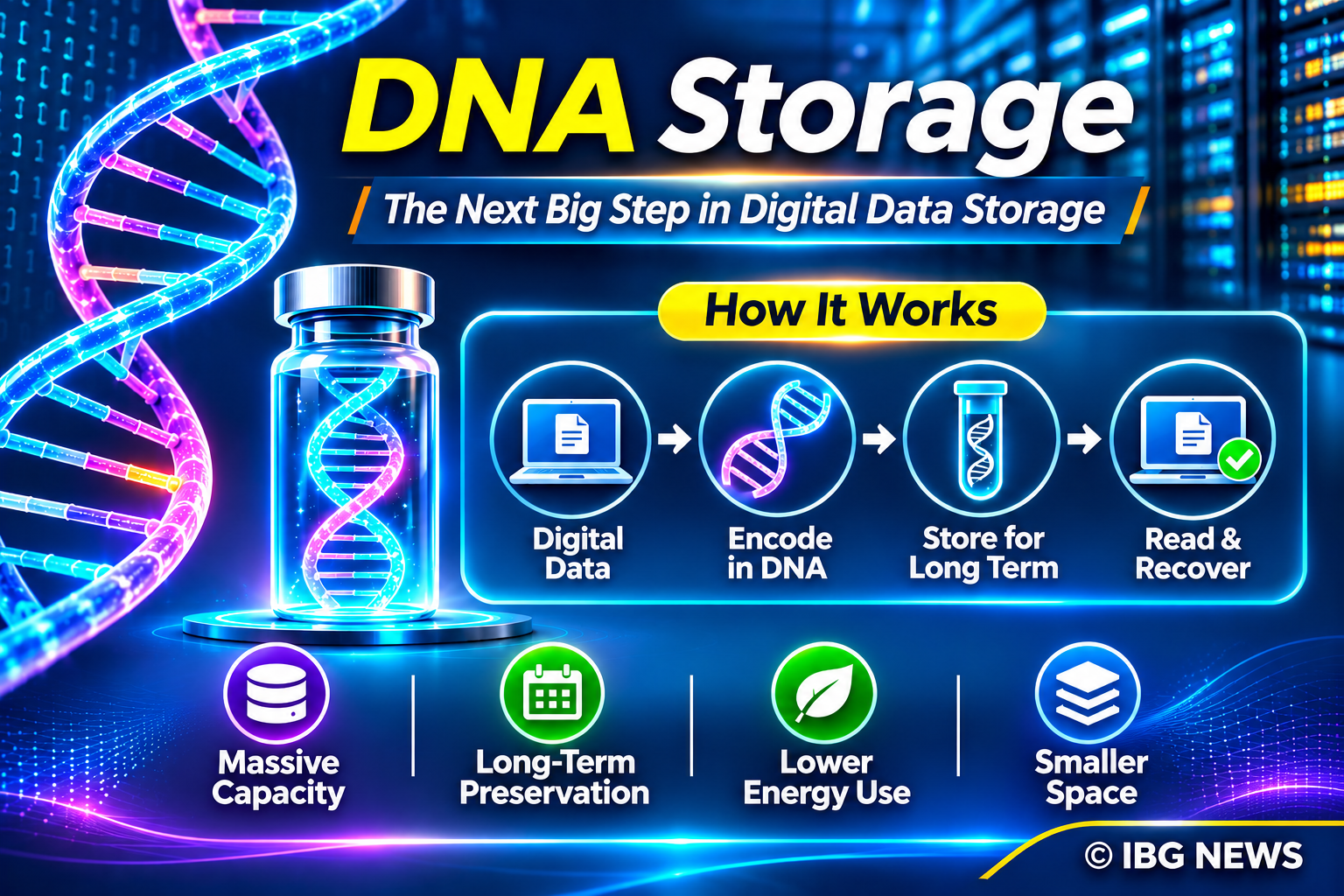
In simple terms, computers store information using combinations of 0s and 1s. DNA storage converts this digital information into specially arranged sequences of A, T, C and G. These sequences are then created in laboratories and preserved as synthetic DNA.
When the information is needed again, scientists use DNA-reading equipment to identify the sequences and computer software converts them back into the original digital files.
This means that photographs, documents, videos and other digital records could potentially be preserved in a biological molecule rather than on a conventional electronic storage device.
Why is the technology attracting attention?
One of the biggest attractions of DNA storage is its extraordinary potential storage capacity.
Researchers have estimated that one gram of DNA could theoretically hold hundreds of millions of gigabytes of information. One frequently discussed theoretical estimate is approximately 455 exabytes per gram.
To understand the scale, an exabyte represents one billion gigabytes.
However, this is a theoretical capacity. Practical systems need additional DNA for identifying files, correcting errors and ensuring that information can be recovered accurately. Current technology has not yet reached this theoretical level in everyday commercial use.
If scientists can make the process affordable and reliable, DNA could allow enormous digital archives to be preserved in very small physical spaces.
Could DNA reduce the energy burden of data centres?
Modern data centres consume large amounts of electricity. They operate thousands of servers and storage devices, while cooling systems work continuously to prevent equipment from overheating.
DNA storage offers a different approach.
Once information has been successfully encoded into DNA and properly preserved, the stored material does not need a continuous electrical supply to retain the information.
This could make DNA particularly useful for storing records that are rarely accessed but must remain available for many years.
However, the technology is not completely energy-free. Creating synthetic DNA, reading the stored information and operating laboratory equipment all require energy.
Its main potential advantage is reducing the need for continuous powered operation of certain long-term archival storage systems.
What could be stored in DNA?
DNA storage may become particularly useful for information that needs to be preserved for decades or even centuries.
Potential applications include:
- Historical documents, manuscripts and cultural records.
- Government and national archives.
- Medical research and genomic information.
- Scientific research databases.
- Satellite images and space exploration records.
- Climate research and environmental observations.
- Important corporate and financial records.
- Large artificial intelligence training datasets.
For example, a national archive could use DNA storage to preserve rare historical documents and digital records without depending entirely on conventional storage devices that require periodic replacement.
Similarly, research organisations could preserve valuable scientific information for future generations.
Could DNA replace hard drives and SSDs?
Not in the near future.
Hard drives and solid-state drives are designed to provide relatively fast access to information. They are essential for running computer programmes, websites, mobile applications, databases and artificial intelligence systems.
DNA storage works differently. The process of creating DNA and reading information from it involves specialised laboratory procedures. It is currently much slower and more expensive than ordinary electronic storage.
Therefore, DNA is unlikely to replace the storage devices used in personal computers, smartphones or everyday data-centre operations.
Instead, it could become an additional storage layer for information that does not need to be accessed frequently.
Future data centres may combine several technologies:
- SSD storage: For applications and information requiring very fast access.
- Hard drives: For storing large volumes of regularly accessed information.
- Magnetic tape: For conventional long-term backups and archives.
- DNA storage: For extremely dense, long-term preservation of selected digital records.
This combination could provide a more flexible way of managing the world’s growing information needs.
What are the major challenges?
Despite its promise, DNA data storage still faces several important obstacles.
High cost: Producing synthetic DNA remains expensive. The cost must fall significantly before the technology becomes commercially attractive for large-scale storage.
Slow process: Writing and reading information through DNA synthesis and sequencing takes considerably longer than saving or opening a file on an SSD.
Data accuracy: Errors can occur while creating or reading DNA sequences. Special software is needed to identify and correct these errors.
Finding individual files: Retrieving one particular document from a huge DNA collection is a complex technical challenge. Researchers are developing methods to locate and recover selected information more efficiently.
Practical infrastructure: Commercial systems will require automated laboratory equipment, secure storage facilities and reliable methods of handling and retrieving DNA samples.
These challenges explain why DNA storage remains an emerging technology rather than a replacement for existing data-centre infrastructure.
The connection between DNA storage and artificial intelligence
Artificial intelligence is increasing the demand for digital storage. AI systems are trained using large collections of text, images, videos, scientific records and other information.
Over time, organisations may need to preserve enormous historical datasets so that researchers can study earlier developments, verify results and train future systems.
DNA storage could eventually provide a way to preserve selected datasets for long periods.
However, AI applications will still need conventional high-speed memory, processors and electronic storage to perform calculations and respond to users in real time. DNA would be more suitable for preserving information than for directly powering AI operations.
What does the latest research indicate?
Research in 2026 continues to examine ways of making DNA storage more practical.
Scientists are investigating improved methods of producing synthetic DNA, reading molecular information, correcting errors and retrieving specific files.
One interesting research direction involves modular DNA storage systems. These aim to make molecular information easier to organise and update, bringing DNA storage closer to the way people manage files on computers.
Such developments are encouraging, but laboratory demonstrations should not be confused with commercially available systems capable of replacing conventional data centres.
The technology still needs substantial improvements in cost, speed, reliability and large-scale automation.
Conclusion: The future of data storage may come from nature
DNA data storage represents an exciting meeting point between biology and computer technology. It offers the possibility of preserving enormous amounts of digital information in a very small physical space, potentially for exceptionally long periods.
It is unlikely that our everyday computers will start using DNA instead of SSDs anytime soon. But the technology could eventually become an important solution for governments, research institutions, libraries, museums and large organisations that need to preserve valuable information for future generations.
The future data centre may therefore look very different from today’s facilities. Alongside servers, hard drives and magnetic tapes, it could one day contain specialised molecular archives.
The molecule that stores the information of life may also help humanity preserve the information of its civilisation.
By Suman Munshi | IBG NEWS
Major Research References
1. DNA as a Data Storage Medium (2026)
-
Authors: Renato Rebimbas, Inês Glória, Júlia Chegão and others.
-
Journal: Journal of Biotechnology, Volume 414, June 2026, pages 19–35.
-
DOI: 10.1016/j.jbiotec.2026.03.003
-
Relevance: DNA storage capacity, synthesis, sequencing, preservation, error correction and future applications.
2. DNA Data Storage: A Critical Review of Bio-Algorithmic Integration (2026)
-
Authors: Beyza Öztürk, Ayşenur İgit, Selen Arıcı and others.
-
Journal: Archives of Computational Methods in Engineering, 2026.
-
Relevance: Integration of biotechnology and computer science, cost, performance, error correction and scalable data-storage architecture.
3. Advances and Challenges in Non-Canonical Nucleic Acids Data Storage (2026)
-
Journal: Nature Communications, Volume 17, Article 2354.
-
Published: 4 February 2026.
-
Relevance: New approaches to molecular information storage using DNA and other nucleic acids.
4. From Deep Archival to Real-Time Applications: Challenges and Opportunities in DNA Data Storage (2026)
-
Journal: Biotechnology Advances, Volume 88, Article 108833.
-
Relevance: Examines DNA storage for different levels of data access, from long-term archives to more frequently accessed information.
5. A Survey on the Coding for DNA Storage: Challenges, Algorithms, and Future Directions (2026)
-
Publisher: IEEE.
-
Journal: IEEE Open Journal of the Communications Society, Volume 7, pages 3528–3558.
-
Published: 26 March 2026.
-
DOI: 10.1109/OJCOMS.2026.3677114
-
Relevance: Digital encoding, error correction, reliability and machine-learning-assisted storage techniques.
6. High-Throughput DNA Synthesis for Data Storage (2024)
-
Authors: Meng Yu, Xiaohui Tang, Zhenhua Li and others.
-
Journal: Chemical Society Reviews, Volume 53, pages 4463–4489.
-
DOI: 10.1039/D3CS00469D
-
Relevance: DNA manufacturing technology and the challenges of producing synthetic DNA at large scale.
7. Recent Progress in DNA Data Storage Based on High-Throughput DNA Synthesis (2024)
-
Authors: Seokwoo Jo, Haewon Shin, Sung-Yune Joe and others.
-
Journal: Biomedical Engineering Letters, 2024, Volume 14, pages 993–1009.
-
DOI: 10.1007/s13534-024-00386-z
-
Relevance: DNA writing, preservation, retrieval and sequencing, with particular attention to synthesis bottlenecks.
8. Efficient Data Reconstruction: The Bottleneck of Large-Scale Application of DNA Storage (2024)
-
Journal: Cell Reports, Volume 43, Issue 4, Article 113699.
-
Published: 23 April 2024.
-
Relevance: Data recovery, sequencing errors, reconstruction speed and the practical challenges of large-scale DNA storage.

