













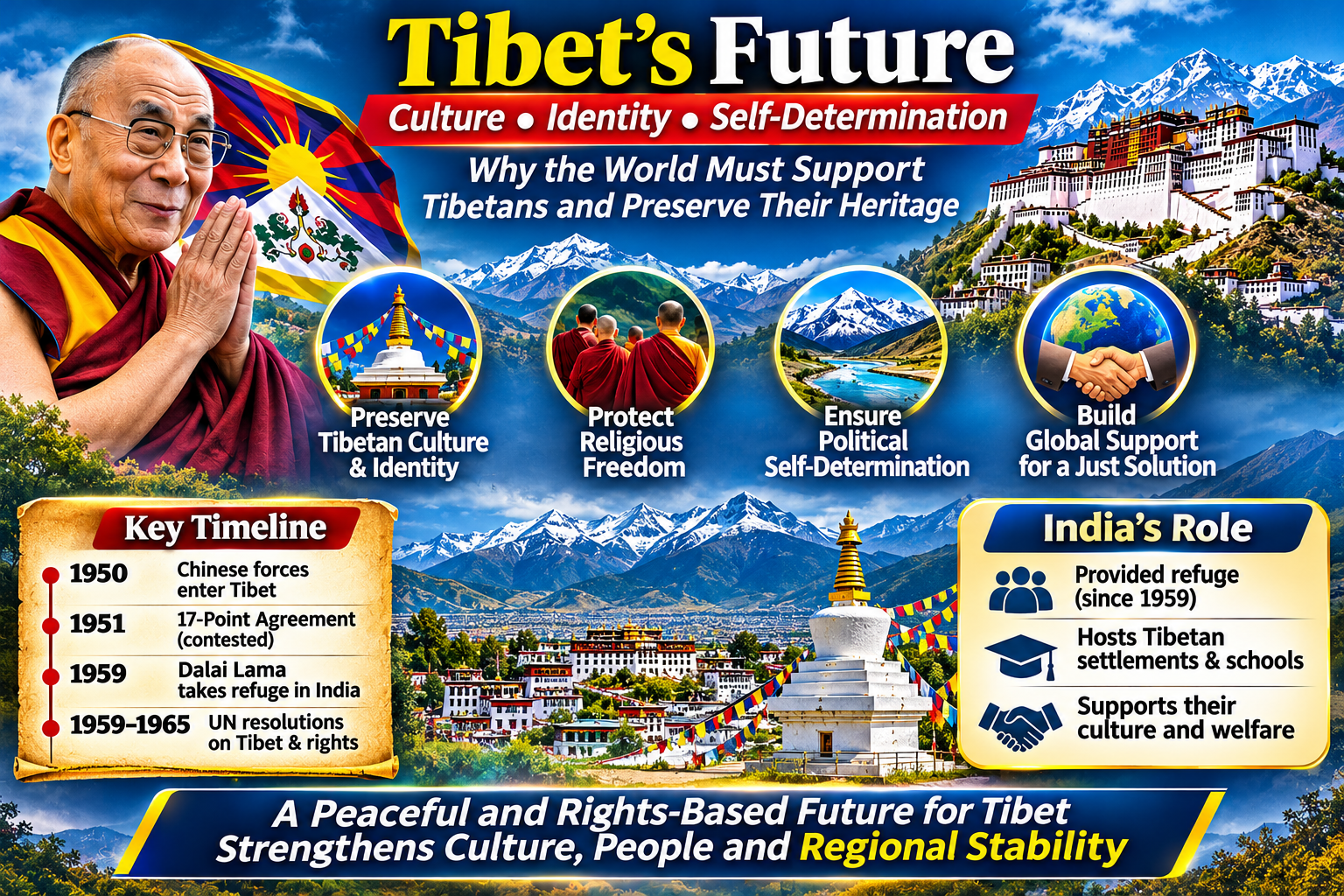

Tibet’s Future: Cultural Survival, Political Self-Determination and the Geopolitical Responsibility of the World
Why Tibetan Settlements in India Must Preserve Their Heritage and Why the International Community Should Support Tibetans’ Right to Determine Their Future
By Suman Munshi | IBG NEWS
Introduction: Tibet Is More Than a Territorial Dispute
The question of Tibet remains one of Asia’s most enduring political, cultural and geopolitical challenges. It involves the survival of an ancient civilisation, the protection of religious and linguistic identity, the right of a people to participate in decisions about their future, the strategic balance in the Himalayas and the international community’s commitment to human rights.
Since Chinese forces entered Tibet in 1950, the region’s political status and relationship with Beijing have been the subject of sharply different interpretations. The Chinese government maintains that Tibet has historically been part of China and describes the events of the 1950s as the peaceful liberation and integration of the region. Many Tibetans in exile, however, regard those events as the loss of their political self-governance and the beginning of a period of profound political and cultural transformation.
In May 1951, representatives of the Chinese Central People’s Government and the Tibetan local government signed the Seventeen-Point Agreement. Beijing regards this agreement as the foundation of Tibet’s peaceful liberation and integration. Many Tibetans in exile dispute the circumstances under which it was concluded and argue that it did not represent a freely negotiated expression of Tibetan political consent.
The Tibetan uprising of 1959 and the subsequent departure of the 14th Dalai Lama for India transformed the issue into an international concern. India became the principal home of the Tibetan exile community, while Dharamshala developed into the centre of Tibetan political, religious and cultural institutions.
Today, Tibet is not simply an issue between Beijing and the Tibetan community. It has implications for India-China relations, Himalayan security, water resources, regional diplomacy, religious freedom and the future of international human rights advocacy.
The central question is whether Tibetans can preserve their distinctive identity and exercise meaningful political choice about their future.
1. Cultural Heritage: The Foundation of Tibetan Identity
A civilisation cannot be measured only by its territory or political boundaries. Its language, literature, religious institutions, historical memory, art, philosophy and traditions are equally important.
Tibetan civilisation has developed a distinctive cultural inheritance over many centuries. Its major elements include:
- The Tibetan language and its classical and modern literary traditions.
- Tibetan Buddhism and its major schools of philosophy and religious practice.
- Monasteries, nunneries and institutions of religious scholarship.
- Traditional Tibetan medicine and knowledge systems.
- Thangka painting, sculpture, architecture, music and dance.
- Historical manuscripts, oral traditions and community practices.
- A distinctive relationship with the Himalayan environment.
These are not merely cultural symbols. They connect generations and provide a community with a shared sense of identity.
Language is particularly important. When children grow up without meaningful opportunities to learn and use their mother tongue, communication between generations can weaken. Religious traditions, oral histories and cultural knowledge may also become more difficult to transmit.
A Human Rights Watch report published on 4 May 2026, titled Start with the Youngest Children: China’s Use of Preschools to Integrate Tibetans, raised serious concerns about the expansion of Chinese-medium preschool education in Tibetan areas. The organisation argued that the policies could weaken Tibetan-language transmission and cultural continuity. Its findings draw on Chinese policy documents, academic and media sources, and interviews with Tibetans and scholars. Access to Tibetan areas remains restricted, and the report’s findings should be understood as the organisation’s documented assessment.
Freedom House’s 2026 assessment also rated Tibet 0 out of 100 for political rights and civil liberties, classifying it as Not Free. The organisation reported restrictions on political participation, religious expression and cultural identity.
Chinese authorities present their education and development policies as efforts to improve national-language proficiency, educational opportunities and integration. The disagreement over the consequences of these policies remains a major international human rights issue.
The protection of Tibetan cultural heritage must therefore be treated as a question of fundamental rights rather than simply an exercise in preserving traditional customs.
2. Tibetan Settlements in India: Protecting a Living Civilisation
India has played an exceptional role in preserving Tibetan institutions since 1959. Tibetan communities have established settlements, schools, monasteries, cultural centres and social organisations across the country.
Dharamshala became the headquarters of the Central Tibetan Administration (CTA), while settlements in different parts of India developed their own educational, religious and community institutions.
These settlements should not be regarded merely as temporary refugee communities. They are important centres for the continuation of Tibetan civilisation outside Tibet.
The CTA’s Department of Education was established in 1960. Its stated objectives include providing modern education while preserving Tibetan language and culture. This dual purpose remains central to Tibetan education in exile.
The next generation faces an important responsibility: maintaining a strong cultural identity while participating fully in modern education, science, technology and international society.
Priority areas should include:
Language preservation: Tibetan should remain a living language of education, literature, communication and community life. Young people should have opportunities to learn classical Tibetan as well as contemporary forms of the language.
Education and research: Tibetan institutions should strengthen research in history, philosophy, Buddhist studies, medicine, Himalayan ecology and international relations.
Religious continuity: Monasteries and nunneries should retain the ability to educate monks and nuns and preserve religious traditions.
Digital preservation: Historical manuscripts, rare books, photographs, music, oral histories and traditional knowledge should be digitised and protected through secure international archives.
Cultural transmission: Festivals, traditional arts, storytelling, community programmes and intergenerational education should help younger Tibetans experience their heritage as a living culture.
Economic sustainability: Tibetan settlements need viable employment, entrepreneurship, professional education and opportunities for young people so that cultural preservation does not become disconnected from economic independence.
The objective should not be to isolate younger Tibetans from the modern world. It should be to ensure that modernisation does not require the abandonment of their cultural identity.
3. Political Self-Determination: The Central Question of Tibet’s Future
The Tibetan question is not limited to language and religion. It also concerns political representation, governance, autonomy and the right of a people to participate meaningfully in decisions affecting their future.
The principle of self-determination is recognised in the United Nations Charter and in international human rights instruments. Article 1 of the International Covenant on Civil and Political Rights and Article 1 of the International Covenant on Economic, Social and Cultural Rights state that all peoples have the right of self-determination.
The United Nations General Assembly adopted resolutions concerning Tibet in 1959, 1961 and 1965.
The 1959 resolution, A/RES/1353(XIV), addressed the question of Tibet and called for respect for fundamental human rights and freedoms. The 1961 resolution, A/RES/1723(XVI), explicitly referred to the Tibetan people’s right to self-determination. The 1965 resolution, A/RES/2079(XX), again expressed grave concern about violations of fundamental rights and the suppression of Tibet’s distinctive cultural and religious life.
These resolutions are important records of international concern. However, they did not recognise Tibet as an independent sovereign state or establish an internationally recognised Tibetan government.
This distinction is essential to an accurate discussion of Tibet’s legal and diplomatic position.
Within Tibetan communities, political opinions are not uniform. Some support genuine autonomy within the People’s Republic of China, while others advocate full independence and the restoration of Tibetan sovereignty.
Both positions are part of the wider Tibetan political debate. The international community should respect the right of Tibetans to express these different aspirations peacefully.
Ultimately, any credible political settlement should provide Tibetans with meaningful participation in determining their constitutional and political future.
4. The Dalai Lama: Spiritual Leadership and the Question of Succession
The 14th Dalai Lama is one of the world’s most recognised spiritual leaders and an important symbol of Tibetan cultural continuity.
His influence extends beyond religious leadership. For decades, he has advocated non-violence, compassion, interfaith dialogue, religious freedom and a peaceful resolution of the Tibetan question.
His political position must, however, be accurately understood.
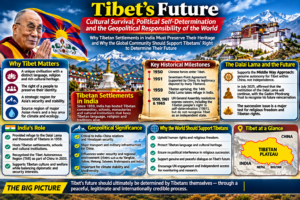
The Dalai Lama has consistently supported the Middle Way Approach, which seeks genuine autonomy for Tibet within the framework of the People’s Republic of China rather than complete independence.
The proposal envisages meaningful Tibetan control over areas such as education, language, culture, religion, environmental protection and other internal affairs. Defence and foreign relations would remain with Beijing under this approach.
Some Tibetans and supporters of the independence movement believe that full sovereignty is the more appropriate expression of Tibetan self-determination. Their position is different from the Dalai Lama’s stated Middle Way policy, although both approaches emphasise the importance of Tibetan identity and rights.
The question of the Dalai Lama’s future reincarnation has added another dimension to the dispute.
In his statement of 2 July 2025, the Dalai Lama affirmed that the institution of the Dalai Lama would continue. He stated that the Gaden Phodrang Trust, the office associated with his institution, would have sole authority to recognise his future reincarnation, following established religious procedures and consultations with Tibetan Buddhist leaders.
The Chinese government, meanwhile, maintains that the recognition of major religious reincarnations must follow Chinese laws and state procedures.
This creates a potential confrontation between religious authority and state power.
The succession question is not simply about identifying an individual. It concerns who has the authority to interpret and continue a religious tradition.
The international community should defend the principle that religious succession must be determined through the legitimate procedures of the relevant religious tradition, free from political coercion.
5. Tibet’s Strategic Importance: The Geopolitical Heart of the Himalayas
Tibet’s significance extends far beyond its cultural and political identity.
The Tibetan Plateau occupies a strategically important position in Asia. Its elevation, mountain systems, transport corridors, river sources and proximity to several countries make it central to the regional security environment.
Its geopolitical implications include:
- India-China relations and the Himalayan border.
- The security environment of Nepal and Bhutan.
- Water resources across South and Southeast Asia.
- China’s transport and military infrastructure.
- Regional trade and connectivity.
- Climate change, glaciers and ecological stability.
China has invested substantially in roads, railways, airports, communications and other infrastructure across the plateau. Beijing presents these investments as part of regional development and economic modernisation.
Strategic analysts also examine their implications for military mobility, logistics and border security.
For India, this infrastructure has particular significance because of the unresolved boundary dispute with China. Improved transport and logistics networks can influence the speed and scale of military deployments in sensitive Himalayan areas.
However, Tibet’s strategic importance should not be reduced to military competition.
The plateau is the source region of several major Asian rivers, including the Yangtze, Yellow, Mekong, Salween, Brahmaputra and Indus. Its glaciers, snowfields and river systems are important to regional hydrology.
Scientific research published in 2024 has cautioned against describing the plateau as the sole or dominant water source for all downstream countries. One study estimated that the weighted average contribution of plateau runoff to the studied river basins was approximately 18%, with considerable variation between basins.
Nevertheless, changes in glacial conditions, river flows, hydropower development and water management can have significant consequences for downstream communities.
Transparent environmental data-sharing and regional cooperation are therefore essential.
6. India’s Unique Responsibility and Diplomatic Limitations
India occupies a distinctive position in the Tibetan question because of its geography, cultural connections and long-standing role as host to the Tibetan exile community.
India provided refuge to the Dalai Lama and thousands of Tibetans after the 1959 uprising. It has continued to host Tibetan settlements, schools, monasteries and cultural institutions.
Tibetan Buddhism also has deep historical connections with India. Many foundational Buddhist teachings and philosophical traditions originated in the Indian subcontinent before spreading across the Himalayan region.
However, India’s official diplomatic position must be understood clearly.
Under the India-China Declaration on Principles for Relations and Comprehensive Cooperation signed on 23 June 2003, India recognised the Tibet Autonomous Region as part of the territory of the People’s Republic of China.
The declaration also stated that India would not allow Tibetans to engage in anti-China political activities on Indian territory.
This position demonstrates the difference between India’s humanitarian role as a host country and its formal diplomatic recognition of China’s territorial claim.
India must balance several interests:
- Protecting the safety, dignity and lawful rights of Tibetan residents.
- Supporting Tibetan education, cultural preservation and religious freedom.
- Preventing intimidation or transnational repression of Tibetan communities.
- Maintaining academic, cultural and religious engagement with Tibetan institutions.
- Encouraging peaceful dialogue between Beijing and legitimate Tibetan representatives.
- Promoting transparency and cooperation over Himalayan river systems.
- Avoiding the use of Tibetan refugees as instruments of geopolitical confrontation.
India does not need to abandon diplomatic realism to remain a responsible protector of Tibetan cultural and humanitarian interests.
Its historical relationship with Tibet gives it an important role in encouraging peaceful dialogue and protecting the rights of the Tibetan community.
7. International Responsibility: Moving Beyond Symbolic Support
Governments, international organisations and human rights institutions have repeatedly expressed concern about developments in Tibet. However, international responses have often remained limited by economic and diplomatic considerations.
China is a major global economic power, a permanent member of the United Nations Security Council and an influential participant in international institutions.
Many governments are cautious about taking strong positions that could affect trade, investment, technology partnerships and wider diplomatic relations with Beijing.
Nevertheless, human rights and cultural freedom should not become negotiable simply because the country concerned is powerful.
International support can become more meaningful through practical measures.
United Nations engagement: Governments should support credible monitoring of human rights, cultural rights, religious freedom and educational conditions in Tibet.
Independent access: The international community should encourage transparent and independent access for relevant UN experts, journalists and human rights observers.
Religious freedom: Governments should oppose political interference in Tibetan Buddhist religious succession and defend the autonomy of religious institutions.
Academic cooperation: Universities and research institutions should support Tibetan studies, language research, historical documentation and independent scholarship.
Protection of exile communities: Countries hosting Tibetans should investigate credible reports of intimidation, surveillance or pressure directed at Tibetan residents and their families.
Cultural investment: International foundations, libraries, museums and educational institutions should support the preservation of Tibetan manuscripts, art, language and oral traditions.
The goal should be consistent international engagement based on principles rather than occasional political statements.
8. Tibet and Great-Power Competition: A Cause Must Not Become a Political Instrument
Tibet is increasingly discussed in the context of strategic competition involving China, the United States, India, Japan and European countries.
Some governments have introduced legislation or issued policy statements addressing Tibetan human rights, religious freedom and the question of the Dalai Lama’s succession.
Such attention can create opportunities for international advocacy. But it also carries a risk.
The Tibetan cause must not become merely a tool in a larger contest between powerful states.
If governments support Tibet only when their relations with Beijing deteriorate, Tibetan aspirations become vulnerable to changes in international politics.
A durable international position should be based on consistent principles:
- Respect for human rights.
- Freedom of religion and belief.
- Protection of minority languages and cultural heritage.
- Peaceful resolution of political disputes.
- Opposition to intimidation and coercion.
- Meaningful participation of affected communities in decisions about their future.
The strongest international coalition would include democratic countries, non-aligned states, Buddhist-majority nations, universities, cultural institutions and human rights organisations.
Such a coalition should support Tibetan rights without promoting military confrontation or treating the Tibetan population as an instrument of strategic pressure.
9. The Next Generation: The Future of Tibetan Identity
One of the most important challenges facing the Tibetan exile community is generational continuity.
Many young Tibetans living in India and elsewhere were born outside Tibet. Their relationship with their homeland is often shaped by family history, religious education, cultural institutions and accounts passed down by earlier generations.
At the same time, reports indicate that movement from Tibet into exile has become increasingly difficult because of restrictions on travel, border controls and security measures.
This creates a growing challenge for the continuity of relationships between Tibetan communities inside Tibet and those living abroad.
Tibetan institutions must therefore strengthen their long-term capacity.
Key priorities should include:
- Transparent and accountable democratic governance.
- Greater participation by younger Tibetans and women.
- Professional diplomatic, historical and legal research.
- International educational partnerships.
- Secure digital archives and independent media.
- Sustainable economic opportunities for Tibetan settlements.
- Dialogue among different Tibetan political viewpoints.
- Stronger links between younger generations and Tibetan language, literature and religious traditions.
The Central Tibetan Administration and other representative institutions have an important role in maintaining political participation among Tibetans in exile.
Their legitimacy and long-term effectiveness will depend on democratic accountability, institutional transparency and the ability to represent the diversity of Tibetan opinion.
10. The Path Ahead: Autonomy, Sovereignty and a Peaceful Political Future
The restoration of Tibet as a sovereign state remains an aspiration for sections of the Tibetan community and its supporters. It is also an exceptionally difficult geopolitical objective.
China rejects Tibetan independence and regards Tibet as an integral part of its national territory. Most governments do not recognise Tibet as an independent country. India’s formal diplomatic position also recognises the Tibet Autonomous Region as part of the People’s Republic of China.
A unilateral declaration of independence without a negotiated settlement or substantial international recognition would face enormous political and diplomatic obstacles. It could also increase risks for Tibetans living inside Tibet.
A realistic long-term strategy must therefore begin with the protection of Tibetan rights and the development of legitimate political institutions.
Stage One: Preserve Tibetan civilisation
Strengthen language, education, religion, cultural institutions, historical research and community participation in settlements around the world.
Stage Two: Build international legal and diplomatic support
Document human rights concerns, encourage independent investigations, engage the United Nations and build a consistent international coalition around cultural rights, religious freedom and self-determination.
Stage Three: Strengthen democratic representation
Ensure that Tibetan political institutions remain transparent, accountable and representative of Tibetans living inside and outside Tibet.
Stage Four: Encourage meaningful negotiations
Promote dialogue between Beijing and legitimate Tibetan representatives. Any settlement should provide verifiable guarantees for language, religion, education, environmental protection, local governance and political participation.
Stage Five: Let Tibetans determine their constitutional future
The final political arrangement should reflect the freely expressed wishes of the Tibetan people through a credible, peaceful and internationally respected process.
Possible outcomes could include genuine autonomy, a federal or other negotiated constitutional arrangement, or, if circumstances and international law permit, a sovereign Tibet.
The decision should not be imposed by Beijing, New Delhi, Washington or any other external capital.
The principle must be clear: Tibetans should have a meaningful and peaceful voice in determining their own future.
Conclusion: The World Must Not Allow a Civilisation to Become a Historical Footnote
The Tibetan question is ultimately about whether a distinct people can preserve their identity, exercise meaningful political agency and pass their civilisation to future generations.
Tibetan settlements in India carry a responsibility that extends beyond the welfare of their present residents. They preserve a living connection to Tibet’s language, religion, literature, history and political aspirations.
The 14th Dalai Lama remains an extraordinary symbol of Tibetan spiritual continuity and peaceful advocacy. His position on genuine autonomy, dialogue and religious freedom deserves serious international attention. At the same time, the aspirations of Tibetans who seek full independence should be heard and debated without intimidation.
The international community should not confuse respect for China’s people and culture with unquestioning acceptance of every policy of the Chinese state. Nor should it turn Tibet into a bargaining chip in strategic competition.
A peaceful future requires dialogue, accountability, freedom of religion, protection of language and meaningful political participation.
The world should stand with the Tibetan people—not to provoke a war with China, but to defend the principle that no civilisation should lose its voice, no religious tradition should be controlled by political decree, and no people should be denied a meaningful say in their own future.
Tibet’s future should ultimately be determined by Tibetans themselves, through peaceful, legitimate and internationally credible means.
The preservation of Tibetan civilisation is not only a Tibetan responsibility. It is a shared responsibility of all who believe that cultural diversity, religious freedom, human dignity and peaceful coexistence are essential to a stable world.
By Suman Munshi | IBG NEWS
Major References and Research Sources
- United Nations General Assembly Resolution 1353 (XIV), 1959 – Question of Tibet.
https://digitallibrary.un.org/ - United Nations General Assembly Resolution 1723 (XVI), 1961 – Question of Tibet.
https://digitallibrary.un.org/ - United Nations General Assembly Resolution 2079 (XX), 1965 – Question of Tibet.
https://digitallibrary.un.org/record/203591 - Seventeen-Point Agreement on Measures for the Peaceful Liberation of Tibet, 1951.
Historical document; its interpretation and the circumstances of its signing remain disputed. - Human Rights Watch, 4 May 2026 – Start with the Youngest Children: China’s Use of Preschools to Integrate Tibetans.
https://www.hrw.org/report/2026/05/04/start-with-the-youngest-children/chinas-use-of-preschools-to-integrate-tibetans - Freedom House – Tibet: Freedom in the World 2026.
https://freedomhouse.org/country/tibet/freedom-world/2026 - The Office of His Holiness the Dalai Lama – The Middle Way Approach.
https://dalailama.com/messages/tibet/middle-way-approach - The Office of His Holiness the Dalai Lama – Statement Affirming the Continuation of the Institution of Dalai Lama, 2 July 2025.
https://www.dalailama.com/the-dalai-lama/biography-and-daily-life/reincarnation/statement-affirming-the-continuation-of-the-institution-of-dalai-lama-july-2-2025 - Central Tibetan Administration, Department of Education – Introduction and history.
https://sherig.org/en/about-us/introduction/ - India-China Declaration on Principles for Relations and Comprehensive Cooperation, 23 June 2003.
See paragraph 70, concerning India’s recognition of the Tibet Autonomous Region as part of the People’s Republic of China. - Is the Tibetan Plateau Really a Water Tower? – Hydrological Processes, 2024.
https://doi.org/10.1002/hyp.15103 - United Nations Convention on the Rights of the Child, 1989.
https://www.ohchr.org/en/instruments-mechanisms/instruments/convention-rights-child - International Covenant on Civil and Political Rights, 1966.
https://www.ohchr.org/en/instruments-mechanisms/instruments/international-covenant-civil-and-political-rights - International Covenant on Economic, Social and Cultural Rights, 1966.
https://www.ohchr.org/en/instruments-mechanisms/instruments/international-covenant-economic-social-and-cultural-rights - Government of the People’s Republic of China – Tibet: Development and Official Policy Statements.
https://english.scio.gov.cn/

