














Bangladesh After Sheikh Hasina: The Development Legacy, the Cost of Political Upheaval and What the Nation Has Lost in Two Years
An in-depth assessment of Hasina’s leadership, Bangladesh’s economic slowdown, institutional disruption and the challenges of rebuilding national confidence
By Suman Munshi | IBG NEWS
Introduction: A development story interrupted
Bangladesh’s modern economic transformation is one of the most significant development stories in South Asia. A country that emerged from the devastation of the 1971 Liberation War, burdened by poverty, food insecurity and weak infrastructure, gradually became a major manufacturing and export economy. Its progress in electricity access, women’s employment, garment manufacturing, education, life expectancy and poverty reduction attracted international recognition.
Among the political leaders associated with this transformation, Sheikh Hasina occupies a particularly important place. Her governments, especially during the long period from 2009 to August 2024, presided over an era of large-scale infrastructure development, industrial expansion, digitalisation and rising international economic visibility.
The Padma Bridge, Dhaka Metro Rail, major power-generation projects, improved road connectivity and the expansion of digital public services became visible symbols of the country’s development ambitions. Bangladesh strengthened its position in global garment supply chains, increased electricity access and improved several important social indicators.
However, the final years of Hasina’s rule also exposed serious weaknesses. Inflation, foreign-exchange pressure, banking-sector vulnerabilities, corruption allegations, political exclusion and restrictions on democratic freedoms undermined public confidence. The violent response to the July–August 2024 protests and Hasina’s departure on 5 August 2024 marked a decisive break in the country’s political history.
Two years later, Bangladesh faces a difficult question: What did the country gain during Sheikh Hasina’s leadership, what has it lost since the political upheaval, and how much of the current economic difficulty can fairly be attributed to the change of government?
The answer requires a balanced examination. Bangladesh did not lose every achievement after Hasina’s departure, nor were all economic problems created by the subsequent administrations. Several weaknesses were already visible before August 2024. Nevertheless, the political transition disrupted economic activity, weakened confidence and created a period of uncertainty at a critical moment in the country’s development.
1. Sheikh Hasina’s development legacy: A period of major national transformation
Sheikh Hasina’s most significant economic contribution was the scale and continuity of development during her long period in office. Between 2009 and 2024, Bangladesh experienced substantial expansion in infrastructure, manufacturing, electricity access and digital services.
The International Monetary Fund has acknowledged that the country’s garment-led growth over the preceding two decades significantly increased employment, reduced poverty and raised per-capita income. It also recognises major improvements in life expectancy, child mortality, basic services and financial inclusion. <Link ref=”turn550894search7″ title=”IMF Bangladesh Article IV Consultation, January 2026″/>.
A. Infrastructure that changed the country’s economic geography
<AsyncImageGroup query={[“Padma Bridge Bangladesh aerial photograph”,”Dhaka Metro Rail Bangladesh train”,”Karnaphuli tunnel Bangladesh entrance”,”Rooppur nuclear power plant Bangladesh construction”]} aspectRatio=”5:4″ layout=”carousel”/>
The infrastructure programme under Hasina’s leadership was among the most visible aspects of her development legacy.
Padma Bridge: The bridge created a major road and rail connectivity link between the capital and the south-western region. It reduced dependence on ferry crossings and opened opportunities for trade, tourism, logistics and regional economic integration.
Dhaka Metro Rail: The introduction of urban mass rapid transit represented a major step towards modernising transport in one of the world’s most densely populated capitals.
Karnaphuli Tunnel: The tunnel was designed to improve connectivity around Chattogram and strengthen the region’s potential as an industrial and logistics centre.
Rooppur Nuclear Power Plant: This strategically important project was intended to diversify electricity generation and provide additional long-term energy capacity.
Alongside these projects, Bangladesh expanded highways, bridges, power plants, ports and rural infrastructure.
These developments were not simply construction achievements. They represented an attempt to change the country’s economic geography, reduce transport barriers and improve the foundations for industrialisation.
Their ultimate success, however, must be measured by actual economic returns, utilisation, maintenance costs and the ability to generate productive employment.
B. Electricity access and industrial development
Reliable electricity is essential for factories, hospitals, education, agriculture, telecommunications and modern services.
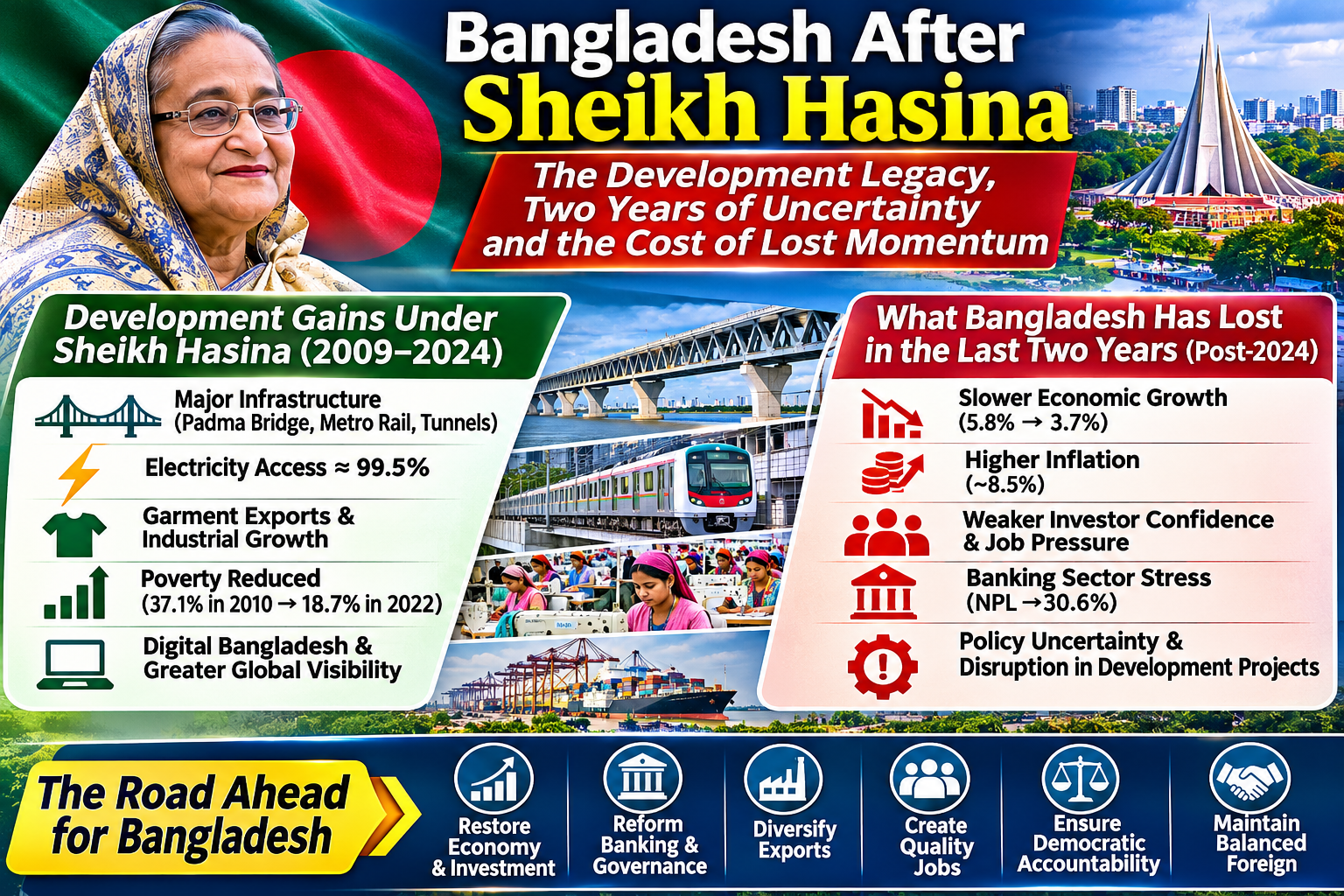
Bangladesh made major progress in extending electricity access to households. The World Bank’s country data records electricity access at 99.5% of the population in 2024. <Link ref=”turn550894search1″ title=”World Bank Bangladesh Data”/>.
This achievement helped improve rural living standards and supported the expansion of commercial activity. However, electricity access and reliable electricity supply are not the same. Energy shortages, fuel-import costs and financial difficulties in the power sector remain important challenges.
C. The garment industry: Bangladesh’s international economic identity
<AsyncImage query=”Bangladesh garment factory workers modern textile manufacturing production line” aspectRatio=”16:9″ width=”100%”/>
The ready-made garment industry became the backbone of Bangladesh’s export economy.
The sector created millions of jobs, particularly for women, and connected Bangladesh with international brands and retailers. It also encouraged the development of logistics, banking, transport, packaging and other supporting industries.
Hasina’s governments presided over a period in which Bangladesh consolidated its global position as a major apparel manufacturing centre.
Yet this achievement was built over several decades, beginning with earlier private-sector initiatives and trade reforms. It was not the creation of one administration alone.
The country’s dependence on garments also became a structural weakness: excessive concentration in one export sector leaves Bangladesh vulnerable to international demand shocks, labour disputes, trade restrictions and competition from other manufacturing economies.
D. Poverty reduction and social development
Bangladesh’s progress in health, education, women’s participation and poverty reduction is an important part of its national development story.
According to the World Bank’s 2025 poverty assessment, the national poverty rate declined from 37.1% in 2010 to 18.7% in 2022 under the national upper poverty line. Extreme poverty also fell substantially.
The IMF has recognised that economic growth over the past two decades contributed to improvements in employment, income and social indicators. <Link ref=”turn550894search7″ title=”IMF assessment of Bangladesh’s development”/>.
These improvements were supported by multiple factors: government programmes, private-sector employment, overseas remittances, agricultural productivity, women’s participation in the workforce and the work of development organisations.
Sheikh Hasina’s governments deserve recognition for presiding over this period of progress, but the achievements belong to the people and institutions that made the transformation possible.
E. Digital Bangladesh and international visibility
The expansion of mobile financial services, telecommunications, digital public administration and online services changed the relationship between citizens, businesses and the state.
Bangladesh also increased its international visibility through infrastructure investment, manufacturing exports, regional connectivity and participation in global development discussions.
Hasina’s government promoted the ambition of transforming Bangladesh into a more technologically capable and economically influential country.
The broader development challenge was to convert this digital expansion into higher productivity, innovation, skilled employment and a stronger domestic technology industry.
2. The weaknesses that weakened the Hasina-era model
A serious evaluation must also acknowledge that the final years of Hasina’s government were increasingly troubled.
The IMF’s January 2026 assessment makes an important distinction: Bangladesh’s economic transformation had produced significant gains, but weak governance and institutions contributed to an uneven distribution of those gains and severely undermined the banking system. Public dissatisfaction over inequality and exclusion contributed to the 2024 uprising. <Link ref=”turn550894search7″ title=”IMF Article IV Consultation”/>.
Major weaknesses included:
- High inflation and pressure on household purchasing power.
- Declining foreign-exchange reserves before the political transition.
- Banking-sector vulnerabilities and concerns over non-performing loans.
- Weak tax mobilisation and limited public revenue.
- Concentration of exports in the garment sector.
- Concerns about corruption, transparency and the allocation of public resources.
- Political polarisation and restrictions on opposition activity, media freedom and democratic competition.
The political crisis of 2024 therefore did not emerge in an economic vacuum. It reflected a combination of public dissatisfaction, governance problems, employment concerns and political grievances.
The lesson is that economic growth without institutional accountability and fair distribution can eventually undermine the very stability on which development depends.
3. August 2024: The political rupture and its economic consequences
The July–August 2024 uprising brought an end to Hasina’s long period in power. The protests began around public-sector job quotas but expanded into a wider movement against the government.
The political crisis had immediate consequences for the economy.
Factories and businesses faced disruption. Transport and logistics were affected. Investors became concerned about political uncertainty, security and continuity of economic policy.
The IMF’s 2025 review recorded that real GDP growth slowed to 3.3% year-on-year in the first half of FY2025, compared with 5.1% in the corresponding period of FY2024. It attributed the slowdown partly to production disruptions during the uprising, tighter economic policies and uncertainty suppressing investment. ref “IMF Bangladesh Review, 2025”.
This is important evidence that the political upheaval had a measurable economic cost.
But it is equally important to recognise that Bangladesh’s economic slowdown had already begun before Hasina left office. Inflation, reserve pressure and weaker growth were not created entirely by the transition.
The political upheaval intensified existing vulnerabilities and added new uncertainties to an already difficult economic situation.
4. What has Bangladesh lost in the two years since Hasina’s departure?
The question of what Bangladesh has lost should not be reduced to a political argument about one leader. It should be examined through the economic, institutional and strategic costs of the transition.
A. Loss of policy continuity and development momentum
Large infrastructure projects require long-term planning, financing, technical supervision and consistent implementation.
Political transitions can disrupt:
- Project approvals and procurement.
- Administrative decision-making.
- Contract execution.
- Investor confidence.
- Coordination between ministries and development partners.
Bangladesh’s challenge has been to maintain continuity while reviewing projects for transparency, cost-effectiveness and accountability.
A project should not be continued merely because it was initiated by a previous government. Equally, it should not be delayed or abandoned simply because it carries the political identity of a former administration.
The country risks losing economic value when political competition replaces objective project evaluation.
B. Weaker private investment and business confidence
Investors require predictable regulations, secure property rights, reliable energy, stable taxation and confidence that contracts will be respected.
The IMF’s 2025 review identified political uncertainty and disruptions as factors suppressing investment. The World Bank’s April 2026 update also highlighted subdued private investment and the need to improve the business environment. <Link ref=”turn548156search1″ title=”World Bank Bangladesh Development Update, April 2026″/>.
The cost of uncertainty is not always visible in a government budget. It appears in factories that postpone expansion, entrepreneurs who delay investment, foreign companies that reconsider new projects and young people who cannot find employment.
Bangladesh has lost some of the predictability that investors need to make long-term decisions.
This is not necessarily permanent. Restoring political stability, transparent regulation and confidence in the financial system can reverse the damage.
C. Slower economic growth and pressure on employment
The IMF reported that Bangladesh’s GDP growth declined from 5.8% in FY2023 to 4.2% in FY2024 and 3.7% in FY2025. <Link ref=”turn550894search2″ title=”IMF Executive Board Assessment, January 2026″/>.
The World Bank’s April 2026 update projected growth of 3.9% for FY2026 and identified weak job creation, inflation and rising poverty as serious concerns. <Link ref=”turn548156search1″ title=”World Bank Economic Update, April 2026″/>.
This slowdown has consequences beyond national GDP figures:
- Fewer opportunities for new graduates.
- Greater pressure on small and medium enterprises.
- Reduced expansion plans among manufacturers.
- Greater difficulty for households facing rising prices.
- More uncertainty for workers in export-dependent industries.
Bangladesh needs a strong employment strategy. A large young population is an advantage only when the economy can create productive and adequately paid jobs.
D. The erosion of household purchasing power
One of the most painful economic problems has been the continued rise in the cost of living.
The World Bank reported that inflation remained high at around 8.5% in FY2026 and that wages of low-income workers had not kept pace with prices. Its April 2026 update estimated that national poverty had risen to 21.4% in 2025 from 18.7% in 2022 under the national poverty measure. <Link ref=”turn548156search1″ title=”World Bank Bangladesh Development Update”/>.
This means that the development gains of earlier years have become more fragile for some households.
It would be inaccurate to say that every increase in poverty was caused by Hasina’s departure. Inflation, global energy prices, exchange-rate changes, weak employment and long-standing structural problems all matter.
Nevertheless, the failure to restore purchasing power quickly has become one of the most serious tests for the post-2024 political leadership.
E. A difficult banking and financial-sector inheritance
Bangladesh’s banking sector was already facing serious problems before the uprising. The IMF has highlighted weak governance, undercapitalisation, non-performing loans and deficiencies in financial supervision.
The World Bank reported that the non-performing loan ratio reached 30.6% in December 2025. <Link ref=”turn548156search1″ title=”World Bank Bangladesh Development Update”/>.
This is a major obstacle to recovery. Banks burdened with bad loans become less capable of financing new factories, entrepreneurs, exporters and productive businesses.
The country has lost time in addressing these structural weaknesses. Financial-sector reform must now become a national priority, not a political instrument.
F. Damage to political trust and national reconciliation
The political transition created expectations of democratic renewal, institutional reform and greater accountability.
However, a country cannot build a stable economy if political competition becomes a cycle of revenge, exclusion and retaliation.
Bangladesh needs space for peaceful political participation, protection of minorities, independent journalism, lawful opposition activity and credible institutions.
The UK government’s October 2026 fact-finding report described improvements in the ability of political parties, journalists, civil society organisations and human-rights groups to operate and express views compared with the Hasina-era environment. <Link ref=”turn550894search5″ title=”UK Government Bangladesh Political Situation Report, October 2026″/>.
That development should not be ignored. Greater political freedom is an important potential gain of the transition, even as economic uncertainty and institutional weaknesses remain.
The real challenge is to ensure that political freedoms are protected consistently and that no party or government becomes immune from accountability.
G. A risk to Bangladesh’s international economic reputation
Bangladesh’s international standing was built partly on its record of growth, garment exports, development partnerships and infrastructure investment.
The political transition attracted international attention and scrutiny. Investors, trading partners and development institutions needed reassurance that Bangladesh would maintain stability, honour contracts and protect commercial operations.
The country must now demonstrate that it remains a dependable manufacturing and investment destination.
For a nation preparing to graduate from the United Nations’ Least Developed Country category, the importance of trade diplomacy, labour standards, market access and policy predictability is especially high.
5. What Bangladesh has not lost: The recovery indicators that deserve recognition
A fair assessment must also acknowledge developments that do not fit a simple narrative of decline.
The economy has shown signs of stabilisation in some areas.
According to the IMF’s January 2026 assessment:
- Foreign-exchange reserves began rebuilding.
- The current account improved.
- Remittance inflows supported the external sector.
- The authorities made progress in adjusting the exchange-rate framework.
The IMF also warned that inflation, weak tax collection and banking-sector vulnerabilities remained serious. <Link ref=”turn550894search2″ title=”IMF January 2026 assessment”/>.
A subsequent report by the Metropolitan Chamber of Commerce and Industry, published by Bangladesh Sangbad Sangstha in August 2026, reported provisional FY2026 GDP growth of 4.14%, higher than the 3.49% recorded in FY2025. It also reported stronger remittances and foreign-exchange reserves. <Link ref=”turn548156search2″ title=”Bangladesh economy shows signs of stabilisation, August 2026″/>.
A separate October 2026 analysis by ThePrint found that reserves and remittances had improved, while growth remained weak and private-sector credit growth had slowed. It also emphasised that the economic slowdown and reserve decline had begun before Hasina’s departure. <Link ref=”turn548156search3″ title=”Bangladesh economy two years after Hasina’s fall”/>.
These developments matter because they show that Bangladesh’s economy has not collapsed. It has retained significant resilience, supported by its workers, exporters, overseas migrants and economic institutions.
The challenge is to turn stabilisation into sustainable growth.
6. The geopolitical cost: Bangladesh must not lose its strategic balance
Bangladesh occupies a strategically important position between South Asia and Southeast Asia, with access to the Bay of Bengal and close economic links with India, China, Japan, the United States and Europe.
During Hasina’s tenure, Bangladesh expanded infrastructure and economic cooperation with multiple international partners. Its relations with India were particularly important for connectivity, energy trade, security cooperation and regional transport.
The post-2024 transition has created a new diplomatic environment. Bangladesh must now rebuild confidence with neighbours and global partners without compromising its national independence.
India: Geography and economic interdependence cannot be ignored
India and Bangladesh share a long border, river systems, transport networks, energy connections and important trade relationships.
Political disagreements should not be allowed to destroy practical economic cooperation.
A stable relationship benefits both countries through:
- Cross-border electricity trade.
- Rail and road connectivity.
- Port and transit facilities.
- Regional supply chains.
- Water management.
- Security cooperation.
Bangladesh should maintain constructive relations with India while pursuing balanced relationships with other partners.
China: Infrastructure cooperation with financial discipline
China remains an important source of infrastructure finance, construction services and industrial equipment.
Bangladesh can benefit from Chinese investment, but every project must be evaluated through transparent procurement, repayment capacity, environmental impact and economic return.
The objective should be economic partnership, not excessive dependence.
Japan, Europe and the United States: Investment and export markets
Bangladesh needs continued access to major international markets and investment partners.
Japan can contribute through infrastructure, industrial technology and quality investment. Europe and the United States remain crucial for export markets, labour standards and supply-chain partnerships.
The country must maintain predictable trade policies and meet international standards if it wants to move towards higher-value manufacturing.
The Bay of Bengal: A strategic economic opportunity
Bangladesh’s ports and maritime location provide opportunities to become a regional logistics and industrial centre.
Port modernisation, shipping, coastal infrastructure, energy connectivity and regional trade can strengthen the national economy.
But the benefits will depend on political stability, efficient customs, reliable transport and investment in skills.
7. Sheikh Hasina’s leadership: The historical judgement
A leader’s legacy should be assessed through achievements, failures, institutions and long-term consequences.
Sheikh Hasina’s leadership delivered a period of major economic and infrastructure expansion. The country’s progress in electricity access, garment exports, transport connectivity, digital services and poverty reduction deserves recognition.
Her governments also presided over serious institutional and political weaknesses. The concentration of power, restrictions on political competition, governance failures and the violent response to the 2024 protests damaged the legitimacy and sustainability of the development model.
The most balanced historical conclusion is therefore:
Sheikh Hasina was one of the most consequential development leaders in Bangladesh’s modern history, particularly in the scale of infrastructure expansion and economic transformation during 2009–2024. However, the failure to strengthen independent institutions, political accountability and inclusive governance weakened the foundations of that achievement.
Her departure did not erase the infrastructure, factories, electricity networks, roads, bridges or human capital created during her tenure. Nor did it automatically create all the economic problems that followed.
But the political upheaval interrupted development momentum, damaged confidence and exposed how vulnerable economic progress can become when institutions are weak.
8. What Bangladesh must do now: A national recovery agenda
Bangladesh should not approach its future as a contest between the legacy of Sheikh Hasina and the ambitions of the current political leadership.
It should protect what works, correct what failed and build institutions capable of serving the country regardless of which party holds power.
The following priorities are essential:
1. Protect development infrastructure: Continue economically viable projects, audit their costs and improve their operational performance. Avoid politically motivated cancellation or continuation.
2. Restore investor confidence: Ensure predictable regulations, contract enforcement, commercial security and transparent procurement.
3. Repair the banking system: Conduct credible asset-quality reviews, address bad loans and strengthen independent supervision.
4. Control inflation: Improve food supply chains, market competition, monetary discipline and targeted support for vulnerable households.
5. Diversify exports: Expand pharmaceuticals, electronics, engineering, agro-processing, leather and IT services beyond garments.
6. Create employment: Link education and vocational training with industrial requirements and the needs of the digital economy.
7. Strengthen democratic institutions: Protect independent journalism, political pluralism, the judiciary, civil society and the rights of minorities.
8. Improve public revenue: Reform taxation, reduce evasion and ensure that public money is used transparently.
9. Maintain balanced foreign relations: Develop constructive economic relationships with India, China, Japan, Europe, the United States and Southeast Asia.
10. Establish a national development consensus: Infrastructure, education, energy security, healthcare and industrial development should remain national priorities beyond electoral cycles.
Conclusion: Bangladesh lost time, confidence and momentum—but its future is not lost
Bangladesh’s development story under Sheikh Hasina was substantial. Her governments presided over a period in which the country expanded its infrastructure, strengthened its industrial base, increased electricity access and improved important social indicators. The scale of the Padma Bridge, Dhaka Metro Rail, power-sector expansion and garment-led economic growth reflected a national ambition to move beyond the limitations of a low-income economy.
But development cannot be measured only by bridges, buildings, GDP and power plants. It must also be measured by the strength of institutions, fairness of opportunity, freedom of citizens and the ability of ordinary families to live with dignity.
The political crisis of 2024 exposed the weaknesses of the previous development model. The two years that followed brought economic disruption, uncertainty and slower growth. Bangladesh lost valuable time, some investment momentum and a degree of policy continuity. Poverty and inflation pressures increased, while the banking and employment challenges remained unresolved.
At the same time, stronger remittances, recovering reserves, improved opportunities for public debate and the resilience of the export economy show that the country retains the capacity to recover.
The greatest loss for Bangladesh would be to allow political rivalry to destroy the economic and social achievements built over generations.
The country should neither reject every achievement of Sheikh Hasina’s era nor overlook the failures that contributed to her government’s fall. It must preserve successful infrastructure and development programmes while addressing corruption, institutional weakness, inequality and democratic deficits.
History may remember Sheikh Hasina as a leader who presided over one of Bangladesh’s most visible periods of economic transformation. It will also judge whether her successors can preserve those gains, correct the weaknesses and deliver a more inclusive and accountable model of development.
Bangladesh does not need another personality-centred development model. It needs strong institutions, stable policies, responsible leadership and a national commitment to prosperity.
The real measure of leadership is not how much a country builds under one government, but how much progress it can sustain after that government leaves office.
By Suman Munshi | IBG NEWS

