










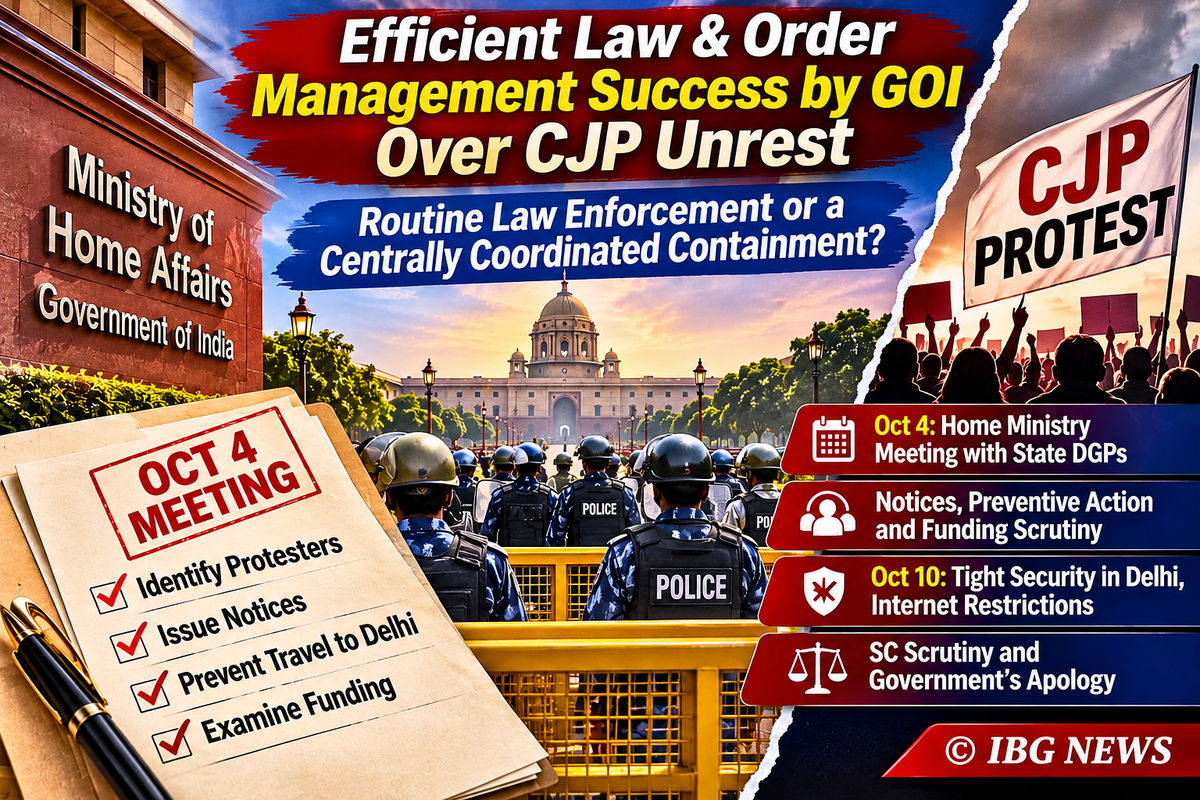

CJP Protest Restrictions Raise Questions Over Public Order Measures and Democratic Rights Or Efficient Law & Order Management Success by GOI
Home Ministry meetings, inter-state police coordination and preventive actions ahead of October 10 protest come under public and judicial scrutiny
By Suman Munshi | IBG NEWS
New Delhi, 15 November 2026: The Union Government’s response to the Cockroach Janata Party’s (CJP) proposed October 10 demonstration in New Delhi has generated debate over the balance between maintaining public order and protecting the constitutional right to peaceful protest.
According to publicly reported accounts and court filings, preparations undertaken by the Union Home Ministry, state police authorities and Delhi Police involved preventive measures aimed at restricting the mobilisation of demonstrators after permission for the event was reportedly denied. The episode has since attracted legal, political and constitutional scrutiny, particularly regarding the scope and proportionality of the measures adopted.
The central issue is not whether authorities have the power to maintain public order. Rather, it is whether the actions taken before and during the proposed demonstration met established standards of legality, necessity and proportionality.
Home Ministry Preparations Before the Protest
According to reporting by The Indian Express, Union Home Secretary Govind Mohan convened a meeting on October 4 with several state Directors General of Police (DGPs) and police commissioners to discuss preparations relating to the proposed October 10 mobilisation.
Published reports indicate that authorities reviewed intelligence assessments, considered preventive policing measures and discussed coordination among states regarding participants who might travel to Delhi for the demonstration.
A subsequent review meeting was reportedly held on October 8 as officials monitored developments ahead of the scheduled protest.
If accurate, these meetings demonstrate a significant level of inter-governmental coordination before the proposed gathering took place.
Preventive Measures Across States
Media reports indicated that several state police agencies took preventive action in the days preceding October 10.
In Maharashtra, confidential communications reportedly circulated among police units referred specifically to the proposed CJP mobilisation. Authorities were instructed to monitor developments and undertake preventive measures where considered necessary under applicable law.
Reports also suggested that notices were issued to certain individuals associated with previous protest activities, while police authorities monitored travel plans and mobilisation efforts linked to the proposed gathering.
The extent to which such preventive actions were individually assessed and legally justified remains a matter that may warrant further examination.
Delhi Police Security Arrangements
Delhi Police adopted extensive security preparations in advance of the proposed protest.
According to media reports, authorities established numerous security checkpoints across New Delhi and identified facilities that could be used for preventive detention if circumstances required.
Officials defended the preparations as precautionary measures intended to prevent unauthorised assembly, ensure public safety and avoid possible disruption in sensitive areas of the national capital.
The security arrangements reflected the authorities’ assessment that a large number of participants might attempt to enter Delhi despite restrictions on the proposed event.
Government’s Justification
The Union Government and Delhi Police have consistently maintained that their actions were guided by public-order concerns.
In submissions before the Supreme Court, police authorities referred to their experience during an earlier CJP mobilisation and argued that preventive measures were necessary to avoid a recurrence of situations that could potentially affect public order and security.
Authorities also stated that intelligence inputs suggested supporters might travel to Delhi even after permission for the proposed demonstration had reportedly been denied.
From the government’s perspective, the steps undertaken were designed to maintain peace, protect public property and prevent potential law-and-order challenges.
At the same time, constitutional jurisprudence requires that restrictions on fundamental rights be justified through clear legal authority and remain proportionate to the threat being addressed.
Internet Restrictions and Judicial Examination
The controversy expanded further when cellular internet services were temporarily suspended in parts of Delhi during the protest period.
Government affidavits submitted before the Supreme Court stated that the restrictions were limited in geography and duration and were imposed as preventive measures intended to maintain public order.
The issue subsequently became the subject of judicial scrutiny, with the Court examining the legal basis and implementation of the restrictions.
In later filings, the Union Home Secretary submitted an unconditional apology to the Court while defending the government’s actions as measures undertaken in the interest of public safety and order.
The proceedings underline the continuing national debate regarding the use of internet restrictions during periods of political mobilisation and public protest.
Democratic Rights and State Responsibilities
India’s constitutional framework seeks to balance two equally important obligations.
On one hand, governments are responsible for maintaining public order, protecting citizens and preventing violence. Law-enforcement agencies possess lawful authority to take preventive action where credible security concerns exist.
On the other hand, the Constitution protects freedom of speech, peaceful assembly and democratic dissent. These rights are central to public participation in a democratic society and may only be restricted through lawful, necessary and proportionate measures.
The challenge for democratic institutions is ensuring that legitimate security concerns do not result in unnecessary limitations on peaceful political expression.
Questions That Continue to Invite Public Scrutiny
Several issues remain relevant for public debate and possible future examination:
- What specific intelligence assessments informed the October 4 and October 8 meetings?
- What written instructions, if any, were issued following those meetings?
- Were preventive notices and restrictions supported by individualized legal grounds?
- What conclusions emerged from inquiries into protest-related funding, if any?
- How do these measures compare with responses to other major demonstrations in the national capital?
- What findings emerged from subsequent judicial and statutory reviews?
- Were all restrictions imposed consistent with established constitutional standards?
Answers to these questions would contribute to a clearer understanding of how authorities balanced public-order considerations with democratic freedoms.
Conclusion
Available public reporting indicates that the response to the proposed October 10 mobilisation involved significant coordination among the Union Home Ministry, state police authorities and Delhi Police.
The documented measures were aimed at preventing an unauthorised gathering and managing anticipated public-order concerns. At the same time, the scope of the restrictions, the preventive actions undertaken and the temporary suspension of mobile internet services have attracted judicial attention and public debate.
The available evidence establishes extensive security coordination. However, it does not by itself establish the existence of any formally documented plan to weaken, dismantle or suppress a political organisation.
Ultimately, the episode serves as a reminder that democratic governance requires both effective public-order management and robust protection of constitutional freedoms. The legitimacy of any restriction depends not only on its intended purpose but also on its legal basis, necessity, proportionality and accountability.
In a constitutional democracy, maintaining public order and protecting peaceful dissent are complementary responsibilities. The durability of democratic institutions depends on both being upheld together.
Suman Munshi | IBG NEWS
Sources and References
This analysis is based on publicly reported information, court proceedings, and official communications available as of November 2026.
Primary Reporting Sources
- Share intel with Delhi Police: Home secretary writes to top cops across country ahead of CJP protest, Hindustan Times, 10 October 2026. Reports on Union Home Secretary Govind Mohan‘s communication with state police chiefs regarding intelligence sharing and preventive coordination.
- Centre held two meetings before notices, detentions across states to stop CJP protesters reaching Delhi, WION citing reporting by The Indian Express, 10 October 2026. Reports on the October 4 and October 8 coordination meetings involving police and Home Ministry officials.
- Union Home Secretary directs states, UTs to coordinate with Delhi Police ahead of CJP protest, The New Indian Express, 9 October 2026. Reports details of the Home Ministry directive and preventive security measures.
- ‘Coordinate with Delhi Police’: Home secy directs states, UTs amid CJP mobilisation concerns ahead of banned protest, Times of India, 9 October 2026. Reports official instructions issued to states and Union Territories.
Judicial and Affidavit References
- Delhi protests contempt case: Union Home Secretary tenders unconditional apology to SC, Mint, 15 October 2026. Reports details of the Union Home Secretary’s affidavit before the Supreme Court and explanations regarding internet restrictions.
- Delhi protest: Union Home Secretary tenders unconditional apology to Supreme Court in contempt case, Telegraph India, 15 October 2026. Provides details relating to the suspension of cellular internet services and the government’s position before the Court.
- Govind Mohan apologises to Supreme Court in Delhi protest shutdown contempt case, India Today, 15 October 2026. Reports affidavit contents concerning public-order measures and internet restrictions.
- Government apologises to SC, says no wilful violation of its orders; measures were needed on Oct 10, Times of India, 15 October 2026. Reports the government’s legal justification and affidavit submissions.
- Govt apologises to SC over October 10 Delhi curbs, denies wilful defiance, Business Standard (PTI), 15 October 2026. Reports official submissions regarding proportionality and internet suspension orders.
Additional Reporting
- Trains to Delhi cancelled, metro shut even as Supreme Court tells Centre, cops to lift blanket curbs, Hindustan Times, 10 October 2026. Reports on transport restrictions, security arrangements and the broader protest context.
Editorial Note
IBG NEWS has not independently verified all government communications, intelligence assessments, meeting minutes, or confidential police correspondence referenced in third-party media reports. Interpretations and analysis contained in this article are based on publicly available reporting, court records, and official statements available at the time of publication.
IBG NEWS | News for the Earth, Raising the Bar…

