














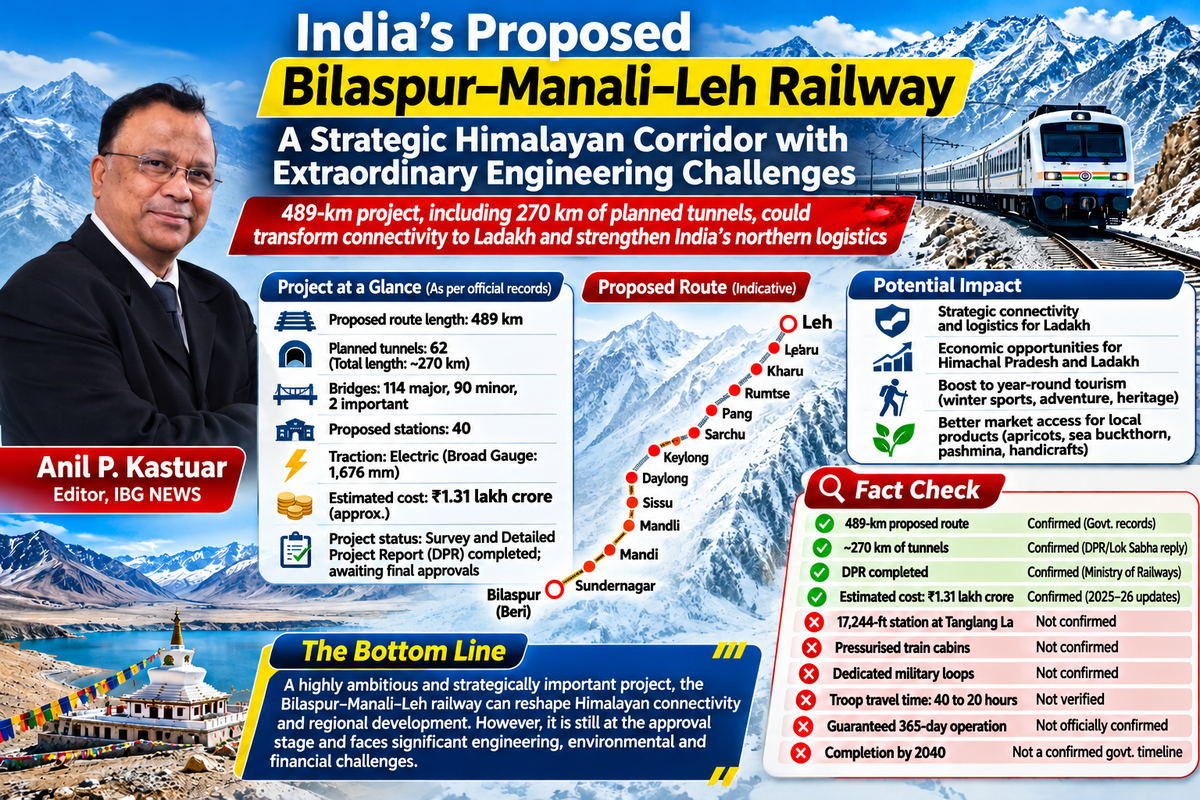

India’s Proposed Bilaspur–Manali–Leh Railway: A Strategic Himalayan Corridor with Extraordinary Engineering Challenges
489-km railway project, including 270 km of planned tunnels, could transform connectivity to Ladakh and strengthen India’s northern logistics network
By Anil P. Kastuar | Editor, IBG NEWS
India’s proposed Bilaspur–Manali–Leh railway project is emerging as one of the country’s most ambitious strategic infrastructure proposals. Planned across the challenging Himalayan terrain of Himachal Pradesh and Ladakh, the 489-kilometre broad-gauge railway is intended to connect the Indian railway network with Leh, opening up new possibilities for civilian transportation, regional development and strategic logistics.
The Ministry of Defence has identified the railway as a strategic project. The Ministry of Railways has confirmed that the survey has been completed and a Detailed Project Report (DPR) prepared. However, the project is still awaiting the necessary approvals and sanction before construction of the full corridor can proceed.
According to the Ministry of Railways, the estimated project cost is approximately ₹1.31 lakh crore, with around 270 kilometres of the proposed route planned through tunnels. The scale of investment and the extraordinary engineering requirements underline both the strategic importance and the complexity of the undertaking.
A railway through the heart of the Himalayas
The proposed railway will begin from the Beri area near Bilaspur and pass through several important locations in Himachal Pradesh before entering Ladakh and terminating at Leh.
The alignment identified in the official project documents includes:
- Beri
- Sundernagar
- Mandi
- Manali
- Sissu
- Darcha
- Keylong
- Sarchu
- Pang
- Rumtse
- Upshi
- Kharu
- Leh
The proposed corridor is expected to improve access to remote Himalayan settlements and connect important towns that currently depend heavily on road transport.
The route will cross difficult geological formations, high-altitude landscapes and environmentally sensitive mountain regions. The extensive tunnelling requirement reflects the engineering challenges involved in building a railway through this terrain.
The scale of the engineering challenge
The official Detailed Project Report, as presented in a Lok Sabha reply in July 2023, outlined a substantial engineering programme.
The proposed railway includes:
- Total route length: 489 kilometres
- Broad-gauge track: 1,676 mm
- Proposed stations: 40
- Proposed tunnels: 62
- Total tunnel length: approximately 270 kilometres
- Major bridges: 114
- Minor bridges: 90
- Important bridges: 2
- Proposed traction: Electric
- Estimated project cost in the 2023 DPR: ₹99,201.40 crore
The Ministry subsequently cited an anticipated DPR cost of ₹1.31 lakh crore in its December 2025 and March 2026 updates.
The difference between the earlier and later estimates highlights the importance of updated project costing for a technically complex undertaking. The final cost will depend on approvals, detailed assessments and implementation conditions.
The railway will require advanced tunnelling methods, specialised construction planning, geological monitoring and robust safety systems. The Himalayan region is vulnerable to earthquakes, landslides, extreme weather and difficult ground conditions. These factors will have to be addressed through detailed engineering and operational planning.
Strategic significance for India’s northern frontier
The proposed railway is important not only as a passenger and commercial transport corridor but also because of its strategic location.
Ladakh occupies a sensitive position along India’s northern frontier. Maintaining reliable connectivity to the region is a major national priority, particularly during periods when severe winter conditions restrict road movement.
The existing road network, including the Manali–Leh route, faces seasonal weather disruptions. A railway designed for reliable operation in challenging conditions could provide an additional transport option for essential supplies, equipment and personnel.
The Ministry of Defence’s identification of the project as a strategic railway line reflects its importance beyond ordinary passenger transportation.
A functioning railway could potentially strengthen logistical resilience, reduce dependence on a limited number of road corridors and improve the movement of goods into remote areas.
However, specific claims about troop deployment times, dedicated military loading loops, military station facilities or guaranteed year-round movement have not been established by the official project information reviewed. These should not be treated as confirmed features until the relevant authorities publish details.
Connecting Ladakh with wider economic opportunities
The railway could also become an important driver of economic development in Himachal Pradesh and Ladakh.
Reliable rail access may help local producers transport agricultural and specialised regional products to larger markets. Ladakh’s apricots, sea buckthorn products, pashmina and handicrafts could benefit from improved logistics if suitable freight facilities and commercial services are developed.
Tourism could be another major beneficiary.
Ladakh attracts visitors because of its landscapes, monasteries, cultural heritage and adventure tourism opportunities. Improved connectivity could make travel more accessible to domestic tourists and support local businesses, hotels, transport operators and service providers.
The possibility of more reliable winter access could create new opportunities for tourism beyond the traditional peak season. However, the actual benefits will depend on the railway’s eventual operating capacity, weather resilience, passenger services and environmental safeguards.
Development must also protect Ladakh’s fragile ecology, water resources and cultural heritage. Infrastructure expansion should be accompanied by responsible tourism policies and meaningful participation by local communities.
The Bhanupalli–Bilaspur–Beri connection: An important but separate development
An important part of the wider railway connectivity effort is the 63-kilometre Bhanupalli–Bilaspur–Beri new railway line in Himachal Pradesh.
This project is sanctioned and under construction. It is relevant to the proposed extension towards Manali and Leh, but it should not be confused with the full 489-kilometre strategic railway, which remains at the DPR and approval stage.
According to the Ministry of Railways’ update published on 13 March 2026:
- The project requires approximately 124 hectares of land.
- Around 82 hectares had been provided by the Himachal Pradesh Government.
- Fifteen of the 16 planned tunnels had been completed.
- Ten of the 27 major bridges had been completed.
- Work was continuing on the remaining structures and stations.
- Land availability and the State Government’s financial commitments were affecting progress.
The project has an approved detailed estimate of ₹6,753 crore, including land costs.
These figures demonstrate that the feeder railway is progressing, although important construction and land-related challenges remain.
Why the ₹1.31 lakh crore proposal requires careful planning
The proposed Bilaspur–Manali–Leh corridor represents a substantial public investment. Its economic and strategic benefits must therefore be assessed alongside its financial and environmental costs.
The key challenges include:
Geological uncertainty: Himalayan rock formations and ground conditions can create major difficulties during tunnelling and construction.
Environmental protection: The alignment passes through ecologically sensitive mountain regions. Forest, environmental and other statutory clearances will be essential.
Land acquisition: Land availability and coordination with State and local authorities will influence implementation.
Financial viability: The project will require a detailed assessment of passenger demand, freight potential, maintenance costs and long-term operating requirements.
Operational safety: Extreme altitude, low temperatures, snow, seismic activity and difficult access conditions will require specialised railway systems and emergency-response arrangements.
Regional participation: Local communities must have a meaningful role in decisions affecting land, livelihoods, tourism and the environment.
Project status: DPR completed, final approval still awaited
The most important distinction in understanding the project is the difference between a completed DPR and an approved construction project.
In its official communication dated 13 March 2026, the Ministry of Railways confirmed that the survey and Detailed Project Report for the 489-kilometre Bilaspur–Manali–Leh railway had been completed.
The Ministry also explained that sanctioning a railway project involves several considerations, including traffic projections, economic returns, connectivity requirements, socio-economic benefits, availability of funds and consultations with relevant authorities.
The project will require the necessary appraisals and approvals from stakeholders, including the Ministry of Finance and Ministry of Defence.
The government has not established a confirmed completion date for the entire Bilaspur–Manali–Leh railway in the official updates reviewed. Consequently, proposed dates such as 2040 should not be presented as an approved government deadline.
A long-term investment in India’s Himalayan future
The Bilaspur–Manali–Leh railway has the potential to become a transformative infrastructure corridor for northern India. It could improve connectivity to Ladakh, strengthen logistics, support regional commerce and create new opportunities for tourism and employment.
Its strategic importance is equally significant. In a region where geography and weather can influence national logistics, an additional reliable transport network could strengthen India’s long-term infrastructure resilience.
Yet the project’s success will depend on more than political intent or engineering ambition. It will require transparent financial planning, rigorous geological assessment, environmental responsibility, timely clearances and sustained coordination between the Union Government and the States.
India has demonstrated its capacity to execute challenging railway projects in mountainous terrain. The proposed Himalayan corridor will demand an even higher level of engineering precision, institutional coordination and long-term commitment.
The Bilaspur–Manali–Leh railway is not yet a completed strategic achievement; it is an ambitious national proposal with the potential to reshape Himalayan connectivity. Its real success will be measured by whether India can convert the completed project planning into a safe, financially responsible, environmentally sustainable and operationally reliable railway link to Ladakh.
By Anil P. Kastuar
Editor, IBG NEWS

