





RSS is Not an Adversary of Muslims, but a Partner in Nation-Building: The Need for Trust, Dialogue and Shared National Identity
From Mohan Bhagwat’s Outreach to Narendra Modi’s Inclusive Vision: Why Hindu-Muslim Dialogue Must Move Beyond Intellectual Circles and Reach the Grassroots and the Last Person
By Prof. Jasim Mohammad
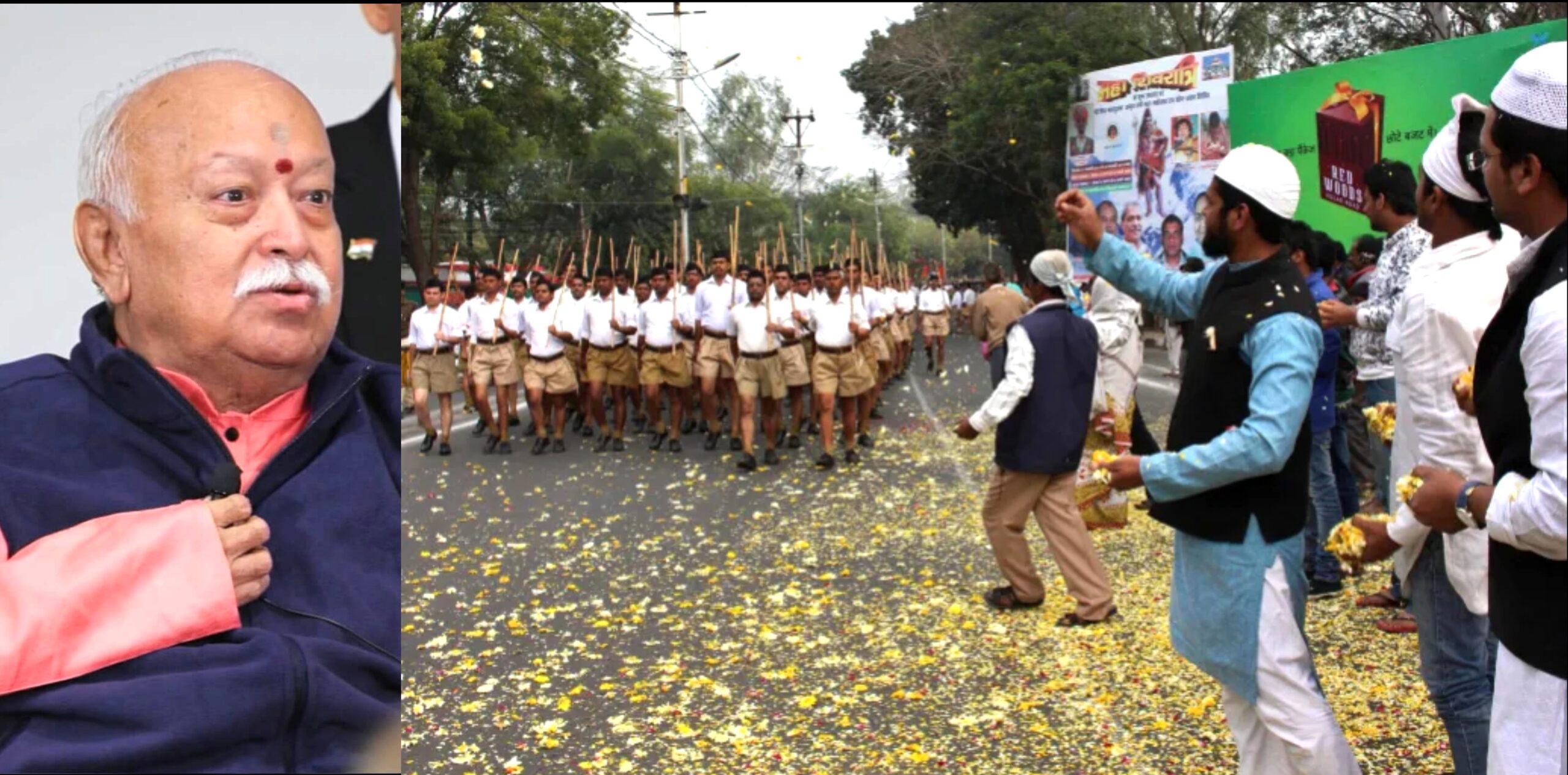
India’s national unity, cultural diversity and social harmony cannot be meaningfully discussed without examining the relationship between its different communities and influential social organisations. Among these, the Rashtriya Swayamsevak Sangh (RSS) occupies a significant position. For decades, sections of the Indian Muslim community have viewed the organisation with apprehension, shaped by historical experiences, political perceptions and competing ideological narratives. However, a closer examination of the public statements of RSS chief Dr Mohan Bhagwat reveals an important dimension that deserves greater attention: the possibility of dialogue, coexistence and a shared national identity.
In September 2018, addressing an audience in Delhi, Bhagwat made a significant observation: “Hindu Rashtra does not mean there is no place for Muslims. The day it is said that Muslims are not wanted here, that day it will cease to be Hindutva.” This statement was important because it sought to distinguish the idea of Hindutva, as articulated by him, from the exclusion of Muslims from India’s national life.
In January 2023, Dr Bhagwat reiterated that Muslims in India had no reason to fear and could practise their religion freely. In August 2025, he conveyed that Muslims should not harbour the apprehension that living together with others would threaten their Islamic faith. In November 2025, he also emphasised that Muslims should not be viewed as a homogeneous group and that engagement with individuals who hold constructive and positive views was important.
These observations deserve consideration because they encourage an approach based on individual engagement rather than collective suspicion. An important development in this direction was Bhagwat’s meeting with a delegation of Muslim intellectuals in September 2022. The delegation included former Chief Election Commissioner Dr S.Y. Quraishi and other distinguished members of the community. Such interactions demonstrated that difficult questions could be addressed through conversation rather than confrontation.
The Larger National Vision: Sabka Saath, Sabka Vikas. The broader philosophy of inclusive nation-building is also reflected in Prime Minister Narendra Modi’s guiding principle of Sabka Saath, Sabka Vikas, Sabka Vishwas, Sabka Prayas — collective participation, development, trust and effort. Addressing Aligarh Muslim University’s centenary celebrations in December 2020, the Prime Minister emphasised that the benefits of development should reach every citizen without discrimination. No individual should have their opportunities restricted because of their religious identity.
Nation-building cannot be the responsibility of one community alone. Education, healthcare, social welfare, environmental protection, disaster relief and national integration require the participation of every section of society. Indian Muslims, with their rich historical, cultural and intellectual contributions, have an equally important role in shaping India’s future.
In November 2025, addressing a gathering in Bengaluru, Bhagwat also spoke about the participation of people from different religious backgrounds in the Sangh’s activities, emphasising their common national identity as children of Bharat Mata. Such statements provide an opportunity to explore avenues for greater social interaction and cooperation.
From Elite Conversations to Grassroots Engagement; However, an important limitation must be acknowledged. Much of the interaction between the RSS and Muslim representatives so far has remained concentrated among intellectuals, academics, prominent personalities and individuals associated with selected organisations. While such engagement is valuable, it cannot, by itself, transform perceptions across the wider Muslim community.
The concerns, misconceptions, distrust and sense of distance surrounding the RSS are often more deeply rooted at the grassroots — in villages, blocks, small towns, neighbourhoods and Muslim-majority localities. These are the spaces where ordinary people form their perceptions through everyday experiences, local interactions and community conversations. Consequently, dialogue confined to drawing rooms, conferences and meetings with prominent personalities cannot adequately address the challenge.
The RSS must therefore expand its outreach beyond established intellectual circles and make sustained efforts to connect directly with ordinary Muslims. Village-level meetings, neighbourhood interactions, community visits, educational initiatives and joint social-service programmes could provide meaningful opportunities to build mutual confidence.
Equally important, the RSS should reach beyond organisations established, supported or funded by its own network and engage with voluntary organisations and civil society institutions across the country, irrespective of their ideological backgrounds. Genuine national integration requires openness to working with people and institutions that may hold different perspectives but share a commitment to social welfare and national development.
Unless dialogue reaches the last person in the community, mutual distrust and social distance will remain difficult to overcome. The real measure of successful engagement will not be the number of prominent personalities participating in meetings, but the extent to which ordinary citizens begin to interact with one another with confidence and mutual respect.
A Reciprocal Responsibility; I believe Indian Muslims should approach the RSS with an open mind, a willingness to understand its philosophy and the confidence to engage critically with its ideas. Disagreement with an organisation is legitimate, and its positions can certainly be questioned. However, permanently defining an institution as an adversary without meaningful interaction does little to advance social understanding.
At the same time, the RSS has an equally important responsibility. It must demonstrate sensitivity towards the religious sentiments, constitutional rights and legitimate concerns of Muslims. Trust cannot be built through statements alone; it must be reflected in consistent conduct, meaningful participation and equal respect.
Muslim patriotism, their contribution to Indian civilisation and their role in the freedom movement and the making of modern India need no validation. From former President Dr A.P.J. Abdul Kalam and freedom fighter Ashfaqulla Khan to Param Vir Chakra recipient Company Quartermaster Havildar Abdul Hamid, India’s national heritage is enriched by Muslim contributions. These personalities represent a shared inheritance that belongs to every Indian.
I appeal to Indian grass roots Muslims to come forward, understand the RSS through direct interaction, meet its volunteers and participate in programmes serving the wider community. Similarly, the RSS must make a conscious effort to extend its engagement beyond a limited circle and establish meaningful connections with Muslims at the grassroots.
India cannot be complete without Hindus, nor can it be complete without Muslims. Our future lies not in confrontation, but in trust, mutual respect and shared responsibility. Building a constructive relationship between the RSS and the Muslim community is therefore not merely an organisational or inter-community concern; it is a national imperative for creating a developed, harmonious and self-reliant India. The journey towards Viksit Bharat 2047 must be a collective journey, in which every Indian feels respected, represented and equally responsible for the nation’s future.
(The author is an educationist and Principal Adviser to the Institute for Islamic and Cross Cultural Studies (IICS). He can be contacted at [email protected] )
–
Professor (Dr.) Jasim Mohammad
Served As:-
-Head & Group Editor, Roznama Rashtriya Sahara (National Urdu Daily)
– Editor in Chief , Aalami Sahara TV at Sahara News Network
-Bureau Chief, The Daily Pioneer (English & Hindi)
-Media Advisor, Aligarh Muslim University (AMU)