











The question of an independent Balochistan is highly political and speculative. Different analysts, governments, and scholars see very different outcomes—some positive, some negative. So the most balanced way to answer is to outline potential positive impacts on world politics if a peaceful, stable, and internationally recognized Baloch state were to emerge.
Possible positive impacts on world politics
1. Greater regional stability if handled peacefully

If independence occurred through negotiation rather than conflict, it could:
- Reduce long-running insurgency and military tensions in the region.
- Lower friction between local populations and central authorities.
- Encourage negotiated settlements in other long-running conflicts.
A peaceful resolution model would be closely watched globally as a case study in conflict resolution and self-determination.
2. Strategic trade and connectivity opportunities
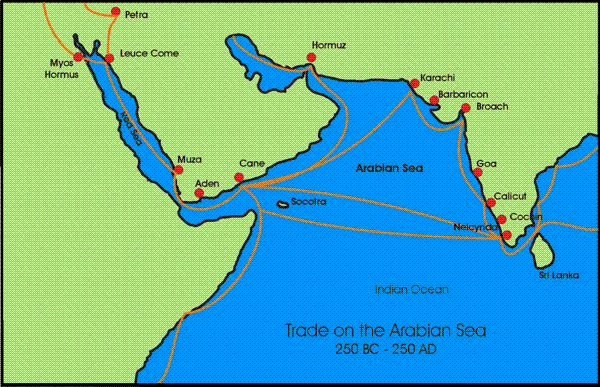
Balochistan sits on the Arabian Sea and near key energy routes. A stable independent state could:
- Open new trade corridors between South Asia, Central Asia, and the Middle East.
- Potentially provide alternative port access for landlocked regions (e.g., parts of Central Asia).
- Attract global shipping and logistics investment if governance is stable.
Ports like Gwadar could become neutral commercial hubs rather than geopolitical flashpoints.
3. Energy security diversification
The region is believed to hold natural gas, minerals, and possible offshore energy resources. If developed transparently:
- It could diversify global energy supply chains.
- Offer new partners to countries seeking alternatives to existing energy dependencies.
- Create investment opportunities in mining, LNG, and renewables.
This would matter especially for Asian energy markets.
4. Shift in great-power competition dynamics
Currently, Balochistan is geopolitically significant because of:
- China–Pakistan Economic Corridor (CPEC)
- Proximity to Iran and the Strait of Hormuz
- Indian Ocean naval routes
An independent, neutral Balochistan could:
- Become a buffer state, reducing direct rivalry in some areas.
- Offer a new diplomatic actor in regional forums.
- Potentially rebalance influence among China, the U.S., the Gulf states, India, and Iran.
Whether this stabilizes or complicates geopolitics would depend heavily on the new state’s foreign policy.
5. Human rights and governance precedent (best-case scenario)
If independence resulted in:
- Democratic governance
- Resource-sharing with local populations
- Protection of minority rights
It could strengthen global norms around:
- Self-determination
- Federalism vs secession debates
- Indigenous and regional autonomy movements
This would only be seen as positive if the new state were stable and rights-respecting.
Important caveats
Even analysts who support independence acknowledge major risks:
- Possible regional conflict during transition
- Economic fragility of a new state
- Rival power competition over ports and resources
- Internal political fragmentation
So the positive global impact depends entirely on how independence happens:
- Peaceful, negotiated, internationally recognized → potential stabilizing effects
- Violent, contested, or proxy-driven → destabilizing effects
A negotiated conflict-resolution model for a place like Balochistan (or any long-running territorial conflict) has to balance three things:
- security and stability,
- political self-determination, and
- economic viability.
Below is a practical, phased model drawn from real-world precedents such as the Good Friday Agreement (Northern Ireland), the Comprehensive Peace Agreement, and Aceh’s peace process in Indonesia.
A Negotiated Conflict-Resolution Model
Phase 1 — Pre-Negotiation Confidence Building
Goal: Create enough trust for talks to begin.
Key steps
- Mutual ceasefire or de-escalation agreement.
- Release of non-violent political detainees.
- End to large-scale military operations in civilian areas.
- International or neutral observers to verify compliance.
- Safe passage for negotiators and diaspora leaders.
Why this matters:
No political solution is possible if violence continues.
Confidence-building measures reduce fear and prevent spoilers from derailing talks.
Phase 2 — Framework Agreement
Goal: Agree on what is being negotiated.
Parties would sign a Framework for Political Dialogue covering:
- Recognition of grievances (political, economic, cultural).
- Agreement that the dispute will be resolved peacefully.
- Commitment to respect human rights during talks.
- Acceptance of neutral mediation (UN, neutral states, or regional bodies).
Core principle:
“Nothing is agreed until everything is agreed.”
This prevents partial deals from collapsing later.
Phase 3 — Interim Autonomy & Governance Arrangements
Goal: Test coexistence and reduce conflict incentives.
Possible interim measures:
- Expanded provincial autonomy or self-rule.
- Local control over natural resources and revenues.
- Joint security mechanisms (local + national forces).
- Cultural and language protections.
- Elected regional assembly with real powers.
Why interim arrangements help
They allow:
- A “trial period” for political solutions.
- Economic improvements that reduce support for violence.
- Time to build institutions.
Phase 4 — Final Status Negotiation
This is the most sensitive stage.
Options typically negotiated:
- Enhanced federal autonomy
- Confederation
- Long-term self-rule within a state
- Independence (often with a referendum)
- Special international guarantees
Referendum model (if agreed)
- Voter rolls verified by neutral observers.
- Campaign period with equal media access.
- Clear options on the ballot.
- International monitoring.
Key rule:
Both sides must agree in advance to respect the outcome.
Phase 5 — Economic & Resource Settlement

Conflicts often persist because of resource control.
A settlement should include:
- Revenue-sharing formula for gas, minerals, ports.
- Development fund for local communities.
- Infrastructure investment plan.
- Jobs and education guarantees.
- International development support.
Economic inclusion is essential for durable peace.
Phase 6 — Security Transition
Goal: Prevent relapse into violence.
Measures:
- Gradual demilitarization.
- Integration of former fighters into security or civilian life.
- International peace monitors (temporary).
- Disarmament, demobilization, reintegration (DDR) programs.
- Border and policing arrangements.
This phase is often the most fragile.
Phase 7 — International Guarantees
Successful agreements usually include external guarantees.
Possible guarantors:
- United Nations
- Neutral states
- Regional organizations
- Multilateral development banks
They can:
- Monitor compliance
- Provide economic aid
- Act as mediators if disputes re-emerge
Core Principles for Success
1. Inclusivity
Include:
- Tribal leaders
- Political parties
- Women and civil society
- Diaspora representatives
Excluding groups creates spoilers.
2. Gradualism
Avoid “all-or-nothing” outcomes.
Step-by-step arrangements build trust.
3. Economic incentives
Peace must deliver visible benefits:
- Jobs
- Infrastructure
- Revenue transparency
4. Neutral mediation
Third-party mediators reduce mistrust.
5. Security guarantees
All sides must feel physically safe during transition.
Risks to anticipate
Even with a strong model:
- Hardliners may reject compromise.
- External powers may compete for influence.
- Economic instability can undermine peace.
- Fragmented leadership can stall talks.
Mitigation requires sustained diplomacy and funding.
Simplified Model Flow
Ceasefire → Framework Agreement → Interim Autonomy → Final Status Talks → Referendum or Settlement → Security Transition → Economic Development → Long-term Guarantees
Bottom line
A negotiated resolution is most likely to succeed if it:
- Starts with trust-building
- Moves gradually
- Shares resources fairly
- Includes international guarantees
- Lets people decide their political future peacefully
Only, fact remains till, Balocihistan gets her freedom is injustice to humanity under the international community being ignorant. A beautiful section of the oldest civilization will continue to suffer because of the conflict that imposed in the region.
With present armed struggle against illegal occupire Pakistani army people of Balochistan desparate to achive freedom soon and world can not live with closed eyes to the urge for the freedom.