










Famous Buddhist Physicians in History: Healing, Compassion and the Legacy of Buddhist Medicine
By Suman Munshi IBG NEWS Research Desk
Introduction
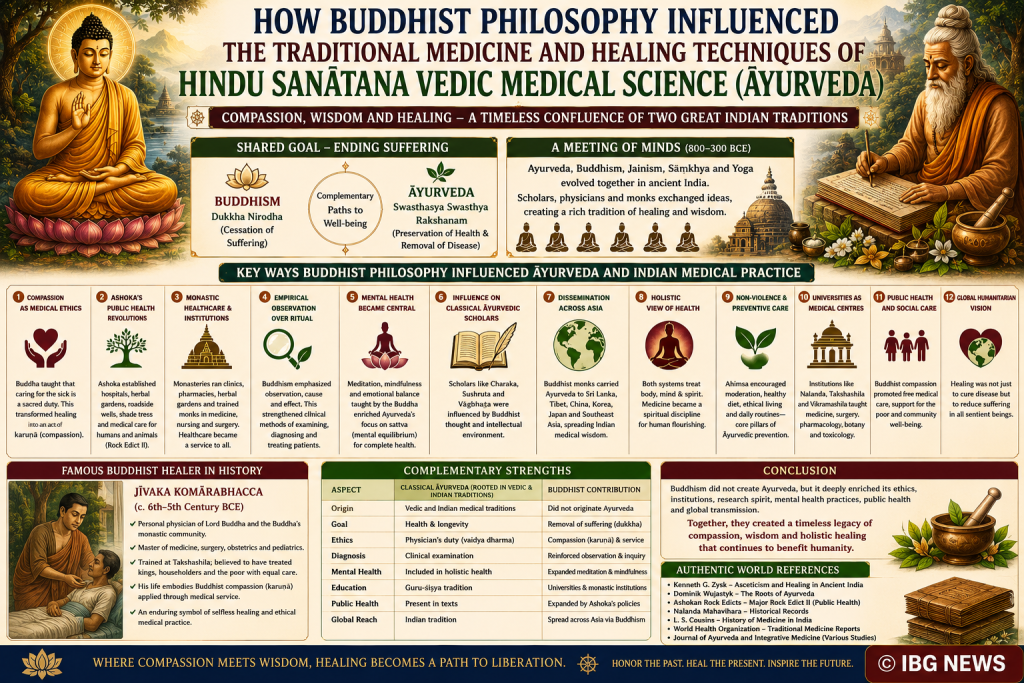
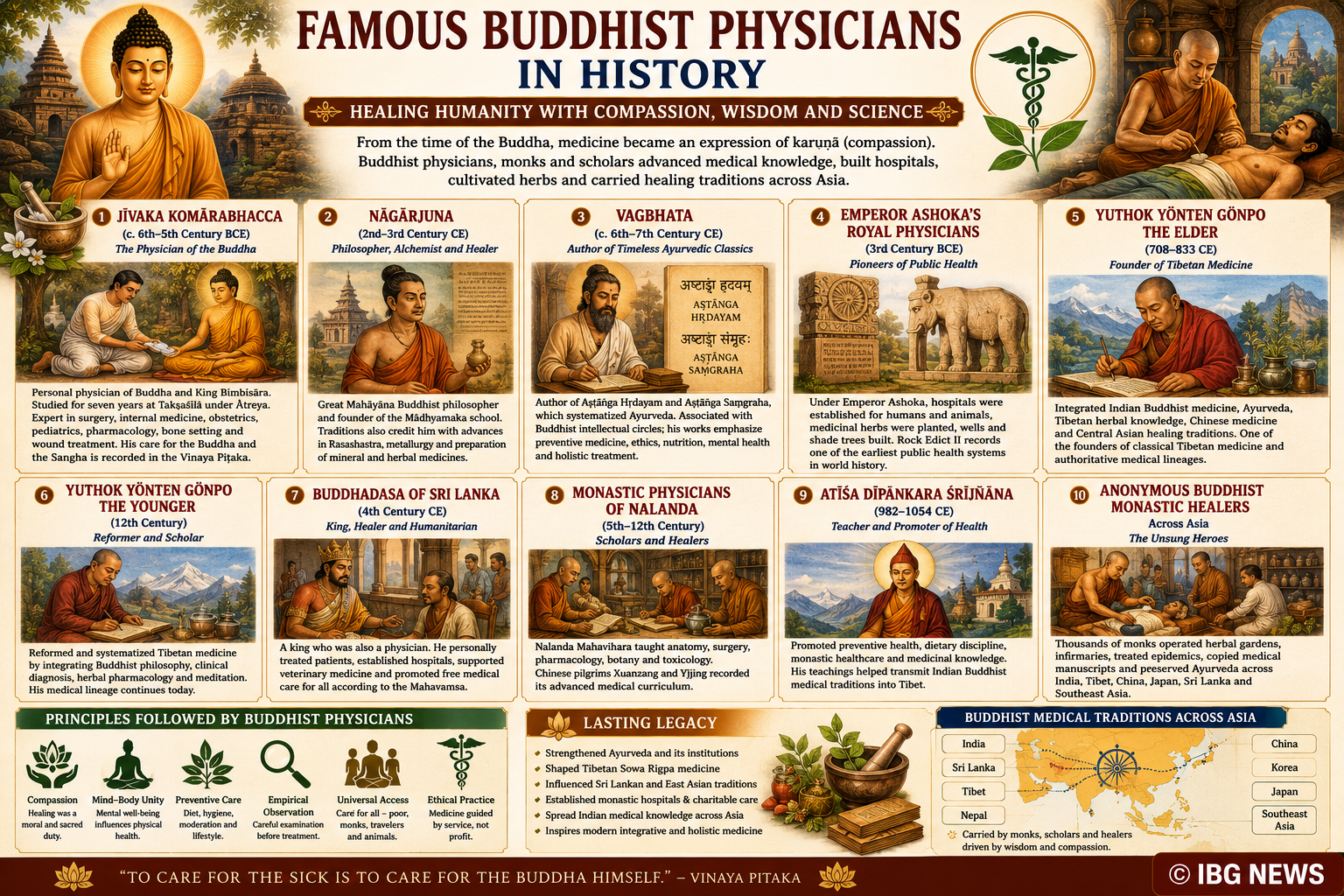
The history of Buddhism is not only a story of philosophy, meditation, and spiritual enlightenment—it is also a remarkable history of healing. From the time of the Buddha in the 6th century BCE, medicine became an essential expression of karuṇā (compassion). Buddhist monks established hospitals, cultivated medicinal herbs, documented therapeutic knowledge, and carried Indian medical traditions across Asia.
Among the many physicians associated with Buddhism, several stand out for their extraordinary contributions to medicine, surgery, pharmacology, and public health. Their legacy continues to influence traditional medicine in India, Sri Lanka, Tibet, China, Japan, and Southeast Asia.
1. Jīvaka Komārabhacca (c. 6th–5th Century BCE)
The Physician of the Buddha


No physician in Buddhist history is more celebrated than Jīvaka Komārabhacca (Pali: Jīvaka Komārabhacca; Sanskrit: Jīvaka Kumārabhṛtya).
He was the personal physician of Gautama Buddha, King Bimbisāra of Magadha, and later served the Buddhist monastic community (Sangha).
According to the Vinaya Piṭaka, Jīvaka was abandoned as an infant and later adopted by Prince Abhaya. He studied medicine for seven years at the renowned university of Takṣaśilā (Taxila) under the celebrated teacher Ātreya, one of the great names associated with ancient Indian medicine.
Medical Achievements
Historical Buddhist texts credit Jīvaka with remarkable medical expertise, including:
- Surgery
- Internal medicine
- Obstetrics
- Pediatrics
- Herbal pharmacology
- Bone treatment
- Wound management
The Jīvaka Sutta and Vinaya literature describe him performing surgical procedures, treating severe illnesses, and preparing herbal medicines.
Although some accounts contain legendary elements, historians widely regard Jīvaka as one of the earliest historically identifiable physicians in South Asia.
2. Nāgārjuna (2nd–3rd Century CE)


The great Buddhist philosopher Nāgārjuna is primarily known as the founder of the Mādhyamaka school of Mahāyāna Buddhism.
Several later traditions also associate him with:
- Medicine
- Alchemy
- Metallurgy
- Pharmaceutical preparations
While historians distinguish between the philosopher Nāgārjuna and later figures bearing the same name, Buddhist and Ayurvedic traditions credit “Nāgārjuna” with advances in Rasashastra, particularly the preparation of mineral and metallic medicines.
3. Vagbhata (c. 6th–7th Century CE)
Although remembered primarily as one of Ayurveda’s greatest scholars, many historians believe Vagbhata lived within a Buddhist intellectual environment, and some traditions identify him as a Buddhist.
His two masterpieces remain among Ayurveda’s most influential texts:
- Aṣṭāṅga Hṛdayam
- Aṣṭāṅga Saṃgraha
These books synthesized earlier medical knowledge and emphasized:
- Preventive medicine
- Ethics
- Nutrition
- Mental health
- Daily routines
- Holistic treatment
Whether or not Vagbhata was personally Buddhist, his work reflects the close interaction between Buddhist scholarship and classical Ayurveda.
4. Emperor Ashoka’s Royal Physicians
Although their individual names are largely unknown, the physicians working under Emperor Ashoka (3rd century BCE) transformed healthcare in India.
Ashoka’s Rock Edict II records:
- Establishment of medical treatment for humans
- Veterinary hospitals
- Planting of medicinal herbs
- Public wells
- Roadside trees
These measures represent one of the earliest documented public health initiatives in world history.
5. Yuthok Yönten Gönpo (708–833 CE)
One of Tibet’s greatest physicians,
Yuthok Yönten Gönpo the Elder
integrated:
- Indian Buddhist medicine
- Ayurveda
- Tibetan herbal traditions
- Chinese medicine
- Central Asian knowledge
He is regarded as one of the founders of classical Tibetan medicine.
His work eventually influenced the famous medical treatise:
The Four Medical Tantras (Gyüshi)
6. Yuthok Yönten Gönpo the Younger (12th Century)
Several centuries later,
Yuthok Yönten Gönpo the Younger
reformed Tibetan medicine by integrating:
- Buddhist philosophy
- Clinical diagnosis
- Meditation
- Herbal pharmacology
- Spiritual healing
His medical lineage continues today in Tibetan medical institutions.
7. Buddhadasa of Sri Lanka (4th Century CE)
King Buddhadasa of Sri Lanka was both ruler and physician.
According to the Mahavamsa, he:
- personally treated patients
- established hospitals
- supported veterinary medicine
- promoted free medical care
Sri Lankan chronicles describe him treating both humans and animals, making him one of the earliest physician-kings in recorded history.
8. Monastic Physicians of Nalanda
The great Buddhist university of Nalanda produced numerous unnamed physicians who studied:
- Anatomy
- Pharmacology
- Surgery
- Toxicology
- Botany
- Nutrition
Chinese pilgrims Xuanzang and Yijing recorded that medicine formed an important part of Nalanda’s curriculum, helping disseminate Indian medical knowledge throughout Asia.
9. Atīśa Dīpaṅkara Śrījñāna (982–1054 CE)
Although primarily remembered as a Buddhist master, Atīśa also promoted:
- preventive health
- dietary discipline
- monastic healthcare
- medicinal knowledge
His teachings helped transmit Indian Buddhist medical traditions into Tibet.
10. Anonymous Buddhist Monastic Healers
Perhaps the greatest contribution came not from famous individuals but from thousands of anonymous monks.
Across India, Sri Lanka, Nepal, Tibet, China, Korea, Japan, Myanmar and Southeast Asia they:
- operated herbal gardens
- established infirmaries
- treated epidemics
- copied medical manuscripts
- trained healers
- preserved Ayurvedic knowledge
Without them, much of India’s medical heritage may never have spread across Asia.
Principles Shared by Buddhist Physicians
These physicians generally emphasized:
- Compassion (Karuṇā): Healing as a moral duty.
- Mind–Body Unity: Mental well-being influences physical health.
- Preventive Care: Diet, hygiene, moderation, and lifestyle to prevent illness.
- Empirical Observation: Careful examination before treatment.
- Universal Access: Medical care for the poor, travelers, monks, and laypeople.
- Ethical Practice: Medicine guided by service rather than profit.
Lasting Legacy
The influence of Buddhist physicians extends far beyond monasteries. Their work helped shape:
- Ayurveda in its institutional development
- Tibetan Sowa Rigpa medicine
- Sri Lankan traditional medicine
- East Asian Buddhist medical traditions
- Monastic hospitals and charitable healthcare
- The ethical ideal of compassionate medicine
The story of Buddhist medicine demonstrates that healing was viewed not merely as a technical profession but as a profound act of compassion. Figures such as Jīvaka Komārabhacca, Vagbhata, the physician-scholars of Nalanda, Yuthok Yönten Gönpo, and King Buddhadasa exemplify a tradition in which medical knowledge, ethical conduct, and the relief of suffering were inseparable. Their contributions continue to inspire healthcare professionals and scholars studying the history of medicine and the enduring dialogue between Buddhism and the Indian knowledge systems.