













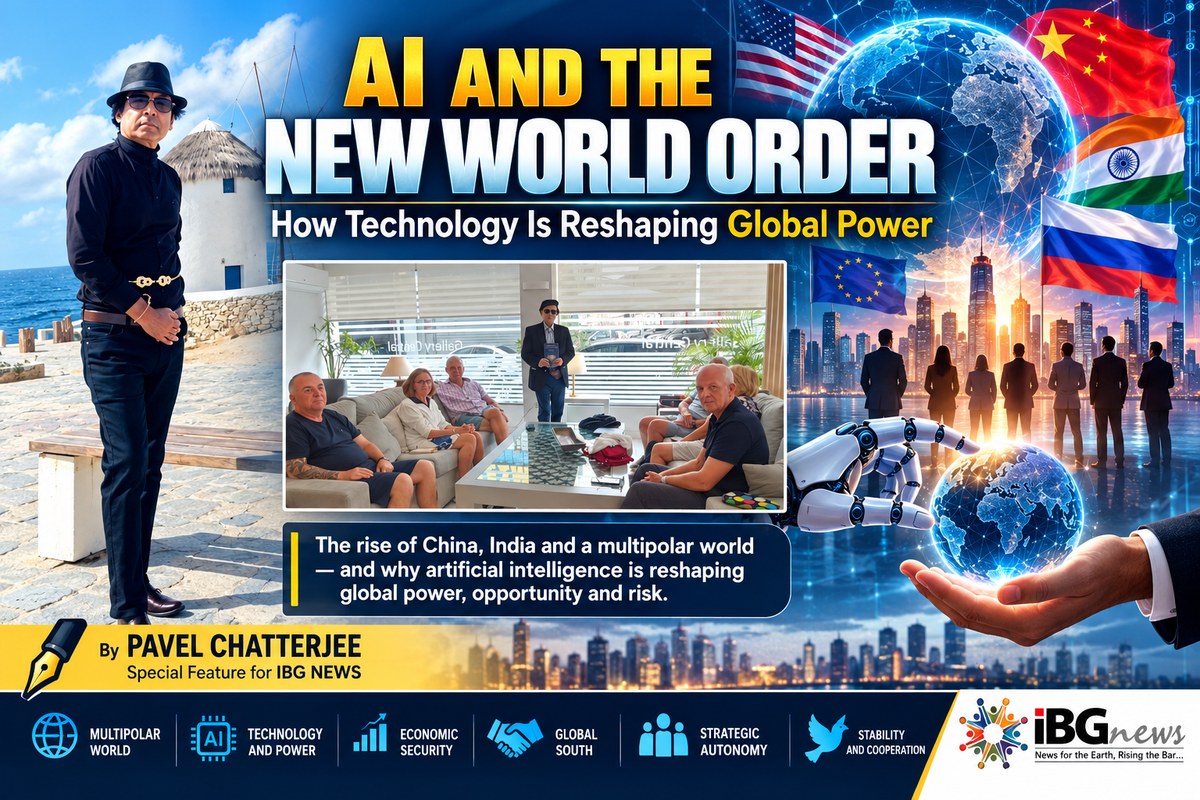
AI and the New World Order: How Technology Is Reshaping Global Power
The rise of China, India’s strategic autonomy, and the growing influence of artificial intelligence are transforming international relations, creating new opportunities and risks for global stability.
By Pavel Chatterjee | Special Feature for IBG NEWS
LISBON, PORTUGAL: The global balance of power is undergoing a significant transformation. Economic competition, geopolitical rivalries, emerging technologies, and shifting international alliances are challenging the traditional dominance of established powers. At the centre of this transition is artificial intelligence (AI), which is increasingly becoming a strategic asset capable of influencing economic growth, national security, scientific innovation, and international diplomacy.
The emerging world order is moving towards multipolarity, with influence distributed among several major powers and regional centres rather than concentrated in the hands of a single dominant country. China, India, Russia, the European Union, and countries across the Global South are contributing to this evolving landscape.
However, the transition is not simply about which country will become the next superpower. It is also about who will control critical technologies, shape global economic rules, secure essential resources, and determine how artificial intelligence is developed and deployed.
From a Unipolar Era to a Multipolar World
The end of the Cold War and the dissolution of the Soviet Union in 1991 established the United States as the predominant global power. Over subsequent decades, however, the rapid expansion of China’s economy, India’s growing international influence, Russia’s renewed geopolitical assertiveness, and Europe’s economic and regulatory strength have changed the distribution of global influence.
Today’s international system cannot be adequately explained through a simple contest between Washington and Beijing. Multiple countries possess different forms of power, including military capabilities, economic resources, technological expertise, energy supplies, and diplomatic influence.
This transition offers opportunities for greater representation in international decision-making. Yet, it also creates challenges as competing national interests complicate efforts to maintain peace and coordinate responses to global crises.
China, India and the Changing Strategic Landscape
China has become a major force in manufacturing, international trade, infrastructure development, and advanced technology. Its capabilities in electric vehicles, renewable energy, telecommunications, and artificial intelligence have strengthened its position in the global economy.
Through initiatives such as the Belt and Road Initiative, Beijing has also expanded its economic and infrastructure relationships across several regions. Nevertheless, competition with the United States over trade, advanced technology, maritime security, and regional influence remains a defining feature of contemporary geopolitics.
India, meanwhile, is emerging as an increasingly important independent centre of power. Its economic potential, technological capabilities, demographic scale, and strategic location give it growing international significance.
India’s engagement with platforms such as the G20, BRICS, and the Quad, alongside its relationships with the United States, Russia, Europe, Japan, and other developing economies, illustrates its preference for maintaining strategic flexibility.
Rather than depending exclusively on a single geopolitical bloc, India seeks partnerships that support its economic development, national security, and technological progress.
This approach reflects a broader international trend towards strategic autonomy and diversified cooperation.
Russia continues to exercise influence through its military capabilities, nuclear arsenal, energy resources, and diplomatic relationships. Its war against Ukraine has intensified tensions with Western countries and contributed to changes in European security and energy policies.
The European Union represents another important centre of influence through its collective economic strength, regulatory frameworks, trade relationships, and technological policies. However, differences among its member states can complicate the development of a unified strategic approach.
Together, these developments demonstrate that global power is becoming more distributed, although substantial inequalities between countries remain.
The Global South Seeks a Greater Voice
Countries across Africa, Asia, Latin America, and the Middle East are seeking stronger representation in international institutions and a greater role in shaping global economic priorities.
Many want improved access to development finance, infrastructure investment, advanced technology, and international markets. They are also calling for reforms that better reflect contemporary economic and political realities.
Platforms such as BRICS provide opportunities to discuss economic cooperation, development finance, and institutional reform. However, their members have different national interests and political priorities, meaning that their cooperation should not automatically be interpreted as a unified opposition to Western countries.
Increasingly, states are building flexible partnerships according to their individual needs. A country may cooperate with one partner on defence, another on trade, and a third on energy or technology.
This network of overlapping relationships is likely to become a defining characteristic of the emerging multipolar order.
Artificial Intelligence: A New Instrument of Global Power
Artificial intelligence could become one of the most consequential determinants of future international influence.
AI is already being applied across scientific research, healthcare, agriculture, education, manufacturing, logistics, and public administration. Its potential to improve productivity and accelerate innovation could significantly influence national competitiveness.
Its strategic applications also extend to military intelligence, cybersecurity, surveillance, autonomous systems, and defence planning.
Consequently, a country’s AI capabilities will depend on more than the algorithms developed by its researchers. Access to advanced semiconductor chips, computing infrastructure, high-quality data, skilled professionals, reliable energy supplies, and substantial research investment will also be essential.
Countries capable of combining these resources may secure important economic and strategic advantages.
However, unequal access to AI infrastructure could create a new technological divide. Nations that depend heavily on foreign computing platforms, advanced chips, or external expertise may face additional vulnerabilities.
For developing countries, the challenge will be to adopt AI effectively while building domestic capabilities, strengthening education, supporting research, and reducing excessive technological dependence.
Smaller economies may also find opportunities by specialising in particular applications, developing skilled workforces, and using AI to improve public services and industrial productivity.
The emerging world could therefore become more multipolar politically while remaining highly concentrated technologically.
Economic Security, Supply Chains and Energy
Technology is only one component of the changing global balance. International trade, industrial production, financial systems, and energy security are equally important.
Governments and businesses are increasingly examining the risks associated with excessive dependence on individual suppliers or markets. Strategies such as nearshoring and friendshoring seek to diversify supply chains and reduce exposure to geopolitical disruption.
Semiconductor manufacturing, quantum computing, advanced robotics, space technology, and cybersecurity are also becoming important elements of national competitiveness.
Energy policy is closely connected to these developments. Renewable energy, battery manufacturing, nuclear power, and access to critical minerals influence both economic growth and strategic independence.
Meanwhile, some countries are exploring greater use of local currencies and alternative payment arrangements for international transactions. Nevertheless, the US dollar continues to play a central role in global finance, and any substantial change to the existing system is likely to be gradual.
These developments indicate that economic power increasingly depends on the ability to secure essential resources, develop advanced technologies, and maintain resilient production networks.
Can Multipolarity Deliver Greater Global Stability?
A more distributed international system could create opportunities for diplomatic negotiation, regional cooperation, and stronger representation for developing countries.
However, multipolarity does not automatically guarantee peace.
When several major powers possess significant military, economic, and technological capabilities, competition can intensify. Measures taken by one country to strengthen its security may be interpreted by another as a threat.
Disputes involving Ukraine, Taiwan, the South China Sea, critical minerals, energy routes, and advanced technologies illustrate how regional tensions can acquire wider international consequences.
AI introduces additional concerns involving cyber operations, surveillance, autonomous military systems, misinformation, and the potential misuse of powerful technologies.
Effective international cooperation will therefore be necessary to establish responsible AI practices, improve cybersecurity, manage strategic competition, and reduce the risk of unintended escalation.
Reforming global institutions is another important challenge. The United Nations Security Council, established after the Second World War, continues to reflect the geopolitical circumstances of that period. Calls for reform seek to make international decision-making more representative of contemporary economic and political realities.
Achieving meaningful reform, however, will require negotiations among countries with different interests and expectations.
Three Possible Futures for the World Order
The future of global power could develop along three broad paths.
Cooperative multipolarity: Major powers accept the legitimacy of one another’s interests, strengthen international institutions, and cooperate on shared challenges while managing strategic competition through diplomacy.
Competitive multipolarity: Countries intensify their rivalry over technology, markets, military influence, and critical resources. Cooperation continues in selected areas, but economic restrictions and strategic distrust increase.
Fragmented multipolarity: International cooperation weakens, competing economic blocs become more isolated, and countries increasingly prioritise national security over global coordination. Such a scenario could disrupt trade, weaken climate action, and raise the risks of conflict.
These possibilities are not mutually exclusive. Cooperation may continue in some sectors even as competition intensifies in others.
Artificial intelligence could influence which direction the world takes, depending on whether countries use it primarily to advance shared prosperity or to strengthen exclusive strategic advantages.
Conclusion: The Future Depends on How Power Is Used
The emerging international order is being shaped by the combined influence of economic change, geopolitical competition, technological innovation, and the growing diplomatic role of countries beyond the traditional centres of power.
Artificial intelligence adds a new dimension to this transformation. It offers opportunities to accelerate scientific progress, improve public services, strengthen productivity, and address complex global challenges. At the same time, unequal access to computing resources and the concentration of technological capabilities could create new forms of dependence.
For India and other emerging economies, the priority will be to strengthen domestic innovation, develop skilled talent, protect strategic interests, and participate actively in international cooperation.
The central question is no longer simply how many powerful countries will shape the world. It is whether they can exercise their influence responsibly.
Climate change, pandemics, nuclear risks, cyber threats, AI safety, and economic instability cannot be addressed effectively by individual countries acting alone.
A stable multipolar world will require mutual respect, credible international institutions, scientific collaboration, and mechanisms for resolving disputes peacefully.
The future of global power will ultimately depend not only on who possesses the most advanced technology or the greatest economic strength, but also on whether those capabilities are used to build cooperation or deepen divisions.
Source inspiration: Pavel Chatterjee’s original analysis, “The Transformation of Global Power and the Role of Artificial Intelligence in This Multi-Polar World,” published on Medium. This IBG NEWS feature has been independently restructured and rewritten for publication.
Pavel Chatterjee | IBG NEWS
Original Article Link of this author:

