











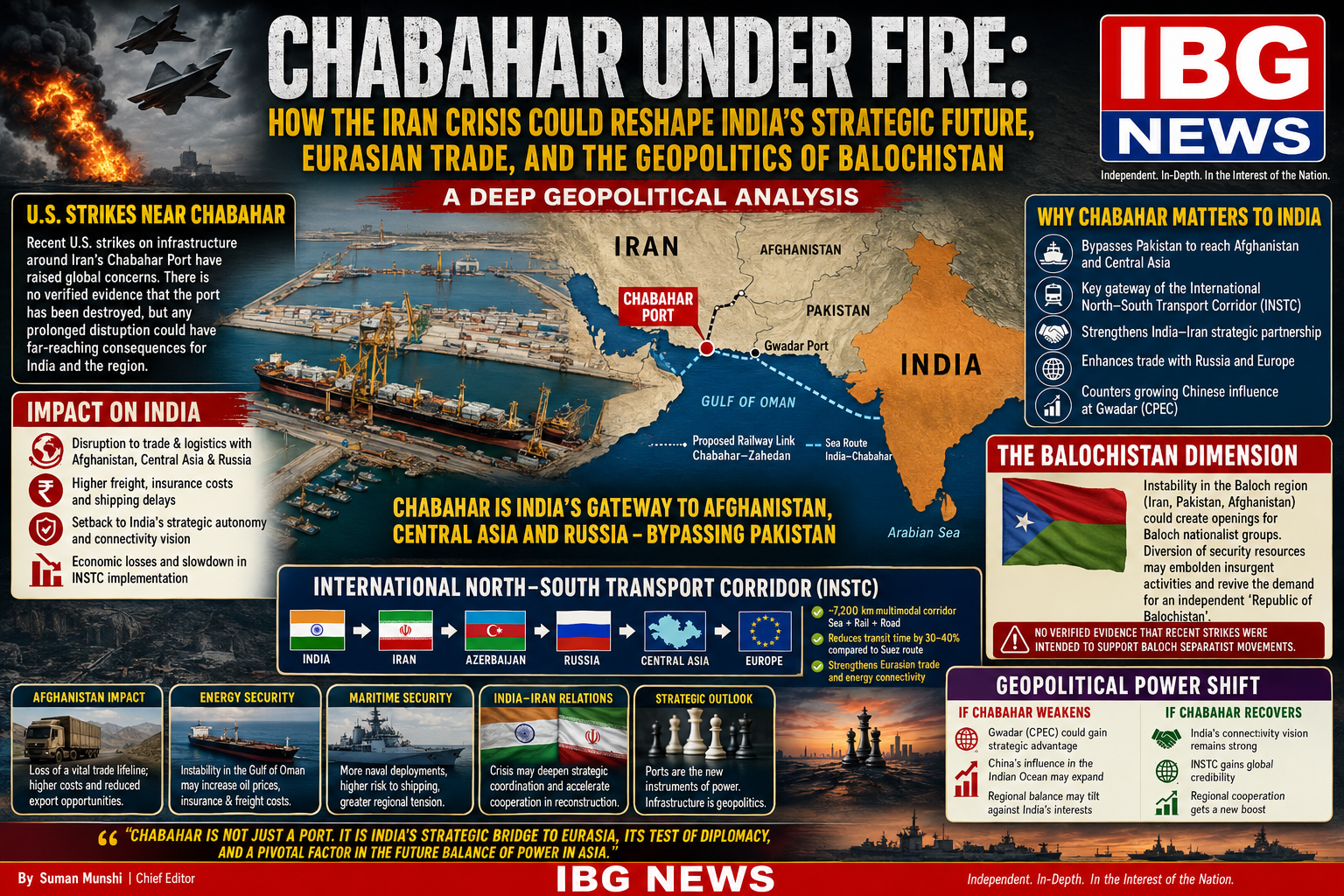
Chabahar Under Fire: How the Iran Crisis Could Reshape India’s Strategic Future, Eurasian Trade, and the Geopolitics of Balochistan
A Deep Geopolitical Analysis
By Suman Munshi | Chief Editor | IBG NEWS
New Delhi | July 9, 2026
The reported U.S. strikes around Iran’s Chabahar Port may prove to be one of the most consequential geopolitical developments in West Asia in recent years. Although there is no verified evidence that Chabahar Port has been completely destroyed or rendered permanently inoperable, attacks in and around the port region have raised serious concerns about the future of one of Asia’s most strategically important maritime gateways.
For India, Chabahar represents much more than a commercial port. It is a geopolitical instrument that underpins New Delhi’s access to Afghanistan, Central Asia and Russia, while supporting India’s broader objective of maintaining strategic autonomy. Any prolonged disruption would reverberate across the International North–South Transport Corridor (INSTC), regional connectivity, and the strategic balance in the northern Indian Ocean.
Chabahar: India’s Gateway Beyond Pakistan
For decades, India’s access to Afghanistan and Central Asia has been constrained by Pakistan’s refusal to permit overland transit. Chabahar, located on Iran’s southeastern coast along the Gulf of Oman, offered India a strategic alternative.
Developed with Indian investment and operated through India Ports Global Limited, Chabahar provides direct maritime access to Afghanistan and Central Asia while bypassing Pakistan. It is also a vital component of the International North–South Transport Corridor (INSTC), a multimodal network connecting India with Iran, the Caucasus, Russia and Europe.
Unlike Pakistan’s Gwadar Port—which is closely linked to China’s Belt and Road Initiative (BRI) and the China–Pakistan Economic Corridor (CPEC)—Chabahar has evolved as India’s principal connectivity project in West Asia.
Its importance is therefore measured not only in cargo volumes but in strategic leverage.
India’s Strategic Investment
India’s investment in Chabahar has always extended beyond economics.
The project was intended to:
- establish an independent route to Afghanistan;
- strengthen ties with Central Asian republics;
- support trade with Russia through the INSTC;
- reduce dependence on traditional sea routes via the Suez Canal;
- counterbalance China’s growing strategic footprint in Gwadar.
Every shipment through Chabahar strengthens India’s long-term vision of diversified regional connectivity and strategic autonomy.
The International North–South Transport Corridor at Risk
The INSTC has often been described as one of the most ambitious trade corridors connecting South Asia with Europe.
The corridor integrates maritime, rail and road transport across:
- India
- Iran
- Azerbaijan
- Russia
- Central Asia
- Europe
Operational Chabahar infrastructure significantly improves the efficiency of this network.
If port operations were seriously disrupted, the immediate consequences could include:
- delays in cargo movement;
- increased freight and insurance costs;
- reduced commercial confidence;
- slower implementation of INSTC logistics projects.
While the corridor itself would continue to exist, one of its most strategically valuable maritime gateways could face prolonged uncertainty.
A Challenge to India’s Multi-Alignment Strategy
The evolving situation places India in a diplomatically complex position.
India simultaneously maintains strategic partnerships with:
- the United States;
- Iran;
- Israel;
- Russia;
- the Gulf monarchies.
Few countries possess such a diverse network of relationships.
Should instability around Chabahar continue, India would be required to carefully balance competing strategic interests while protecting one of its most important overseas infrastructure investments.
This will test New Delhi’s long-standing doctrine of strategic autonomy.
China’s Potential Strategic Advantage
Every disruption in Chabahar inevitably draws attention to China’s investments in Gwadar.
The two ports are separated by less than 200 kilometres.
Yet they symbolize competing geopolitical visions.
Gwadar represents:
- China’s Belt and Road Initiative
- China-Pakistan Economic Corridor
- Beijing’s expanding maritime presence
Chabahar represents:
- India’s connectivity strategy
- Independent access to Eurasia
- Multipolar regional trade architecture
Should Chabahar face prolonged operational challenges, Gwadar could gain relative importance for regional logistics and strategic planning, although commercial viability would still depend on security and economic conditions.
Energy Security and Maritime Stability
The Gulf of Oman forms one of the world’s most strategically significant maritime regions.
Any escalation near Chabahar could:
- increase shipping insurance premiums;
- raise freight costs;
- disrupt commercial shipping schedules;
- intensify naval deployments across the Arabian Sea.
Although Chabahar is not India’s principal oil import terminal, instability in the region could indirectly affect India’s energy security through higher transportation costs and increased geopolitical risk.
Afghanistan Could Lose an Alternative Trade Corridor
For Afghanistan, Chabahar has long served as an important alternative to dependence on Pakistani ports.
A prolonged disruption could:
- reduce export opportunities;
- increase transportation costs;
- limit access to international markets;
- complicate humanitarian and commercial logistics.
The broader regional economy would therefore also feel the consequences.
The Balochistan Dimension: A Region at the Centre of Geopolitics
One of the least discussed—but strategically significant—aspects of the current crisis concerns the wider Baloch region.
The Baloch homeland spans:
- Pakistan’s Balochistan Province;
- Iran’s Sistan and Baluchestan Province;
- parts of southern Afghanistan.
For decades, various Baloch nationalist organizations have sought greater autonomy or independence, while the governments of Pakistan and Iran have opposed such movements through political, legal and security measures.
Because both Chabahar and Gwadar are located within the broader Baloch region, any sustained instability inevitably attracts renewed attention to long-standing political, economic and security issues affecting the area.
Could Regional Instability Affect Baloch Nationalist Movements?
Conflict often alters local security dynamics.
If military resources are redirected toward protecting critical infrastructure or responding to wider regional tensions, analysts suggest that some insurgent or separatist organizations may attempt to exploit the situation through increased recruitment, propaganda or local operations.
Potential scenarios include:
- diversion of security resources;
- increased insurgent activity in remote border regions;
- greater international attention to socio-economic grievances;
- renewed debate over governance and development in Baloch areas.
However, these remain analytical possibilities rather than established outcomes.
The “Republic of Balochistan” Debate
Some political activists advocating an independent Republic of Balochistan argue that prolonged instability in the region could create opportunities for advancing their political objectives.
From a geopolitical perspective, any weakening of state control or prolonged regional conflict could change the strategic environment in which such movements operate.
However, it is important to distinguish between political aspirations and verified developments.
There is currently no credible public evidence that:
- the reported U.S. strikes were intended to support Baloch separatist movements;
- any foreign government has recognized or endorsed an independent Republic of Balochistan;
- recent military operations have materially strengthened prospects for Baloch independence.
At present, claims that the attacks constitute direct strategic support for an independent Balochistan remain speculative and are not supported by publicly available evidence.
Why Chabahar Matters to the Future of South Asia
The future of Chabahar extends far beyond Iran.
Its success or failure will influence:
- India’s connectivity ambitions;
- China’s regional infrastructure strategy;
- Pakistan’s strategic calculations;
- Afghanistan’s economic integration;
- Russia’s Eurasian trade networks;
- the long-term viability of the INSTC.
Ports have become instruments of geopolitical influence, not merely commercial infrastructure.
Who controls maritime corridors increasingly shapes the regional balance of power.
The Military and Maritime Equation
Should instability persist, regional powers may expand their naval presence in the Arabian Sea and Gulf of Oman to safeguard commercial shipping and strategic infrastructure.
For India, this could mean:
- enhanced maritime surveillance;
- stronger naval deployments in the western Indian Ocean;
- closer cooperation with regional partners on maritime security;
- continued investment in resilient logistics networks.
Protecting sea lines of communication will remain central to India’s maritime strategy.
IBG NEWS Strategic Assessment
The events unfolding around Chabahar represent more than another episode in the U.S.–Iran confrontation.
They illustrate how modern geopolitics increasingly revolves around ports, logistics corridors, maritime trade routes and critical infrastructure rather than territorial conquest alone.
For India, Chabahar is a symbol of strategic independence—a gateway that connects the Indian Ocean to Central Asia, Russia and Europe without dependence on Pakistan. Any prolonged disruption would complicate New Delhi’s regional strategy and test its ability to balance relationships with major global powers.
At the same time, the crisis has refocused attention on the wider Baloch region, where unresolved political, economic and security issues continue to shape regional stability. While some analysts speculate that prolonged instability could create opportunities for Baloch nationalist movements, there is no verified evidence that the recent attacks were intended to advance the cause of an independent Balochistan or that they have fundamentally altered the region’s political trajectory.
As the situation evolves, Chabahar will remain more than a port—it will serve as a barometer of the shifting geopolitical landscape stretching from the Indian Ocean to Eurasia. The decisions taken by regional and global powers in the coming weeks may determine not only the future of a single maritime hub but also the architecture of connectivity, trade and strategic influence across one of the world’s most contested regions.