











FCRA 2.0: India’s Fight Against Foreign Influence or a Challenge for Civil Society?
How the Evolution of India’s Foreign Funding Law Has Reshaped NGOs, National Security, and the Debate Over Anti-India Narratives
By Suman Munshi | IBG NEWS
New Delhi: Foreign funding of non-governmental organizations (NGOs) has become one of the most debated issues in India’s governance and national security discourse. While thousands of NGOs receiving overseas contributions continue to play an essential role in healthcare, education, disaster relief, women’s empowerment and rural development, successive governments have also expressed concerns that some organizations may have used foreign funds beyond their stated charitable purposes, including influencing public opinion, strategic litigation, infrastructure projects, and international advocacy.
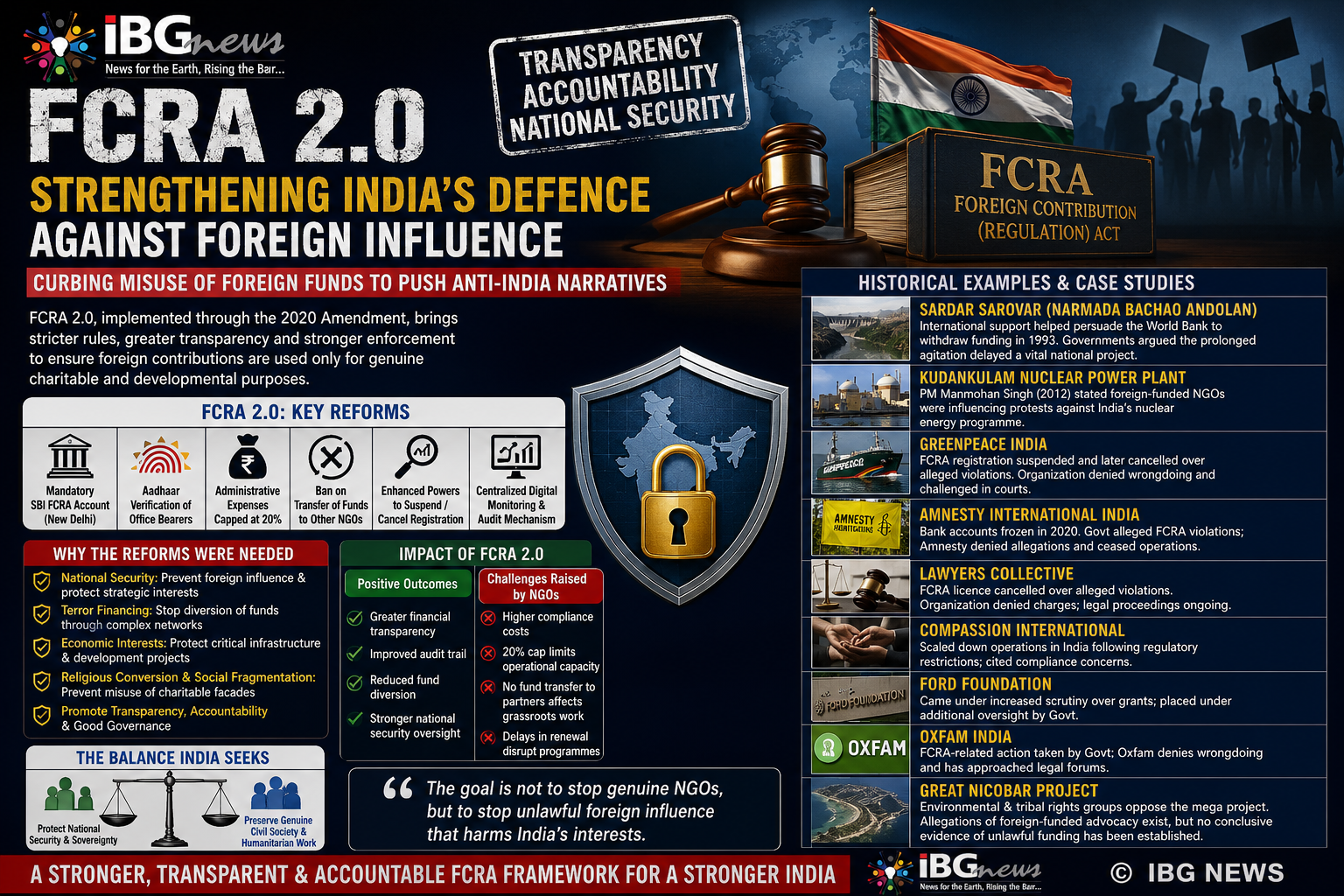
These concerns have driven the evolution of India’s Foreign Contribution (Regulation) Act (FCRA) into what is widely referred to as FCRA 2.0—a strengthened regulatory framework introduced through the FCRA Amendment Act, 2020, along with stricter compliance, centralized banking, digital monitoring and enhanced enforcement by the Ministry of Home Affairs (MHA).
Why Was FCRA Strengthened?
Originally enacted in 1976 during the Emergency and substantially revised in 2010, the FCRA was designed to regulate foreign contributions and prevent overseas influence in India’s democratic, political and strategic affairs.
The 2020 amendments introduced significant reforms:
- Mandatory SBI FCRA Account at New Delhi
- Aadhaar verification of office bearers
- Administrative expenses capped at 20%
- Ban on onward transfer of foreign contributions to other NGOs
- Enhanced government powers to suspend or cancel registrations
- Centralized digital monitoring and audit mechanisms
According to the Government, these reforms were aimed at increasing transparency, preventing diversion of foreign funds, combating terror financing, and protecting India’s sovereignty.
Can Foreign Funding Influence National Narratives?
Experts note that NGOs can influence public discourse through research reports, environmental campaigns, legal interventions, international advocacy, media engagement and public mobilization. While such activities are a legitimate part of democratic participation, Indian authorities have maintained that some organizations have, in specific instances, gone beyond charitable objectives.
Whether such advocacy amounts to an “anti-India narrative” depends on the evidence available in each case. It is important to distinguish between documented regulatory actions, political allegations and judicial findings.
Historical Case Studies
Narmada Bachao Andolan and the Sardar Sarovar Dam
One of the earliest and most significant examples frequently cited in debates over foreign influence is the Narmada Bachao Andolan (NBA), which opposed the construction of the Sardar Sarovar Dam.
The movement, led by Medha Patkar, attracted support from international environmental and human rights organizations and successfully campaigned before the World Bank. In 1993, following an independent review, the World Bank withdrew the undisbursed portion of its funding for the project.
Supporters of the movement regarded it as a landmark struggle for environmental protection and the rights of displaced communities. However, governments at both the Centre and in Gujarat argued that prolonged opposition delayed a critical national project intended to provide irrigation, drinking water and electricity to millions.
While political leaders have at times alleged that foreign-funded organizations influenced the campaign, no court has conclusively held that the movement itself was illegally financed for anti-India activities.
Kudankulam Nuclear Power Project
The protests against the Kudankulam Nuclear Power Plant in Tamil Nadu marked another turning point.
In 2012, then Prime Minister Dr. Manmohan Singh publicly stated that certain foreign-funded NGOs were influencing protests against India’s nuclear energy programme.
Subsequently, several organizations came under FCRA scrutiny. While the Government argued that foreign funding was affecting a strategically important energy project, activists maintained that their opposition was based on environmental and safety concerns.
No court has declared the entire protest movement to have been unlawfully financed.
Greenpeace India
Greenpeace India became one of the most prominent organizations to face government action under FCRA.
Its registration was suspended and later cancelled over alleged violations of foreign funding regulations. The organization challenged several government actions before the courts, maintaining that it had complied with Indian law and that the action affected legitimate environmental advocacy.
The case became an international example in discussions about the balance between environmental activism and national regulatory oversight.
Amnesty International India
In 2020, Amnesty International India ceased operations after its bank accounts were frozen.
The Government alleged violations relating to FCRA and financial regulations. Amnesty rejected the allegations, arguing that the action hindered independent human rights work.
The matter remains one of the most internationally discussed FCRA cases.
Lawyers Collective
The Lawyers Collective also lost its FCRA registration after the Government alleged violations of the Act.
The organization denied wrongdoing, and legal proceedings have continued over aspects of the case.
Compassion International
The U.S.-based Christian humanitarian organization significantly reduced its India operations following regulatory restrictions.
Government authorities cited compliance issues, while the organization stated that humanitarian programmes suffered because of the restrictions.
Ford Foundation
The Ford Foundation came under increased scrutiny after grants made to certain Indian organizations raised regulatory questions.
The Government subsequently placed the Foundation under additional oversight before compliance mechanisms were strengthened.
Oxfam India
More recently, Oxfam India has faced FCRA-related regulatory action. Government authorities have argued that the organization violated provisions governing foreign contributions, while Oxfam has denied wrongdoing and challenged the action through legal channels.
Great Nicobar Mega Infrastructure Project
One of India’s most strategically significant infrastructure projects is the Great Nicobar Development Programme, comprising:
- International Container Transshipment Terminal
- Greenfield International Airport
- Township Development
- Power Infrastructure
- Expansion of India’s naval and strategic capabilities in the Andaman and Nicobar Islands
The project has faced opposition from environmental groups and tribal rights organizations concerned about biodiversity, forest conservation and indigenous communities.
Supporters argue that the project is vital for India’s Indo-Pacific strategy, maritime security and economic competitiveness.
Some commentators have alleged that international advocacy networks have amplified opposition to the project. However, there is no publicly established judicial finding or official conclusion demonstrating that protests against the Great Nicobar project were financed through unlawful foreign funding mechanisms.
Why Strategic Infrastructure Has Become a National Security Issue
Over the last three decades, protests have emerged around several strategic projects, including:
- Sardar Sarovar Dam
- Kudankulam Nuclear Power Plant
- POSCO Steel Project
- Sterlite Copper Plant
- Great Nicobar Mega Project
- Certain mining and industrial corridors
Government agencies have increasingly viewed prolonged disruptions to nationally important infrastructure through the lens of economic and national security, while civil society organizations maintain that environmental protection, rehabilitation and constitutional rights remain legitimate concerns deserving public debate.
Impact of FCRA 2.0
According to the Government, the strengthened framework has:
- Improved transparency in foreign donations
- Reduced opportunities for diversion of funds
- Enhanced financial accountability
- Strengthened national security oversight
- Created a centralized audit trail
However, many NGOs argue that:
- Compliance costs have increased significantly.
- Smaller organizations face operational challenges.
- The prohibition on transferring funds to partner NGOs has affected grassroots implementation.
- The 20% cap on administrative expenses limits organizational capacity.
- Delays in registration renewals have interrupted welfare programmes.
India’s Global Context
India is not alone in strengthening oversight of foreign-funded organizations. Comparable regulatory frameworks exist in several countries, including:
- Russia’s Foreign Agents Law
- China’s Overseas NGO Law
- Israel’s NGO Transparency Regulations
- Similar disclosure requirements in various Western democracies for foreign lobbying and political funding
Governments worldwide increasingly regard foreign funding as a matter of national security, financial transparency and strategic resilience.
Striking the Right Balance
The challenge for policymakers is balancing two equally important objectives:
- Protecting India’s sovereignty, democratic institutions and strategic interests from unlawful foreign influence.
- Preserving the ability of genuine charitable organizations to continue serving society through healthcare, education, disaster relief, environmental conservation and humanitarian assistance.
Most policy experts agree that transparent regulation, efficient compliance mechanisms and fair judicial review are essential to maintaining public confidence while safeguarding democratic freedoms.
Conclusion
FCRA 2.0 represents the most comprehensive reform of India’s foreign funding regulations in decades. The law has significantly altered how NGOs receive, manage and report foreign contributions, reflecting the Government’s emphasis on transparency, accountability and national security.
Historical controversies surrounding the Sardar Sarovar Dam, Kudankulam Nuclear Plant, Greenpeace India, Amnesty International India, Lawyers Collective, Compassion International, Ford Foundation, Oxfam India, and ongoing debates over projects such as the Great Nicobar Transshipment Hub illustrate the complex intersection of foreign funding, public activism, development policy and strategic interests.
As India seeks to emerge as a major global power, the debate surrounding FCRA is likely to continue. The central question remains whether regulatory reforms can effectively prevent unlawful foreign influence while ensuring that legitimate civil society organizations retain the space to contribute constructively to India’s democratic and developmental journey.
As Late General Bipin Rawat said, we are fighting a 2.5-front war; definitely, the enemy within is more dangerous than the enemy outside the borders. FCRA 2.0 is trying to hold the bull by the horns. Let’s see how Team Modi can fight it out for India.