











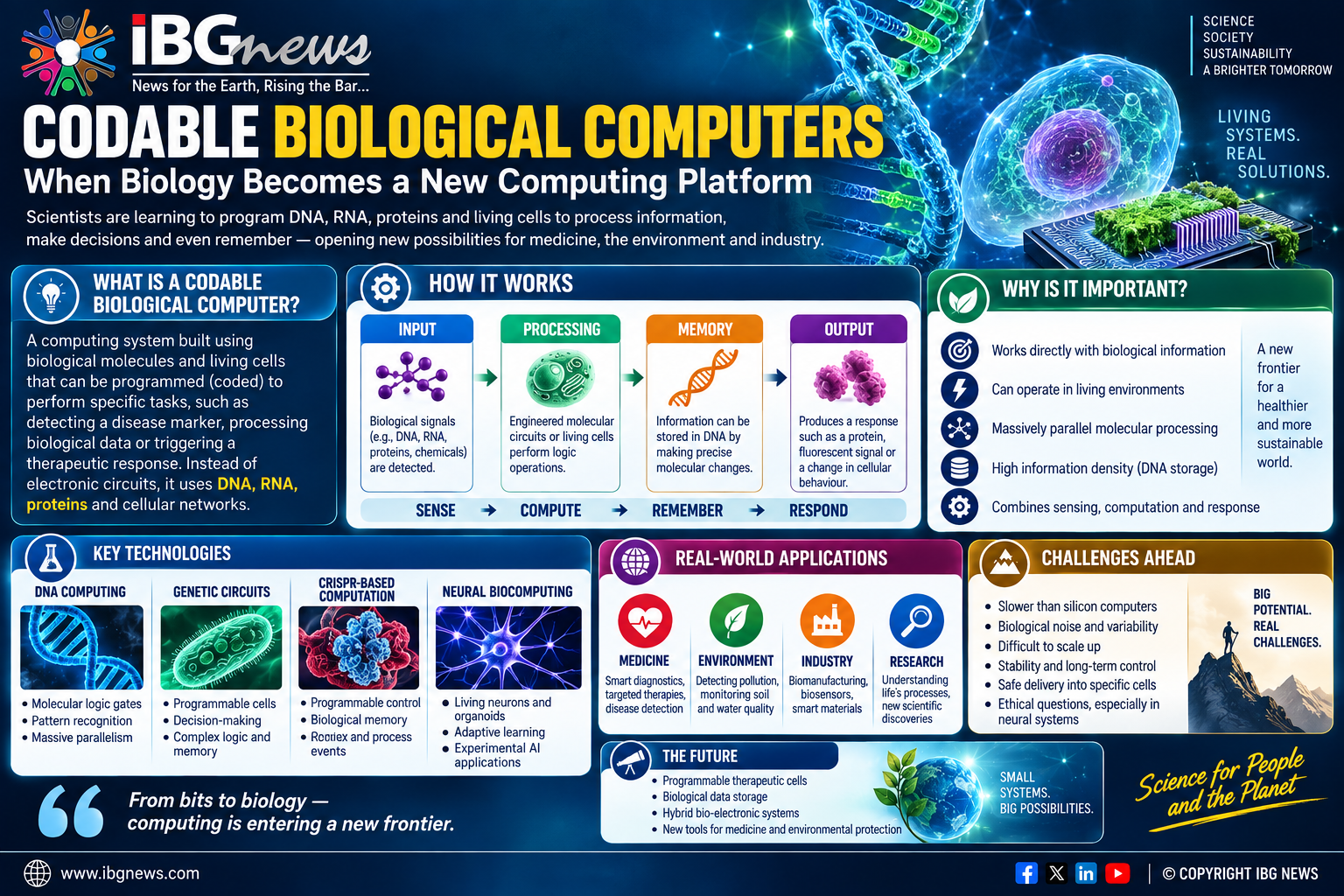
Codable Biological Computers: How Scientists Are Turning Living Cells and DNA into Programmable Machines
By Suman Munshi | IBG NEWS
From silicon chips to living systems, scientists are developing a new form of computing in which DNA, RNA, proteins and even whole cells can process information, make decisions and store biological memories.
For decades, the word computer has meant a machine built from silicon, electronic circuits and electrical signals. But a rapidly developing area of science is challenging that traditional idea.
Researchers are learning how to use DNA molecules, RNA, proteins and living cells as computational components. Instead of electricity moving through transistors, molecular interactions can carry information, execute logic and produce a response.
This emerging field is broadly described as biological computing, biomolecular computing, DNA computing or cellular computing. The idea of a “codable biological computer” takes the concept one step further: a biological system whose behaviour can be programmed by designing its molecular instructions.
Importantly, this does not mean that scientists have built a biological replacement for today’s laptop or smartphone. Rather, researchers are creating highly specialised molecular systems capable of performing particular computational tasks—especially tasks involving biological information. (Nature)
What exactly is a codable biological computer?
The simplest way to understand the concept is to compare it with an ordinary computer.
A conventional computer has:
Hardware → Processor → Memory → Software → Output
A programmable biological system can have an analogous structure:
Molecules/cells → Molecular circuits → DNA-based memory → Genetic instructions → Biological response
The analogy is not perfect, but it is useful.
A biological computer may be designed to receive molecular information—for example, the presence of particular RNA molecules or proteins—and then determine what to do with that information.
It could effectively follow instructions such as:
If A is present AND B is present, produce X.
Or:
If A is present but B is absent, produce Y.
That is essentially the biological equivalent of a logic gate.
Researchers have already demonstrated NOT, AND, NAND and other forms of logic in engineered mammalian cells. More advanced systems have even performed arithmetic operations such as half-addition and half-subtraction. (Nature)
DNA can behave like an information-processing material
DNA is normally introduced as the molecule that stores genetic information.
But DNA has another remarkable property: its four chemical bases—A, T, C and G—can be arranged into extraordinarily large numbers of sequences.
Scientists can exploit this molecular structure to encode information.
More importantly, DNA strands can recognise and bind to complementary sequences. Researchers can design these interactions so that one molecular event triggers another.
This allows DNA molecules to function as components of computational circuits.
Modern DNA-computing research includes molecular switches, logic gates, amplifiers, neural-network-like systems and other computational architectures. (Nature)
The surprising beginning: a DNA solution to a mathematical problem
One of the landmark demonstrations of DNA computing came in the 1990s, when researchers showed that DNA molecules could be used to solve a computational problem.
The basic idea was revolutionary: instead of representing information with electronic bits, enormous numbers of DNA molecules could represent possible solutions simultaneously.
This introduced an important advantage of molecular computing:
Massive parallelism
Millions or billions of molecular interactions can occur at the same time.
In conventional computing, operations are generally organised through electronic circuits and clocked processes. In molecular systems, however, huge populations of molecules can interact simultaneously in a reaction mixture.
This does not automatically make DNA computers faster than electronic computers. Reading the molecular result, controlling errors and preparing the biological system can be difficult and time-consuming.
But for particular problems, molecular parallelism can be extremely attractive. Recent reviews identify high parallelism, information density and potentially low energy requirements among the major attractions of DNA computing. (Royal Society of Chemistry Publishing)
The key technology: DNA strand displacement
One of the most important mechanisms behind modern DNA circuits is called toehold-mediated strand displacement.
The name sounds complicated, but the principle can be understood relatively easily.
Imagine two pieces of molecular information temporarily attached to each other. A third DNA strand arrives carrying a matching sequence. It attaches to an exposed section—a molecular “handle”—and gradually pushes the original strand away.
That molecular replacement can be designed to represent a computational operation.
By connecting many such reactions, researchers can construct increasingly complicated circuits.
DNA strand-displacement systems have been used to create digital circuits and even molecular neural networks. One influential study demonstrated DNA circuits capable of recognising patterns and implementing a small Hopfield associative memory. (Nature)
Another study subsequently demonstrated DNA-based winner-take-all neural networks capable of classifying patterns corresponding to handwritten digits, showing that molecular systems can perform considerably more sophisticated pattern recognition than simple ON/OFF logic. (Nature)
What makes a biological computer different?
The biggest difference is that biological computers can potentially sense their environment directly.
A silicon computer generally needs sensors to translate the physical world into electronic signals.
A biological computer can use biological molecules as its inputs.
For example, a molecular circuit could potentially respond to:
- a particular RNA molecule,
- a protein,
- a metabolite,
- a cellular signal,
- a combination of disease-associated biomarkers.
The biological system can then process those signals and generate an output.
That output might be:
- production of a protein,
- activation of a gene,
- suppression of a gene,
- emission of a fluorescent signal,
- recording of an event,
- or, in future therapeutic applications, a controlled biological response.
This is why biological computing is particularly interesting for medicine and diagnostics. (Nature)
Living cells can actually perform computation
Perhaps the most extraordinary development is that researchers are no longer restricting computation to DNA molecules in test tubes.
They have engineered living cells to perform computational tasks.
In 2012, researchers demonstrated programmable mammalian cells capable of executing several digital logic operations. Their systems used biological control mechanisms to process molecular inputs and produce programmed cellular outputs. (Nature)
In another major development, researchers created the BLADE platform—“Boolean Logic and Arithmetic through DNA Excision”—for constructing complex genetic circuits in mammalian cells.
The researchers tested 113 circuits and reported that 109 functioned as intended without additional optimisation, including circuits capable of sophisticated logic and arithmetic operations. (Nature)
That is an important milestone because it demonstrates that biological computation is not merely a theoretical analogy.
Living cells can be engineered to execute computational instructions.
CRISPR turns the idea into something closer to biological programming
The arrival of CRISPR technologies has dramatically expanded the possibilities.
CRISPR is widely known as a genome-editing technology. But modified CRISPR systems can also be used to regulate genes without necessarily cutting DNA.
Researchers have used CRISPR components as programmable elements of cellular computational systems.
In 2019, scientists reported a CRISPR/Cas9-based central processing unit capable of executing Boolean logic and arithmetic operations in human cells. The system used guide RNAs as programmable inputs and could perform operations including a half-adder. Researchers also demonstrated a dual-core configuration. (PubMed Central (PMC))
This leads to an intriguing concept:
DNA provides the information.
CRISPR provides programmable molecular control.
The cell provides the biological machinery.
Together, they can form something resembling a programmable biological computer.
Biological computers can also remember
A computer is not useful merely because it can calculate. It also needs memory.
Scientists have been working on the biological equivalent.
One strategy uses enzymes called recombinases, which can rearrange specific pieces of DNA.
Once the DNA is rearranged, the change can remain in the cell and be inherited by its descendants.
Researchers have demonstrated synthetic genetic circuits that combine logic and memory in living cells. In one study, engineered E. coli systems implemented all 16 possible two-input Boolean functions and retained recorded states for at least 90 generations. (Nature)
Another approach uses CRISPR itself as a molecular recording mechanism.
Researchers demonstrated systems in which cellular events could be recorded into DNA, effectively creating a molecular history of what happened to a cell. (PubMed)
This is a fundamentally different concept from the memory in a computer’s hard drive.
Instead of storing information magnetically or electronically, the biological system can encode its history in DNA.
Imagine a cell that can ask questions
The ultimate attraction of this technology becomes clearer with a simple hypothetical example.
Imagine a cell encountering three molecular signals:
A = cancer-associated marker
B = second tumour marker
C = healthy-cell marker
Scientists could potentially design a circuit that behaves like:
IF A + B are detected AND C is absent → activate response
This is molecular logic.
Such systems could eventually become highly sophisticated biological decision-making devices.
Research has already demonstrated multi-input logic in mammalian cells. For example, split-Cas12a systems have been engineered to implement two-, three- and four-input AND gates and to respond to tumour-associated signals in experimental settings. (ScienceDirect)
The long-term vision is therefore not simply to make a “DNA calculator”.
It is to create cells that can sense, compute and respond intelligently to their biological environment.
Could biological computers become medical computers?
This is one of the most promising possibilities.
A conventional diagnostic device usually follows this pathway:
Patient → Sample → Laboratory analysis → Computer → Diagnosis
A molecular computer could potentially bring part of the computational process much closer to the biological system itself.
A future engineered cell or molecular device might theoretically:
- Detect several biomarkers.
- Compare their molecular pattern.
- Decide whether a particular condition is present.
- Record the information.
- Trigger a predefined response.
Researchers are already exploring DNA circuits for biosensing, cellular imaging, diagnostics and conditional therapeutics. (Nature)
However, these applications remain an active research area. A laboratory demonstration is not the same thing as an approved medical treatment.
DNA computers can even imitate neural networks
The field is moving beyond simple digital logic.
Researchers have built DNA-based systems inspired by artificial neural networks.
In one landmark experiment, DNA strand-displacement cascades were used to create a molecular neural network and a small associative memory. The system could recognise molecular patterns and retrieve the closest stored pattern. (Nature)
Later work expanded this approach with winner-take-all molecular neural networks capable of recognising patterns corresponding to several handwritten digits, even when substantial portions of the input pattern were altered. (Nature)
This suggests that DNA molecules are not limited to behaving like simple molecular switches.
They can potentially participate in distributed information-processing architectures.
A newer frontier: computation inside living cells
One of the biggest challenges is taking molecular computation from a laboratory test tube into an actual living cell.
Inside a cell, thousands of biochemical reactions occur simultaneously.
A synthetic circuit can therefore interfere with natural cellular processes—or be affected by them.
Scientists are investigating ways to build DNA circuits that can operate in cells and interact with naturally occurring molecules such as messenger RNA and microRNA. Recent reviews describe the development of intracellular DNA nanodevices and the challenges involved in making such systems reliable inside living organisms. (ScienceDirect)
This is where the idea of the codable cell becomes particularly important.
The objective is not necessarily to replace the cell.
Instead, researchers want to program the cell’s existing molecular machinery to perform new tasks.
The cell itself is already a biological computer
There is also a deeper scientific insight behind this entire field.
A natural cell already processes information continuously.
It receives signals from its environment, interprets them through molecular networks and changes its behaviour.
For example:
Signal → receptor → biochemical pathway → gene regulation → cellular response
Synthetic biology essentially attempts to redesign parts of this naturally occurring information-processing system.
Scientists have therefore been developing genetic circuits that perform digital, analogue and mixed-signal computation inside living cells. Research has demonstrated systems that convert continuous biological signals into digital states and combine analogue and digital processing. (Nature)
In that sense, the biological computer is not being invented from nothing.
Scientists are learning how to program an information-processing system that nature already built.
Why this could be revolutionary
Biological computing has several characteristics that conventional computing does not naturally possess.
1. Extremely small scale
DNA and other biomolecules operate at the molecular scale.
2. Massive parallelism
Huge numbers of molecular reactions can occur simultaneously.
3. High information density
DNA can store enormous amounts of information in extremely small physical volumes. (Nature)
4. Biological compatibility
DNA-based systems can potentially operate in aqueous and biological environments.
5. Direct access to biological signals
A molecular computer can use biological molecules themselves as computational inputs.
6. Computation and memory can be combined
DNA can potentially serve both as an information-processing substrate and as a storage medium.
These characteristics make the technology particularly attractive for biosensing, diagnostics, molecular robotics, therapeutics and biological research rather than replacing conventional CPUs for everyday computing. (Nature)
But there are major obstacles
It would be misleading to suggest that biological computers are ready to replace silicon chips.
They are not.
Several difficult problems remain.
Speed
Molecular reactions are generally much slower than electronic switching.
Reliability
Biological reactions are affected by temperature, concentration, molecular noise and unwanted interactions.
Scaling
Building one molecular logic gate is very different from constructing an enormous, reliable computational system.
Reading the answer
The computation may happen molecularly, but researchers often need specialised laboratory methods to determine the result.
Delivery
Putting engineered DNA circuits safely into specific cells or tissues is a major challenge.
Cellular interference
A synthetic circuit must coexist with thousands of natural biochemical reactions.
Safety
Any technology designed to alter living cells requires careful evaluation of unintended effects and long-term behaviour.
Recent scientific reviews emphasise that clinical translation still faces substantial engineering and biological barriers. (Nature)
The next step: from biological circuits to biological microcomputers
The field is now moving toward a more ambitious question:
Can we make biological systems programmable in the same broad sense that electronic computers are programmable?
Recent work describes the idea of treating cells as “codeable” machines, with DNA, RNA and proteins functioning as programmable molecular components. The emerging vision is sometimes described as a DNA-programmable biological microcomputer. (SSRN)
At present, this should be viewed as an emerging research direction rather than a finished technology.
But the underlying science is advancing rapidly.
Recent work has even demonstrated increasingly complex DNA nano-chip architectures capable of multi-level logic and intracellular molecular computation, including experimental systems designed to identify and respond to tumour cells. (ScienceDirect)
What could the future look like?
The most realistic future may not be a biological laptop sitting beside a conventional computer.
Instead, we could see tiny biological computers embedded in biological systems.
They might function as:
- smart diagnostic sensors;
- molecular disease detectors;
- programmable therapeutic cells;
- biological recording devices;
- environmental biosensors;
- molecular robots;
- intelligent drug-delivery systems;
- research tools for understanding how cells make decisions.
A future cell could potentially be given a molecular “program” that tells it:
Sense → Analyse → Remember → Decide → Respond.
That is remarkably close to the basic philosophy of computing.
The bigger scientific meaning
The emergence of codable biological computers represents more than another computing technology.
It is a meeting point between computer science, molecular biology, synthetic biology, nanotechnology and medicine.
For centuries, humans built machines from metal, glass and silicon.
Now scientists are asking whether the machinery of life itself can be programmed.
The most profound possibility is therefore not that DNA will replace silicon.
It is that computing may eventually become something that happens inside biology itself.
The computer of the future may not always look like a computer.
In some applications, it could be a molecule, a tiny DNA circuit—or even a living cell.
Reference Notes — Scientific Studies Consulted
The article above is independently written and paraphrased for IBG NEWS. The following scientific literature was consulted for the scientific background and chronology:
- Jia et al. — “DNA-based biocomputing circuits and their biomedical applications,” Nature Reviews Bioengineering (2025). A major recent review covering DNA switches, logic gates, amplifiers, neural circuits, cellular imaging, biosensing, diagnostics and conditional therapeutics. (Nature)
- “DNA as a universal chemical substrate for computing and data storage,” Nature Reviews Chemistry. Reviews DNA as both a computational substrate and information-storage medium, including molecular neural networks and compartmentalised circuits. (Nature)
- Zhao et al. — “Advancements in DNA computing: exploring DNA logic systems and their biomedical applications,” Journal of Materials Chemistry B (2024). Reviews DNA logic systems and applications in cellular imaging, diagnosis and disease treatment. (Royal Society of Chemistry Publishing)
- Ausländer et al. — “Programmable single-cell mammalian biocomputers,” Nature (2012). Demonstrated programmable logic and arithmetic functions in mammalian cells. (Nature)
- Kim, Bojar & Fussenegger — “A CRISPR/Cas9-based central processing unit to program complex logic computation in human cells,” PNAS (2019). Demonstrated CRISPR-based cellular logic and arithmetic computation. (PubMed Central (PMC))
- Weinberg et al. — “Large-scale design of robust genetic circuits with multiple inputs and outputs for mammalian cells,” Nature Biotechnology (2017). Introduced BLADE and experimentally evaluated 113 mammalian genetic circuits. (Nature)
- Siuti, Yazbek & Lu — “Synthetic circuits integrating logic and memory in living cells,” Nature Biotechnology (2013). Demonstrated Boolean logic combined with persistent DNA-encoded memory. (Nature)
- Qian et al. — “Neural network computation with DNA strand displacement cascades,” Nature. Demonstrated molecular neural-network computation using DNA strand-displacement reactions. (Nature)
- Qian et al. — “Scaling up molecular pattern recognition with DNA-based winner-take-all neural networks,” Nature. Demonstrated molecular pattern classification using DNA neural networks. (Nature)
- Perli, Cui & Lu — “Continuous genetic recording with self-targeting CRISPR-Cas in human cells,” Science (2016). Demonstrated continuous molecular recording using CRISPR systems. (PubMed)
- Shipman et al. — “Molecular recordings by directed CRISPR spacer acquisition,” Science (2016). Demonstrated another approach to storing biological events in DNA. (PubMed Central (PMC))
- Rubens, Selvaggio & Lu — “Synthetic mixed-signal computation in living cells,” Nature Communications (2016). Demonstrated integration of analogue and digital computation in living cells. (Nature)
- Green et al. — “Complex cellular logic computation using ribocomputing devices,” Nature (2017). Demonstrated programmable RNA-based cellular logic, including multi-input circuits. (Nature)
- “From the Test Tube to the Cell: A Homecoming for DNA Computing Circuits?” A recent review examining the challenges of moving DNA strand-displacement computation into living cells. (ScienceDirect)
- “DNA computing: DNA circuits and data storage,” Nanoscale Horizons (2025). Reviews DNA circuits, molecular algorithms, parallelism, information storage and the remaining technological challenges. (Royal Society of Chemistry Publishing)
Editorial note: “Codable Biological Computer” is best treated as an emerging descriptive concept rather than the name of one universally standardised machine or technology. Current research encompasses several related areas—including DNA computing, biomolecular circuits, genetic circuits, CRISPR-based computation, molecular memory and programmable cellular systems.