











ISRO GSLV-F17 / EOS-05 Mission Analysis
By Anil P. Kastuar, Editor, IBG NEWS
1. Mission Overview
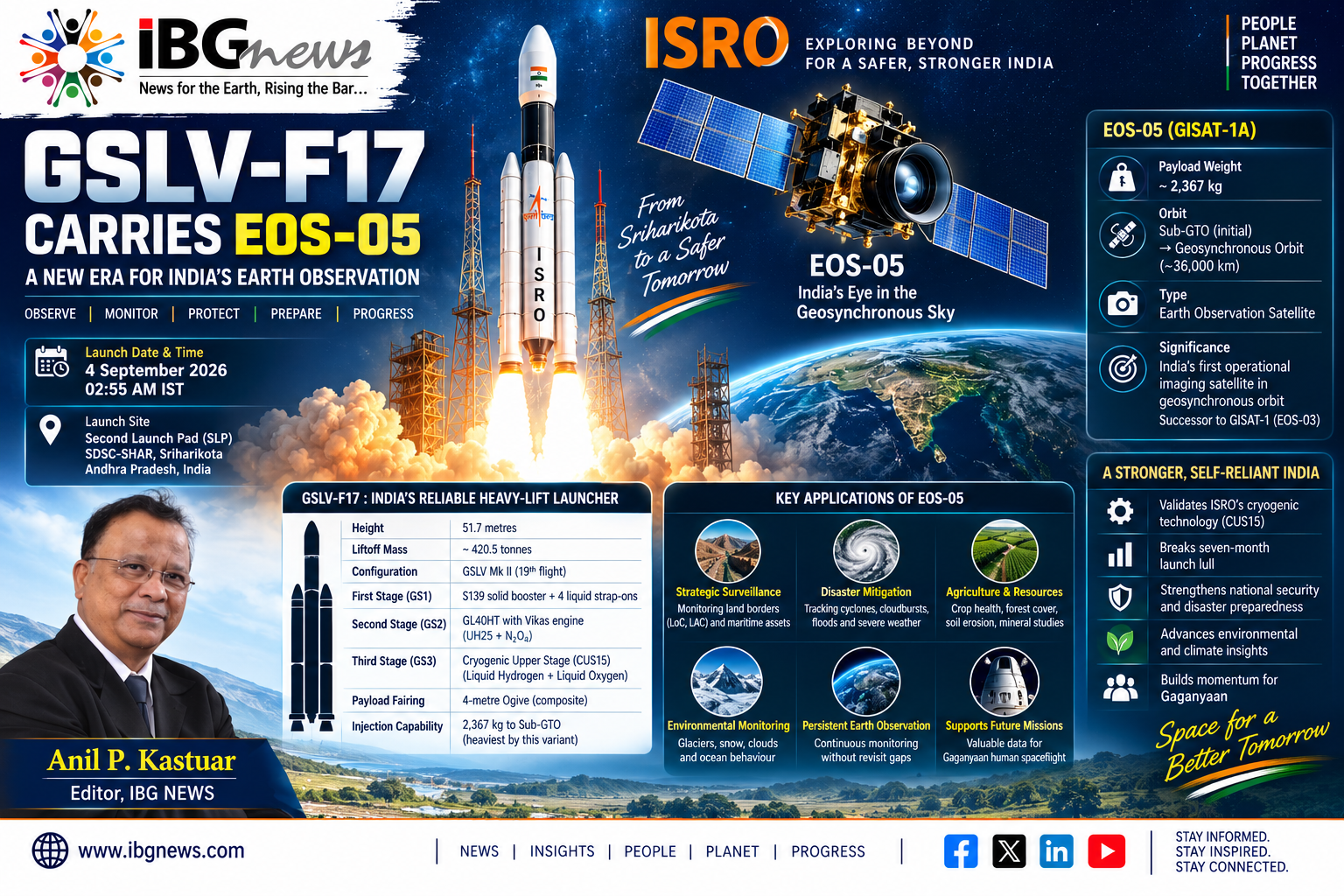
India successfully launched the GSLV-F17/EOS-05 mission on September 4, 2026, at 02:55 AM IST from the Satish Dhawan Space Centre (SDSC-SHAR) in Sriharikota. This milestone flight successfully placed the satellite into a Sub-Geosynchronous Transfer Orbit (Sub-GTO) before heading to its final geosynchronous orbit.
- Launch Vehicle: GSLV-F17 (the 19th flight of the Geosynchronous Satellite Launch Vehicle).
- Payload: EOS-05 (Earth Observation Satellite, also known as GISAT-1A), weighing approximately 2,367 kg.
- Launch Site: Second Launch Pad (SLP), SDSC-SHAR, Sriharikota, Andhra Pradesh.
- Significance: India’s first-ever operational imaging satellite stationed in a geosynchronous orbit, serving as a vital successor to the lost GISAT-1/EOS-03.
2. Technical Specifications of GSLV-F17
The GSLV Mk II configuration utilized for this flight stands 51.7 metres tall and features a liftoff mass of approximately 420.5 tonnes. Below is a breakdown of its key structural stages:
| Rocket Feature | Technical Specification |
| First Stage (GS1) | Powered by an S139 solid propellant booster supplemented by four liquid-propellant strap-on stages. |
| Second Stage (GS2) | GL40HT stage powered by a liquid-fueled Vikas engine using UH25 and N2O4 propellants. |
| Third Stage (GS3) | A Cryogenic Upper Stage (CUS15) running on supercooled liquid hydrogen (LH2) and liquid oxygen (LOX). |
| Payload Fairing | A 4-metre diameter Ogive (composite) fairing deployed to protect the massive satellite during early atmospheric ascent. |
| Injection Capability | Injected a 2,367 kg payload into Sub-GTO, marking the heaviest satellite ever delivered to a transfer orbit by this launcher variant. |
3. Scientific & Practical Applications of EOS-05
Known as India’s premier ‘Eye in the Sky’, the EOS-05 satellite operates from a persistent Geosynchronous orbit (~36,000 km above Earth) to bypass multi-day imagery revisit gaps and deliver near-real-time monitoring.
- Border & Strategic Surveillance: Captures frequent high-resolution imagery to actively monitor land borders (LoC, LAC) and critical maritime assets across the Indian Ocean.
- Disaster Mitigation: Tracks short-term, volatile atmospheric and weather anomalies like cyclones, cloudbursts, severe thunderstorms, and sudden floods.
- Advanced Remote Sensing: Equipped with highly agile multispectral and hyperspectral cameras to map agriculture health, forest cover modifications, soil erosion, and mineralogical properties using continuous chemical fingerprints.
- Environmental Analytics: Continuously tracks variations in glacier movement, snow cloud structures, and oceanic wave behaviors over long timelines.
4. Comprehensive Strategic Analysis
Redemption for the Launcher: Historically nicknamed the ‘Naughty Boy’ due to early inconsistencies, the flawless performance of the CUS15 cryogenic upper stage completely validates ISRO’s homegrown cryogenic engineering. It overcomes the painful 2021 loss of the EOS-03 satellite caused by a failure in the cryogenic stage ignition.
Operational Reset: This flight breaks a tense seven-month launch lull for ISRO that followed back-to-back hardware investigations during winter. It acts as an operational catalyst, returning confidence to scheduling pipelines.
The Power of Persistent ‘Staring’: Unlike conventional Low Earth Orbit (LEO) satellites that pass over a specific area once every few days, EOS-05 remains stationary relative to India. This eliminates revisit delays entirely, offering uninterrupted real-time tracking for security commands and meteorological alerts.
Pathways to Gaganyaan: The structural, thermal, and telemetry data mastered during this heavy-lift injection provides massive momentum and safety validation for the upcoming uncrewed Gaganyaan human spaceflight capsule test scheduled for late 2026.