












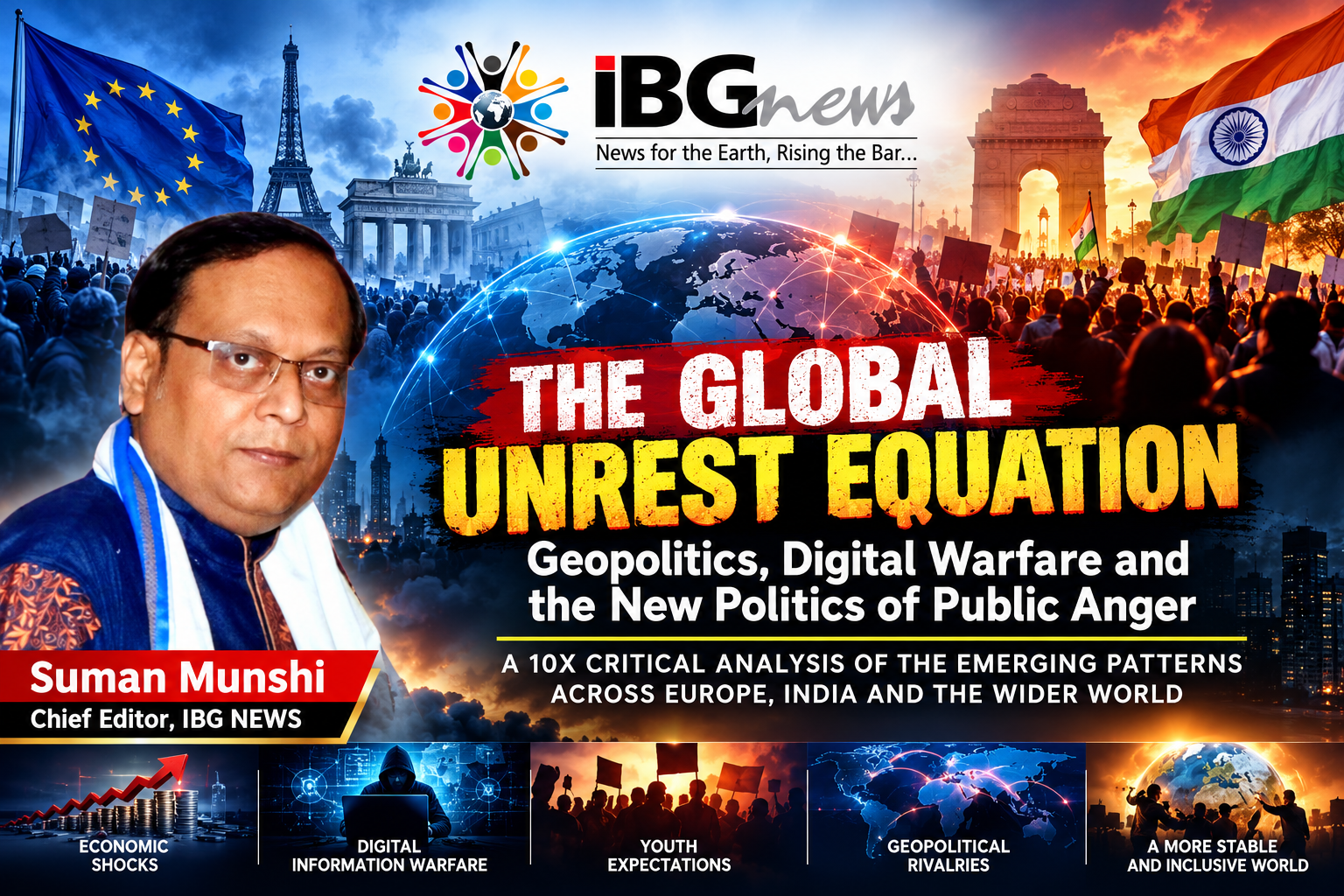
The Global Unrest Equation: Geopolitics, Digital Warfare and the New Politics of Public Anger
A 10X Critical Analysis of the Emerging Patterns Across Europe, India and the Wider World
By Suman Munshi | IBG NEWS
Date: 26 October 2026
From European streets shaken by economic grievances to youth-led demonstrations in India and political upheavals across Asia, a common question is emerging: are these isolated domestic crises, or different expressions of a deeper global transformation? The evidence points towards interconnected pressures, transnational information networks and geopolitical competition—but not necessarily a single coordinated operation.
1. The Big Picture: A World Under Increasing Political Pressure
The contemporary international order is experiencing a complicated convergence of economic anxiety, declining institutional trust, generational frustration, political polarisation and strategic rivalry. Public unrest has become an important indicator of how these pressures are affecting societies, from established European democracies to emerging economies in Asia.
The pattern deserves serious investigation.
In October 2026, France experienced large demonstrations over the cost of living, economic inequality and government policies. Reports described violence in some locations alongside predominantly peaceful demonstrations. Economic grievances have also fuelled protests in other European countries, including Italy, Portugal, Spain, Belgium and Albania. Rising energy costs and wider geopolitical disruptions have added to the pressure on households and businesses.
India, meanwhile, has experienced a substantial increase in demonstrations during 2026, including youth-led protests, demands for electoral accountability and movements over education and employment-related concerns. The Armed Conflict Location & Event Data Project (ACLED) reported that India was on course to record its highest number of protests in a decade. Its analysis also found that the overwhelming majority of Indian demonstrations remained peaceful.
These developments raise a fundamental question: what connects public anger in countries with different political systems, economic structures, social compositions and strategic interests?
The answer is not necessarily a common political command centre. It may instead lie in the interaction of several forces:
- Economic shocks transmitted through global markets.
- Public dissatisfaction with political institutions and governance.
- Social media systems that accelerate the circulation of anger.
- Transnational political movements sharing narratives and tactics.
- Foreign information operations that exploit existing divisions.
- Strategic competition among major powers seeking diplomatic, economic or informational advantages.
These mechanisms can operate simultaneously without requiring every protest to have the same origin.
That distinction is essential to understanding the global picture.
2. Europe: When Geopolitical Shocks Enter the Household Budget
Europe offers a particularly clear illustration of the connection between international events and domestic political instability.
The economic consequences of geopolitical conflict are not confined to the countries directly involved. Energy markets, shipping routes, commodity prices, insurance costs and supply chains transmit shocks across national borders.
In October 2026, Reuters reported that disruptions associated with the US-Iran war had intensified energy-price pressures in Europe, contributing to protests over fuel affordability and the wider cost of living. The resulting political debate has created opportunities for parties challenging established governments and their foreign-policy choices.
The underlying mechanism is straightforward:
Geopolitical conflict → market disruption → higher household costs → declining confidence in government → public mobilisation → political realignment.
However, each link must be examined separately.
A rise in energy prices does not automatically cause a riot. The political consequences depend on household savings, welfare protections, wage growth, government credibility, opposition mobilisation and the public’s perception of whether the burden is being distributed fairly.
Two countries exposed to the same external shock can experience very different outcomes.
A government with credible communication, effective relief measures and trusted institutions may contain public frustration. Another government facing longstanding dissatisfaction may find that a relatively small additional shock triggers a much larger political response.
This is why economic indicators alone cannot fully explain unrest. The distribution of economic pain and the credibility of the institutions managing it are equally important.
The political consequences of economic insecurity
When people struggle with fuel, food, rent, transport and electricity costs, foreign policy can become a domestic electoral issue.
Citizens may begin questioning whether their government has prioritised national security over economic welfare, whether sanctions or military commitments have imposed excessive costs, or whether domestic policy choices have made the country unnecessarily vulnerable to international shocks.
Political parties then compete to explain the crisis.
Some emphasise external aggression and the need for strategic resilience. Others blame government incompetence, excessive regulation, immigration, international commitments or the structure of the economic system.
These explanations may contain different degrees of factual accuracy. Their political effectiveness depends partly on whether they offer a convincing account of the public’s lived experience.
The crucial point is that geopolitical decisions can generate domestic political consequences far beyond the battlefield.
Yet the same economic pressures do not produce identical political outcomes. Europe’s political fragmentation, national electoral systems and differing levels of exposure to energy shocks make a single continent-wide explanation inadequate.
3. India: Youth Expectations, Institutional Trust and Political Accountability
India’s unrest must be analysed through its own social and institutional context rather than treated as an extension of European political developments.
India is a large, diverse democracy with a federal structure, substantial regional variation and a political environment in which demonstrations can be used to demand accountability through constitutional processes.
ACLED’s October 2026 analysis reported approximately 19,500 protests in India between January and mid-October. It found that fewer than 4% involved violence by demonstrators. The organisation also documented hundreds of demonstrations associated with a youth-led movement demanding the resignation of the Chief Election Commissioner between 2 and 16 October.
These figures require careful interpretation.
A high protest count does not, by itself, establish that a government is approaching collapse, that society is becoming more violent or that the country is experiencing a revolutionary situation. Protest frequency measures mobilisation, not necessarily the depth of public opposition, the representativeness of demonstrators or the likelihood of political change.
Nevertheless, the reported increase deserves attention.
The generational dimension
Young citizens often evaluate political performance through immediate expectations: access to employment, educational opportunities, fair recruitment, affordable living, transparent administration and the possibility of social mobility.
When these expectations are not met, frustration can develop even in societies experiencing economic growth or technological progress.
The contradiction is particularly significant in countries where public messaging emphasises national ambition and future prosperity while some citizens experience uncertainty in their everyday lives.
This does not mean that young people share a single political ideology. Youth movements can contain competing political, regional, economic and cultural interests. Their participation may reflect a specific grievance rather than a unified opposition to the political system.
However, social media can allow these otherwise fragmented concerns to converge around common demands for accountability.
Institutional disputes can become mobilisation points
Disputes over electoral rolls, recruitment examinations, public appointments or administrative fairness can acquire importance beyond the original issue.
An examination controversy may become a debate about equal opportunity. An electoral dispute may become a wider argument about institutional neutrality. A local grievance may be reframed as evidence of a national governance problem.
This process can produce rapid mobilisation because the immediate dispute connects with a broader perception of unfairness.
The same mechanism can occur in European democracies, although the institutions and political demands involved are different.
The meaningful connection between India and Europe is therefore not necessarily ideological alignment. It is the way unmet expectations, perceived unfairness and questions of institutional credibility can turn local disputes into wider political movements.
India’s constitutional framework, regional political diversity and electoral competition remain important differences. These factors make direct comparisons with European street movements or youth-led upheavals elsewhere informative only when their limitations are acknowledged.
4. Beyond Europe and India: A Shared Global Pattern, Not a Single Global Crisis
The wider international picture reinforces the importance of comparing protest patterns without assuming that every movement has the same cause.
A September 2026 geostrategic analysis by EY, drawing on the Carnegie Endowment’s Global Protest Tracker, described a marked increase in public protest activity across Europe and Asia since 2022. It noted the diversity of issues driving mobilisation, including anti-immigration demonstrations, farmer protests over trade policy and demands for accountability in education.
The significance lies in the diversity itself.
A farmer protesting a trade agreement, a young person demanding fair recruitment, a household protesting fuel prices and a citizen demonstrating against an electoral decision may all be participating in public unrest. Yet the grievances, constituencies and desired outcomes can be fundamentally different.
Their simultaneous appearance does not establish a common organiser.
Instead, it suggests that the political system is being challenged at multiple points by groups that believe existing institutions are failing to protect their interests or respond adequately to their demands.
Four dimensions of the wider pattern
First, economic exposure. Global markets transmit the consequences of conflict, trade restrictions, inflation and supply-chain disruption across national borders.
Second, institutional confidence. Citizens may become more willing to protest when they believe conventional channels of representation are ineffective, unresponsive or unfair.
Third, digital mobilisation. Online networks allow people to observe similar grievances elsewhere, coordinate demonstrations and adopt familiar slogans or tactics.
Fourth, political interpretation. Domestic and foreign actors can present local events as evidence of a much larger struggle involving national identity, sovereignty, economic justice or the legitimacy of established institutions.
These dimensions reinforce one another, but they should not be confused with proof of a single worldwide movement.
A more accurate description is an interconnected international environment in which domestic crises can spread through markets, media, political narratives and cross-border networks.
That is a significant geopolitical development in its own right.
5. The Information Battlefield: When Unrest Becomes a Strategic Opportunity
One of the most consequential changes in modern geopolitics is the speed with which a domestic crisis can become an international information event.
A protest begins over a local issue. Videos circulate online. Commentators offer explanations. Political influencers identify supposed villains. Foreign-language accounts repeat selected claims. International audiences encounter the event through competing narratives rather than through a complete record of the underlying facts.
The result can be a widening gap between what happened, what people believe happened and what political actors want audiences to believe happened.
The European experience in October 2026 provides a particularly relevant example.
On 21 October, Euronews reported that there was no conclusive evidence that foreign powers had caused the unrest in France, Italy and other European countries. It distinguished between originating the protests and exploiting the unrest after it began. The report described how foreign actors amplified narratives around the disturbances, while noting that the available evidence did not establish that they had initiated the protests.
This distinction is central to any serious geopolitical investigation.
An external actor does not need to organise a demonstration to benefit from it.
It may instead:
- Amplify footage that depicts the state as weak or illegitimate.
- Promote claims that deepen divisions between social groups.
- Circulate misleading accounts of police action or protester behaviour.
- Present isolated violence as representative of an entire movement.
- Encourage audiences to interpret a domestic crisis as proof of democratic failure.
- Selectively highlight unrest in rival countries while minimising comparable problems at home.
These activities can serve strategic communication objectives without proving that the actor caused the original grievance.
The three-stage model of information exploitation
A useful analytical model separates information activity into three stages.
Stage one: The underlying grievance. Economic pressure, a disputed government decision, a security incident or an institutional controversy generates public dissatisfaction.
Stage two: Domestic mobilisation. Citizens, political parties, activists, community groups and other participants interpret the event, circulate information and decide whether to demonstrate.
Stage three: External amplification. Domestic and international networks select particular images, claims and interpretations to advance their political objectives.
The stages can overlap. Digital communication can influence mobilisation from the beginning, and foreign involvement may sometimes precede an event. However, the model prevents investigators from assuming that external amplification automatically establishes external orchestration.
It also recognises that domestic actors can deliberately exploit their own country’s unrest for political purposes.
The evidence is real, but its limits matter
The European External Action Service’s 2025 report on Foreign Information Manipulation and Interference documented digital infrastructure used by foreign actors, particularly Russia and also China, to manipulate or interfere with information environments in the European Union and partner countries.
A separate 2026 report by the Institute for Strategic Dialogue documented a range of hybrid incidents affecting EU member states since Russia’s full-scale invasion of Ukraine in February 2022.
These sources establish that foreign information manipulation and hybrid interference are legitimate subjects of security analysis.
They do not establish that every protest, riot or political crisis is a foreign operation.
The evidence must be specific to the event being investigated.
To attribute a particular episode to a foreign actor, researchers should seek corroboration through such evidence as authenticated communications, identifiable funding arrangements, coordinated inauthentic account networks, operational links, reliable platform data or credible investigative findings.
Shared hashtags, similar slogans, suspiciously timed posts or the rapid international circulation of a video may justify further investigation. On their own, they do not prove who organised an event or whether an outside government directed it.
The correct standard is evidence, not geopolitical suspicion.
6. The Hidden Connection: Economic Warfare, Energy Security and Political Stability
A major weakness in conventional political analysis is the tendency to separate international security from domestic economic stability.
In practice, the two are increasingly intertwined.
A military conflict can affect oil and gas supplies. Energy prices influence transport and manufacturing costs. Higher production costs affect food prices and consumer spending. Inflation reduces purchasing power, while uncertainty discourages investment. Governments then face pressure to provide relief, increase subsidies or change policy.
If citizens believe that the government is either unable or unwilling to protect their living standards, an external economic shock can become a domestic political crisis.
This mechanism helps explain why unrest in one region may coincide with dissatisfaction in another, even when the two movements have no organisational connection.
The geopolitical transmission chain
Consider the following sequence:
International conflict → disruption of trade or energy supplies → domestic inflationary pressure → declining purchasing power → public dissatisfaction → political mobilisation.
Each step is measurable in principle.
Researchers can examine international commodity prices, shipping disruptions, inflation data, household expenditure, public opinion surveys, protest dates and changes in political support.
If these indicators move in a consistent sequence, the argument for a connection becomes stronger.
However, timing alone is insufficient. A rise in fuel prices followed by protests does not prove that the price increase caused the demonstrations. Researchers must consider other explanations, including existing political disputes, seasonal protest patterns, election campaigns and domestic policy decisions.
Why the same shock produces different results
The impact of an international crisis depends on a country’s economic and institutional resilience.
Countries with diversified energy supplies, credible public institutions, effective social protection and sufficient fiscal capacity may absorb external shocks more successfully.
Countries with limited fiscal space, high household exposure to essential commodity prices or deep political distrust may experience a more severe reaction.
Even within the same country, the impact differs across social groups. A fuel-price increase may be particularly damaging to transport workers, farmers, small businesses and low-income households, while having a more limited immediate effect on wealthier citizens.
This distributional dimension can turn an economic problem into a political argument about fairness.
The important geopolitical conclusion is that economic interdependence creates channels through which international conflict can influence domestic stability, but national institutions determine much of the eventual political outcome.
7. Migration, National Identity and the Politics of Social Anxiety
Migration has become another important point of political contention in parts of Europe. However, the issue cannot be reduced to a single explanation for unrest.
Migration debates intersect with housing shortages, employment competition, pressure on public services, integration policies, demographic change, crime perceptions and national identity.
These issues can produce genuine policy disagreements. They can also be distorted by misinformation and collective blame.
The Institute for Strategic Dialogue’s August 2026 analysis of anti-migrant disorder in Southampton and Belfast provides a useful illustration. It examined how two separate violent incidents were reframed online as evidence of a broader threat supposedly posed by migrant communities. The report documented the circulation of narratives that moved beyond the facts of the individual incidents to target entire populations.
This demonstrates an important mechanism: a specific event can become a vehicle for a much wider political narrative.
The process often follows a recognisable pattern:
- An incident attracts public attention.
- Incomplete or unverified information circulates rapidly.
- Influencers or political groups assign collective responsibility.
- The incident is linked to existing fears about identity or social change.
- The resulting narrative encourages anger towards a broader community.
This sequence can operate even when the original incident has no connection to the wider claims being promoted.
The implications extend beyond Europe. In diverse societies such as India, narratives involving religion, caste, ethnicity, migration and regional identity can also influence public mobilisation. However, the specific histories and political circumstances differ, and evidence from one country cannot simply be transferred to another.
The relevant comparison is the mechanism by which information about a specific event can intensify pre-existing social divisions.
The policy challenge is therefore twofold: governments must address legitimate public concerns through credible and fair policies while preventing misinformation, collective blame and political incitement from turning those concerns into intergroup hostility.
Neither dismissing all public anxiety as manufactured nor accepting every alarming claim as factual is a defensible approach.
8. Digital Platforms and Artificial Intelligence: The New Speed of Political Contagion
Political mobilisation once depended heavily on established organisations, local networks, physical meetings and conventional media.
Digital communication has reduced the time and resources needed to organise demonstrations and circulate political messages.
A video recorded in one city can reach audiences across several continents within minutes. A slogan developed by one movement can be adopted by another. Demonstrators can observe protest tactics elsewhere and adapt them to local conditions.
This is a genuine form of transnational diffusion.
It does not necessarily imply foreign direction.
The emerging problem of synthetic evidence
Artificial intelligence adds a further complication: digital material may depict events that never happened or substantially misrepresent events that did.
In September 2026, Euronews reported on AI-generated videos portraying large demonstrations in multiple European cities. The material circulated on TikTok and addressed emotionally charged themes such as immigration, nationalism and political dissatisfaction. The reporting described how such imagery could influence perceptions of public opinion and intensify polarisation.
This creates a dangerous feedback loop.
A fabricated video depicts a massive demonstration. Viewers assume that the event is real. The apparent scale of public opposition encourages further engagement. Other accounts repeat the imagery, and audiences begin interpreting it as evidence that a political movement is spreading.
The resulting perception can become influential even when the original footage is false.
Yet it is equally important to avoid exaggerating the effect of AI. The existence of synthetic protest videos does not demonstrate that AI created the underlying political grievances, changed election results or caused violence in a particular location.
Those claims require separate evidence.
How researchers should test digital influence
A credible investigation should distinguish at least four questions:
- Authenticity: Is the content genuine, altered, synthetic or taken from an unrelated event?
- Distribution: Which accounts and networks circulated it, and how did its reach develop?
- Coordination: Is there evidence of organised behaviour beyond ordinary sharing or common political interests?
- Impact: Can the content be linked to changes in beliefs, mobilisation, violence or political decisions?
The fourth question is particularly difficult.
A video receiving millions of views does not prove that millions of people believed it. A large number of coordinated posts does not establish that they changed public opinion. Even demonstrated exposure does not necessarily prove that the content caused someone to participate in a protest.
Researchers need a combination of platform data, content analysis, surveys, event timelines and corroborated evidence to assess these relationships.
Digital networks can accelerate the spread of unrest-related narratives, but the speed of information circulation must not be confused with proof of political control.
9. Is There a Common Geopolitical Strategy Behind Global Unrest?
This is the most consequential question—and the one that demands the greatest analytical discipline.
Several states and political organisations have incentives to exploit instability in rival countries. Weakening confidence in democratic institutions, deepening social divisions or discrediting a government’s foreign policy may provide strategic advantages.
However, the existence of these incentives does not establish that a particular actor has carried out a specific operation.
The distinction between strategic opportunity and operational responsibility is fundamental.
Three competing explanations
The apparent global pattern of unrest can be examined through three hypotheses.
| Hypothesis | What it argues | Evidence needed |
|---|---|---|
| Hypothesis A: Shared structural pressures | Different countries experience unrest because of overlapping economic, social and institutional pressures. | Comparable economic indicators, public-opinion data, protest records and country-specific causal analysis. |
| Hypothesis B: Transnational diffusion and amplification | Movements learn from one another, while digital networks and political actors spread common narratives across borders. | Documented information flows, identifiable networks, shared tactics and evidence of cross-border amplification. |
| Hypothesis C: Coordinated external orchestration | A state or organised network deliberately directs or materially supports unrest in multiple countries. | Verified operational communications, funding trails, command relationships, authenticated records or corroborated investigative findings. |
These explanations are not mutually exclusive.
A protest may originate in a genuine domestic grievance, adopt tactics observed abroad, receive extensive online amplification and subsequently be exploited by a foreign information operation.
The central analytical challenge is determining the relative importance of each factor in a particular case.
What the current evidence establishes
The available research supports several conclusions.
First, public protest activity has increased across multiple regions in recent years, although the trends and causes differ between countries. The Carnegie Endowment’s Global Protest Tracker, cited in EY’s September 2026 analysis, is one resource for examining these developments comparatively.
Second, domestic economic and political grievances remain important explanations for many demonstrations. India’s protest data, for example, show substantial mobilisation alongside a predominance of peaceful events.
Third, foreign information manipulation is a documented security concern. European institutions and independent research organisations have identified foreign influence infrastructure and cases in which external actors exploit domestic divisions.
Fourth, evidence that an actor exploited unrest after it began is not equivalent to evidence that the actor initiated it. The October 2026 reporting on France makes this distinction particularly clear.
What has not been established by these findings is the existence of a single, centrally coordinated operation directing unrest across Europe, India and the wider world.
That would require evidence connecting specific events, actors, resources and operational decisions across national boundaries.
The strongest conclusion is therefore not that all global unrest is coordinated, but that genuine domestic grievances increasingly unfold in an interconnected information and geopolitical environment in which external exploitation is possible—and sometimes demonstrable.
10. A Practical Framework for Detecting Genuine Cross-Border Connections
To move beyond speculation, journalists, researchers and security analysts need a consistent method for investigating suspected links between unrest in different countries.
IBG NEWS can apply the following framework when examining emerging events.
A. Establish the original grievance
Identify the specific event or policy that triggered mobilisation.
Was the protest driven by fuel prices, employment, electoral procedures, immigration, a security incident, public-sector reform or another issue?
Establishing the original grievance helps determine whether the movement has an independently documented domestic explanation.
B. Build a verified chronology
Record when the original event occurred, when demonstrations began, when particular narratives appeared online and when foreign accounts or organisations became involved.
A timeline can reveal whether a purported foreign campaign preceded mobilisation or merely reacted to it.
Chronology is necessary but not sufficient for establishing causation.
C. Identify demonstrable network connections
Investigate whether individuals, organisations, funding sources or digital accounts have verifiable links across national borders.
Researchers should distinguish ordinary ideological similarity from coordinated behaviour.
The same political message appearing in several countries may reflect common beliefs, imitation, algorithmic amplification or deliberate coordination. Further evidence is needed to determine which explanation is most plausible.
D. Compare the economic and political conditions
Examine whether the countries concerned experienced comparable shocks.
Relevant indicators include inflation, fuel and food prices, unemployment, real wages, housing affordability, public-service access, institutional trust and changes in government policy.
Where the timing is consistent with a common external shock, researchers should still test whether domestic factors better explain the differences between countries.
E. Examine the digital evidence
Preserve original posts, publication times, account histories, video metadata where available, archived material and independent fact-checks.
Check whether the same footage has been presented as originating from different cities or dates. Investigate suspicious amplification patterns without assuming that automated or coordinated activity necessarily originated with a foreign government.
F. Measure the real-world outcome
Separate online attention from actual mobilisation.
Compare digital activity with verified protest attendance, police records, independent reporting, documented violence and subsequent political developments.
This step helps prevent an exaggerated online narrative from being mistaken for a large-scale social movement.
G. State what remains unknown
A responsible investigation should distinguish between verified facts, plausible explanations, contested claims and unresolved questions.
If the evidence establishes amplification but not direction, the report should say so. If the funding source is unknown, it should not be inferred from an organisation’s ideology or geopolitical alignment.
This approach may appear less dramatic than a sweeping allegation of global orchestration, but it produces more reliable journalism.
11. The Strategic Consequences for India
For India, the international pattern carries implications across economic policy, internal security, diplomacy and information resilience.
Economic resilience is part of national security
The ability to withstand international shocks depends partly on energy diversification, reliable supply chains, food security, employment opportunities and fiscal capacity.
Economic stability cannot eliminate political disagreement, but reducing unnecessary vulnerability can limit the domestic impact of external crises.
Public trust is a strategic asset
Institutions that communicate transparently and respond credibly to grievances are better positioned to maintain public confidence during periods of uncertainty.
When citizens believe that complaints can be investigated and corrected through established processes, the incentive to resort to destructive or extra-constitutional methods may be reduced.
This does not mean that peaceful protest should be discouraged. In a democracy, protest can be an important means of accountability.
The relevant objective is to preserve the space for peaceful dissent while responding proportionately to genuine threats to public safety.
Foreign interference must be addressed without criminalising dissent
India, like other major countries, has a legitimate interest in protecting its information environment from covert foreign interference.
However, a policy that labels domestic criticism or peaceful demonstrations as foreign-sponsored without credible evidence would undermine the very institutional trust that resilience efforts are supposed to protect.
The distinction between foreign manipulation, domestic political opposition, independent journalism and peaceful civic activism must remain clear.
Diplomatic flexibility matters
India’s international relationships are shaped by energy security, trade, technology, defence, regional stability and its engagement with the Global South.
The consequences of geopolitical instability may affect these interests simultaneously.
A disciplined foreign policy should therefore assess external shocks according to their demonstrated effects on India’s interests rather than automatically interpreting every international disturbance as evidence of an adversary’s strategy.
12. What the International Community Should Do
The appropriate response to global unrest is neither complacency nor indiscriminate securitisation.
Governments and international institutions should concentrate on four priorities.
First, reduce the underlying sources of avoidable instability. This includes addressing severe economic insecurity, improving access to public services, strengthening institutional accountability and responding credibly to legitimate grievances.
Second, improve the integrity of the information environment. Independent fact-checking, transparent platform policies, media literacy, provenance tools and timely official communication can help limit the reach of fabricated or misleading material.
Third, strengthen evidence-based investigations of foreign interference. Authorities should use corroborated evidence, transparent attribution standards and proportionate legal processes rather than making unsupported allegations.
Fourth, protect peaceful democratic participation. Security responses should distinguish peaceful demonstrators from individuals committing violence or serious criminal offences. Excessively broad restrictions can deepen distrust and make a manageable dispute more difficult to resolve.
International cooperation can help identify cross-border information operations and share investigative methods. But such cooperation should not become a mechanism for suppressing legitimate disagreement.
A resilient democracy is not one in which citizens never protest. It is one in which institutions can withstand disagreement, correct mistakes and protect lawful participation without allowing violence or covert interference to determine political outcomes.
Conclusion: One Interconnected World, Many Different Causes
The apparent convergence of unrest across Europe, India and other regions is one of the important political developments of the present decade.
The evidence points towards a world in which economic shocks travel across borders, domestic grievances can mobilise rapidly, political narratives circulate internationally and foreign actors have opportunities to exploit existing divisions.
These developments are connected, but they are not interchangeable.
France’s cost-of-living protests cannot be explained by the same factors that shape India’s electoral or youth-led demonstrations. A European information operation cannot be assumed to have a counterpart in India without event-specific evidence. Nor does a common protest tactic establish that the movements share a command structure.
The global picture becomes clearer when three realities are recognised together.
First, domestic grievances are real. Economic insecurity, political dissatisfaction and questions of institutional accountability can generate public mobilisation without foreign intervention.
Second, unrest is increasingly transnational in its information environment. People observe events abroad, movements exchange narratives and tactics, and political actors can amplify developments far beyond their place of origin.
Third, geopolitical exploitation is possible, but attribution requires evidence. A state or political network may benefit from another country’s instability without having caused it.
The most useful question, therefore, is not whether a single hidden hand controls every disturbance.
It is how international shocks, domestic vulnerabilities and digital influence interact—and under what conditions these interactions produce peaceful reform, prolonged instability or violence.
That is where comparative research can provide genuine strategic value.
For India, the answer lies in strengthening economic resilience, institutional credibility, democratic accountability and the capacity to distinguish verified threats from political speculation. For Europe and other regions, the same broad principles apply, even where the underlying problems differ.
In the emerging geopolitical environment, the countries best equipped to manage unrest will not necessarily be those with the strongest security apparatus alone. They will also be those able to maintain public trust, absorb external shocks, communicate credibly and resolve legitimate grievances before those grievances become entrenched crises.
The big picture is not a proven global conspiracy. It is a connected world in which domestic instability can acquire international consequences—and in which evidence, rather than assumption, must determine who or what is responsible.
Editorial methodology and source note
This analysis draws on reporting published in October 2026, ACLED’s assessment of protest activity in India, European reporting on foreign information manipulation, and research into digital amplification and transnational hybrid threats.
The article distinguishes between documented events, analytical interpretations and hypotheses that require further verification. It does not claim that a single organisation or foreign government is responsible for unrest across multiple countries.
Sources consulted
- Reuters, reporting on European protests and energy-price pressures, October 2026.
- ACLED, analysis of India’s 2026 protest activity.
- Euronews, analysis of foreign exploitation of European unrest, 21 October 2026.
- European External Action Service, Third Report on Foreign Information Manipulation and Interference Threats, 19 March 2025.
- Institute for Strategic Dialogue, Europe’s Other Battlefields: Foreign Hybrid Threats in the EU, February 2026.
- Institute for Strategic Dialogue, analysis of online narratives and anti-migrant disorder in the UK, August 2026.
- Euronews, investigation into AI-generated protest videos circulating in Europe, September 2026.
- EY, Geostrategic Analysis: September 2026 Edition, including discussion of global protest trends.
By Suman Munshi | IBG NEWS

