












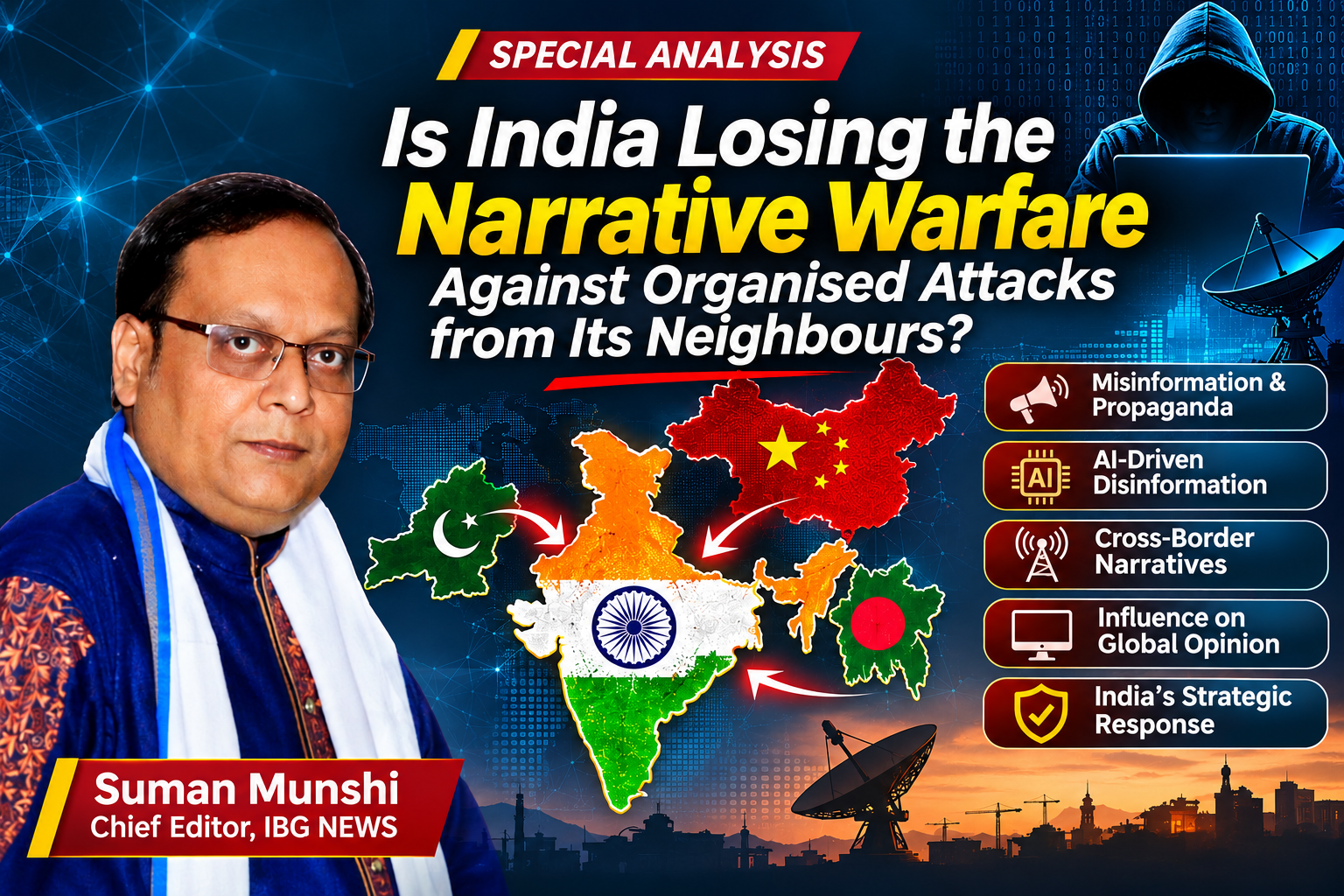

India’s Growing Challenge in the Information Domain: Strategic Competition, Misinformation and the Battle for Credibility
Special Strategic Affairs Analysis | International Relations | National Security
By Suman Munshi | IBG NEWS
Introduction: A New Arena of Strategic Competition
India’s national security challenges are increasingly extending beyond conventional military threats and diplomatic competition. In an era shaped by social media platforms, artificial intelligence, cyber operations and real-time global communication, the contest for international perception has become an important dimension of statecraft.
Across South Asia, governments, political actors, media organisations and online influence networks are competing to shape public understanding of political and security developments. For India, this evolving information environment presents both opportunities and challenges.
While India remains one of the world’s fastest-growing major powers with significant diplomatic influence, technological capabilities and international partnerships, recent events have highlighted the growing importance of strategic communication, digital resilience and rapid misinformation response.
Rather than asking whether India is losing an information war, a more relevant question is whether India is sufficiently prepared to compete effectively in an increasingly complex information ecosystem.
Information Competition as a National Security Challenge
Modern geopolitical competition extends beyond military deployments and economic influence. Information has become a strategic asset capable of shaping public perceptions, influencing diplomatic discourse and affecting international reputation.
Researchers and security analysts increasingly highlight the role of misinformation, disinformation, cyber-enabled influence operations and coordinated online campaigns in contemporary conflicts. During periods of political tension or military confrontation, competing narratives often emerge alongside developments on the ground.
The objective is not always to alter facts. More often, it is to influence how those facts are interpreted by domestic and international audiences.
For India, the challenge is particularly significant because developments involving border disputes, terrorism, internal security, religious issues and regional diplomacy frequently attract global media attention.
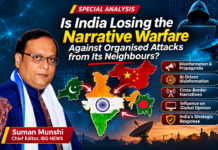
Pakistan and the Expanding Information Battlespace
Pakistan remains one of India’s most significant security challenges, both in traditional and information domains.
Following the April 2025 Pahalgam terrorist attack and India’s subsequent Operation Sindoor, military developments were accompanied by intense online activity. Competing claims regarding military effectiveness, casualties and operational outcomes circulated widely across digital platforms.
Research by Recorded Future documented rival pro-India and pro-Pakistan influence networks that were active during the crisis, illustrating how information operations increasingly accompany geopolitical confrontations. These networks sought to promote narratives favourable to their respective national positions while attempting to influence public perception and diplomatic discourse. [recordedfuture.com], [assets.rec…future.com]
Analysts also observed the circulation of manipulated visuals, recycled footage and unverified claims during the confrontation. The experience demonstrated that information management has become an important component of crisis response. [orfonline.org], [rusi.org]
The primary lesson for India is that military success and strategic communication are increasingly interconnected. Timely dissemination of verified information can help prevent misinformation from filling information gaps during periods of uncertainty.
China’s Long-Term Influence Challenge
If Pakistan represents an immediate security challenge, China presents a broader and more enduring strategic competition.
China’s regional influence is supported through economic investment, infrastructure projects, technological cooperation and diplomatic engagement. Simultaneously, researchers have documented online influence activities linked to Chinese information operations targeting sensitive political and social issues involving India.
Analysis published by the Australian Strategic Policy Institute identified coordinated online narratives related to India’s northeastern region and the Manipur conflict, demonstrating how domestic issues can become subjects of external information campaigns. [aspistrate…ist.org.au], [aspistrate…ist.org.au]
Such developments highlight an important reality: information competition often works by amplifying existing social tensions rather than creating entirely new grievances.
India’s response therefore requires not only countering misleading narratives but also strengthening social cohesion, institutional trust and regional engagement.
Bangladesh and a Changing Information Environment
India’s relationship with Bangladesh has become more complex following the political transition that began in 2024.
Political developments in Dhaka, debates about minority rights, cross-border narratives and regional geopolitical competition have contributed to a more contested information environment.
Independent fact-checking organisations have documented the growing circulation of misinformation relating to both Bangladesh and India. AFP Fact Check reported a significant increase in election-related disinformation and AI-generated content during Bangladesh’s 2026 election period. [factcheck.afp.com], [us.afpnews.com], [rfi.fr]
At the same time, Bangladesh-based fact-checking organisation Rumor Scanner reported multiple instances of misinformation about Bangladesh originating from Indian social media accounts and media outlets. [dhakatribune.com], [rumorscanner.com], [bssnews.net]
These findings demonstrate that misinformation is rarely a one-sided phenomenon. Information disorder can cross borders in multiple directions, affecting diplomatic relations and public trust.
For India, preserving credibility requires maintaining high standards of verification and responsible reporting, particularly when dealing with developments in neighbouring countries.
Lessons from Operation Sindoor
The May 2025 India-Pakistan confrontation highlighted the growing importance of information management during military crises.
Cybersecurity researchers observed that cyberspace became an active arena of competition alongside military operations. Information campaigns, cyber activities and competing narratives emerged rapidly across social media platforms. [orfonline.org], [rusi.org]
The episode demonstrated how quickly information vacuums can be filled by speculation, misinformation and partisan narratives.
Governments face a delicate balance. Operational security must be protected, but excessive information gaps can create opportunities for misleading claims to gain traction.
Building public trust through credible, timely and evidence-based communication remains one of the most effective responses.
International Perception and India’s Global Voice
India possesses one of the world’s largest and most diverse media ecosystems. However, domestic influence does not automatically translate into global narrative influence.
International audiences often rely on foreign media organisations, policy institutes, academic publications and digital platforms that operate according to their own editorial priorities and geopolitical perspectives.
Strengthening India’s presence in these spaces will require sustained investment in international journalism, research publications, multilingual communication, think-tank engagement and public diplomacy.
Credibility cannot be created solely through official messaging. It is strengthened through transparency, independent reporting and a demonstrated commitment to factual communication.
Artificial Intelligence and the Future Threat Landscape
The rapid advancement of generative artificial intelligence has introduced a new layer of complexity to information security.
Deepfakes, synthetic audio, fabricated photographs and AI-generated propaganda can now be produced and distributed at unprecedented speed. Researchers studying Bangladesh’s recent election cycle documented the growing role of AI-generated misinformation in political discourse. [factcheck.afp.com], [dergipark.org.tr]
India, like many democracies, will need stronger investments in digital forensics, verification technologies and rapid-response fact-checking systems.
The challenge is no longer simply identifying misinformation. It is identifying it quickly enough to limit its impact.
Strengthening India’s Information Resilience
Experts increasingly argue that information resilience must become an integral component of national security planning.
Several priority areas deserve attention:
1. Institutional Coordination
Strengthen cooperation between security agencies, communication departments and cyber institutions during national crises.
2. International Media Engagement
Improve outreach to foreign journalists, researchers and policy institutions.
3. Support for Independent Fact-Checking
Encourage robust verification mechanisms while protecting editorial independence.
4. AI-Based Detection Systems
Invest in deepfake detection, digital forensics and multilingual misinformation monitoring.
5. Regional Public Diplomacy
Expand educational, cultural and media partnerships across South Asia.
6. Responsible Journalism
Promote stronger editorial verification standards, particularly during military or diplomatic crises.
7. Public Media Literacy
Help citizens recognise manipulated content, misleading headlines and coordinated online influence campaigns.
These are not merely defensive measures. They are investments in long-term credibility.
The Real Contest Is About Trust
Current evidence does not demonstrate that India has lost an information war against its neighbours. However, it does show that information competition has become an increasingly significant strategic challenge.
Pakistan-linked and China-linked influence activities, regional misinformation campaigns and the spread of AI-generated content illustrate a rapidly evolving information environment. At the same time, misinformation originating within India can also undermine the country’s credibility and diplomatic standing. [recordedfuture.com], [assets.rec…future.com], [aspistrate…ist.org.au], [dhakatribune.com]
The central challenge for India is therefore not merely countering unfavourable narratives. It is building a reputation for reliability, transparency and credibility that can withstand periods of crisis.
In the long run, geopolitical influence will depend not only on military strength or economic growth but also on the ability to earn trust.
For India, strengthening that trust may become one of the most important strategic priorities of the coming decade.
Conclusion: Credibility as Strategic Power
The information environment has emerged as a critical arena of geopolitical competition. Pakistan’s information campaigns, China’s influence activities and evolving political dynamics across South Asia each present distinct challenges for India.
Yet India’s response must remain grounded in evidence, transparency and strategic patience.
Attempting to counter every criticism through official messaging risks undermining credibility. Building trust through facts, professional journalism, technological innovation and sustained diplomatic engagement offers a more durable path.
India possesses substantial economic, technological and diplomatic strengths. The challenge ahead is ensuring those strengths are communicated effectively and credibly to global audiences.
The future of influence will not belong solely to those who speak the loudest. It will belong to those who are trusted the most.
Sources
- Recorded Future – Influence Operations and Conflict Escalation in South Asia [recordedfuture.com], [assets.rec…future.com]
- Observer Research Foundation – Operation Sindoor and India’s Cyber Threat Landscape [orfonline.org]
- Australian Strategic Policy Institute – Beijing’s Online Influence Operations Along the India-China Border [aspistrate…ist.org.au], [aspistrate…ist.org.au]
- AFP Fact Check – Flood of Disinformation Ahead of Bangladesh Election [factcheck.afp.com], [us.afpnews.com], [rfi.fr]
- Rumor Scanner Bangladesh – Annual Review of Disinformation Concerning Bangladesh [dhakatribune.com], [rumorscanner.com], [bssnews.net]
Editorial Disclaimer: This article is an independent strategic analysis based on publicly available research, fact-checking reports and policy studies. It distinguishes documented influence operations from unverified allegations, independent criticism and organic public opinion. References to influence activities reflect the assessments of cited researchers and should not be interpreted as conclusive evidence of direct state control unless explicitly established by the cited sources.

