














Modi’s Gold Purchase Appeal: Did a Call for Restraint Help Indian Households Avoid a Costly Precious-Metal Correction?
A closer look at the Prime Minister’s May 2026 appeal, the subsequent fall in bullion prices, household savings and India’s foreign-exchange position
By Suman Munshi
Chief Editor, IBG NEWS
Date: 14 November 2026
A timely appeal amid economic uncertainty
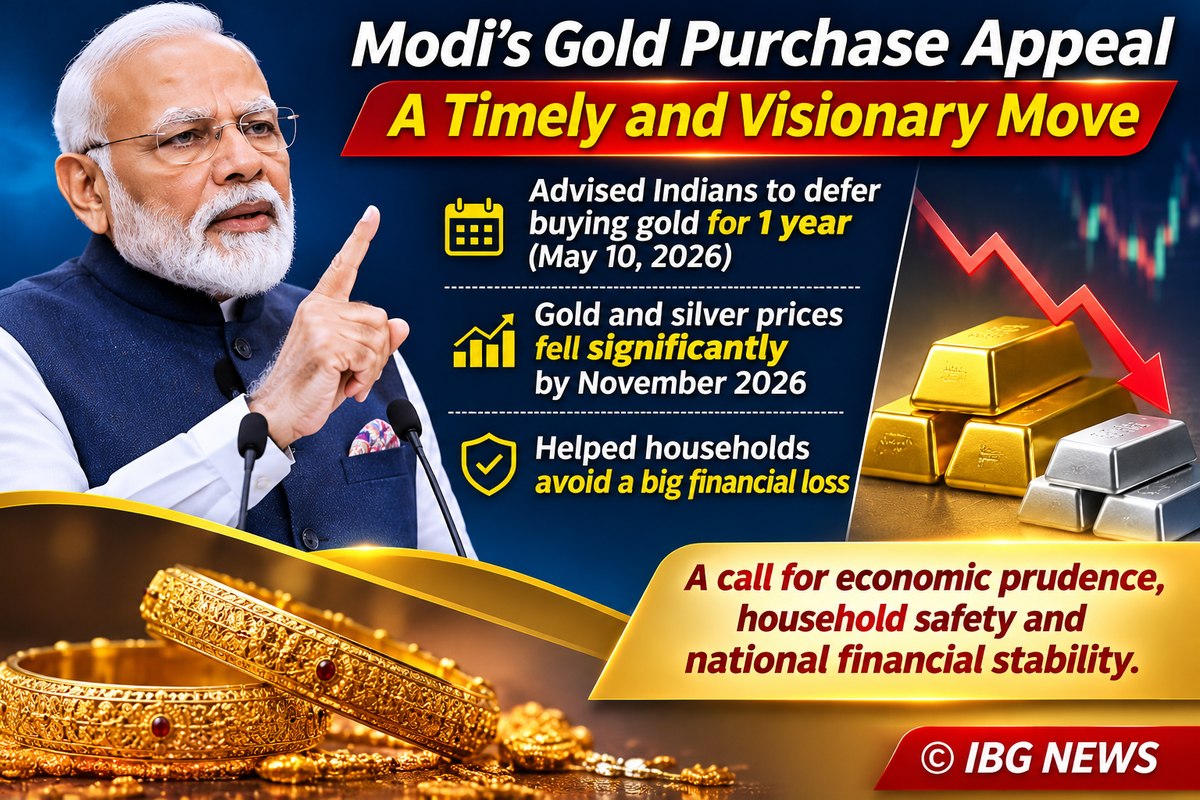
On 10 May 2026, Prime Minister Narendra Modi made an unusual appeal to Indian citizens: defer gold purchases for one year, particularly purchases associated with weddings, as the country faced mounting pressure on its foreign-exchange resources.
Speaking in Secunderabad, Telangana, against the backdrop of the West Asia conflict and rising international energy prices, the Prime Minister urged people to reconsider discretionary expenditure involving imported commodities. His broader appeal also covered fuel conservation, reduced unnecessary foreign travel, greater use of public transport and the revival of work-from-home arrangements wherever practical.
The message was rooted in an economic concern. India imports almost all the gold it consumes and depends heavily on imported crude oil. When international oil prices rise sharply, the country needs more foreign currency to pay its energy bill. Continued high gold imports can add further pressure to the balance of payments and the rupee.
The Prime Minister’s appeal therefore had a macroeconomic purpose: reduce avoidable foreign-exchange outflows during a period of global uncertainty.
But the subsequent movement in precious-metal prices has introduced another dimension to the discussion. Gold and silver experienced substantial corrections after reaching extraordinary highs in early 2026. For households that postponed large purchases, this created the possibility of avoiding a significant mark-to-market loss.
What happened to gold and silver prices?
The bullion market experienced exceptional volatility in 2026. A strong rally was followed by a sharp correction, with changing expectations about US interest rates, the dollar, inflation, geopolitical developments and investor profit-booking influencing prices.
A comparison of reported India Bullion and Jewellers Association (IBJA) rates illustrates the movement between the period immediately before the Prime Minister’s appeal and early November.
Indicative IBJA 999 bullion rates
| Commodity | 8 May 2026 | 6 November 2026 | Approximate change |
|---|---|---|---|
| Gold, per 10 grams | ₹1,51,149 | ₹1,41,452 | -6.4% |
| Silver, per kg | ₹2,54,798 | ₹1,82,868 | -28.2% |
Source: IBJA daily bullion market rates, as reported in the available bullion-market records. These are indicative benchmark rates, excluding GST and other retail charges.
The figures indicate that a person who purchased at the May benchmark and valued the same quantity at the November benchmark would have faced a lower market value.
For example:
- A 10-gram gold purchase at ₹1,51,149 would have had an indicative November value of ₹1,41,452 — a difference of approximately ₹9,697.
- A one-kilogram silver purchase at ₹2,54,798 would have had an indicative November value of ₹1,82,868 — a difference of approximately ₹71,930.
These are illustrative price differences, not verified household losses. Actual purchase prices vary by date, city, purity, GST, making charges, dealer margins and product type.
The comparison nevertheless demonstrates why postponing a large discretionary purchase during a period of extreme volatility could have protected a household from buying at a relatively expensive level.
The January peak and the scale of the correction
The correction becomes even more striking when compared with the extraordinary January 2026 highs.
Financial Express reported that MCX gold reached approximately ₹1,76,306 per 10 grams on 29 January 2026, while the November 6 price was around ₹1,43,184. That represents a decline of roughly 18.8% from the reported peak.
For silver, the same report cited a January peak of approximately ₹3,84,632 per kilogram and a November 6 price of ₹1,87,490. Calculated from those two quoted figures, the decline is approximately 51.3%.
The silver comparison is particularly significant because silver is both an investment metal and an industrial commodity. Its price can react sharply to changes in investor sentiment, industrial-demand expectations, liquidity and speculative positioning.
The figures are based on the quoted MCX price observations and should not be confused with retail jewellery prices or a guaranteed return available to every investor.
How postponing a purchase could have protected household wealth
Indian households purchase gold for several reasons: weddings, religious ceremonies, family traditions, gifts, savings and long-term wealth preservation.
However, a purchase made during a price surge can create a substantial financial burden, particularly when financed through savings accumulated over many years or through borrowing.
Consider a household planning to purchase 50 grams of gold for a wedding. At the IBJA benchmark of 8 May, the indicative bullion value would have been approximately ₹7.56 lakh. At the 6 November benchmark, the equivalent bullion value would have been approximately ₹7.07 lakh.
The difference would be about ₹48,500 before accounting for taxes, making charges and other retail costs.
For a family planning to purchase five kilograms of silver, the corresponding indicative difference between the two benchmark dates would be approximately ₹3.60 lakh.
Such examples explain the potential benefit of avoiding a large purchase during a period of elevated prices. They do not establish that every household would have made these savings, because actual purchase dates, quantities and prices differ.
There is also an important distinction between an investment loss and a lower replacement value. A family buying jewellery for a wedding and using it for generations may not regard a short-term market correction in the same way as a trader holding bullion for profit.
Why the Prime Minister’s appeal mattered to India’s economy
The household dimension was only one part of the issue. The larger concern was India’s dependence on imported commodities and the foreign currency required to pay for them.
1. Reducing demand for imported gold
India is one of the world’s largest gold-consuming countries, but domestic production is insufficient to meet household demand. A substantial proportion of gold consumption is therefore met through imports.
When import demand rises, Indian buyers and importers require more foreign currency. This can increase demand for US dollars and add pressure to the country’s external accounts.
2. Protecting the rupee during an oil shock
Crude oil is a strategic necessity for India’s transport, industrial and energy systems. A sudden increase in global oil prices raises the import bill and can put pressure on the rupee.
When oil imports become more expensive at the same time as gold imports remain elevated, the combined foreign-exchange requirement can become more difficult to manage.
3. Limiting the current-account burden
The current account records trade in goods and services, income and transfers. A large import bill, particularly when not matched by export earnings, can widen the current-account deficit.
Reducing non-essential import demand can help moderate that pressure, although the overall outcome also depends on oil prices, exports, services earnings, capital flows and the exchange rate.
4. Encouraging more cautious household financial decisions
A temporary pause can encourage families to review whether a large purchase is essential immediately or can be postponed.
This is particularly relevant when prices have risen rapidly and the possibility of a correction is high. It can help households preserve liquidity and avoid using emergency savings or expensive loans to purchase an asset at an inflated price.
Did Modi’s appeal cause gold and silver prices to fall?
This is where a careful distinction is essential.
The subsequent correction in bullion prices does not prove that the Prime Minister’s appeal caused the fall. Gold and silver are traded in global markets, and Indian prices are influenced by international bullion prices, the rupee-dollar exchange rate, import duties, taxes and domestic demand.
Among the factors reported during the 2026 correction were:
- Changing expectations about US Federal Reserve interest-rate policy.
- Movements in US bond yields and the dollar.
- Profit-booking after a powerful rally.
- Changes in inflation expectations and global energy prices.
- Investor liquidity requirements and portfolio adjustments.
- Silver’s additional exposure to industrial-demand expectations.
The correction was therefore part of a much wider international market movement.
The more defensible interpretation is that Modi’s appeal encouraged restraint at a time when precious-metal prices were unusually high and the national economy was facing external financial pressures. Households that delayed purchases were subsequently in a position to benefit from lower benchmark prices, although the extent of any benefit depended on their individual circumstances.
An important point: the advice was about gold, not an explicit silver-buying ban
The Prime Minister’s widely reported appeal specifically called for avoiding gold purchases for one year, particularly wedding-related purchases. It was part of a wider foreign-exchange conservation message.
The subsequent silver correction is relevant to understanding precious-metal market risk, but it should not be presented as proof that the Prime Minister specifically advised citizens to avoid buying silver.
This distinction matters for accurate reporting.
What Indian households should learn from the episode
The episode offers several practical lessons for household financial planning.
Avoid panic buying: A rapidly rising price does not automatically make an asset a good purchase.
Separate jewellery from investment: Jewellery carries making charges, wastage and other costs. Its financial return can differ considerably from the movement in the underlying bullion price.
Avoid excessive borrowing: Financing gold or silver purchases through high-interest debt can magnify the financial consequences of a price correction.
Use a planned purchase strategy: Families with genuine long-term requirements may consider purchasing in stages rather than committing their entire budget at one market level.
Maintain emergency savings: Gold and silver should not replace liquid funds needed for healthcare, education, household emergencies or other essential expenses.
Understand that prices can recover: A correction does not guarantee that prices will continue falling. Precious metals can rise again, and decisions should reflect individual financial needs and risk tolerance.
A broader lesson in economic communication
The May 2026 appeal also highlighted an important relationship between national economic management and household decisions.
Macroeconomic stability is not determined solely by government policy, central-bank decisions or international trade negotiations. Millions of individual decisions, taken together, can influence the demand for imported goods and the country’s foreign-exchange requirements.
A temporary reduction in discretionary imports cannot by itself resolve structural challenges. India still needs stronger exports, greater domestic production, diversified energy supplies, efficient logistics and a stable investment environment.
Nevertheless, public awareness of the economic consequences of import dependence can be valuable during periods of external stress.
Conclusion: A case for prudence, not a guaranteed market prediction
Prime Minister Narendra Modi’s May 2026 appeal came at a time when India was confronting a difficult combination of geopolitical uncertainty, elevated energy prices and pressure on foreign-exchange resources.
The subsequent correction in gold and silver prices gave the appeal an additional household-finance dimension. The available benchmark figures show that postponing purchases from elevated May levels could have helped some families avoid a lower market valuation by November, particularly in silver.
However, the correction was driven by international market forces, not demonstrably by the Prime Minister’s statement. Nor can the available evidence establish how many households followed the advice or how much money they actually saved.
The lasting lesson is that national economic prudence and household financial prudence can sometimes point in the same direction: avoid unnecessary spending during periods of uncertainty, preserve liquidity, and do not confuse a rapidly rising market with a guaranteed investment opportunity.
For Indian families, the value of the appeal may ultimately lie not in a prediction about the next movement in gold prices, but in the reminder that timing, affordability and financial discipline matter when making large purchases.
Data Sources and Verification Notes
This analysis is based on publicly available statements, market data and official economic information available as of 14 November 2026.
Prime Minister’s Appeal
References to Prime Minister Narendra Modi’s appeal on 10 May 2026 are based on publicly reported remarks delivered during an address in Secunderabad, Telangana, concerning foreign-exchange conservation, energy security and precautionary economic measures during a period of international uncertainty.
Gold and Silver Price Data
The indicative bullion-price comparisons in this article are derived from benchmark rates reported by the India Bullion and Jewellers Association (IBJA) and publicly reported Multi Commodity Exchange (MCX) price observations.
The figures are intended to illustrate market movements rather than actual realised gains or losses for individual households.
Actual consumer purchase prices may vary because of:
- GST
- Making charges
- Wastage charges
- Product design premiums
- Dealer margins
- Local market differences
- Purity variations
Household Savings Illustrations
Examples involving 10 grams, 50 grams or larger quantities of precious metals are hypothetical illustrations intended to demonstrate the effect of changing bullion prices.
They should not be interpreted as verified savings achieved by specific households or as evidence that individual consumers followed the Prime Minister’s advice.
Import Dependence and Foreign Exchange
Discussion concerning India’s dependence on imported gold and crude oil is based on publicly available government, Reserve Bank of India (RBI), Ministry of Commerce, Ministry of Petroleum and Natural Gas, and World Gold Council data regarding India’s commodity-import profile.
Relationship Between the Appeal and Bullion Prices
IBG NEWS has found no publicly available evidence demonstrating that Prime Minister Modi’s appeal caused the subsequent decline in gold or silver prices.
Gold and silver are globally traded commodities whose prices are influenced by:
- International bullion markets
- Monetary-policy expectations
- United States interest rates
- Inflation expectations
- Currency movements
- Geopolitical developments
- Investment demand
- Industrial demand (particularly for silver)
Accordingly, this article does not claim a causal relationship between the Prime Minister’s remarks and subsequent market movements.
Household Behaviour
At the time of publication, no publicly available nationwide dataset has been identified that conclusively measures how many Indian households postponed gold purchases as a direct result of the appeal.
Consequently, any discussion of household financial benefit should be viewed as a potential outcome rather than a verified national trend.
Where a conclusion cannot be established from available evidence, IBG NEWS has sought to identify the limitation explicitly.
The assessment presented is therefore intended as an economic and financial analysis rather than proof of causation.
Suman Munshi
Chief Editor, IBG NEWS

