









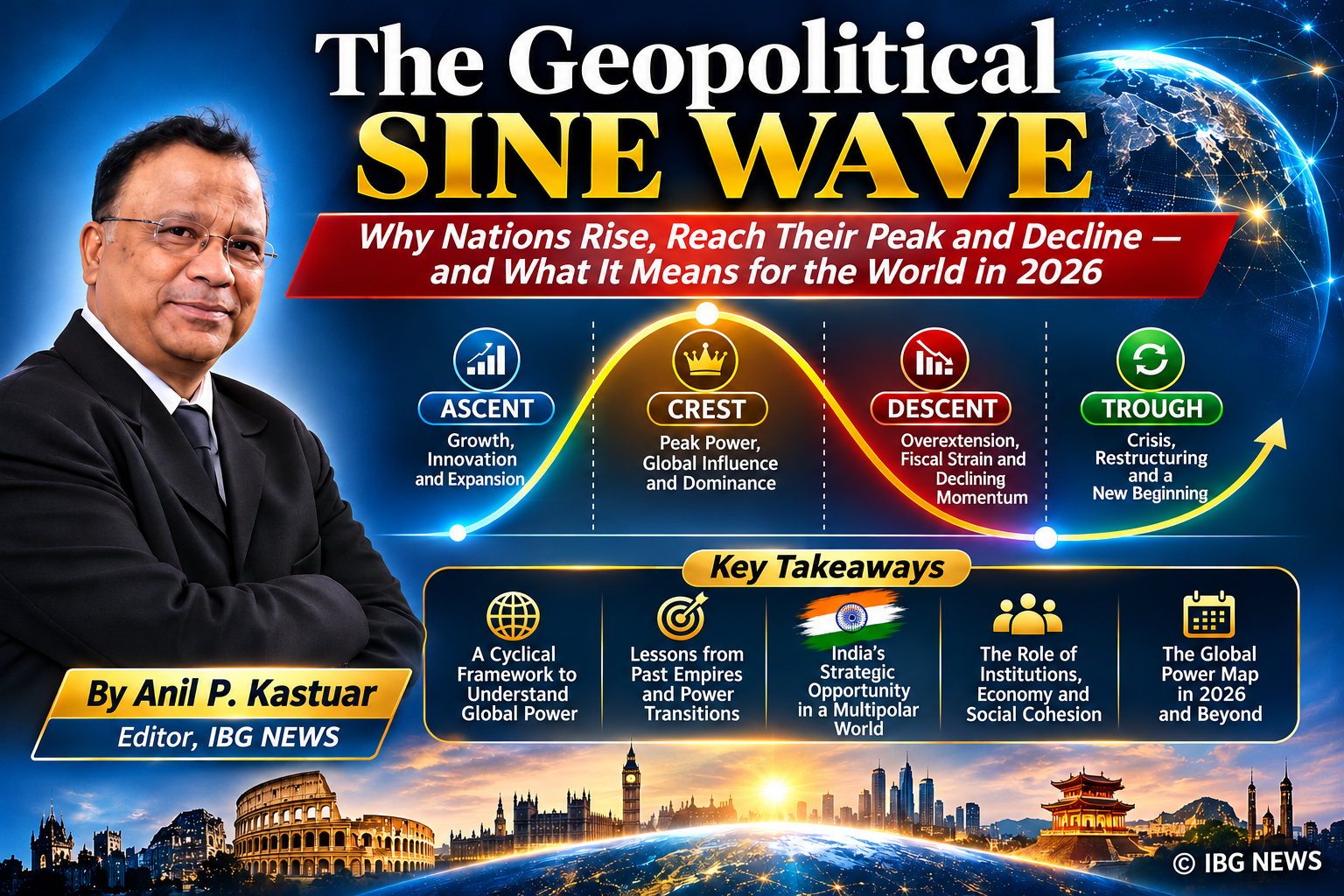

The Geopolitical Sine Wave: Why Nations Rise, Reach Their Peak and Decline — and What It Means for the World in 2026
A new framework for understanding global power shifts, the changing balance between East and West, and India’s strategic opportunity in an emerging multipolar order
By Anil P. Kastuar | Editor, IBG NEWS
History rarely moves in a straight line. Empires rise, expand their influence, reach periods of extraordinary power and eventually confront the pressures of economic exhaustion, institutional weakness, political divisions and external competition. Some manage to reinvent themselves, while others lose their influence or disappear from the geopolitical map.
The rise and decline of nations is one of the most enduring subjects of political and economic research. From the Roman Empire and the Ottoman Empire to the British Empire and the emergence of the United States, history offers numerous examples of how global power changes hands.
A compelling way to examine these developments is through the concept of the Geopolitical Sine Wave — a framework that views the power of nations as a cyclical process rather than an uninterrupted upward journey.
The idea is particularly relevant in 2026, when the international system is experiencing significant changes. The United States continues to exercise enormous financial, military and technological influence, China has emerged as a major economic and industrial power, India is expanding its international role, and several regional powers are seeking greater strategic independence.
The central question is no longer simply which country is powerful today. It is whether the existing global power structure is approaching a period of transformation.
Understanding the Geopolitical Sine Wave
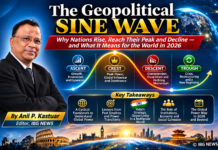
The Geopolitical Sine Wave framework proposes that the power trajectory of a nation can be understood through four broad stages:
- The Ascent — the period of growth and expansion
- The Crest — the peak of influence and dominance
- The Descent — the period of structural pressure and declining momentum
- The Trough — the phase of crisis, restructuring or transformation
This model draws attention to the relationship between economic productivity, institutional strength, military capability, currency influence, demographic trends and social cohesion.
It suggests that a country’s international position depends not only on the resources it possesses but also on how effectively it manages those resources over time.
The framework is conceptual. It should not be interpreted as a mathematical law that predicts the exact rise or collapse of a country. Its value lies in providing a structured way to examine recurring historical patterns and compare the strengths and vulnerabilities of different powers.
Four stages that shape the destiny of nations
1. The Ascent: Innovation, investment and national confidence
The ascent phase is generally associated with economic expansion, institutional development, technological progress and a strong sense of national purpose.
Countries in this phase often invest heavily in infrastructure, education, research, manufacturing and productive capacity. Their institutions are capable of responding to new challenges, while entrepreneurship and innovation create opportunities for economic mobility.
The rise of post-1978 China offers an important example of rapid economic transformation. Market-oriented reforms, industrial expansion, infrastructure investment and integration into global trade helped turn China into one of the world’s leading economic powers.
India’s economic liberalisation beginning in 1991 also marked a major structural transition. The expansion of private enterprise, services, technology, telecommunications and international trade opened new possibilities for the Indian economy.
However, economic ascent is not guaranteed to continue indefinitely. Maintaining momentum requires institutional adaptability, investment in human capital, technological competitiveness and social stability.
2. The Crest: When dominance creates new vulnerabilities
The crest represents a period when a nation reaches an extraordinary level of international influence.
It may dominate global trade, finance, technology, military alliances or international institutions. Its currency may become widely used, its companies may lead global markets, and its military presence may extend across important strategic regions.
The British Empire during the nineteenth century and the United States during the post-Second World War period demonstrate different forms of global dominance.
Yet the peak of power can also create new vulnerabilities.
Maintaining international commitments becomes expensive. Domestic economic priorities compete with overseas responsibilities. Established industries face pressure from emerging competitors, while political and institutional complacency can weaken the ability to respond to change.
The central lesson is that dominance does not automatically guarantee future security. A country must continue to innovate and reform even when its international position appears unchallenged.
3. The Descent: Overextension, inequality and institutional pressure
The descent phase describes a situation in which the momentum of a powerful nation begins to weaken.
Several factors may contribute:
- Excessive public debt and fiscal pressure.
- Declining industrial competitiveness.
- Political polarisation and institutional distrust.
- Growing economic inequality.
- Strategic overextension and expensive international commitments.
- Demographic pressures and declining productivity.
- Dependence on vulnerable international supply chains.
These conditions do not necessarily mean that a country is about to collapse. Powerful economies can remain influential for generations despite serious internal difficulties.
The United States, for example, continues to possess major advantages in advanced technology, financial markets, research institutions, military capabilities and global alliances. At the same time, debates over public debt, political polarisation, industrial competitiveness and international commitments raise important questions about the long-term sustainability of its global leadership.
Europe faces a different set of challenges, including demographic ageing, energy security, industrial competitiveness and the management of political differences among member states.
The geopolitical sine-wave approach encourages analysts to examine these pressures together rather than treating each problem as an isolated development.
4. The Trough: Crisis, restructuring or a new beginning
The trough represents the lowest point of a power cycle.
A nation reaching this stage may experience political fragmentation, economic instability, territorial losses or institutional breakdown. Alternatively, it may undertake major reforms and establish the foundations for a new period of growth.
The post-Second World War reconstruction of Germany and Japan illustrates how countries devastated by conflict can rebuild through institutional reform, industrial development, education and international economic cooperation.
China’s transformation following the economic reforms initiated in 1978 provides another example of a major structural shift.
The important distinction is that decline does not always mean disappearance. The ability to reform, learn and adapt can determine whether a country enters a prolonged period of weakness or begins a new phase of development.
Why the duration of national power cycles differs
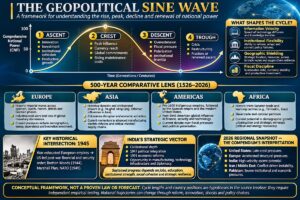
The attached research framework proposes that geopolitical cycles can expand or contract depending on several structural variables.
Four factors are particularly important.
Information and technological velocity: In earlier centuries, technological knowledge could remain concentrated within a country or region for long periods. Today, information moves rapidly across borders. New technologies can transform industrial and military competition within a relatively short period.
Institutional flexibility: Countries with accountable institutions, effective governance, peaceful political transitions and the ability to correct policy failures may be better equipped to manage crises.
Geographic and strategic security: Geography, energy resources, food security, access to maritime routes and supply-chain resilience influence a country’s exposure to external shocks.
Fiscal discipline: Public debt, currency stability, productive investment and the quality of government expenditure influence the long-term financial strength of a nation.
These factors help explain why some countries sustain international influence for centuries while others experience rapid changes in their relative position.
The suggested historical cycle lengths in the framework should, however, be treated as hypotheses requiring further empirical testing rather than universal timelines.
The global power transition: Europe, America and Asia
The past five centuries have witnessed major changes in the geographical centre of global power.
European maritime empires expanded their influence through trade, colonisation, naval strength and industrial development. The Industrial Revolution transformed the economic and military capabilities of European states.
The two World Wars devastated much of Europe and accelerated the transfer of global strategic influence towards the United States and the Soviet Union.
The collapse of the Soviet Union in 1991 created a period of American predominance, while the economic rise of China and the growing influence of other Asian economies have gradually changed the international balance.
Today, the global system is moving towards greater strategic competition and a more complex distribution of power.
The future may not be defined by a simple transfer of leadership from one country to another. It may instead involve several centres of influence competing and cooperating across finance, technology, trade, defence, energy and diplomacy.
The 1945 turning point: A lesson in the transfer of global influence
The year 1945 represents one of the clearest historical turning points in the modern international system.
The Second World War left Britain and France economically exhausted, while large parts of Europe faced enormous reconstruction challenges.
The United States emerged with a powerful industrial base, substantial financial resources and a central role in shaping the post-war international economic and security architecture.
The Bretton Woods arrangements of 1944 established a dollar-centred international monetary system. The United States subsequently played a major role in European reconstruction through the Marshall Plan, while NATO, established in 1949, became a central pillar of Western collective security.
This transition illustrates an important principle of the geopolitical sine-wave framework: international power is not determined only by military victory or territorial control. Financial strength, industrial capacity, institutional influence and the ability to organise international partnerships can be equally decisive.
India’s historical journey: From civilisational influence to modern strategic power
India occupies a distinctive position in the geopolitical analysis of the last five centuries.
Before the expansion of European colonial rule, the Indian subcontinent was one of the world’s important centres of agriculture, manufacturing, textiles, metallurgy, commerce and intellectual activity.
Indian cultural, religious, philosophical and commercial influences travelled across Southeast Asia through maritime trade, migration, religious exchange and cultural interaction.
The Mughal Empire, regional kingdoms and maritime trading networks represented different forms of political and economic organisation across the subcontinent.
The expansion of the British East India Company and the establishment of British colonial rule fundamentally altered India’s economic and political structure. Colonial extraction, changes in trade patterns, industrial disruption and the transfer of political authority had profound consequences for the subcontinent.
Independence in 1947 brought the enormous responsibility of building a modern democratic republic while addressing the consequences of Partition, poverty, institutional fragmentation and economic underdevelopment.
The integration of princely states under the leadership of Sardar Vallabhbhai Patel was a defining achievement in the consolidation of independent India.
The economic reforms of 1991 subsequently opened a new phase of development. Liberalisation, the expansion of the services sector, information technology, telecommunications, pharmaceuticals, manufacturing and international trade helped transform India’s economic position.
India’s current opportunity lies in combining its large domestic market, young workforce, technological capabilities, democratic institutions and strategic partnerships.
However, the country’s long-term success will depend on several critical priorities:
- High-quality education and skills development.
- Manufacturing competitiveness and research investment.
- Employment generation and inclusive growth.
- Modern infrastructure and reliable energy supplies.
- Strong institutions and effective public administration.
- Social harmony and constitutional pluralism.
- Strategic autonomy supported by credible international partnerships.
India’s ascent cannot be measured solely through GDP growth or military expenditure. Its durability will depend on whether economic progress translates into better living standards, stronger institutions and greater opportunities for its citizens.
Ideology, religion and social cohesion: The hidden forces behind national strength
One of the most important arguments in the research framework concerns the role of ideological and religious tensions in shaping a country’s geopolitical trajectory.
Economic and military power are visible indicators of national strength. Social cohesion and institutional trust are less visible, but they can be equally important.
When political, religious or cultural divisions become deeply entrenched, they can weaken public institutions, obstruct policymaking and reduce the capacity of a country to respond to external challenges.
A society does not need to be culturally uniform to remain strong. In fact, diverse societies can derive considerable strength from pluralism, open debate and the ability to accommodate different identities within a common constitutional framework.
The challenge arises when political competition turns social differences into permanent hostility.
For India, preserving its pluralistic constitutional framework while ensuring social stability is a strategic necessity. For the United States and European countries, maintaining institutional trust and managing social change will remain important components of long-term national resilience.
The wider lesson is that social cohesion should not be confused with enforced uniformity. Sustainable unity is built through equal citizenship, justice, opportunity and public confidence in institutions.
The 2026 geopolitical map: Four different trajectories
The research compendium places four major geopolitical regions and countries within its proposed framework.
United States — Late crest and possible descent pressures: The document identifies political polarisation, institutional distrust, fiscal pressures and the cost of maintaining global commitments as potential vulnerabilities. Nevertheless, American leadership in technology, finance, research, defence and alliances remains substantial.
Europe — Accelerated descent pressures: The framework highlights demographic ageing, energy dependence, industrial challenges and political fragmentation. Europe’s future influence will depend partly on its ability to strengthen strategic coordination, technological competitiveness and economic resilience.
India — High-velocity ascent: India is presented as a major potential beneficiary of changing global economic and strategic conditions. Its demographic profile, expanding market, technological development and international partnerships create significant opportunities. Social stability, employment and institutional effectiveness will be essential to sustaining this trajectory.
Pakistan and the wider Middle East — Structural instability: The framework identifies political, economic and security pressures in these regions. However, their future trajectories are highly dependent on domestic reforms, regional diplomacy, conflict resolution, economic diversification and international developments.
These are analytical interpretations rather than definitive predictions. The geopolitical position of any country can change significantly as economic, political, technological and security conditions evolve.
The coming multipolar world
The emerging international order is increasingly shaped by competition across several interconnected fields.
Artificial intelligence, semiconductors, advanced manufacturing, critical minerals, energy security, space technology, maritime routes and financial systems are becoming central instruments of national power.
Countries that control important technological ecosystems and resilient supply chains may gain strategic advantages beyond what conventional economic indicators reveal.
China’s manufacturing capacity, America’s technological and financial influence, India’s expanding digital and industrial capabilities, Europe’s research and regulatory influence, and the strategic resources of several emerging economies will all shape the next phase of global competition.
No single indicator can adequately measure this transformation.
A country may possess considerable military strength but remain economically vulnerable. Another may have a large economy but lack strategic autonomy in critical technologies. A third may have abundant natural resources but weak institutions.
The future balance of power will increasingly depend on the ability to combine economic productivity, technological innovation, social resilience, institutional credibility and strategic partnerships.
What the Geopolitical Sine Wave means for India
For India, the present international transition offers both an opportunity and a warning.
The opportunity is to become a leading centre of manufacturing, technology, trade, education and strategic diplomacy. India’s location in the Indo-Pacific, its growing international partnerships and its position in global supply-chain diversification provide important advantages.
The warning is that economic growth alone cannot guarantee sustained national power.
India must avoid the vulnerabilities that have weakened other major powers: institutional complacency, excessive inequality, policy inconsistency, inadequate investment in human capital, strategic dependence and social polarisation.
A strong India will require a productive economy, capable institutions, technological independence in critical sectors and a society confident in its constitutional values.
Its international influence will be strongest when domestic development and global engagement reinforce one another.
Conclusion: History offers patterns, not predetermined destinies
The Geopolitical Sine Wave provides an interesting way to examine the rise, peak, decline and possible renewal of nations. Its four-stage framework encourages a broader understanding of national power by bringing economic, military, institutional, demographic and social factors into one analytical picture.
But history does not operate according to a perfectly predictable mathematical clock. Nations can break established patterns through innovation, reform, diplomacy and institutional renewal. External shocks, technological breakthroughs, leadership decisions and public movements can also alter the direction of national development.
The decline of one power does not automatically guarantee the rise of another. Nor does economic expansion ensure long-term geopolitical leadership.
The most important lesson for the world in 2026 is that national power must be continuously renewed.
For India, the coming decades may provide a historic opportunity to strengthen its position in an increasingly multipolar world. Realising that opportunity will require not merely economic expansion or military modernisation, but also social trust, institutional strength, technological capability and responsible global leadership.
The nations that understand the changing forces of history — and possess the courage to reform before a crisis arrives — are more likely to shape the future rather than become victims of it.
History may move in cycles, but the decisions of nations determine how those cycles unfold.
By Anil P. Kastuar
Editor, IBG NEWS
Editorial note: This article develops the conceptual framework presented in the research compendium “The Geopolitical Sine Wave”. The proposed cycle model and its country assessments are analytical interpretations, not independently validated mathematical forecasts. Historical and economic comparisons should be read as broad interpretations rather than precise statistical measurements.

