


















Substrate promiscuity of fungi-generated enzyme Laccase shows potential in degrading industrial dye effluents
By PIB Delhi
An enzyme called laccase generated by a group of fungi has been found capable of degrading a variety of hazardous organic dye molecules that are regularly drained into water bodies after dying clothes in the textile industry. This observed characteristic which the scientists termed substrate promiscuity, can have deep implications in designing enzyme-coated cassettes for treating heavily dye-polluted water through a natural solution to make the environment greener.
Laccase, was known for its capacity to degrade various organic molecules. Hence the scientists saw scope in using it to develop a technology to treat/degrade the dye effluents emanating from textile industries.
A joint team of Prof. Ranjit Biswas and Dr. Suman Chakrabarty from S. N. Bose National Center for Basic Sciences (SNBNCBS), Kolkata, an autonomous institute of Department of Science and Technology (DST) tested the efficacy of laccase in degrading some standard dye molecules like Methyl Green, Crystal Violet, Thioflavin T, Coumarin 343, and Brilliant Blue.
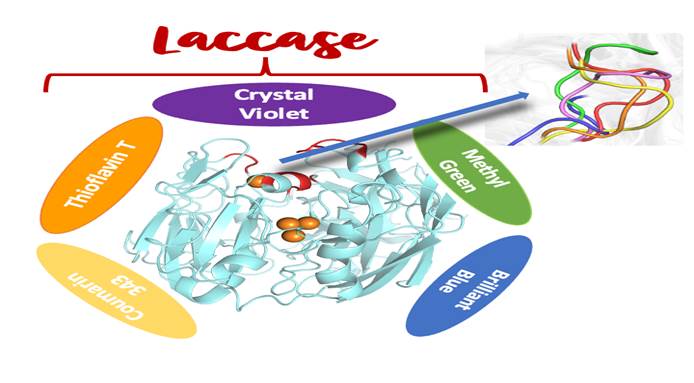
Combining UV/Visible spectroscopy and computer simulations they demonstrated that many organic dye molecules with varying kinetics and wide variation in charge, size and shape can be degraded by the enzyme laccase. Laccase, generated by a group of fungi, contains 4 copper atoms in two different oxidation states, and degrades substrates through redox reactions, producing only water and simplest non-virulent or less virulent oxides of carbon, nitrogen and sulphur.
Using computational modeling and simulation the scientists have elucidated the molecular thermodynamic origin and mechanism behind this substrate promiscuity. Molecular docking and Molecular Dynamics (MD) simulation studies confirmed that the active site of laccase can accommodate a wide range of dye molecules with varying charge and shape due to conformational plasticity of a loop covering the active site. The shape of the binding pocket can change adaptively. Internal cancellation between different types of interactions leads to almost similar binding affinity for very different molecules. This substrate promiscuity of laccase offers an immense biotechnological potential for a broad-spectrum degrader for industrial dye effluents.
Publication link: doi: 10.1021/acs.jpclett.2c03126
For more details, please contact Prof. Ranjit Biswas (ranjit[at]bose[dot]res[dot]in) and Dr. Suman Chakrabarty (sumanc[at]bose[dot]res[dot]in).

