





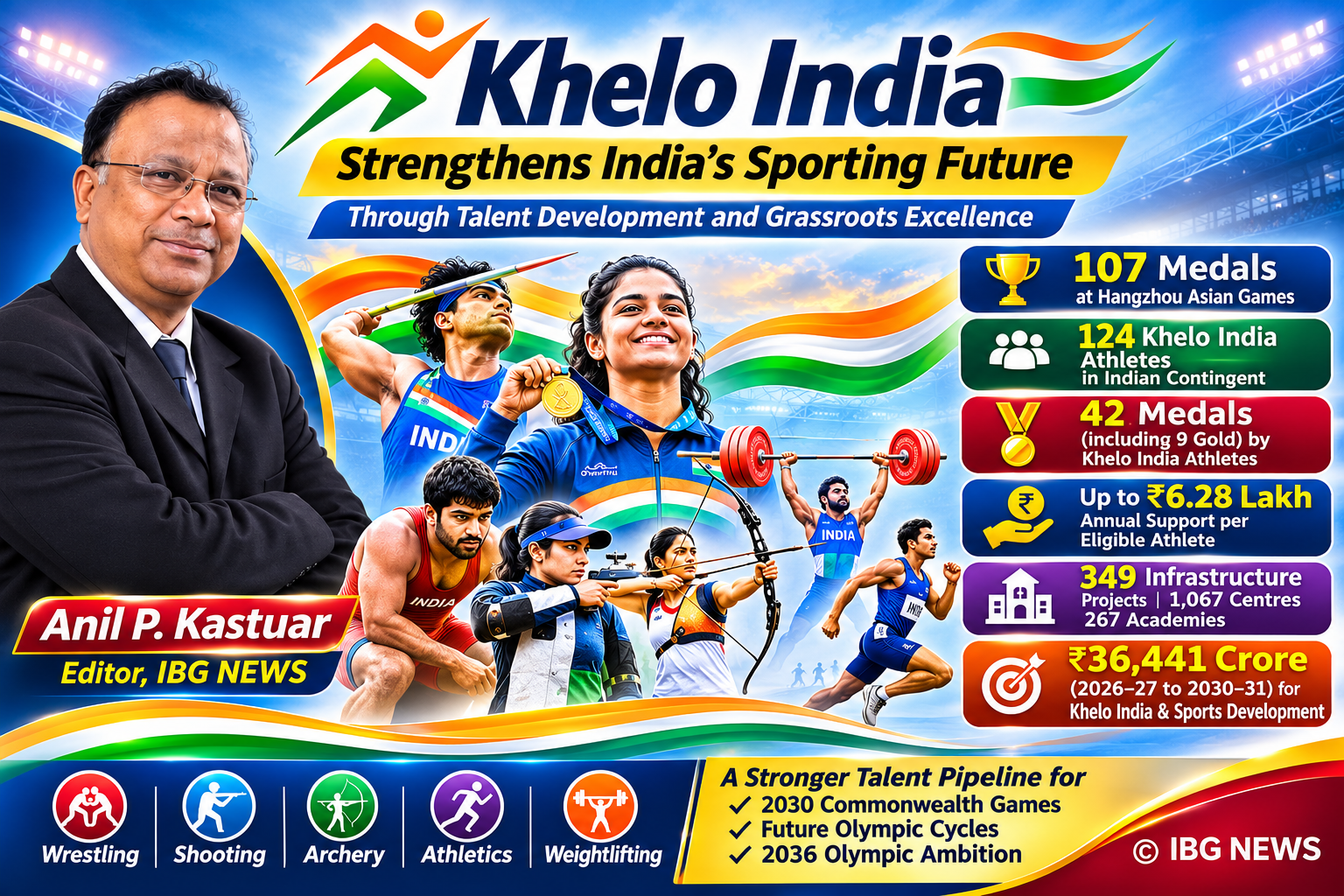

KHELO INDIA STRENGTHENS INDIA’S SPORTING FUTURE
Grassroots Talent, Financial Support and a New Pathway to Global Excellence
By Anil P. Kastuar,Editor,
New Delhi | IBG NEWS
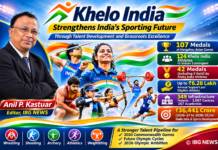
India’s ambition to emerge as a leading sporting nation is receiving fresh momentum through the Khelo India programme, a national sports development initiative focused on identifying young talent, strengthening grassroots infrastructure and creating a structured pathway towards international sporting excellence.
Launched in 2017, Khelo India has progressively developed into an important component of India’s sports ecosystem. By connecting grassroots competitions, schools, universities, specialised training centres and elite development programmes, the initiative seeks to ensure that promising athletes receive opportunities irrespective of their geographical or economic background.
The programme has entered a significantly expanded phase for 2026–27 to 2030–31, with the Union Cabinet approving a combined financial outlay of ₹36,441 crore for the revamped Khelo India Scheme and enhanced assistance to National Sports Federations. The expansion is intended to strengthen athlete development, coaching, sports infrastructure, scientific training and international exposure.
International Achievements Demonstrate the Growing Talent Pipeline
The contribution of Khelo India athletes to India’s international sporting performances is reflected in the country’s achievements at major competitions.
At the Hangzhou Asian Games in 2023, India recorded a historic total of 107 medals, comprising 28 gold, 38 silver and 41 bronze medals.
According to a written parliamentary reply by the Union Minister for Youth Affairs and Sports, 124 athletes in India’s 644-member contingent were Khelo India athletes. They contributed 42 medals, including nine gold medals, according to the Ministry’s reported figures.
The same government communication also confirmed that 28 Khelo India athletes were included in India’s 117-member contingent for the Paris 2024 Olympic Games.
These figures demonstrate the importance of a structured athlete-development system in connecting grassroots sporting opportunities with elite international competition.
Government Support Reaches Thousands of Athletes
Financial assistance and professional training are central components of the Khelo India athlete-development framework.
As reported by the Ministry of Youth Affairs and Sports in its July 2026 programme update, 2,745 Khelo India Athletes were receiving support through coaching, sports equipment, medical care and monthly out-of-pocket allowances.
The same official update reported the following achievements:
- 349 sports infrastructure projects approved.
- ₹3,176 crore invested in these infrastructure projects.
- 1,067 Khelo India Centres established.
- 267 sports academies supported.
- 2,745 Khelo India Athletes receiving programme assistance.
Under the established Khelo India scholarship framework, eligible residential athletes training at accredited academies have been provided annual assistance of up to ₹6.28 lakh. This includes ₹1.20 lakh as an annual Out of Pocket Allowance, transferred directly to the athlete, and ₹5.08 lakh in institutional support covering training and associated development expenses.
The ₹6.28 lakh provision is subject to the applicable scholarship and training conditions; it should not be interpreted as an unconditional cash payment to every registered athlete.
Such assistance helps address the financial challenges associated with professional coaching, accommodation, nutrition, equipment and competition exposure.
Strengthening India’s Sporting Disciplines
Khelo India’s development strategy extends across multiple sporting disciplines, with an emphasis on improving infrastructure, identifying promising athletes and providing specialised training.
Wrestling
India has a strong tradition of wrestling, particularly in Haryana and other northern states. Modern training facilities, mat-based infrastructure, professional coaching and scientific assessment are helping young wrestlers progress beyond traditional training environments. The objective is to create a broader talent-identification network and prepare athletes for national and international competitions.
Shooting
Shooting requires specialised equipment, electronic targets, ammunition and technically advanced training facilities. Investment in dedicated shooting infrastructure is important for reducing entry barriers and providing young athletes with access to professional training environments.
Archery
Archery development has particular significance for rural and tribal communities, where promising talent may not always have access to expensive equipment and specialised coaching. Training academies and competitive opportunities can help identify and nurture athletes from these regions.
Athletics
The development of athletics infrastructure, including synthetic tracks and specialised training facilities, is important for expanding India’s talent base in track and field. The establishment of training centres beyond major metropolitan areas can provide opportunities to athletes from smaller cities and districts.
Weightlifting
Weightlifting requires scientific training, proper technique, nutrition, physiotherapy and injury prevention. Access to specialised coaching and sports science support can help young athletes develop safely and improve their competitive performance.
Khelo India Infrastructure Expands Across the Country
Infrastructure development remains one of the programme’s major priorities.
The 2026 government update records 349 approved sports infrastructure projects involving an investment of ₹3,176 crore, alongside 1,067 Khelo India Centres and support for 267 academies.
These facilities are intended to provide athletes with access to training environments closer to their communities and reduce dependence on a limited number of established sporting centres.
The nationwide development ecosystem also includes National Centres of Excellence, Khelo India Centres of Excellence, Sports Authority of India Training Centres and Khelo India Accredited Academies.
The expanded programme introduces Khelo India Feeder Schools and Khelo India Utkrishta Vidyalayas to integrate sporting development with mainstream education and identify promising athletes at an early stage.
KIRTI: Identifying Sporting Talent at an Early Age
An important component of India’s talent-identification strategy is the Khelo India Rising Talent Identification initiative, commonly known as KIRTI.
The programme focuses on identifying and nurturing sporting talent among children aged 9 to 18 years.
According to the Ministry’s August 2026 programme information, 174 Talent Assessment Centres were operational across three States and Union Territories, with 1,87,921 assessments completed.
KIRTI uses standardised assessment procedures, technology, artificial intelligence and data analytics to support transparent and merit-based talent identification.
The objective is to identify children with sporting potential and connect them with appropriate training and development opportunities.
From Grassroots Competitions to the Olympic Pathway
Khelo India has established several national-level sporting platforms to provide competitive exposure to emerging athletes.
- Khelo India Youth Games: A national platform for young athletes representing their respective States and Union Territories.
- Khelo India University Games: Opportunities for university-level athletes to compete nationally.
- Khelo India Winter Games: A platform for developing winter sports talent.
- Khelo India Para Games: Promoting competitive opportunities for athletes with disabilities.
- Khelo India Beach Games: Supporting beach and coastal sporting disciplines.
- Khelo India Tribal Games: Expanding sporting opportunities and identifying talent among tribal communities.
The Khelo India competition framework has expanded considerably since the introduction of the School Games in 2018. According to the Ministry, more than 63,000 athletes have participated in the Khelo India Games since their inception.
The pathway also connects promising athletes with the Target Olympic Podium Scheme (TOPS), which provides specialised assistance to athletes preparing for Olympic and Paralympic competitions.
TOPS support includes international training, coaching camps, specialised equipment and participation in overseas competitions.
Greater Opportunities for Women and Para-Athletes
Inclusive participation is another important element of India’s sports-development strategy.
India’s Paralympic performances have improved significantly over recent editions. The country’s medal tally increased from four medals at Rio 2016 to 19 at Tokyo 2020 and 29 at Paris 2024.
Government sports-development initiatives, including TOPS and the Khelo India Para Games, are helping expand opportunities for para-athletes through competition, infrastructure and specialised support.
The expanded Khelo India framework also places emphasis on women’s participation, indigenous sporting disciplines and athletes from remote and underserved regions.
A ₹36,441 Crore Push Towards India’s Sporting Ambitions
The Union Cabinet’s approval of a combined ₹36,441 crore outlay for 2026–27 to 2030–31 marks a significant expansion of India’s sports-development investment.
The allocation covers the revamped Khelo India Scheme together with enhanced assistance to National Sports Federations.
The expanded framework aims to strengthen:
- Grassroots talent identification.
- Professional coaching and coach development.
- Modern sports infrastructure.
- Sports science and technology.
- National and international competitions.
- Athlete tracking and performance assessment.
- Preparation for major international sporting events.
The programme is aligned with India’s preparations for the 2030 Commonwealth Games and the country’s broader Olympic and Paralympic hosting ambitions.
The long-term vision also supports the ambition of making India a leading sporting nation by 2036 and a major sporting power by 2047.
Challenges Ahead: Converting Participation into International Medals
Despite the progress in infrastructure and athlete identification, several challenges remain.
Ensuring equal access to quality coaching across States, maintaining sports facilities, improving the availability of qualified coaches and strengthening sports science services will be essential.
Another important priority is creating a sustainable transition from junior competitions to senior international events. Identifying talent is only the beginning; athletes also require consistent training, psychological support, medical care and regular exposure to high-level competition.
Transparent selection procedures and periodic performance assessments will be equally important to ensure that public investment produces measurable sporting outcomes.
Building a Sustainable Sporting Culture
Khelo India’s importance extends beyond medal counts. Its broader objective is to make sports an integral part of India’s educational, social and developmental framework.
By connecting schools, universities, training academies, national competitions and elite sporting programmes, the initiative is helping create a more organised environment for the next generation of Indian athletes.
The real measure of its success will be the ability to transform grassroots participation into sustained international excellence while ensuring that talented young sportspersons receive opportunities regardless of their background or location.
With expanded infrastructure, financial assistance, scientific training and a strengthened talent-identification system, Khelo India is positioned to remain an important pillar of India’s journey towards global sporting excellence.
By Anil P. Kastuar
Editor, IBG NEWS
IBG NEWS | Sports | National Development | Khelo India | Indian Sports | Youth Development
Official References and Authenticity Verification
1. Ministry of Youth Affairs and Sports – Impact of Khelo India Scheme
2 December 2024 | Parliamentary reply. Supports the Hangzhou Asian Games participation and medal contribution figures, and Paris 2024 Olympic participation.
2. Ministry of Youth Affairs and Sports – Khelo India 2026 Programme Update
3 August 2026 | Government programme backgrounder. Supports the July 2026 figures for infrastructure projects, centres, academies and supported athletes, as well as KIRTI information.
3. Union Cabinet approval – ₹36,441 crore sports investment
31 July 2026 | Press Information Bureau. Confirms the combined outlay for the revamped Khelo India Scheme and enhanced National Sports Federations assistance for 2026–27 to 2030–31.
4. Ministry of Youth Affairs and Sports – Annual Report 2024–25
Official annual report. Reference for the athlete scholarship framework and Khelo India programme structure.
5. Ministry of Youth Affairs and Sports – International sporting performance records
Official sports performance information. Reference for India’s Asian Games and Paralympic medal records.
Editorial and Factual Notes
- Asian Games: India’s final Hangzhou tally was 107 medals. The Ministry’s December 2024 parliamentary reply reports 42 medals contributed by Khelo India athletes against the 106-medal figure cited in that reply. These are different reporting references and should not be conflated.
- Athlete scholarship: ₹6.28 lakh is the documented annual support framework for eligible residential athletes at accredited academies, not a universal cash grant to every Khelo India athlete.
- ₹36,441 crore: This is the combined outlay for Khelo India and enhanced National Sports Federations assistance, not the standalone Khelo India allocation.
- Before publication, confirm that the cited 2026 releases and all programme statistics match the latest official versions and retain the exact source URLs in the CMS.