


















New metal oxide nanocomposite can be used for sustainable photocatalytic degradation of organic pollutants
By PIB Delhi
A new metal oxide nanocomposite has been developed that can help photocatalytic degradation of organic pollutants like dyes and pharmaceuticals and hence can be used as sustainable technologies for cleaning up the environment.
Metal oxide photocatalysis offers a sustainable solution for removing organic pollutants from water bodies. Titanium dioxide (TiO2), zinc oxide (ZnO), and tungsten trioxide (WO3) are notable catalysts due to their high surface area and stability. When exposed to light, they generate electron-hole pairs that degrade pollutants into harmless by-products. Factors affecting efficiency include choice of metal oxide, crystal structure, light parameters, pollutant concentration, pH, and catalyst loading. Optimizing these factors is crucial for maximizing degradation rates.
Dr. Arundhuti Devi and her team at Institute of Advanced Study in Science and Technology (IASST), an autonomous institution of the Department of Science and Technology (DST) have developed an innovative metal oxide nanocomposite for photocatalytic degradation of organic pollutants. Ni-doped TiO2 on Fuller’s earth (NiTF) was characterized and tested as a photocatalyst for methylene blue decolorization. It achieved 96.15% decolorization of dye solution at pH 9.0 under visible light for 90 minutes. Fuller’s earth improved TiO2 adsorption in the dark, suggesting cost-effective environmental photocatalysts. This work was recently published in the journal Elsevier (Inorganic Chemistry Communications).
The nanocomposite prepared can have potential applications in catalysis, energy storage, sensors, optoelectronics, biomedical fields, coatings, and renewable energy production through water splitting.
Publication link, DOI: https://doi.org/10.1016/j.inoche.2023.110550
For further correspondence: Dr. Arundhuti Devi arundhuti@iasst.gov.in
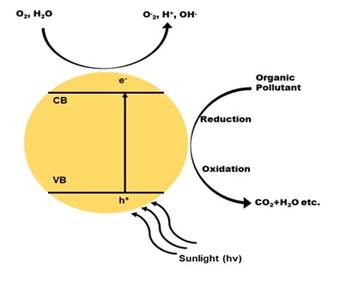
Figure: Schematic representation of the photocatalytic degradation pathway.

