















Quantum Advantage Unveiled: From Theory to Real-World Demonstration
By PIB Delhi
A new study on how a quantum system can outperform its classical counterpart reshapes our understanding of what is possible with quantum systems and hints at a future where quantum technologies might solve problems classical computers cannot, even when resources are scarce.
In the race to build the ultimate computer, quantum systems are often hailed as the future, capable of outclassing their classical counterparts in ways that could revolutionize technology. But proving this quantum advantage has been no small feat. Experiments are notoriously tricky, and fundamental limitations often seem to dash our hopes.
Recently, researchers from the S. N. Bose National Center for Basic Sciences, an autonomous institute of the Department of Science and Technology, working alongside the teams from the Henan Key Laboratory of Quantum Information and Cryptography, Laboratoire d’Information Quantique, University libre de Bruxelles, and ICFO-the Barcelona Institute of Science and Technology, have made a breakthrough.
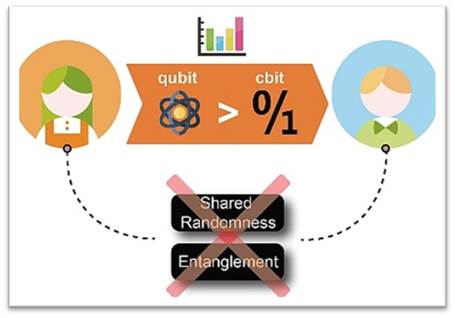
They’ve shown that even the simplest quantum system—a single qubit—can outperform its classical counterpart, the bit, in a communication task where no extra help, like shared randomness, is allowed. The theoretical study conducted by Professor Manik Banik and his team at the S. N. Bose Centre, published in the journal Quantum, alongside their collaborative experiment, featured as an Editors’ Suggestion in Physical Review Letters, provides a rare and compelling demonstration of quantum advantage in a real-world scenario.
Here’s why this is so exciting: Classical communication typically relies on shared resources, like pre-agreed random numbers, to function efficiently. Without these shared correlations, communication tasks can become much more difficult. A qubit, however, doesn’t seem to need this help.
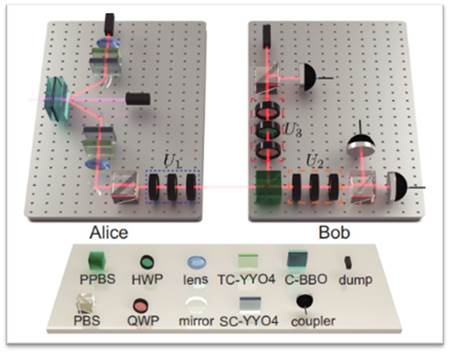
The researchers showed that, under the same conditions, a qubit could achieve more than a classical bit—a result that challenges long-held assumptions in the field. To demonstrate this, the team developed a photonic quantum processor, and a new tool called a variational triangular polarimeter. This device allowed them to measure light polarization with extreme precision, using a technique called Positive Operator-Valued Measurements (POVM). These measurements are key to understanding the behaviour of quantum systems under realistic conditions, including noise.
The study is more than just an academic milestone—it’s a step closer to a future where quantum technologies transform how we process and communicate information making the horizon between quantum and classical a bit more interesting.