













‘The M Factor Has Cheated Indian History the Most’ – Dr. Sudhanshu Trivedi
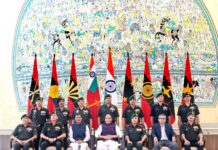
New Delhi: The Indira Gandhi National Centre for the Arts (IGNCA) organised the ‘Shri Devendra Swaroop Memorial Lecture’. The topic of the lecture was ‘Itihasa Ke Sandarbh Mein Bharat’ (Indianness in the Context of History). The keynote speaker of this important lecture was Dr. Sudhanshu Trivedi, MP, Rajya Sabha. He expressed his views on Indian history and its cultural heritage. The programme was presided over by Shri Ram Bahadur Rai, President, IGNCA. Prof. Ramesh Chandra Gaur, HoD, Kala Nidhi Division and Dean (Administration), IGNCA, delivered the welcome address and presented the outline of the programme. On this occasion, the guests also released the book ‘Shodh Purush – Shri Devendra Swaroop’ edited by Shri Hitesh Shankar.
Speaking on the subject, Dr. Sudhanshu Trivedi said, “We have to understand that India is a unique country in itself. The rest of the countries of the world became history, but India never became history. It has been alive from the beginning of history till today. We are the only existing civilisation, which is in continuum from the ancient world.”
Talking about India’s and the Western world’s concept of history, he said, “There is a fundamental difference in the interpretation of history by India and the West. The West says that history is that branch of knowledge which can tell you any event that happened in the past, exactly what has happened and the exact time when it happened. But in our country, it is said that history is that which presents an event that happened in the past in such a form that can play a role in establishing and increasing the moral values of society in the present time. Therefore, our history is ‘Ramlila’. Our history is ‘Ramayana’ and ‘Mahabharata’. We have the complete history of when Rama was born, where he was born, how many years ago, but this is not that important for us. What Rama did and how it can be brought into society is more important. Goswami Tulsidas has written in Ramcharitmanas– “Kahat Param Punit Itihasa. Jo Suni Sakal Lok Bhrama Naasa.” That is, this is such a sacred history that all misconceptions are destroyed just by listening to it. So, the purpose of our history is to remove all misconceptions.”


Taking the subject further, he said that those who give a lot of importance to archaeological evidence should understand that archaeological evidence is effective only in the short term, not in the long term. For example, at the time of the decision on Ram Mandir, those who tried to misquote used to say that there was no archaeological evidence that there was a temple there before the 12th century. So, I tell them that there was no archaeological evidence of any structure there before 6 December 1992.
He said that there were some big conspiracies against our history. There are many conspiracies which need to be understood. Under the conspiracy, our minds were so much demoralised that we could not come out of it. Concluding his speech, he said, “Most of the types of frauds done against the history of India have been done by the ‘M factor’. ‘M factor’ means Macaulay’s thought of the 19th century and Marxist thought of the 20th century.” On a lighter note, he also added that if you are thinking of some other ‘M factor’, then I have full faith in your intelligence.
In his chair remarks, Shri Ram Bahadur Rai shared the main points of Devendra Swaroop’s extremely important unpublished diaries and shed light on the traditional and modern perspectives of Indian history. He said that our history is hidden in our scriptures and that history is described in the ‘Puranas’. Referring to the famous English book ‘Seven Rishis’ (Saptrishi), he informed Devendra Swaroop’s deep research on the ‘Saptarishis’. In the end, he also talked about getting the diary published in the form of a book by IGNCA.
In the end, Prof. Ramesh Chandra Gaur, while giving the vote of thanks, told about the Personal Collections of the Kalanidhi Division and the work of the department. He also mentioned the plan to publish 36 unpublished diaries of Shri Devendra Swaroop.
A large number of researchers and people interested in Indian culture attended this event. It is worth mentioning that every year IGNCA organises many such lectures in the memory of eminent personalities of their field, the aim of which is to encourage in-depth discussions on Indian history, culture, and traditions.