








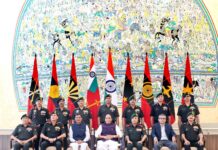








“A Book of Lived Experience and a Ray of Hope” — Shri Ram Bahadur Rai
24th February, New Delhi: The Kalanidhi Division of the Indira Gandhi National Centre for the Arts (IGNCA) organised the release and discussion of the book Mahilayen Kaam aur Shanti. The publication is a curated collection of select lectures by the renowned thinker Ela Bhatt, translated into Hindi by senior journalist and writer Neelam Gupta. The book has been published by Navjivan Sahitya. The programme was chaired by Shri Ram Bahadur Rai, Chairman of the IGNCA Trust. Speakers at the discussion included Rajni Bakshi; noted journalist and social activist, Sudarshan Iyengar; former Vice-Chancellor of Gujarat Vidyapeeth , Prof. Ramesh Chandra Gaur; Head (Kalanidhi) and Dean, IGNCA, Renana Jhabvala; eminent social entrepreneur and activist, as well as the translator of the book, Ms Neelam Gupta.
Speaking as the Chair, Shri Ram Bahadur Rai remarked that the book is not merely a collection of words, but a distillation of lived experiences gathered by Ila Bhatt through decades of engagement with society. He observed that these experiences are expansive, “like the vast sky,” and that the message of the book is not confined to India or its domestic concerns alone, but extends to the broader problematics of South Asia, particularly the conditions of women in the region. Speaking in this context, he further noted that microfinance remains one of Ila ji’s most significant contributions to society. He also emphasised the importance of gaining control over both the body and the mind, reiterating that to truly remember Ila ji, decisions must be taken from the heart rather than the mind. Concluding his remarks, he urged everyone to read the book, stating that in contemporary times marked by distress and despair, Ila ji’s thoughts and this book emerge as a ray of hope.
Speaking on the occasion, Ms Renana Jhabvala recalled her first meeting with Ela Bhatt in 1977, a moment that proved decisive in shaping her life’s direction. She shared that she chose to discontinue her Ph.D. and return to India to work alongside Ila ji, inspired by her vision and commitment. Reflecting on the foundational philosophy of Self-Employed Women’s Association (SEWA), she noted that thought, work, and values formed its core principles, with work always placed at the forefront. She emphasised that Ila ji firmly believed poverty itself to be a form of violence and repeatedly asserted that unless the mainstream fundamentally changed its way of thinking, meaningful transformation would remain elusive. Ms Jhabvala further observed that Ila ji carried the voices and struggles of the country’s “sisters” onto the international stage, ensuring that their labour, dignity, and rights found global recognition.
Reflecting on the life and thought of Ila Bhatt, Sudarshan Iyengar observed that, “In men there is a mentality of the sword, while in women there is an inherent gentleness, like that of a needle.” He noted that the book’s title is particularly apt, as it reflects the emergence of a women-oriented economic system built through collective strength and shared labour. Emphasising the work of the Self-Employed Women’s Association (SEWA), he remarked that a quiet yet profound revolution for peace has begun through the union’s grassroots efforts. Situating Ila ji’s thought within a larger socio-economic context, he further stated that she consistently challenged conventional notions of security, asserting that food alone does not constitute true security; rather, dignity of work, collective empowerment, and social justice are central to a sustainable and humane society.
Speaking on the occasion, Rajni Bakshi observed that Mahatma Gandhi’s philosophy of non-violence should be understood not merely as a moral or political strategy, but as a foundational principle of civilisation itself. Drawing a parallel from anthropology, she referred to the insights of Margaret Mead, who had identified a 1,500-year-old human fossil with a healed broken arm as a marker of civilisation—evidence that someone had paused to care for another in distress. On this basis, she argued that there is no civilisational basis for violence, and that compassion and care precede aggression in human history. She further underlined that the core message of the book lies in recognising that Gandhiji is not merely a source of inspiration, but a source of strength. His ideas, she noted, continue to offer inner resilience and ethical clarity in confronting contemporary challenges, reaffirming that non-violence is as old as civilisation itself and remains central to humanity’s collective future.
The translator of the book, Ms Neelam Gupta, while sharing her thoughts, said that the publication is not a compilation of Ila Bhatt’s written essays but a curated collection of her speeches. The book brings together 27 speeches delivered by Ila Bhatt, and on the occasion, she also read out excerpts from a few of them. She noted that it was Ila Bhatt herself who entrusted her with the responsibility of translating her book ‘Women, Work and Peace’ into Hindi, and that she has dedicated this Hindi translation to Ila Bhatt. Ms Gupta added that while undertaking the translation, she made a conscious effort to convey the original spirit, sensitivity, and depth of thought in an accessible manner, so that a wider Hindi readership could meaningfully engage with this important intellectual tradition.
Prof. Ramesh Chandra Gaur, in his welcome address, remarked that the book offers a significant and thought-provoking discourse on women’s labour, social justice, and peace. He observed that while contemporary society increasingly recognises and acknowledges the active role of women, this has not always been the case. There was a time, he noted, when such status and agency were not accorded to women within the social framework. The book, he added, invites reflection on this historical imbalance while foregrounding the evolving role of women in shaping more just and peaceful societies.
The programme was attended by scholars, researchers, and practitioners from the fields of art, culture, and social thought.

