














The Guns Behind South Asia’s Balance of Power: A Strategic Comparison of Indian and Pakistani Artillery
Firepower, Cost, Industrial Strength and Supply Chain Resilience in the Event of War
By Suman Munshi,Chief Editor,
IBG NEWS Defence & Strategic Affairs Desk
In modern warfare, wars are rarely won by tanks, fighter aircraft or missiles alone. Military historians often describe artillery as the “God of War” because it remains the single largest contributor to battlefield casualties and territorial dominance. From the trenches of World War I to the ongoing conflicts in Eastern Europe, artillery continues to dictate the pace and outcome of conventional warfare.
In South Asia, where India and Pakistan have fought multiple wars and continue to maintain one of the world’s most heavily militarized borders, artillery remains a decisive military instrument. While public attention often focuses on nuclear weapons, fighter jets, and ballistic missiles, it is the artillery arm that would likely carry the heaviest operational burden in any future conventional conflict.
A comprehensive analysis of both countries’ artillery inventories, modernization programs, industrial capabilities, costs, and supply-chain dependencies reveals a widening gap between India and Pakistan. While Pakistan retains a capable and battle-tested artillery force, India’s growing self-reliance and modernization efforts have fundamentally altered the strategic equation.
The Quantitative Reality
Military power begins with numbers.
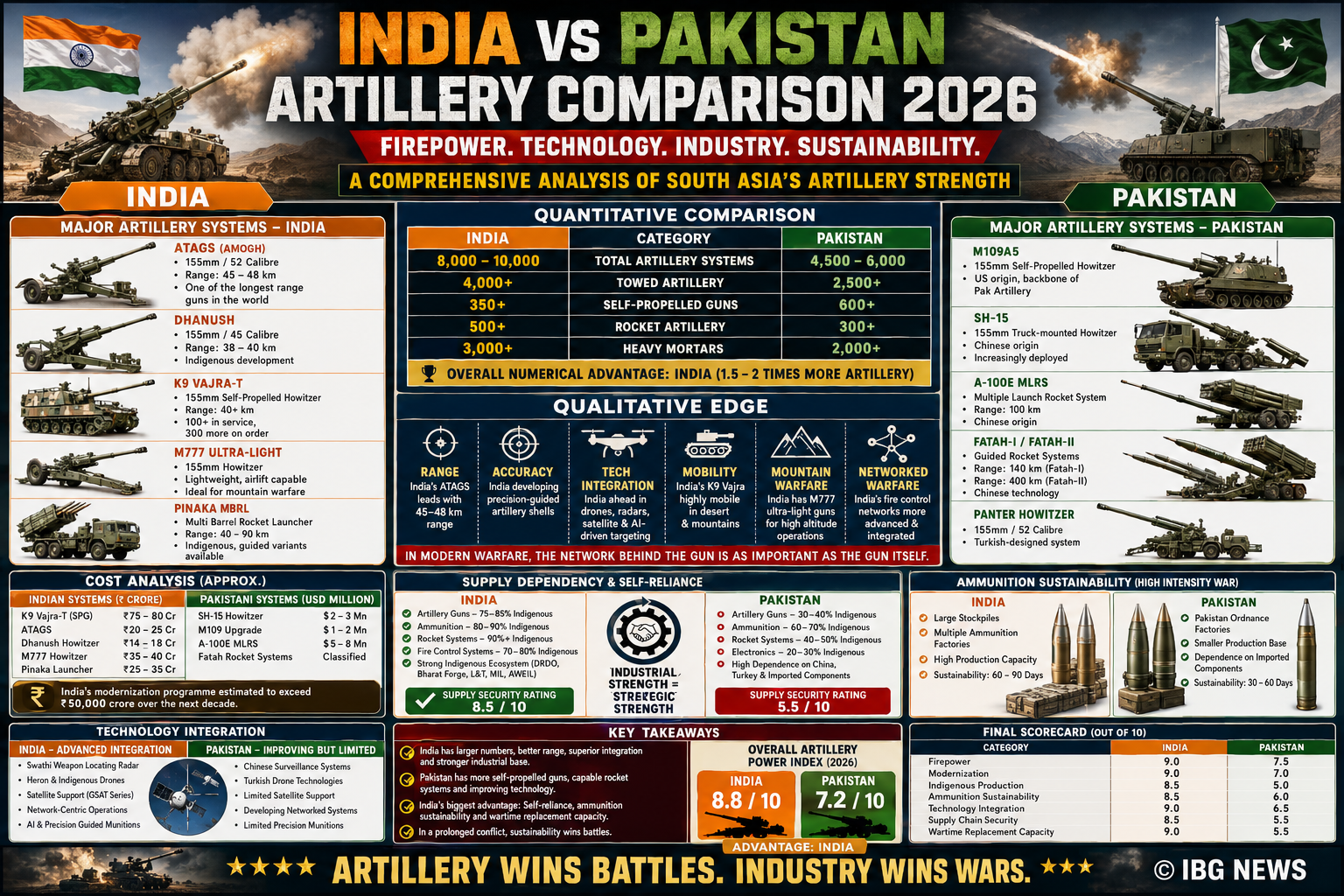
Open-source defence assessments indicate that India currently fields between 8,000 and 10,000 artillery systems, compared to Pakistan’s estimated 4,500 to 6,000 systems.
This numerical advantage extends across multiple categories including towed artillery, rocket systems, and heavy mortars. Pakistan maintains a larger inventory of self-propelled artillery relative to its force size, but India’s overall artillery strength remains significantly larger.
| Category | India | Pakistan |
|---|---|---|
| Total Artillery Systems | 8,000–10,000 | 4,500–6,000 |
| Towed Artillery | 4,000+ | 2,500+ |
| Self-Propelled Guns | 350+ | 600+ |
| Rocket Artillery | 500+ | 300+ |
| Heavy Mortars | 3,000+ | 2,000+ |
However, modern warfare is no longer a contest of numbers alone.
Quality Matters More Than Quantity
For decades after the Kargil War, India’s artillery modernization moved slowly. That situation has changed dramatically.
The Indian Army today is introducing indigenous systems such as the ATAGS (Advanced Towed Artillery Gun System), Dhanush howitzer, Pinaka rocket artillery, and locally manufactured K9 Vajra self-propelled guns.
The ATAGS, in particular, has attracted international attention due to its range of nearly 48 kilometres, making it one of the longest-range conventional artillery systems currently in service anywhere in the world.
Pakistan’s artillery modernization has largely been driven through cooperation with China and, increasingly, Turkey. Systems such as the SH-15 truck-mounted howitzer and Fatah-series guided rockets have improved Pakistan’s capabilities, but much of its modernization remains dependent on foreign suppliers.
The qualitative balance increasingly favors India because of its ability to design, manufacture, modify, and sustain its systems domestically.
The Hidden Factor: Industrial Capacity
Military analysts often focus on the weapons deployed before a war begins. Equally important is the ability to replace losses during a conflict.
This is where India’s advantage becomes most significant.
India today possesses a growing defence-industrial ecosystem involving:
- Defence Research and Development Organisation (DRDO)
- Bharat Forge
- Larsen & Toubro
- Munitions India Limited
- Advanced Weapons and Equipment India Limited
These institutions collectively manufacture artillery guns, ammunition, rockets, radars, and supporting systems.
Pakistan’s defence industry, while competent, operates on a smaller scale. Key systems depend heavily on Chinese technology, imported electronics, and foreign supply chains.
The result is a crucial difference:
India can increasingly sustain its artillery force independently. Pakistan remains substantially dependent on external suppliers.
In military terms, this difference becomes critical in a prolonged conflict.
The Economics of Artillery Power
Modern artillery is expensive.
A single K9 Vajra self-propelled gun costs approximately ₹75–80 crore. The M777 ultra-light howitzer costs roughly ₹35–40 crore per unit, while the indigenous ATAGS costs between ₹20–25 crore.
India’s artillery modernization programme is estimated to exceed ₹50,000 crore over the next decade.
At first glance, Pakistan appears to enjoy a cost advantage because Chinese systems generally cost less than Western or indigenous Indian platforms.
However, lower acquisition costs often conceal a deeper strategic vulnerability.
Weapons purchased from abroad create long-term dependencies for:
- Spare parts
- Electronics
- Ammunition
- Fire-control systems
- Software upgrades
India’s investment in domestic manufacturing may be more expensive initially but significantly reduces long-term strategic risk.
Supply Chain Dependency: The Most Overlooked Battlefield
Wars are won as much by logistics as by combat.
The ongoing Russia-Ukraine conflict has demonstrated that even advanced militaries struggle when ammunition production cannot keep pace with battlefield consumption.
India has steadily expanded domestic production of artillery ammunition, rockets, propellants, and fuzes. Indigenous production now accounts for the overwhelming majority of artillery ammunition requirements.
Pakistan’s Pakistan Ordnance Factories remain capable producers of conventional ammunition, but the country continues to depend on imported components and external technological support for many advanced systems.
Should international supply routes become disrupted during a prolonged conflict, Pakistan would face greater challenges in replacing equipment and maintaining operational tempo.
This factor alone may prove more important than battlefield performance.
Technology Integration: The New Artillery Revolution
The artillery battlefield of 2026 bears little resemblance to that of 1999.
Modern artillery depends on a network of:
- Drones
- Satellites
- Counter-battery radars
- Digital command systems
- Artificial intelligence-assisted targeting
- Precision-guided munitions
India has invested heavily in integrating these capabilities.
Its Swathi Weapon Locating Radars, satellite infrastructure, drone fleets, and precision-strike systems provide a growing advantage in locating and destroying enemy artillery.
Pakistan has made progress through Chinese and Turkish technologies but remains behind India in the scale and depth of battlefield integration.
The future of artillery is increasingly defined not by the gun itself but by the network supporting it.
Mountain Warfare: A Critical Indian Advantage
The Himalayan theatre presents unique challenges.
The deployment of American-made M777 ultra-light howitzers has given India a significant advantage in mountainous terrain such as:
- Ladakh
- Siachen
- Arunachal Pradesh
These systems can be transported by helicopter to remote locations inaccessible to conventional artillery.
Pakistan possesses effective mountain artillery capabilities, but India’s investments in air-mobile artillery provide greater flexibility along high-altitude frontiers.
Ammunition Sustainability: The Long War Question
Military planners increasingly focus on a simple question:
How long can a country sustain high-intensity combat?
Current assessments suggest India possesses sufficient stockpiles and production capacity to sustain 60–90 days of intense artillery operations while continuing domestic replenishment.
Pakistan’s estimated sustainability is lower, generally assessed at 30–60 days under similar conditions, depending on external support and battlefield intensity.
While these figures are necessarily approximate, they illustrate the growing importance of industrial capacity in modern warfare.
Strategic Vulnerabilities
No military is without weaknesses.
India’s Challenges
- Dependence on some imported electronics and guidance systems.
- Foreign-origin engines and transmission systems in certain platforms.
- Long and vulnerable logistics routes in mountainous regions.
Pakistan’s Challenges
- Heavy reliance on Chinese military technology.
- Smaller defence-industrial base.
- Limited indigenous artillery research and development.
- Lower wartime replacement capacity.
The contrast is significant: India’s vulnerabilities are increasingly technological and logistical, while Pakistan’s are structural and industrial.
The Final Balance
A comparison of artillery strength in 2026 reveals that the gap between India and Pakistan is no longer defined solely by numbers.
It is defined by sustainability.
Pakistan continues to possess a capable artillery force capable of inflicting substantial battlefield damage. Its Chinese-supported modernization efforts have improved mobility, precision, and operational effectiveness.
However, India’s artillery transformation has moved beyond procurement. The country is building a comprehensive ecosystem that includes indigenous manufacturing, ammunition production, surveillance integration, digital targeting, and wartime replacement capability.
In a short conflict, both armies possess the capacity to inflict severe damage.
In a prolonged conflict, India’s larger industrial base, deeper ammunition reserves, stronger technological integration, and lower supply-chain dependency would likely provide a decisive advantage.
Overall Strategic Assessment (2026)
| Category | India | Pakistan |
|---|---|---|
| Firepower | 9/10 | 7.5/10 |
| Modernization | 9/10 | 7/10 |
| Indigenous Production | 8.5/10 | 5/10 |
| Ammunition Sustainability | 8.5/10 | 6/10 |
| Technology Integration | 9/10 | 6.5/10 |
| Supply Chain Security | 8.5/10 | 5.5/10 |
| Wartime Replacement Capacity | 9/10 | 5.5/10 |
Editorial Conclusion
The true story of South Asia’s artillery balance is not merely about guns, rockets, or ranges. It is about who can sustain combat when supply lines are stretched, ammunition stocks are depleted, and equipment losses begin to mount.
On that measure, India’s artillery modernization has evolved into a broader strategy of strategic self-reliance. Pakistan remains a formidable military power, but its greater dependence on external suppliers and a comparatively smaller industrial base create vulnerabilities that could become increasingly significant in any extended conflict.
In the twenty-first century, artillery power is no longer measured only by the number of guns a nation possesses—it is measured by the strength of the factories, supply chains, and technological networks standing behind them.
— IBG NEWS Defence & Strategic Affairs Desk