













The Musical Instrument Manufacturing Legacy of Bengal: The Unsung Artisans Behind a Global Musical Heritage
By Antara Tripathy | IBG NEWS
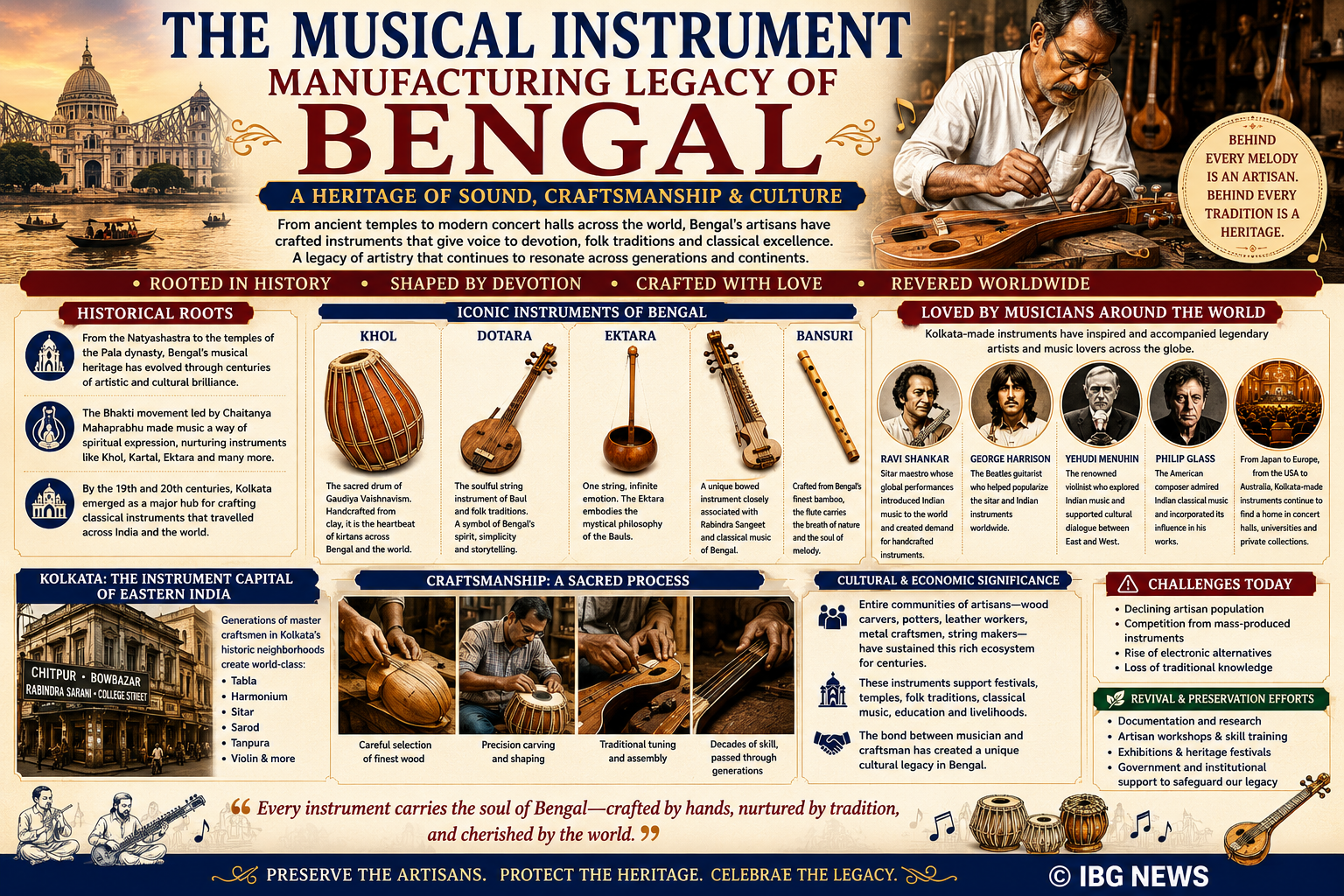
Music is often celebrated through the brilliance of composers, vocalists, and performers. Yet behind every melody lies an equally important story—the story of the artisans who create the instruments that make music possible. Bengal, one of India’s foremost cultural heartlands, possesses a rich and centuries-old tradition of musical instrument manufacturing that has profoundly shaped Indian classical, folk, devotional, and contemporary music.
From the resonant khol of Vaishnava kirtans and the soulful dotara of Baul singers to the finely crafted tablas, esrajs, sitars, and harmoniums of Kolkata’s workshops, Bengal’s instrument makers have contributed significantly to India’s cultural identity. Their craftsmanship represents a unique fusion of art, science, spirituality, and heritage that continues to resonate across the world.
Ancient Roots of a Musical Civilization
The origins of Bengal’s instrument-making tradition can be traced back to ancient India. References in the Natyashastra, Bharata Muni’s seminal treatise on performing arts, describe the classification and construction of musical instruments. Over centuries, these principles evolved through regional adaptations, giving rise to distinctive Bengali traditions.
The Pala and Sena dynasties, which flourished between the 8th and 12th centuries, witnessed remarkable developments in music, sculpture, and temple arts. Terracotta temples and archaeological discoveries across Bengal reveal depictions of drums, string instruments, cymbals, and flutes, indicating a vibrant musical culture supported by skilled craftsmen.
With the rise of the Bhakti movement under Chaitanya Mahaprabhu in the 15th and 16th centuries, devotional music became a central part of Bengali society. This created sustained demand for instruments such as the khol, kartal, ektara, and mridanga, leading to the emergence of artisan communities dedicated to their production.
The Sacred Khol: Heartbeat of Bengal’s Devotional Music
Among Bengal’s most iconic instruments is the Khol, a double-headed terracotta drum synonymous with Gaudiya Vaishnavism.
Crafted primarily in Nadia, Nabadwip, Murshidabad, and Birbhum, the khol is both a musical instrument and a sacred object. Traditional craftsmen shape its clay body by hand, fire it in kilns, and carefully attach animal-skin drumheads using centuries-old techniques.
The instrument occupies a central place in kirtan traditions and has travelled far beyond Bengal through the global spread of Vaishnava culture and the activities of the International Society for Krishna Consciousness.
Dotara and Ektara: Voices of Bengal’s Folk Soul
No instrument captures Bengal’s folk spirit more vividly than the Dotara.
Used extensively in Baul, Bhawaiya, Bhatiyali, Fakiri, and rural folk traditions, the Dotara is handcrafted from locally available woods such as jackfruit and neem, combined with bamboo, animal skin, and metal strings.
The instrument’s warm, earthy sound has accompanied generations of wandering minstrels, particularly the Bauls, whose songs transcend religious and social boundaries.
Equally symbolic is the Ektara, the one-stringed instrument that has become synonymous with Bengal’s mystic traditions. Made from gourds, coconut shells, bamboo, and a single string, the Ektara embodies the simplicity and spiritual philosophy of the Baul way of life.
Kolkata: The Instrument Capital of Eastern India
During the nineteenth and twentieth centuries, Kolkata emerged as one of India’s foremost centres for musical instrument manufacturing.
Historic neighbourhoods such as:
- Chitpur
- Bowbazar
- Rabindra Sarani
- College Street
became home to master craftsmen producing world-class:
- Tabla
- Harmonium
- Sitar
- Sarod
- Esraj
- Tanpura
- Violin accessories
- Classical percussion instruments
The city’s workshops supplied instruments to musicians across India and increasingly to international markets. Many legendary artists preferred Kolkata-made instruments for their superior craftsmanship, tonal quality, and durability.
The Esraj: Bengal’s Distinctive Musical Contribution
Among Bengal’s most unique gifts to Indian music is the Esraj, a bowed string instrument combining features of the sitar and sarangi.
Closely associated with Rabindra Sangeet and the musical traditions of Santiniketan, the Esraj requires exceptional craftsmanship involving precision carving, sympathetic strings, and carefully engineered resonators.
Though its popularity declined during the late twentieth century, renewed efforts are underway to preserve and revive both its manufacture and performance traditions.
Bamboo, Flutes and Indigenous Innovation
Bengal’s rich bamboo resources have supported generations of flute makers.
The Bansuri remains one of the most widely crafted wind instruments in rural Bengal. Master artisans carefully select bamboo based on age, density, flexibility, and acoustic characteristics. Each hole is measured and tuned with remarkable precision to achieve the desired tonal quality.
Traditional craftsmen continue to produce flutes for both folk and classical musicians despite increasing competition from machine-made alternatives.
International Artists and the Global Reach of Bengal’s Craftsmanship
The reputation of Bengal’s instrument makers extends far beyond India’s borders.
As Indian classical music gained international recognition during the twentieth century, Kolkata’s instrument workshops became important destinations for musicians, scholars, collectors, and students from around the world.
The global influence of legendary sitar maestro Ravi Shankar played a pivotal role in introducing Indian instruments to international audiences. His collaborations with Western musicians generated unprecedented interest in Indian musical traditions and the handcrafted instruments that supported them.
Among the most famous admirers of Indian music was George Harrison of The Beatles. Inspired by Ravi Shankar, Harrison helped popularize the sitar and Indian musical aesthetics across Europe and North America. The resulting global curiosity significantly benefited traditional instrument makers, including those in Kolkata.
Distinguished international musicians such as Yehudi Menuhin and Philip Glass also engaged deeply with Indian musical traditions, helping create broader appreciation for Indian craftsmanship and classical instruments.
Many foreign students studying Indian classical music in Kolkata and Santiniketan purchased locally crafted sitars, tablas, tanpuras, esrajs, and harmoniums to take back to their home countries. Universities and conservatories in the United States, United Kingdom, Germany, France, Japan, and Australia continue to source authentic Indian instruments for performance and academic research.
Japan, in particular, developed a strong connection with Bengal’s musical traditions. Students of Rabindra Sangeet and Indian classical music frequently visited Kolkata’s historic instrument markets, helping establish enduring cultural links between Bengal and East Asia.
The international legacy of Bengal’s instrument-making tradition remains visible today in museums, concert halls, educational institutions, and private collections across the world.
The Economic and Cultural Ecosystem
Instrument-making has traditionally supported thousands of artisans, traders, leather workers, wood carvers, metal craftsmen, and musicians.
Entire communities depended on this ecosystem, with skills passed from one generation to another through apprenticeship and family traditions.
The relationship between musician and instrument maker was often deeply personal. Craftsmen tailored instruments to suit an artist’s individual style, creating unique collaborations that enriched Bengal’s musical culture.
Challenges in the Twenty-First Century
Despite its illustrious history, Bengal’s instrument-making heritage faces serious challenges.
Declining Artisan Population
Many younger family members are reluctant to continue traditional occupations due to uncertain incomes and limited market opportunities.
Competition from Mass Production
Factory-made instruments, often cheaper and more easily available, have reduced demand for handcrafted products.
Rise of Electronic Alternatives
Electronic tanpuras, digital percussion systems, and software-based music production tools have altered traditional markets.
Loss of Traditional Knowledge
Many specialized techniques remain undocumented and risk disappearing as master craftsmen age.
Preservation and Revival
Recognizing these challenges, several cultural institutions have initiated efforts to document and preserve instrument-making traditions.
Organizations such as the Indira Gandhi National Centre for the Arts, Sangeet Natak Akademi, universities, museums, and cultural researchers have increasingly focused on safeguarding not only musical performances but also the artisans who make those performances possible.
Recent initiatives, including documentation projects, exhibitions, heritage festivals, artisan workshops, and educational programmes, are helping draw attention to these endangered crafts.
A Legacy That Must Endure
The story of Bengal’s musical instruments is ultimately a story of human creativity, devotion, and resilience. Every khol, dotara, ektara, esraj, tabla, flute, sitar, and tanpura carries within it generations of accumulated knowledge and cultural memory.
As India embraces technological progress, preserving Bengal’s instrument-making traditions becomes more important than ever. These instruments are not merely objects of sound; they are repositories of history, identity, craftsmanship, and collective heritage.
If Bengal’s music is to survive in its fullest form, equal attention must be paid to the artisans whose hands shape the instruments that give voice to its melodies. Their work represents one of the most remarkable yet underappreciated chapters in India’s cultural history—a legacy deserving recognition, preservation, and celebration for generations to come.

