















Critical Analysis of Government of India Skill Development Schemes for Youth (Up to Class XII) and Opportunities for West Bengal
By Suman Munshi | IBG NEWS (Analysis)
Introduction
India has one of the world’s youngest populations, with nearly 65% of its population below the age of 35. However, millions of young people leave school after Class VIII, X or XII due to financial constraints or family responsibilities. For these youths, conventional university education is often not an option. Recognising this challenge, the Government of India has launched several skill development programmes aimed at creating an employable workforce through vocational training, apprenticeships and entrepreneurship.
While these schemes have created opportunities nationwide, their impact varies significantly across states. West Bengal, despite having a large youth population and strategic geographical advantages, has not fully leveraged many of these central initiatives.
Major Government Skill Development Schemes
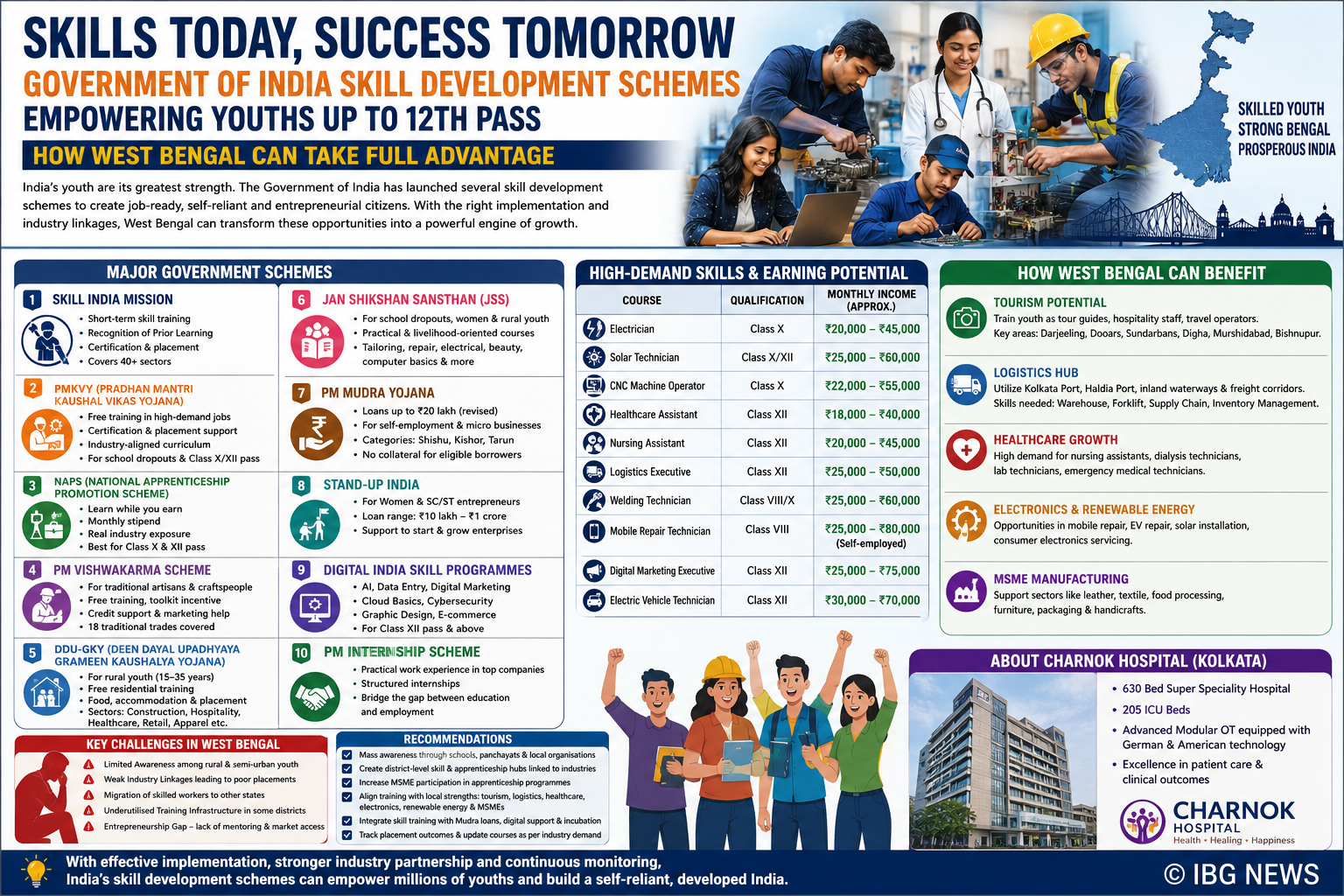
1. Skill India Mission (2015)
The flagship programme aims to train millions of Indians in industry-relevant skills.
Key Components
- Short-term skill training
- Recognition of Prior Learning (RPL)
- Skill certification
- Placement assistance
Suitable for
- School dropouts
- Class VIII, X and XII pass students
- Unemployed youth
- Rural youth
Critical Analysis
Strengths
- Covers more than 40 sectors.
- Nationally recognised certification.
- Industry-oriented curriculum.
Weaknesses
- Training quality differs between centres.
- Placement rates vary considerably.
- Many rural candidates remain unaware.
2. Pradhan Mantri Kaushal Vikas Yojana (PMKVY)
This is India’s largest free skill training programme.
Training includes
- Electrician
- Plumber
- Solar technician
- Healthcare assistant
- Retail executive
- Hospitality
- Security services
- Digital marketing
- Data entry
- Logistics
Benefits
- Free training
- Skill certificate
- Placement support
- Industry partnerships
Challenges
Many trainees receive certificates but struggle to secure stable employment because of:
- weak industry linkage
- limited local job creation
- migration issues
3. National Apprenticeship Promotion Scheme (NAPS)
Perhaps the most underrated programme.
Instead of classroom learning,
Youth work directly inside industries.
Government supports apprenticeships by subsidising training costs.
Advantages
- Monthly stipend
- Real industrial experience
- Better employment prospects
Ideal for
Class X and XII pass students.
4. PM Vishwakarma Scheme
Designed for traditional artisans.
Includes
- Carpenter
- Blacksmith
- Tailor
- Goldsmith
- Mason
- Potter
- Cobbler
- Barber
- Boat maker
Benefits include
- Free training
- Toolkit incentive
- Credit support
- Digital payment incentives
- Marketing assistance
This scheme can transform rural economies if implemented effectively.
5. Deen Dayal Upadhyaya Grameen Kaushalya Yojana (DDU-GKY)
Targets rural poor youth aged 15–35.
Focus areas include
- Construction
- Hospitality
- Healthcare
- Manufacturing
- Retail
- Apparel
Includes
- Free residential training
- Food
- Accommodation
- Placement assistance
6. Jan Shikshan Sansthan (JSS)
One of India’s most practical schemes.
Designed especially for
- School dropouts
- Women
- Rural youth
- Neo-literates
Courses include
- Tailoring
- Food processing
- Mobile repair
- Electrical work
- Beauty services
- Computer basics
7. PM Mudra Yojana
Supports self-employment after skill training.
Loans up to ₹20 lakh (revised upper limit under recent policy changes) are available under different categories without requiring large collateral for eligible borrowers.
Useful for
- Food stalls
- Repair shops
- Tailoring units
- Beauty parlours
- Mobile repair
- Service businesses
8. Stand-Up India
Supports
- Women entrepreneurs
- SC/ST entrepreneurs
Loan range
₹10 lakh–₹1 crore.
9. Digital India Skill Programmes
Growing rapidly because of AI and digital economy.
Courses include
- AI basics
- Data entry
- Digital marketing
- Cloud basics
- Cybersecurity fundamentals
- Graphic design
- E-commerce
Suitable even for Class XII students.
10. PM Internship Scheme
A relatively new initiative aimed at giving young people practical work experience in leading companies through structured internships, helping bridge the gap between education and employment.
Which Courses Offer the Best Income?
| Course | Qualification | Monthly Income |
|---|---|---|
| Electrician | Class X | ₹20,000–45,000 |
| Solar Technician | Class X/XII | ₹25,000–60,000 |
| CNC Machine Operator | Class X | ₹22,000–55,000 |
| Healthcare Assistant | XII | ₹18,000–40,000 |
| Nursing Assistant | XII | ₹20,000–45,000 |
| Logistics | XII | ₹25,000–50,000 |
| Welding | VIII/X | ₹25,000–60,000 |
| Mobile Repair | VIII | ₹25,000–80,000 (self-employed) |
| Digital Marketing | XII | ₹25,000–75,000 |
| Electric Vehicle Technician | XII | ₹30,000–70,000 |
How West Bengal Can Benefit
West Bengal has significant strengths that can be aligned with these schemes:
- Large youth population
- Strong MSME base
- Strategic ports and logistics
- Tourism potential
- Tea industry
- Leather industry
- Textile clusters
- Electronics manufacturing
- Growing IT sector
Sector-wise Opportunities
Tourism
Thousands of youths can be trained as
- Tour guides
- Hospitality executives
- Hotel staff
- Travel operators
Potential areas include:
- Darjeeling
- Dooars
- Sundarbans
- Digha
- Murshidabad
- Bishnupur
Logistics
With
- Kolkata Port
- Haldia Port
- Inland waterways
- Eastern Freight Corridor linkages
West Bengal could become Eastern India’s logistics hub.
Required skills
- Warehouse management
- Forklift operation
- Supply chain
- Inventory management
Healthcare
Demand is increasing for
- Nursing assistants
- Dialysis technicians
- Lab technicians
- Emergency medical technicians
Electronics
Expansion of
- Mobile servicing
- EV repair
- Solar installation
- Consumer electronics repair
can generate substantial employment.
MSME Manufacturing
Skill training can support
- Leather
- Textile
- Food processing
- Furniture
- Packaging
- Handicrafts
Key Challenges in West Bengal
Despite strong potential, several constraints remain:
Limited Awareness
Many eligible youths are unaware of available central schemes.
Weak Industry Linkages
Training often does not translate into employment due to insufficient employer engagement.
Migration
Many skilled workers move to other states because of comparatively fewer local opportunities.
Underutilised Infrastructure
Some training centres operate below capacity because of low enrolment or limited outreach.
Entrepreneurship Gap
Many trainees lack mentoring, market access and business support after completing training.
Recommendations
- Expand awareness campaigns through schools, panchayats and community organisations.
- Establish district-level skill and apprenticeship hubs linked to local industries.
- Increase participation of MSMEs in apprenticeship programmes.
- Align training with sectors such as logistics, tourism, healthcare, renewable energy and electronics.
- Integrate skill development with Mudra loans, digital marketing support and incubation services.
- Track placement outcomes and update curricula regularly based on employer demand.
Conclusion
India’s skill development ecosystem has evolved into a comprehensive framework that can benefit youths with educational qualifications up to Class XII by providing vocational training, apprenticeships and pathways to self-employment. However, the long-term success of these programmes depends not only on the number of people trained but also on sustained employment, quality of training and alignment with industry needs.
For West Bengal, these schemes present a major opportunity. By improving awareness, strengthening partnerships between training providers and industry, and focusing on sectors where the state has natural advantages, West Bengal can generate meaningful employment, reduce migration and contribute significantly to the national vision of a skilled and self-reliant workforce.
Editorial Observation: The Government of India has created a broad policy framework and funding mechanisms for skill development. The next phase of success will depend on effective implementation at the state level, stronger industry participation and continuous monitoring to ensure that training translates into productive livelihoods rather than certificates alone.

