











Baloch Group Voices Support for Afghanistan, Calls for Regional Realignment
By Suman Munshi | IBG NEWS
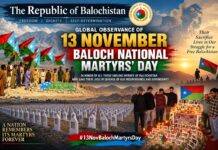
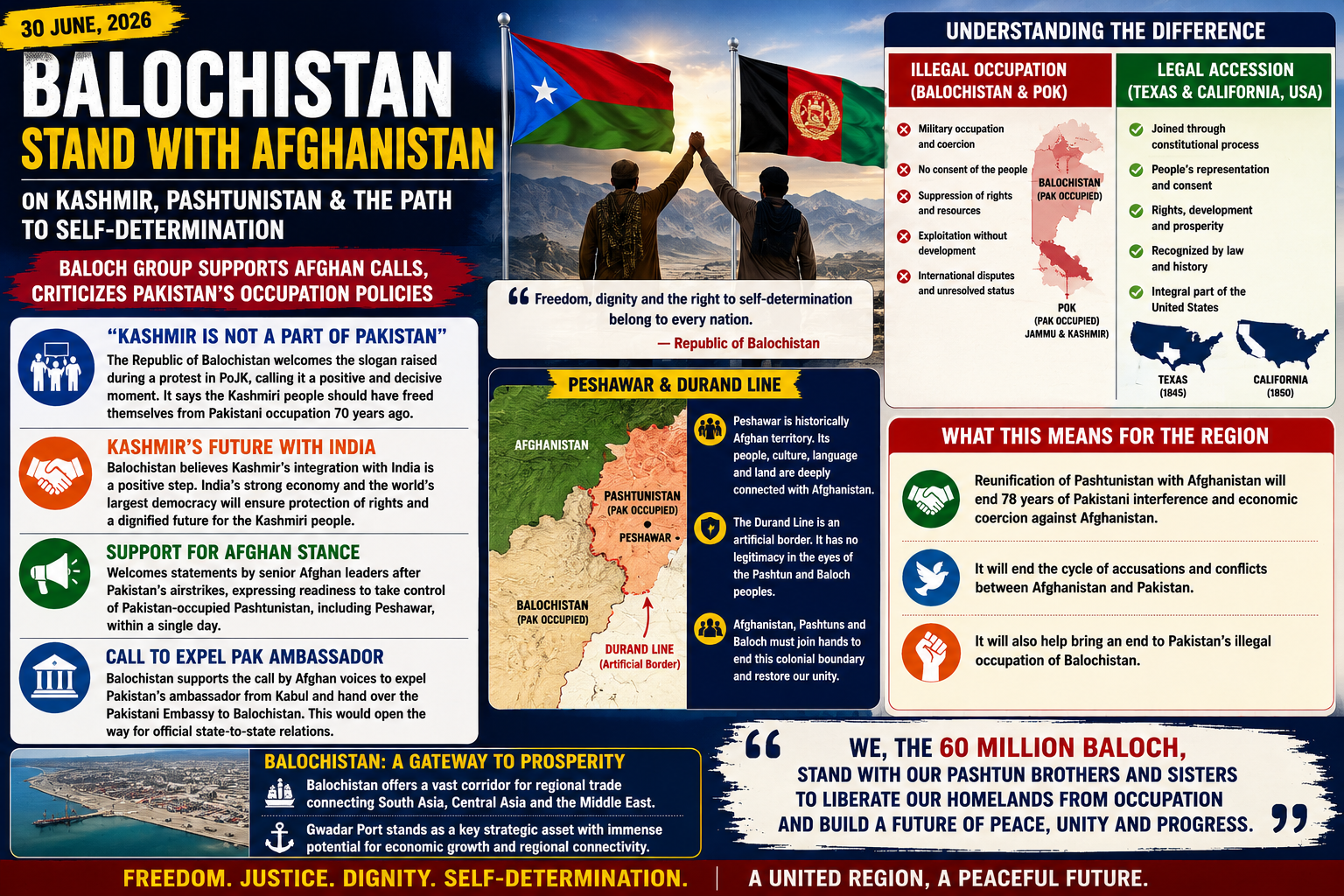
July 2: A group identifying itself as the Republic of Balochistan has issued a statement expressing support for Afghanistan while sharply criticizing Pakistan’s policies in Balochistan and Pakistan-occupied Jammu & Kashmir (PoJK). The statement, released on June 30, contains several political and territorial claims that remain disputed and have not been independently verified.
The organization welcomed slogans reportedly raised during a protest in Pakistan-occupied Jammu and Kashmir declaring that “Kashmir is not a part of Pakistan.” It described the demonstration as a significant political development and argued that the people of the region should determine their own future free from what it termed Pakistani control.
The statement also expressed support for the constitutional status of Jammu & Kashmir within India, arguing that integration with India offers greater democratic and economic opportunities. These views reflect the position of the issuing organization and do not represent internationally accepted legal conclusions.
Support for Afghan Statements
The organization also welcomed recent remarks attributed to certain Afghan political figures following Pakistan’s reported cross-border airstrikes. According to the statement, these comments discussed the possibility of asserting control over areas inhabited predominantly by Pashtuns, including Peshawar.
In addition, the group praised campaigns by some Afghan commentators and social media activists calling for diplomatic measures against Pakistan, including proposals to expel Pakistan’s ambassador from Kabul and establish diplomatic representation for Balochistan in Afghanistan.
The statement claimed that such a move would represent the beginning of formal relations between Afghanistan and a future independent Balochistan.
Durand Line and Territorial Claims
The Republic of Balochistan also reiterated its long-standing opposition to the Durand Line, the border established between British India and Afghanistan in 1893, describing it as an artificial boundary. The group argued that Pashtun and Baloch communities share historical, cultural and linguistic ties and called for greater cooperation between the two peoples.
It further alleged that Pakistan’s control over Balochistan and Pashtun-majority regions lacks legitimacy, while urging closer political cooperation between Baloch and Afghan groups.
Strategic Importance of Balochistan
Highlighting the region’s geopolitical significance, the statement described Balochistan as a crucial trade corridor connecting South Asia, Central Asia and the Middle East. It pointed to Gwadar Port as one of the region’s most strategically important infrastructure assets with considerable economic potential.
Understanding the Legal Context
The statement has once again drawn attention to longstanding disputes involving Balochistan, Pakistan-occupied Kashmir, and the broader regional security situation.
It is important to note that the constitutional and legal histories of different territorial disputes are distinct.
For example, the accession of the U.S. states of Texas and California to the United States occurred through internationally recognized political and constitutional processes during the 19th century, following treaties, annexation, congressional approval and statehood procedures under U.S. constitutional law.
By contrast, disputes involving Balochistan, Pakistan-occupied Kashmir, the Durand Line, and related territories remain subjects of competing historical narratives, constitutional claims, and international political disagreement. Various governments, political organizations and international observers hold differing positions on these issues, and many aspects remain contested under international law and diplomacy.
As regional tensions continue, statements from political groups such as the Republic of Balochistan are likely to remain part of the broader geopolitical debate surrounding South Asia’s evolving security landscape.
Source: Statement released by the organization identifying itself as the Republic of Balochistan and accompanying social media post. The claims contained in the statement have not been independently verified by IBG NEWS.