

















The American Flag at the Top of the World: The Historic Journey to the North Pole
By Suman Munshi | IBG NEWS
Kolkata | IBG NEWS Bureau
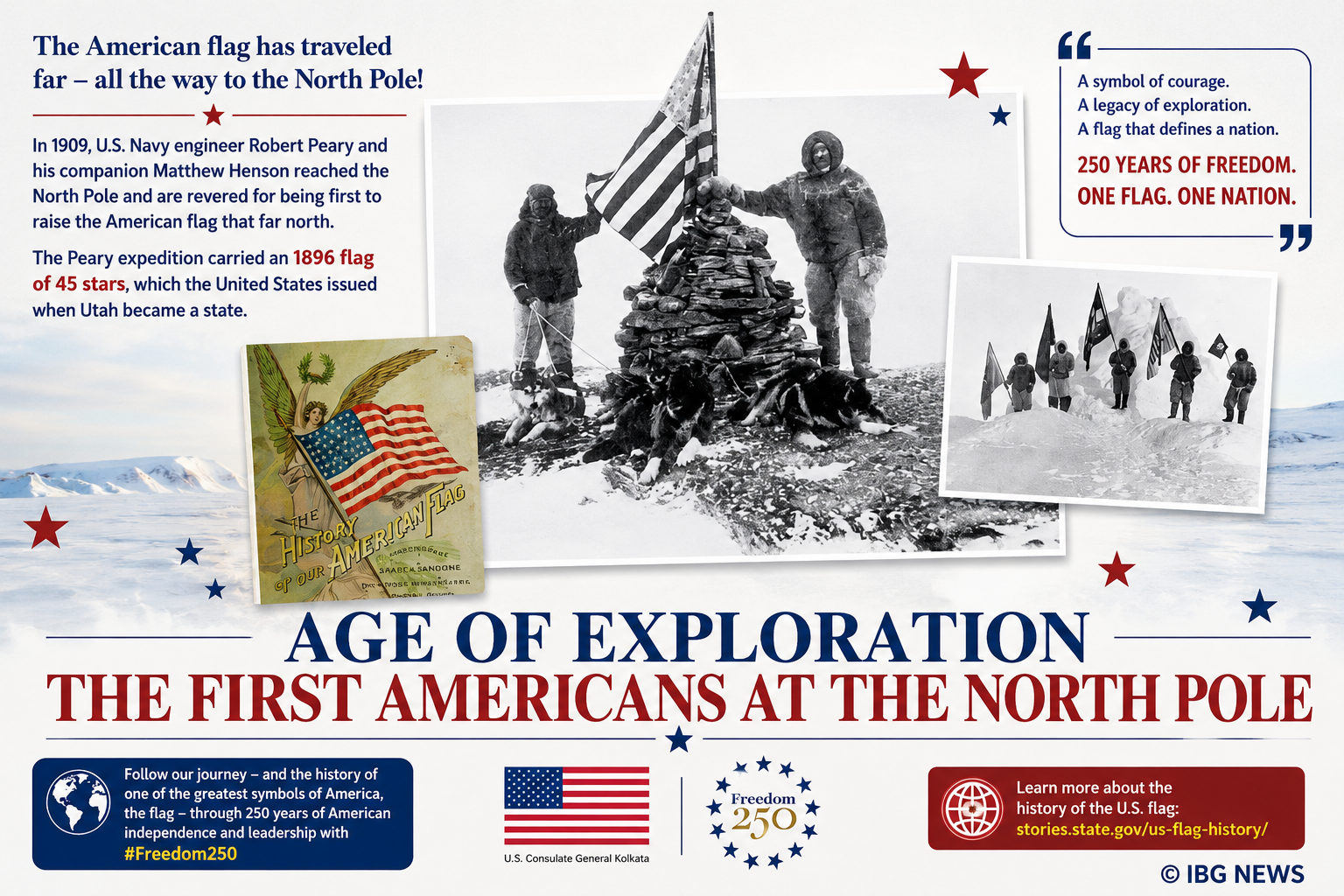
The American flag has flown over battlefields, historic landmarks, the Moon, and even the frozen expanse of the Arctic. One of the most remarkable chapters in its history dates back to 1909, when U.S. Navy engineer and Arctic explorer Robert Edwin Peary, accompanied by the legendary African-American explorer Matthew Henson, claimed to have reached the Geographic North Pole and raised the American flag in one of the world’s most inhospitable environments.
The expedition remains one of the defining moments in the history of polar exploration and reflects the role of the American flag as a symbol of exploration, scientific ambition, and national identity.
A Historic Expedition into the Arctic
At the beginning of the twentieth century, reaching the North Pole represented one of humanity’s greatest geographical challenges. The Arctic Ocean was covered with shifting sea ice, where temperatures often plunged below –40°C, making survival itself an extraordinary achievement.
After several failed attempts over many years, Robert Peary organized his final expedition in 1908–1909. Alongside him was Matthew Henson, whose Arctic expertise, navigation skills, and relationship with Inuit communities played a crucial role in the mission’s success.
On 6 April 1909, Peary announced that the expedition had reached the Geographic North Pole, approximately 90 degrees North latitude.
The Flag That Reached the Top of the World
Among the expedition’s treasured possessions was an American flag carrying 45 stars, representing the United States after Utah became the 45th state in 1896.
Unlike ordinary ceremonial flags, this particular flag had accompanied Peary on numerous Arctic expeditions and had become his personal symbol of perseverance and determination.
According to expedition records, the flag was raised at the North Pole, making it one of the earliest American flags to be carried to one of Earth’s most extreme locations.
The event became an enduring symbol of American exploration during the early twentieth century.
Robert Peary: America’s Polar Explorer
Robert Edwin Peary was a civil engineer with the U.S. Navy who dedicated more than two decades to Arctic exploration.
His expeditions contributed significantly to:
- Mapping Greenland’s northern coastline.
- Advancing Arctic navigation techniques.
- Studying polar geography.
- Expanding scientific understanding of the Arctic environment.
Although historians continue to debate whether Peary’s team actually reached the exact Geographic North Pole, his expeditions transformed Arctic exploration and inspired generations of explorers.
Matthew Henson: The Unsung Hero
Modern historical scholarship increasingly recognizes Matthew Henson as one of the greatest polar explorers in history.
Henson possessed exceptional survival skills in Arctic conditions. Fluent in Inuit languages and highly experienced in dog sledding and navigation, he was indispensable to the expedition.
Many historians argue that Henson may actually have stepped onto the Pole moments before Peary.
For decades, however, his contributions received limited recognition due to racial discrimination prevalent during that era. Today, Henson is celebrated as one of America’s pioneering explorers and an inspiration for future generations.
Why the American Flag Matters
For more than 250 years, the American flag has symbolized:
- National unity
- Constitutional democracy
- Freedom
- Scientific exploration
- Military service
- Human achievement
Throughout history, the flag has accompanied American explorers to many extraordinary destinations, including:
- The North Pole (1909)
- Mount Everest expeditions
- Antarctica
- The Moon during the Apollo missions
- International Space Station missions
Each journey represents a chapter in the nation’s evolving story of exploration and innovation.
The Freedom250 Initiative
As the United States approaches the 250th anniversary of its independence in 2026, the Freedom250 initiative highlights key moments that shaped American history.
The story of the North Pole expedition forms part of this broader narrative, illustrating how exploration, scientific curiosity, and perseverance became integral to the American national identity.
The initiative also reflects on the flag’s journey through major historical milestones spanning two and a half centuries.
Historical Debate Continues
While Peary’s claim remains widely known, historians continue to examine expedition logs, navigation records, and modern calculations.
Some researchers argue that navigation methods available in 1909 make absolute verification difficult. Others believe the expedition came extremely close, even if not precisely to the geographic pole.
Regardless of the continuing academic debate, historians broadly agree that Peary and Henson accomplished one of the most extraordinary Arctic expeditions of their time and significantly advanced polar exploration.
Legacy Beyond Exploration
Today, the story of Robert Peary and Matthew Henson represents more than a race to a geographical point. It highlights courage, endurance, teamwork, scientific curiosity, and the human desire to explore the unknown.
The image of the American flag standing against the endless white Arctic landscape remains one of the enduring symbols of twentieth-century exploration—a reminder that the pursuit of discovery often requires extraordinary resilience and determination.
As the United States commemorates 250 years of independence, the journey of the American flag to the North Pole continues to serve as a powerful reminder of a historic era when exploration expanded the boundaries of human knowledge and inspired future generations to reach even greater frontiers.
Photo and information Courtesy: U.S. Consulate General Kolkata

