












Vadhavan Port: India’s Ambitious Deep-Draft Maritime Gateway Takes Shape
By Anil P. Kastuar, Editor, IBG NEWS
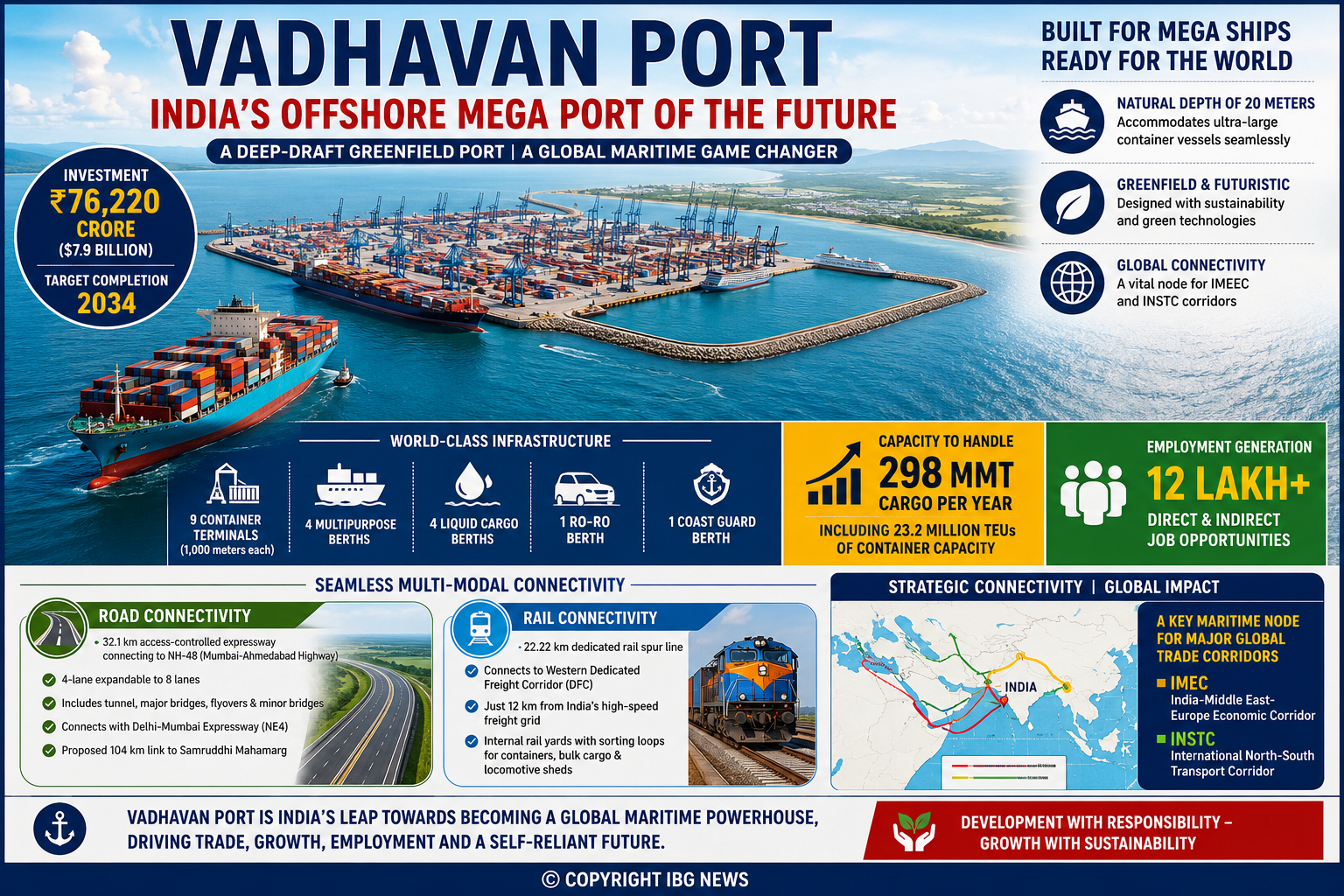
India is taking a major step towards strengthening its position in global maritime trade with the development of the Vadhavan Port in Palghar district of Maharashtra. Conceived as a modern, all-weather, greenfield deep-draft major port, the project is being developed with an estimated investment of ₹76,220 crore.

The Union Cabinet approved the project on 19 June 2024, while Prime Minister Narendra Modi laid its foundation stone on 30 August 2024. The port is being developed through Vadhavan Port Project Ltd. (VPPL), a special purpose vehicle involving the Jawaharlal Nehru Port Authority (JNPA) and the Maharashtra Maritime Board, with equity participation of 74% and 26%, respectively. (Press Information Bureau)
A Mega Port Designed for Mega Ships
Vadhavan is planned as a deep-draft port capable of accommodating some of the world’s largest container vessels. According to government documents, the project is designed for a cumulative cargo-handling capacity of approximately 298 million metric tonnes per annum, including around 23.2 million TEUs of container-handling capacity. (Press Information Bureau)
The proposed port infrastructure includes:
- Nine container terminals, each approximately 1,000 metres long
- Four multipurpose berths
- Four liquid-cargo berths
- One Ro-Ro berth
- One Coast Guard berth
- Offshore breakwater and extensive container and cargo-storage facilities
The project involves reclamation of approximately 1,448 hectares of sea area and construction of about 10.14 km of offshore breakwater. (Press Information Bureau)
One of Vadhavan’s major advantages is its naturally deep maritime approach. Government and project documents indicate a natural water depth of around 20 metres in the relevant offshore area, an important advantage for handling large vessels. (Green Tribunal)
A Potential Global Maritime Hub
The strategic importance of Vadhavan extends well beyond Maharashtra.
The government expects the port to strengthen India’s participation in major international trade corridors, including the India-Middle East-Europe Economic Corridor (IMEC) and the International North-South Transport Corridor (INSTC).
Official projections state that, after completion, Vadhavan could become one of the world’s top ten ports. Its ability to handle mainline mega-vessels is also expected to improve India’s direct connectivity with markets across the Far East, Europe, the Middle East, Africa and the Americas. (Press Information Bureau)
The project is also expected to generate substantial employment. Government estimates have indicated the potential for around 12 lakh direct and indirect employment opportunities, creating a significant economic impact in the region. (Press Information Bureau)
Connectivity: The Other Half of the Project
A port of this scale cannot succeed without equally ambitious road and rail infrastructure. Vadhavan’s development therefore includes dedicated multimodal connectivity designed to move containers and cargo efficiently between the port and India’s industrial hinterland.
Road Connectivity
The Ministry of Road Transport and Highways has taken forward an access-controlled four-lane expressway connecting Vadhavan Port with Tawa Village on NH-48. The alignment is planned to be expandable to eight lanes as traffic requirements increase.
The project is intended to provide faster movement between the port and the national highway network while reducing pressure on local roads. According to the latest government information, the first phase of the port is expected to have a container-handling capacity of 15 million TEUs and is likely to become operational by 2030. (Press Information Bureau)
The wider connectivity network is being developed in line with the objectives of PM Gati Shakti, with the aim of integrating ports, highways, railways and industrial corridors into a coordinated logistics network.
Rail Connectivity
Rail connectivity is equally important because a substantial share of the port’s future cargo will have to travel deep into India’s manufacturing and consumption centres.
The Union Cabinet’s approval specifically included rail connectivity between the port, the existing railway network and the upcoming Dedicated Freight Corridor. This integration is expected to provide Vadhavan with a direct link to India’s high-capacity freight transportation system. (Press Information Bureau)
Such connectivity could allow containers to move towards northern and central India’s industrial centres without placing additional pressure on passenger-oriented railway routes.
Environmental Concerns Must Also Be Taken Seriously
The scale of Vadhavan naturally raises environmental and social questions, particularly because the project involves significant marine reclamation and offshore construction.
There has already been a formal environmental assessment process and a public hearing in Palghar. The Maharashtra Pollution Control Board has published details of objections received during the public-hearing process and the responses of JNPA. (MPCB)
Importantly, the project received Environmental Clearance and Coastal Regulation Zone approval from the Ministry of Environment, Forest and Climate Change on 16 February 2024, according to JNPA’s official project information. (JNPA)
That does not mean environmental concerns should simply be dismissed. Large coastal infrastructure projects must be subjected to continuous monitoring, transparent compliance, protection of marine ecosystems and appropriate safeguards for communities whose livelihoods may be affected.
India’s Maritime Ambition
Vadhavan represents more than another port project. It is part of India’s broader attempt to build an integrated logistics ecosystem capable of competing with established maritime hubs around the world.
The country’s objective should not be to imitate any particular foreign port development model, but to create infrastructure suited to India’s own trade requirements, geography and economic ambitions.
If construction, connectivity, environmental safeguards and logistics integration proceed as planned, Vadhavan could emerge as a critical gateway for India’s expanding international trade and a major component of the country’s maritime infrastructure for decades to come.
The real test, however, will be execution: completing the port and its road-rail links on schedule, maintaining environmental safeguards, protecting local interests and ensuring that the enormous investment translates into lower logistics costs, higher trade volumes and sustainable employment.
Vadhavan’s story is therefore not simply about building a mega port. It is about India’s ambition to build a globally competitive maritime economy—without compromising the environmental and social responsibilities that come with such a massive undertaking.

