














Rubio Clarifies US Position on Starlink Dispute, Ukraine Support and India Engagement
By Suman Munshi | IBG NEWS
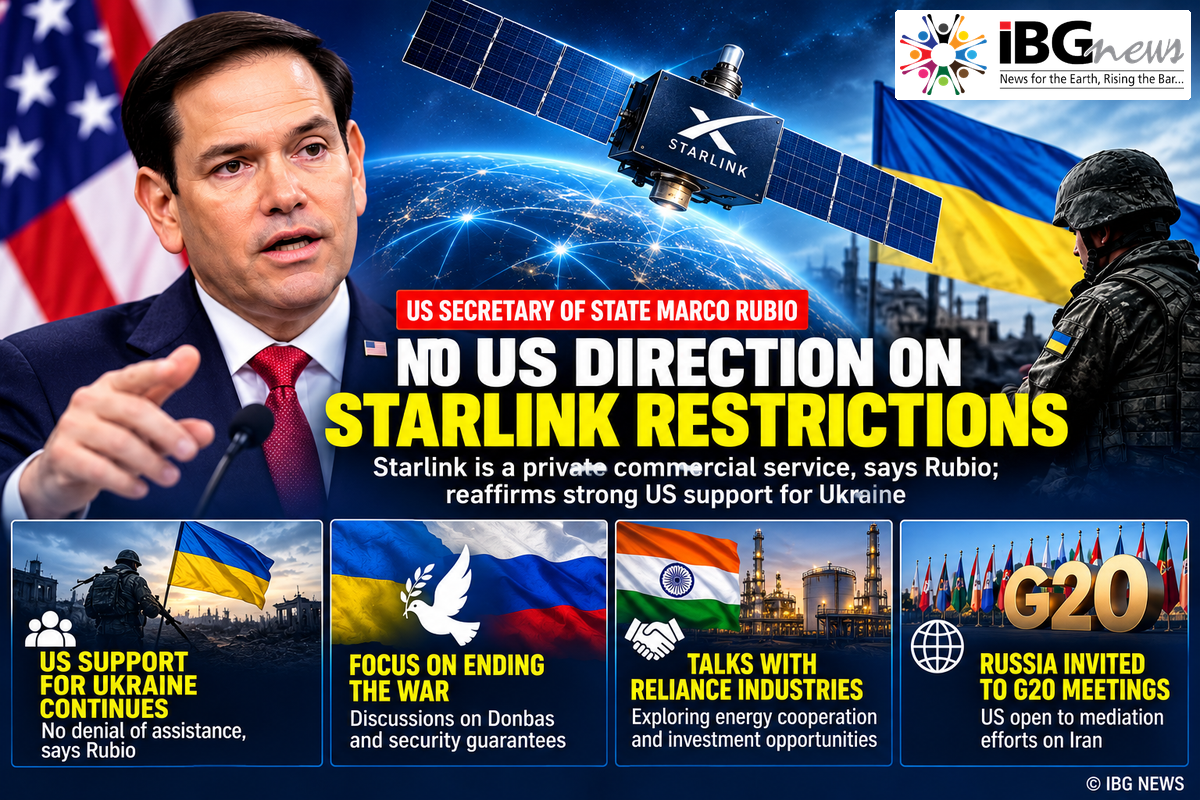
NEW DELHI, October 21, 2026: US Secretary of State Marco Rubio has denied that President Donald Trump or his administration directed SpaceX to restrict Ukraine’s access to Starlink services, while drawing a distinction between the commercial satellite internet network and Starshield, a separate defence-oriented system operated through the US Department of War.
Speaking to reporters during his visit to India, Rubio said Starlink was a privately operated commercial service governed by contractual terms. He rejected claims that Washington had ordered restrictions to punish Ukraine or deliberately undermine its ability to defend itself. Rubio also said he was not aware of any advance knowledge within the US administration of the reported decision.
Washington Rejects Claims of Deliberate Restrictions on Ukraine
Addressing questions about media reports alleging that Elon Musk had decided to limit satellite connectivity affecting Ukraine, Rubio stressed that Starlink and Starshield served different purposes.
He described Starlink as a commercial internet service that could also support activities such as drone operations, whereas Starshield was a specialised defence product supplied and operated through the US defence establishment.
Rubio maintained that the US government did not control the commercial company’s decisions regarding how its products were used. He said Washington had not instructed SpaceX to deny Ukraine access to the service and challenged claims that the administration had deliberately withheld essential assistance.
The secretary of state also defended the scale of American support for Ukraine, arguing that US assistance under successive administrations, including the current Trump administration, had played a crucial role in sustaining the country’s resistance to Russia’s invasion. He reiterated that President Trump remained focused on bringing the war to an end.
Ukraine Peace Efforts Focus on Donbas and Security Guarantees
Rubio described the diplomatic effort to end the conflict as difficult, with the future of the Donbas region remaining a central obstacle to an agreement.
According to his remarks, US special envoy Steve Witkoff had met Ukrainian President Volodymyr Zelenskyy and was expected to convey proposed ideas to the Russian side in St. Petersburg. Rubio indicated that the discussions were aimed at identifying areas of compromise and narrowing differences between the two sides.
He acknowledged that any settlement would require difficult decisions from both Moscow and Kyiv. For Ukraine, he said, long-term security assurances would be a fundamental consideration to prevent renewed attacks or another invasion.
Rubio did not disclose the details of the proposed peace framework, emphasising that negotiations remained complex and that progress would depend on the willingness of both parties to reach an agreement.
Russia Expected to Participate in G20 Meetings
On Russia’s participation in upcoming G20 gatherings, Rubio said Moscow had been invited and was expected to be represented at the meetings. However, he did not confirm whether Russian Foreign Minister Sergey Lavrov would personally attend the foreign ministers’ meeting in Atlanta.
He also referred to the possibility of Russian President Vladimir Putin attending a subsequent G20 gathering in Miami, while making clear that no confirmation was available at the time of his remarks.
Reliance Industries Discussions Highlight Energy Cooperation
Rubio’s India visit also included engagement with Reliance Industries, one of the country’s major energy companies.
Asked whether Washington was seeking a specific investment commitment or a change in the company’s energy-related business activities, Rubio said the meeting would provide an opportunity to discuss Reliance’s global operations and explore potential areas of cooperation.
He highlighted the company’s substantial refining capabilities and existing investment in the United States. Rubio noted that Reliance had the technical capacity to process heavy crude oil produced in the Western Hemisphere, including Venezuelan crude, suggesting that energy trade and investment opportunities could feature in the discussions.
He added that more specific energy-related proposals would involve the US Department of Energy.
Rubio Declines to Comment on India’s Domestic Politics
Responding to questions about opposition and student protests in India, as well as criticism from United Nations experts over the authorities’ response, Rubio declined to take a position on India’s internal political affairs.
He described India as a democracy in which political differences and public demonstrations form part of the political discourse. Drawing a distinction between peaceful expression and violent unrest, he said Washington would leave domestic political questions to the Indian people to debate and resolve.
Rubio also made a sharply dismissive remark about UN experts when the subject was raised, but did not offer a detailed assessment of the specific allegations concerning India.
US Open to Mediation Efforts on Iran
On reports that Qatar and Pakistan had put forward a proposal to bring Washington and Tehran back to negotiations, Rubio said several countries had been engaging with Iran and exploring possible diplomatic initiatives.
He welcomed mediation efforts from partner countries but stressed that the final decision on any acceptable agreement would rest with President Trump. Rubio reiterated that preventing Iran from obtaining nuclear weapons remained a central US objective.
Ethical Standards for US Diplomats Reaffirmed
Rubio also addressed questions about an ethics-related message circulated to US State Department employees following reports concerning Ambassador Kimberly Guilfoyle.
He said the communication had been planned weeks earlier and was not issued specifically in response to the ambassador-related controversy. According to Rubio, the department regularly reminds personnel of their legal and ethical responsibilities.
He emphasised that American diplomats must serve the US government and its people, maintaining high standards of conduct and avoiding any appearance that official responsibilities are being used for personal interests.
Rubio further said the United States continued to seek the release of Stephen Hubbard, adding that Washington had repeatedly communicated its request to Russian authorities.
Diplomatic Significance
Rubio’s October 21 remarks covered several interconnected priorities for Washington: continued support for Ukraine, efforts to negotiate an end to the Russia-Ukraine war, energy and investment cooperation with India, diplomatic pressure over Iran’s nuclear ambitions, and the preservation of ethical standards within the US diplomatic service.
His comments in New Delhi also underscored the distinction Washington draws between government policy and the commercial decisions of private technology companies, an issue with broader implications for satellite communications, defence partnerships and modern warfare.
Source: Remarks by US Secretary of State Marco Rubio to the press, October 21, 2026.
Reporting note: This article is based on the supplied transcript of Rubio’s remarks. Allegations and disputed claims are presented as questions raised by reporters or as positions stated by the secretary of state, rather than as independently verified findings.

