













Indian Scientists Discover New Deep-Sea Shark Species in the Indian Ocean: Echinorhinus roinee
Discovery by ZSI and ICAR-CMFRI highlights India’s unexplored marine biodiversity and the importance of deep-sea conservation
By Suman Munshi
Chief Editor, IBG NEWS
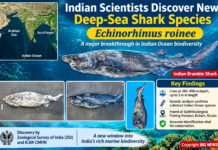
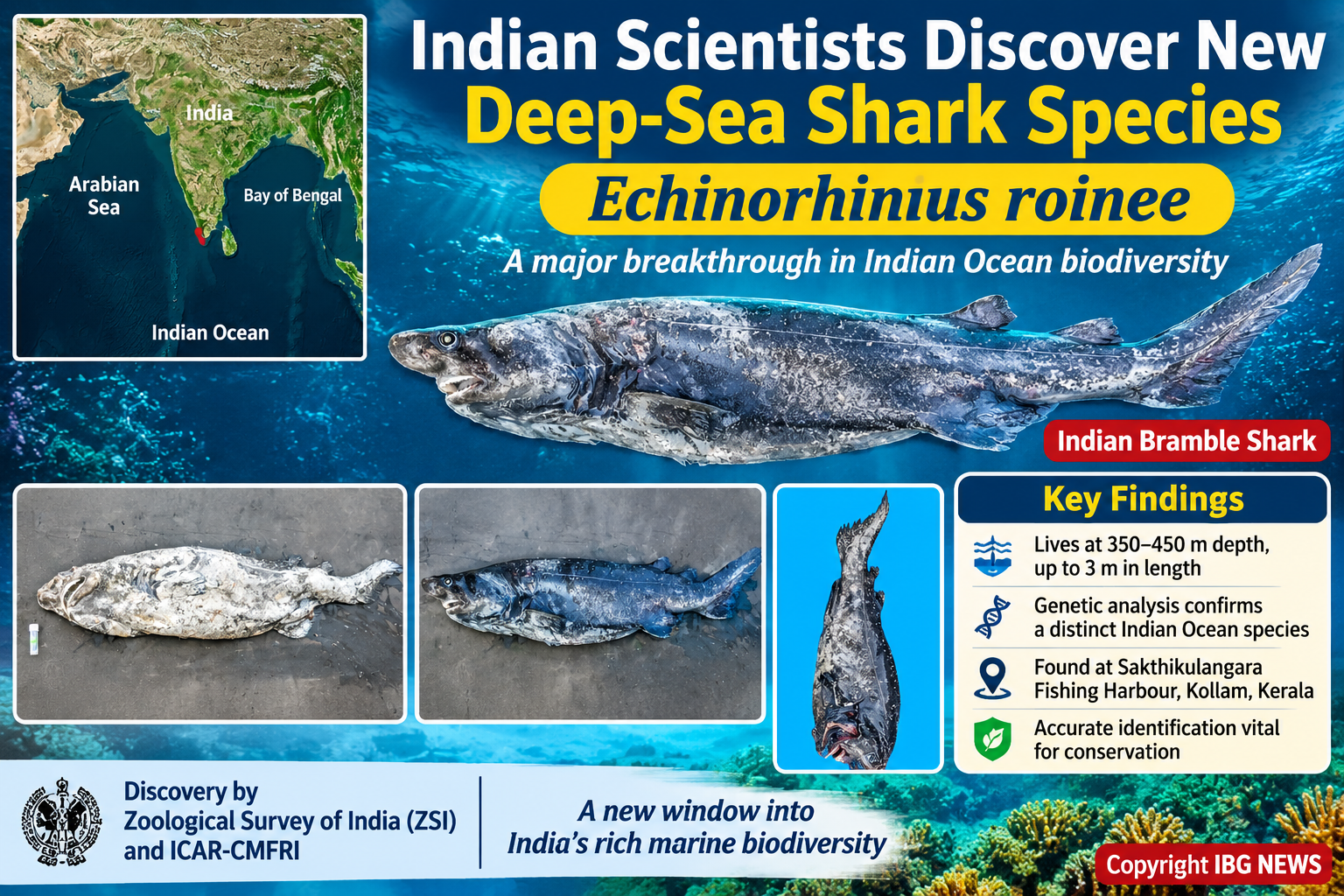
Kolkata, November 11, 2026: In a significant breakthrough for marine biodiversity research, Indian scientists have identified a previously unknown species of deep-sea shark in the Indian Ocean. The species, formally named Echinorhinus roinee and commonly known as the Indian Bramble Shark, had remained incorrectly identified for decades as the Atlantic bramble shark.
The discovery was made by researchers from the Zoological Survey of India (ZSI) and the ICAR-Central Marine Fisheries Research Institute (CMFRI). The scientific findings have been published in the Records of the Zoological Survey of India, Volume 126, Issue 1S (2026).
The discovery is particularly important because it demonstrates that India’s deep-sea ecosystem continues to hold significant biological secrets, many of which are yet to be scientifically documented.
A Shark Hidden in Plain Sight
The specimens of the newly identified shark were collected at Sakthikulangara Fishing Harbour in Kollam, Kerala. They had been brought ashore as incidental catches, or bycatch, by deep-sea shrimp trawlers.
Researchers established that these sharks were not the Atlantic species previously assumed to inhabit Indian waters. Detailed morphological examination, supported by genetic analysis, confirmed that they represent a distinct species.
The Indian Bramble Shark inhabits the continental slopes at depths ranging from approximately 350 to 450 metres and can grow up to three metres in length.
Its body is dark brown to almost black, with prominent thorn-like skin denticles. As the shark matures, these structures develop into distinctive multi-pointed plates. Scientists have also identified larger eyes, relatively larger pelvic fins and a longer snout-to-gill region as important features distinguishing it from related species.
DNA Analysis Confirms a Distinct Species
Genetic investigation using mitochondrial DNA barcode markers provided crucial evidence supporting the discovery.
The analysis established that Echinorhinus roinee belongs to a separate Indian Ocean genetic lineage, distinct from the Atlantic bramble shark (Echinorhinus brucus) and the Pacific prickly shark (Echinorhinus cookei).
Genetically similar records from Oman, Sri Lanka and Thailand further suggest that the distribution of this species may extend across a wider region of the Indian Ocean and adjoining waters.
This finding expands scientific understanding of the diversity and geographical distribution of deep-sea sharks.
Why This Discovery Matters for Marine Conservation
Beyond its taxonomic significance, the discovery has important implications for fisheries management and marine conservation.
Bramble sharks are regularly encountered as incidental catches in deep-sea trawling and longline fishing operations along India’s southwestern coast. However, earlier fisheries records and ecological assessments classified these sharks under the Atlantic bramble shark species.
The correction is important because conservation planning depends on accurate identification of marine species.
Without proper classification, scientists may underestimate the geographical distribution, population status and ecological vulnerability of individual species. Recognising Echinorhinus roinee as a separate species will help researchers develop more reliable fisheries data and assess its conservation requirements.
Deep-sea sharks are particularly vulnerable to fishing pressure because many species have slow growth rates and relatively low reproductive potential. Improved monitoring and scientific assessment are therefore essential.
A Name with a Personal Connection
The species name roinee has a personal significance. It honours Roinee, the daughter of Dr. Dhriti Banerjee, Director of the Zoological Survey of India.
Speaking about the discovery, Dr. Dhriti Banerjee observed that the shark had been considered identical to its Atlantic counterpart for decades. However, detailed physical measurements and DNA evidence established its distinct identity.
She emphasised that the discovery highlights how much of India’s deep-sea biodiversity remains insufficiently explored and understood.
Dr. Bineesh K. K. of ZSI, Chennai, also highlighted the importance of accurate species identification. He pointed out that deep-sea sharks frequently reach fishing landing centres, but are not always correctly identified, limiting the scientific and conservation value of fisheries data.
Research Team and Government Support
The research was conducted by Praveen Rozario, Bineesh K. K., Sweta Beura, Anil Kasinath and Dhriti Banerjee from the Zoological Survey of India, along with Akhilesh K. V. of ICAR-CMFRI.
The research received financial support from the Ministry of Earth Sciences under India’s Deep Ocean Mission, reflecting the country’s growing commitment to exploring and understanding its deep-sea resources.
The type specimens of the newly described species have been preserved in the National Zoological Collections at the Marine Biology Regional Centre of ZSI, Chennai, ensuring their availability for future scientific studies.
India’s Deep Ocean Mission: A New Window into Marine Biodiversity
The identification of Echinorhinus roinee is another reminder of the importance of sustained investment in marine science, taxonomy, genetic research and deep-ocean exploration.
India’s extensive coastline and surrounding oceanic regions support diverse marine ecosystems, including habitats that remain difficult to access and study. Discoveries such as this demonstrate why systematic biodiversity documentation is essential for understanding ecological relationships and protecting vulnerable marine life.
The Indian Bramble Shark may have lived in Indian Ocean waters for generations without being recognised as a separate species. Its identification now provides scientists with a clearer understanding of the region’s marine biodiversity and creates a foundation for future conservation research.
The discovery is not merely the identification of a new shark. It is a reminder that the ocean still holds countless scientific discoveries, waiting for the right combination of observation, technology and research to bring them to light.
Suman Munshi
Chief Editor, IBG NEWS
Scientific Reference:
Rozario, P., Bineesh, K. K., Beura, S., Akhilesh, K. V., Kasinath, A. & Banerjee, D. (2026). Echinorhinus roinee, a new species of Bramble shark (Echinorhiniformes: Echinorhinidae) from the Southwestern Coast of India. Records of the Zoological Survey of India, 126(i1S): 41–58.
DOI: https://doi.org/10.26515/rzsi/v126/i1S/2026/173266

