








Tribal Art Is an Integral Part of India’s Classical Cultural Heritage, Says Prof. Anand Bardhan
IGNCA Lecture Explores the Deep-Rooted Connections Between Indigenous Traditions, Classical Art, Architecture and Indian Religious Heritage
By Suman Munshi | IBG NEWS
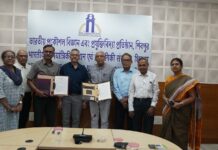
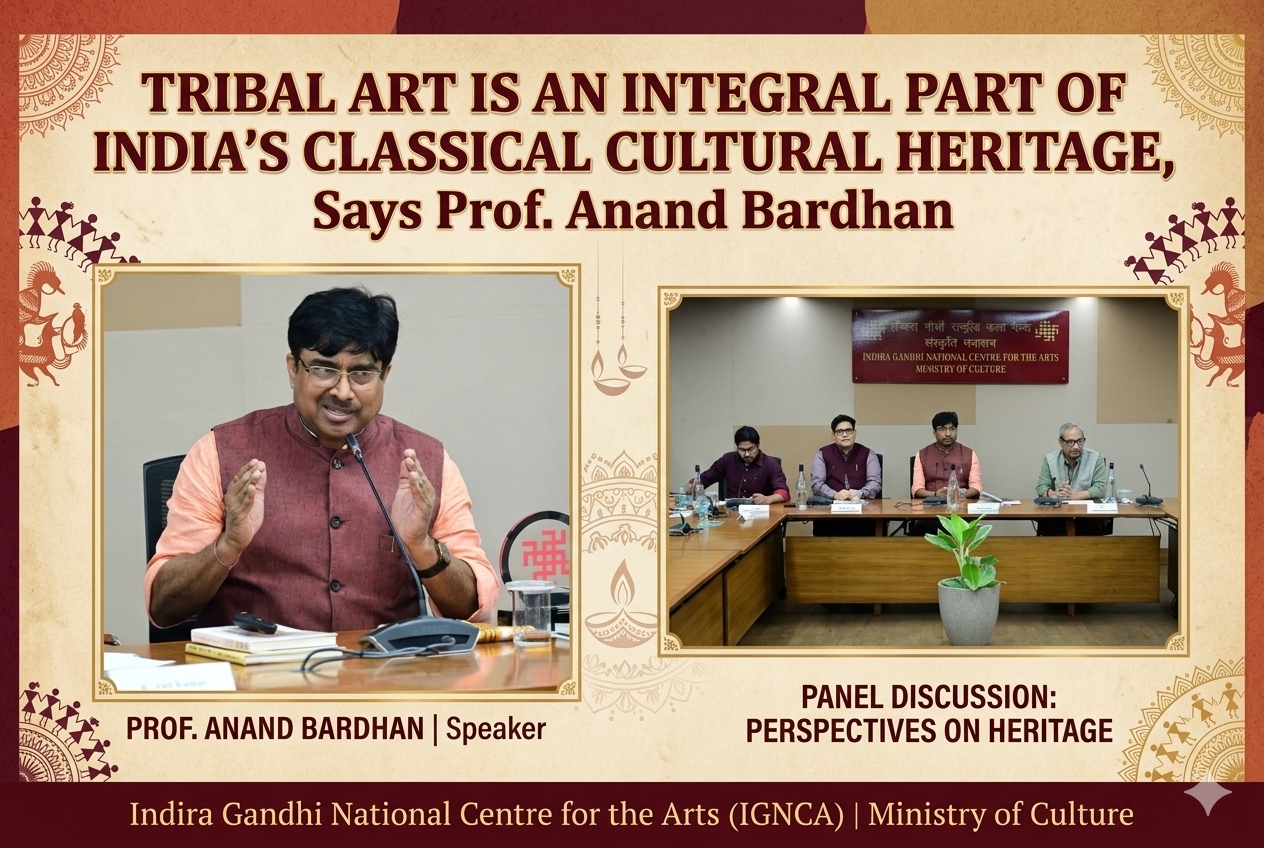
New Delhi, November 19, 2026: Tribal and indigenous art traditions have played a fundamental role in shaping India’s artistic, architectural, religious and philosophical heritage, reflecting a continuous cultural dialogue between local communities and classical traditions. This was the central theme of a special academic lecture organised by the Indira Gandhi National Centre for the Arts (IGNCA) in New Delhi on the occasion of Janjatiya Gaurav Divas 2026.
Organised by IGNCA’s Janapada Sampada Division under its ‘Gyanpath’ lecture series, the programme featured an address by Professor Anand Bardhan, Dean, School of Heritage Research and Management, Dr. B. R. Ambedkar University, Delhi.
Titled ‘The Theoretical Categorisation of Tribal Arts and Their Syncretic Existence in Classical Indian Heritage and History: A Critical Appraisal’, the lecture examined how indigenous, folk, regional and classical traditions have interacted over centuries to shape the distinctive character of Indian civilisation.
The programme was chaired by Dr. Sachchidanand Joshi, Member Secretary, IGNCA. Professor Sudhir Lall, Dean, IGNCA, introduced the speaker and addressed the gathering, while Professor K. Anil Kumar, Head of the Janapada Sampada Division, delivered the welcome address.
Rethinking the Concept of Tribal Art
In his address, Professor Bardhan critically examined the colonial and Western anthropological understanding of the term ‘tribe’, arguing that such classifications do not adequately represent the traditional Indian understanding of communities and their cultural relationships.
He emphasised that indigenous, local and folk traditions should not be treated as isolated or mutually exclusive cultural categories. Instead, their historical interactions and interconnected development must be recognised to understand India’s cultural evolution.
Drawing references from ancient Indian sources, including Kautilya’s Arthashastra and the Aitareya Brahmana, he explained that cultural diversity in India has historically coexisted with an underlying sense of unity. Different communities have preserved their distinct identities, customs and lifestyles while remaining connected through shared cultural practices and exchanges.
Indigenous Contributions to Indian Art and Architecture
Highlighting the contribution of indigenous and local communities, Professor Bardhan explained how traditional practices influenced the development of Indian art, architecture, religious expression and philosophical thought.
He cited examples from stupa construction, megalithic monuments, menhirs, Ashokan pillars, toranas and Buddhist architectural traditions to demonstrate how local beliefs and cultural expressions gradually evolved into sophisticated monumental structures.
He particularly discussed the architectural elements of stupas, including funerary traditions, relic chambers, the yasti and vedika, explaining how these features reflect the integration of folk beliefs, agrarian practices and philosophical concepts.
According to him, the evolution of Indian architecture cannot be understood merely through monumental structures. It is equally important to examine the everyday architectural practices and indigenous construction techniques that influenced their development.
Folk Architecture and the Evolution of Temple Designs
Professor Bardhan also explored the relationship between traditional residential architecture and India’s monumental temple-building traditions.
Referring to cave architecture, arched entrances, roof structures and traditional building forms such as kuti and shala, he explained how indigenous timber construction techniques and local architectural knowledge influenced the later development of temples built in stone and brick.
He highlighted several regional architectural expressions, including the towering gopurams of South Indian temples, Odisha’s Vaital Deul and Khakhara Deul styles, and Bengal’s distinctive Chala architecture.
These examples, he noted, demonstrate how regional building traditions were absorbed, adapted and transformed into India’s diverse classical architectural vocabulary.
Lord Jagannath: A Symbol of Cultural Synthesis
One of the significant aspects of the lecture was the discussion of the Lord Jagannath tradition, which Professor Bardhan presented as an outstanding example of the synthesis between indigenous, folk and classical religious traditions.
He explained that the concept of Daru Brahma, local faith systems, tribal and rural religious practices, and evolved temple architecture collectively contribute to the distinctive character of the Jagannath tradition.
The annual Rath Yatra further illustrates the continuing interaction between different communities and religious expressions.
He also referred to the traditions of Yakshas and Yakshinis, Lord Shiva’s Kirata form, the Gudimallam Shivalinga and Tanginath in Jharkhand to demonstrate how regional and indigenous cultural influences contributed to the evolution of Indian religious iconography and the conceptualisation of deities.
Regional Goddess Traditions and the Concept of Adi Shakti
Discussing the evolution of Shakti worship, Professor Bardhan observed that India possesses an extensive tradition of Mother Goddess worship, with numerous regional and community-specific manifestations.
He explained how local and regional forms of Goddess worship were incorporated into the broader philosophical and religious framework of Adi Shakti.
Referring to important religious texts such as Shakta Pramoda, Durga Saptashati and Lalita Sahasranama, he discussed the syncretic character of Indian religious traditions through examples such as Vanadurga, Vankhandi and other regional manifestations of the Goddess.
He concluded that Indian art and culture have evolved through centuries of interaction, adaptation and synthesis among indigenous, folk, regional and classical traditions.
IGNCA Highlights the Importance of Integrated Cultural Understanding
Responding to the lecture, Professor Sudhir Lall described Professor Bardhan’s presentation as informative and thought-provoking, noting that it offered fresh perspectives on understanding India’s cultural diversity.
Explaining the Indian concept of ‘Lok’, he observed that the term encompasses much more than a geographical area or region. It also represents the communities inhabiting that space, their lifestyles, cultural practices and collective experiences.
He emphasised that India’s folk and classical traditions should not be understood as two disconnected cultural streams but as continuously interacting and mutually enriching expressions of civilisation.
Professor Lall also appreciated the wide historical and literary references presented during the lecture, ranging from Vedic literature and the Arthashastra to inscriptions and Tamil literary traditions.
Referring to the Tolkappiyam, Natyashastra, Odisha’s Madala Panji, the Vitthal tradition of Pandharpur and Maharashtra’s Khandoba worship, he highlighted the cultural similarities and connections that exist across different regions of India.
He described the observations as an important foundation for further academic discussions and research into India’s interconnected cultural heritage.
Strengthening Research on India’s Cultural Diversity
The programme brought together IGNCA scholars, research scholars and academics working in the fields of art, history and culture.
The discussion highlighted the importance of examining India’s artistic heritage beyond conventional classifications and recognising the contributions of indigenous communities to the country’s broader civilisational development.
The lecture also reinforced the need for sustained academic research into the relationship between tribal knowledge systems, folk traditions and classical Indian heritage.
The central message emerging from the deliberations was that India’s cultural identity is not the creation of a single artistic or intellectual tradition. Rather, it is the outcome of centuries of interaction among diverse communities, whose collective contributions continue to shape the country’s artistic and cultural landscape.
IBG NEWS | Art, Culture & Heritage