











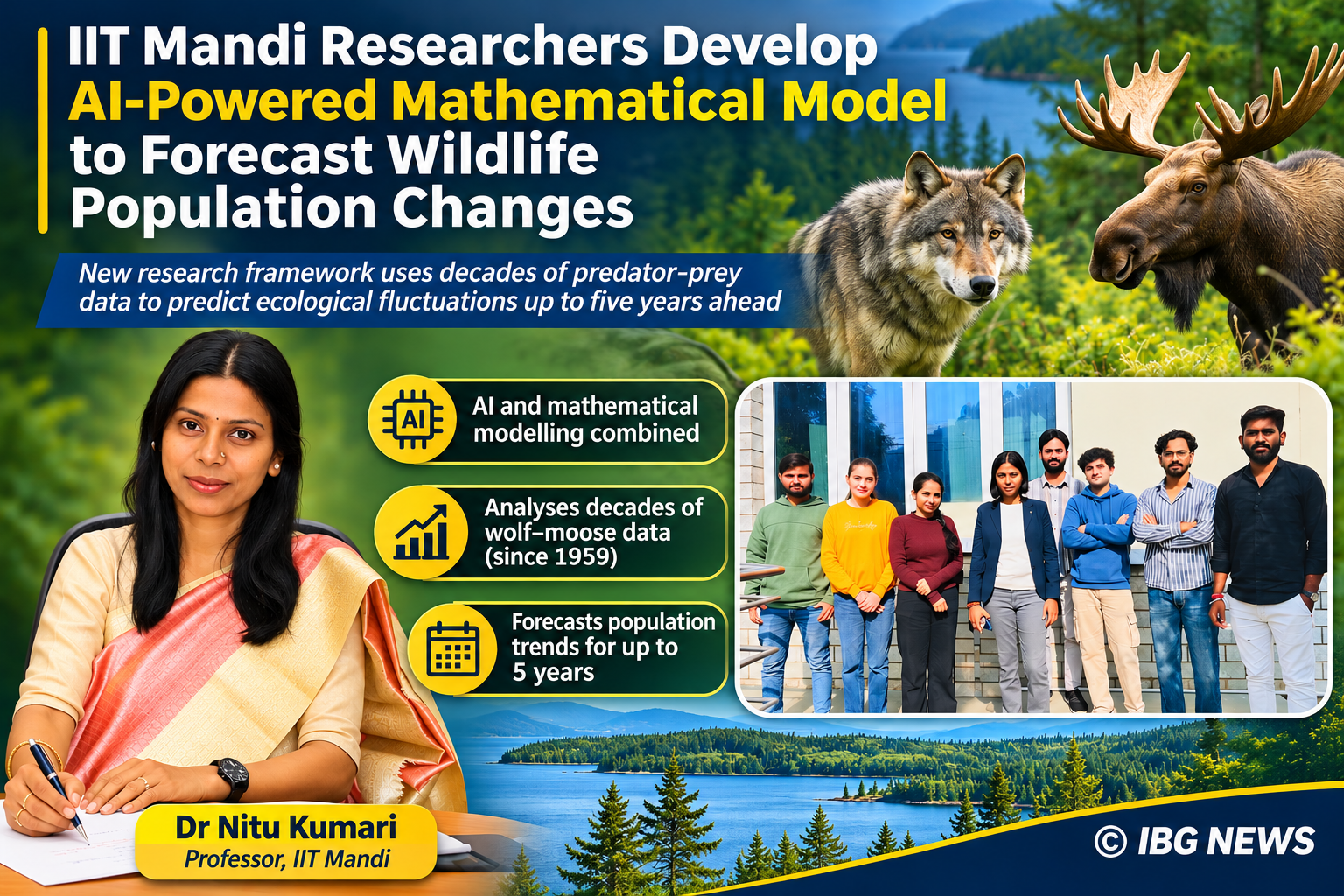

IIT Mandi Researchers Develop AI-Powered Mathematical Model to Forecast Wildlife Population Changes
New research framework uses decades of predator-prey data to predict ecological fluctuations up to five years ahead
By Suman Munshi | IBG NEWS
Mandi, Himachal Pradesh, November 20, 2026: Researchers at the Indian Institute of Technology (IIT) Mandi have developed an innovative mathematical modelling framework incorporating Artificial Intelligence (AI) to predict fluctuations in wildlife populations. The new approach could strengthen ecological research by helping scientists understand predator-prey relationships and forecast changes in animal populations, even when historical data is incomplete, irregular or limited.
The research examines the long-term relationship between wolves and moose in Isle Royale National Park, a 544-square-kilometre island located in Lake Superior, Michigan, USA. Wolves are the principal natural predators of moose in the park, with moose constituting approximately 90 per cent of the wolves’ winter diet.
The two species have been monitored annually since 1959, creating one of the world’s longest-running records of predator-prey population dynamics.
Understanding the Changing Balance of Nature
Over several decades, the wolf and moose populations have experienced considerable fluctuations. A disease outbreak in the early 1980s resulted in a sharp decline in wolf numbers, while the moose population suffered a significant reduction during the mid-1990s.
Such population changes are important indicators of ecological stability. An imbalance between predators and prey can influence food chains, natural habitats and the overall health of an ecosystem.
The IIT Mandi research team has developed a model that analyses historical population records to estimate moose reproduction rates, natural changes in wolf populations and the influence of predation on moose numbers. Based on these calculations, the framework can forecast population trends for periods of up to five years.
AI and Mathematical Modelling Working Together
The research was conducted by Dr Nitu Kumari, Professor at the School of Mathematical and Statistical Sciences, IIT Mandi, along with her PhD researcher Anurag Singh.
The team evaluated two different approaches to modelling the hunting relationship between wolves and moose. Their analysis found that the approach based on the relationship between predator and prey population sizes delivered better results than the alternative method.
The framework was also able to identify unusual periods of population decline within historical records, offering researchers another way to examine significant ecological changes.
One notable finding emerged from the model’s predictions for 2020–2024. It indicated a likely increase in wolf numbers alongside a decline in the moose population, broadly corresponding with the population trends subsequently observed in the national park.
A New Approach Combining Physics-Informed AI and Transfer Learning
According to Professor Nitu Kumari, the research is, to the best of her knowledge, the first study to apply a self-adaptive mathematical modelling framework combining Physics-Informed Neural Networks (PINNs) and Transfer Learning to investigate predator-prey population fluctuations.
The combination is significant because it brings mathematical principles and AI-based learning techniques together to analyse complex ecological systems.
The findings demonstrate the potential of AI-assisted mathematical models to generate meaningful predictions even when environmental datasets contain uncertainties or are not consistently available.
Potential Significance for Ecological Research
Accurate predictions of wildlife population changes can help scientists better understand the relationships between species and the factors influencing ecosystem stability.
By providing forecasts based on historical observations and mathematical modelling, the IIT Mandi framework could contribute to future research in wildlife population dynamics, biodiversity conservation and ecosystem monitoring.
The research also highlights how advanced computational methods can support environmental science, particularly in situations where long-term and reliable ecological data are difficult to obtain.
Professor Kumari has also shared insights into the research in an interview with the US-based media outlet The Primary. According to the press release, the publication’s article on the research is expected to appear online shortly.
IBG NEWS Perspective: The IIT Mandi research represents an encouraging intersection of artificial intelligence, mathematics and environmental science. As climate change, habitat pressures and ecological disturbances continue to influence wildlife populations, predictive modelling could become an increasingly valuable scientific tool for understanding and protecting the natural balance of ecosystems.
Source: Indian Institute of Technology (IIT) Mandi Press Release, November 20, 2026.
Reported by: Suman Munshi, IBG NEWS

