










Yogi Point and Avayogi Point in a Birth Chart: A Complete Vedic Astrology Analysis of Fortune, Talent, Life Potential and Challenges
A Yogi–Avayogi Analysis Based on Lahiri Ayanamsha for a Person Born on 21 November 2026 at 12:20 PM in New Delhi
Introduction
In Vedic astrology, the analysis of a birth chart generally gives considerable importance to the Ascendant (Lagna), Moon sign (Rashi), Nakshatra, planetary positions, planetary aspects and Mahadasha periods.
However, there is another interesting aspect of astrology that remains relatively unfamiliar to many people: the Yogi Point, Yogi Planet and Avayogi Point.
Through this system, astrologers examine the potential supportive influences, areas of talent, opportunities and challenges indicated in a birth chart.
In simple terms:
- Yogi Point: Represents potential positive support and favourable influences in life.
- Yogi Planet: The planetary indicator associated with that supportive influence.
- Duplicate Yogi or Sahayogi: An additional supportive planetary influence.
- Avayogi Point: Represents potential obstacles, areas requiring caution and circumstances that may demand additional effort.
This article explains these concepts through a specific birth-chart example.
1. Birth Details and Basic Horoscope
The following birth details have been used for this analysis:
| Particulars | Details |
|---|---|
| Date of Birth | 21 November 2026 |
| Time of Birth | 12:20 PM |
| Place of Birth | New Delhi, India |
| Time Zone | IST (UTC+5:30) |
| Ayanamsha | Lahiri |
| Astrological System | Vedic Astrology |
| House System | Whole Sign House |
Major Birth Chart Characteristics
| Particulars | Result |
|---|---|
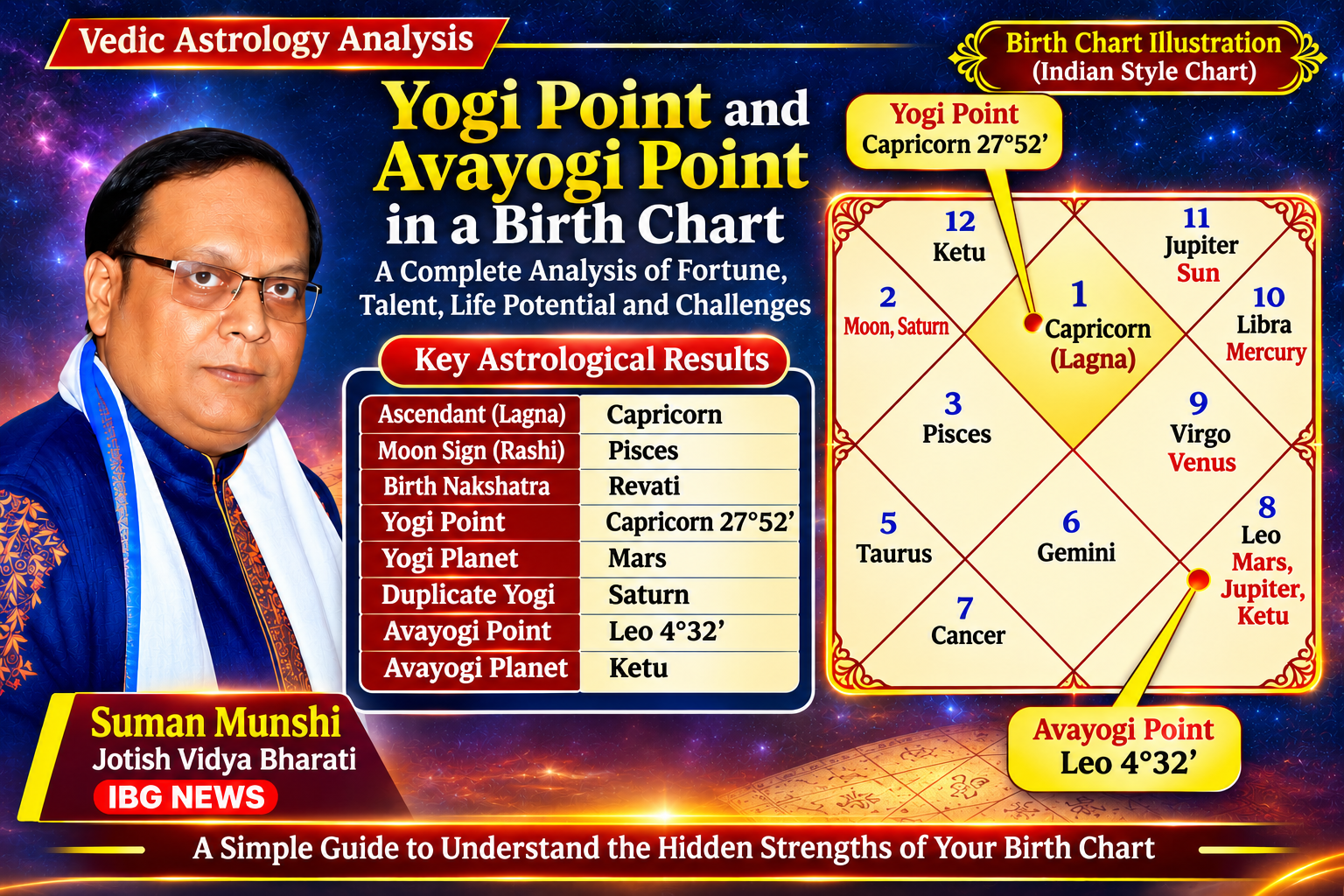
| Ascendant (Lagna) | Capricorn |
| Ascendant Lord | Saturn |
| Moon Sign (Rashi) | Pisces |
| Birth Nakshatra | Revati |
| Nakshatra Lord | Mercury |
| Yogi Planet | Mars |
| Duplicate Yogi | Saturn |
| Avayogi Planet | Ketu |
An important feature of this birth chart is Mars as the Yogi Planet and Saturn as the Duplicate Yogi. Ketu is identified as the Avayogi Planet.
2. What Is the Yogi Point and How Is It Calculated?
The Yogi Point is not an actual planet. It is a mathematical point calculated using the positions of the Sun and Moon.
According to a commonly followed Vedic astrological method:
Yogi Point = Sun’s Longitude + Moon’s Longitude + 93°20′
The zodiac consists of 360 degrees. Therefore, whenever the calculated value exceeds 360 degrees, 360 degrees is subtracted.
The planetary ruler of the Nakshatra occupied by this calculated point is known as the Yogi Planet.
According to traditional astrological beliefs, the Yogi Planet represents certain potential opportunities, abilities, supportive circumstances and favourable influences in a person’s life.
3. Calculation of the Yogi Point in This Birth Chart
According to the approximate planetary positions used in this analysis under Lahiri Ayanamsha:
- Sun: Scorpio 4°44′
- Moon: Pisces 19°48′
Applying the formula:
Sun + Moon + 93°20′
= 214°44′ + 349°48′ + 93°20′
= 657°52′ (approximately)
Subtracting 360 degrees:
Yogi Point = 297°52′ (approximately)
This corresponds to Capricorn 27°52′.
This position falls in the second Pada of Dhanishta Nakshatra.
The results are therefore:
| Particulars | Result |
|---|---|
| Yogi Point | Capricorn 27°52′ |
| Yogi Nakshatra | Dhanishta |
| Nakshatra Pada | Second |
| Yogi Planet | Mars |
| Sign Lord | Saturn |
| Duplicate Yogi | Saturn |
An interesting aspect here is that although Mars is the Yogi Planet, the Yogi Point falls in Capricorn, whose ruling planet is Saturn. Consequently, Saturn is considered the Duplicate Yogi.
4. What Does Mars as the Yogi Planet Signify?
In Vedic astrology, Mars represents energy, courage, initiative, competition, working capacity, technical ability and leadership.
When Mars becomes the Yogi Planet, traditional astrological interpretations associate it with the following potential strengths:
- Courage and self-confidence.
- A competitive mindset.
- Interest in technical and mechanical subjects.
- Leadership tendencies.
- The ability to attempt quick solutions to problems.
- The initiative to face challenging circumstances.
However, how strongly these potential qualities manifest depends on Mars’s position, aspects, strength and planetary periods in the birth chart.
Position of Mars in This Birth Chart
Mars is positioned at 3°50′ in Leo.
From Capricorn Ascendant, this falls in the eighth house.
In Vedic astrology, the eighth house is associated with research, investigation, deep analysis, mysteries, transformation and complex subjects.
Therefore, the placement of Mars as the Yogi Planet in this house may traditionally be interpreted as indicating an inclination towards research-oriented thinking, solving difficult problems and deeper investigation.
However, the presence of Mars in the eighth house should not automatically be interpreted as an indication of danger or accidents in life.
5. Duplicate Yogi or Supporting Yogi Planet: Saturn
Since the Yogi Point falls in Capricorn, its ruling planet is Saturn.
For this reason, Saturn is identified as the Duplicate Yogi in this birth chart.
In Vedic astrology, Saturn represents discipline, patience, responsibility, perseverance, long-term planning and hard work.
While Mars symbolises the energy to act quickly, Saturn represents the ability to work slowly, systematically and consistently.
The symbolic combination of these two planets is particularly interesting:
- Mars: Initiative and working energy.
- Saturn: Patience and discipline.
Thus, the Yogi–Duplicate Yogi combination in this birth chart can be interpreted as a relationship between initiative and planning, and between energy and perseverance.
Position of Saturn in the Birth Chart
Saturn is positioned at 14°03′ in Pisces.
From Capricorn Ascendant, this falls in the third house.
The third house is traditionally associated with:
- Courage.
- Communication.
- Writing.
- Skill development.
- Practical learning.
- Initiative.
- Self-effort.
Therefore, this placement may be interpreted astrologically as representing perseverance, skill development and progress through personal effort.
6. What Is the Avayogi Point?
Along with the Yogi Point, astrologers also calculate the Avayogi Point.
The commonly followed formula is:
Avayogi Point = Yogi Point + 186°40′
For this birth chart:
297°52′ + 186°40′
= 484°32′
After subtracting 360 degrees:
Avayogi Point = 124°32′ (approximately)
This corresponds to Leo 4°32′.
The position falls in the second Pada of Magha Nakshatra.
The ruling planet of Magha Nakshatra is Ketu.
Therefore:
| Particulars | Result |
|---|---|
| Avayogi Point | Leo 4°32′ |
| Nakshatra | Magha |
| Nakshatra Pada | Second |
| Avayogi Planet | Ketu |
7. What Does Ketu as the Avayogi Planet Signify?
Ketu is a shadow planet in Vedic astrology.
Traditional interpretations associate Ketu with detachment, intuition, spirituality, past experiences, deep investigation and unconventional thinking.
When Ketu is identified as the Avayogi Planet, its position may be interpreted as highlighting certain areas where additional awareness and caution could be beneficial.
These include:
- Gathering sufficient information before making decisions.
- Avoiding unnecessary withdrawal from responsibilities.
- Sharing one’s thoughts and ideas with others.
- Avoiding excessive isolation.
- Maintaining a balance between emotions and logical thinking.
However, Ketu does not necessarily represent something negative. Many astrologers also consider it a positive symbol of spiritual exploration, deep thinking and research.
Position of Ketu in This Birth Chart
Ketu is positioned at 0°45′ in Leo.
It occupies the same sign as Mars and Jupiter, namely the eighth house from Capricorn Ascendant.
The positions of Ketu, Mars and Jupiter should therefore be considered together.
In traditional astrological interpretation, this combination may symbolically indicate deep investigation, an interest in understanding complex subjects and a tendency to question conventional ideas.
However, this placement should not be interpreted as a guarantee of any specific problem or negative future event.
8. Complete Planetary Positions in the Birth Chart
The approximate planetary positions used in this analysis are:
| Planet | Zodiac Sign | House from Capricorn Ascendant |
|---|---|---|
| Sun | Scorpio | Eleventh |
| Moon | Pisces | Third |
| Mars | Leo | Eighth |
| Mercury | Libra | Tenth |
| Jupiter | Leo | Eighth |
| Venus | Virgo | Ninth |
| Saturn | Pisces | Third |
| Rahu | Aquarius | Second |
| Ketu | Leo | Eighth |
These house positions follow the Whole Sign House system.
Some Important Astrological Features
Capricorn Ascendant: Traditionally represents discipline, responsibility and long-term effort.
Pisces Moon Sign: Associated with imagination, emotions and sensitivity.
Revati Nakshatra: Ruled by Mercury. Traditional