













US Economy Accelerates to 4.3% Growth in Q3 2026 as Consumer Spending and Investment Surge
By Anil P. Kastuar | Editor, IBG NEWS
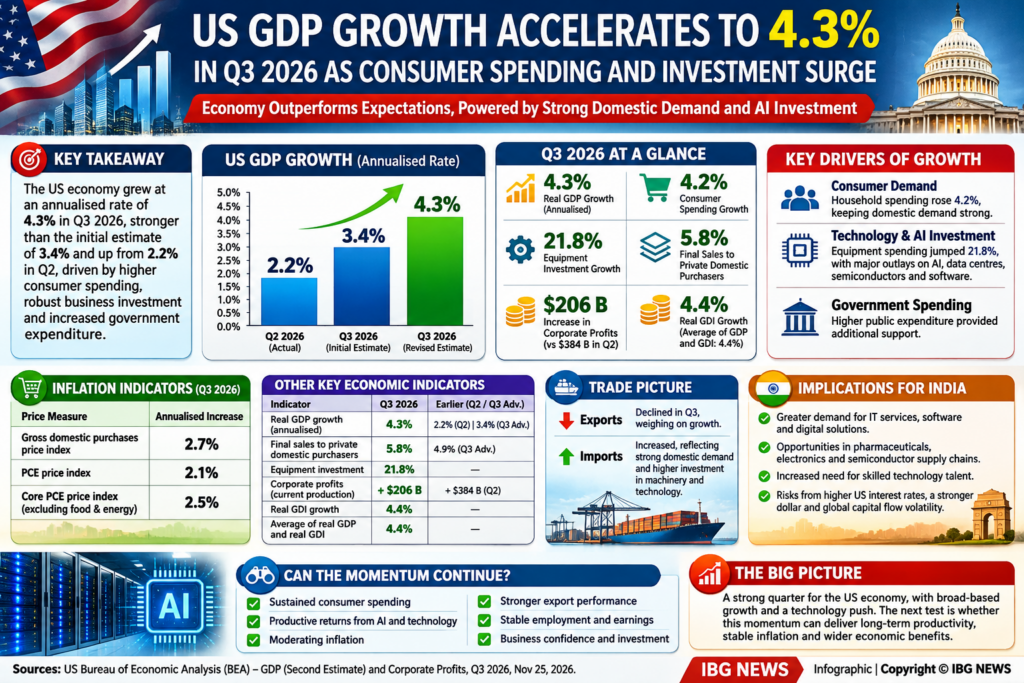
WASHINGTON, November 26, 2026: The US economy recorded stronger-than-expected growth in the third quarter of 2026, with Gross Domestic Product (GDP) expanding at an annualised rate of 4.3%, according to the revised estimate released by the US Bureau of Economic Analysis (BEA) on November 25.
The latest figure marks a significant improvement over the initial estimate of 3.4% and the 2.2% growth recorded in the previous quarter. Strong consumer spending, increased business investment and higher government expenditure contributed to the acceleration.
Consumer Spending Drives Economic Growth
Consumer expenditure remained a major engine of the American economy, growing at an annualised rate of approximately 4.2% during the quarter.
Continued household spending on goods and services demonstrated the resilience of domestic demand despite concerns over living costs, borrowing expenses and inflation.
However, the benefits of economic expansion remain unevenly distributed, with many households continuing to face pressure from housing, healthcare and everyday expenses.
AI and Technology Investment Gain Momentum
Business investment emerged as another important contributor to economic growth. Spending on equipment increased at an annualised rate of 21.8%, reflecting strong demand for technology infrastructure, machinery and advanced computing systems.
The rapid expansion of artificial intelligence (AI), semiconductor technology, cloud computing and hyperscale data centres is reshaping America’s investment landscape.
Major technology investments could improve productivity across manufacturing, healthcare, finance and logistics. However, their long-term economic value will depend on whether companies can convert substantial capital expenditure into sustainable revenues and efficiency gains.
Trade and Inflation Remain Challenges
Despite the strong headline growth, the economy faces important challenges. Exports declined while imports increased, highlighting continuing pressure on international trade performance.
Inflation also remains a key concern for policymakers. The Federal Reserve must balance economic expansion against the need to maintain price stability.
Strong demand could support business activity and employment, but persistent inflation may limit the scope for interest-rate reductions.
What Does It Mean for the Global Economy?
The performance of the world’s largest economy has implications far beyond American borders.
For India, sustained US growth could create opportunities in information technology, software services, pharmaceuticals, electronics manufacturing and global supply chains.
However, changes in US interest rates and dollar movements could also influence foreign investment, emerging-market currencies and international capital flows.
Can the Growth Momentum Continue?
The immediate outlook appears encouraging, but sustaining growth at this pace will depend on several factors:
- Continued consumer spending and employment stability.
- Productive returns from AI and technology investments.
- Moderating inflation and manageable borrowing costs.
- Stronger export performance and resilient global trade.
- Sustainable corporate earnings and business confidence.
The latest GDP estimate also indicates that underlying private domestic demand remained particularly strong, with real final sales to private domestic purchasers increasing at an annualised rate of 5.8%.
Conclusion
The 4.3% GDP expansion represents a strong quarter for the US economy, demonstrating the resilience of American consumers and the growing influence of technology-driven investment.
Yet the sustainability of this expansion will depend on whether investment translates into lasting productivity improvements, inflation remains under control and economic gains reach a wider section of society.
For global markets and emerging economies such as India, America’s economic performance will remain an important indicator of international business and investment trends.
America’s economic momentum is impressive. The real test will be turning short-term growth into long-term prosperity.
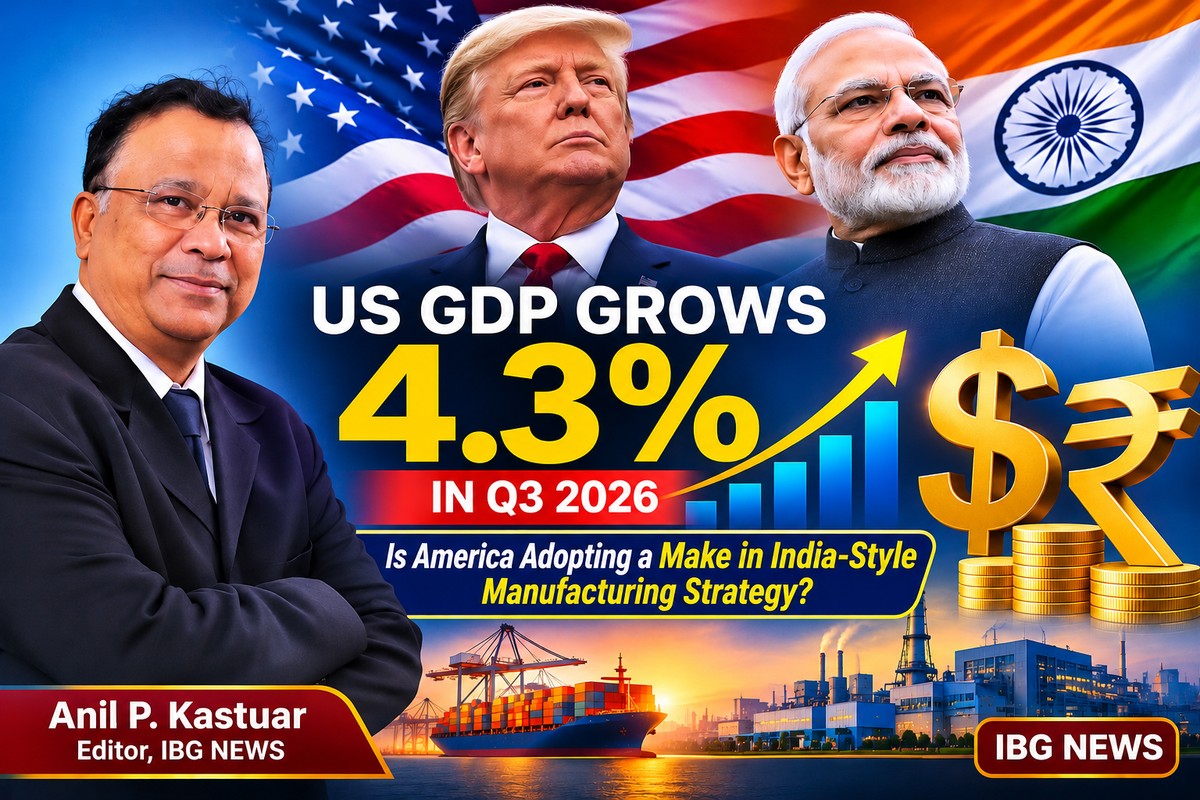
Is America Adopting a Make in India-Style Manufacturing Strategy adopted by Modi?
An interesting dimension of America’s economic transformation is the growing emphasis on domestic manufacturing, industrial self-reliance and reducing dependence on foreign supply chains. These objectives have considerable similarities with Prime Minister Narendra Modi’s Make in India initiative, launched in September 2014.
While Washington has not formally adopted India’s Make in India model, successive US administrations have increasingly pursued policies designed to bring strategic manufacturing activities back to American soil, attract industrial investment and strengthen domestic production capabilities.
In several respects, the United States is now pursuing an industrial policy with objectives comparable to those India identified more than a decade ago.
From Make in India to Made in America
India’s Make in India programme was designed to transform the country into a global manufacturing and design hub. Its priorities include attracting foreign investment, improving industrial infrastructure, encouraging innovation, developing skills and expanding domestic production.
The United States has adopted comparable priorities through several major initiatives:
- CHIPS and Science Act: Supports semiconductor research, development and domestic manufacturing, with incentives intended to strengthen America’s position in the global technology supply chain.
- Inflation Reduction Act: Introduced substantial support for clean energy, electric vehicles and domestic industrial investment, including domestic-content incentives.
- Buy American policies: Encourage federal procurement from American manufacturers and suppliers.
- Reshoring initiatives: Seek to relocate strategically important manufacturing activities to the United States and reduce dependence on concentrated overseas supply chains.
These policies demonstrate that domestic manufacturing is increasingly viewed in Washington as an issue of economic security, technological leadership and national resilience.
The Similarities with Modi’s Make in India Vision
The comparison is particularly relevant in five areas:
- Domestic production: Both countries seek to expand manufacturing capacity within their national borders.
- Strategic industries: Semiconductors, electronics, defence-related production and advanced technologies receive considerable attention.
- Investment incentives: Government support is used to attract capital and encourage industrial expansion.
- Supply-chain security: Both approaches recognise the economic risks of excessive dependence on overseas suppliers.
- Employment and technology: Industrial development is expected to create skilled jobs and strengthen technological capabilities.
India’s Production Linked Incentive (PLI) schemes and America’s semiconductor manufacturing incentives illustrate how governments are using financial and industrial policy instruments to encourage domestic production.
An Important Difference: America Is Also Protecting Its Industrial Market
Despite these similarities, there is a significant difference between the two strategies.
India’s Make in India programme has emphasised attracting foreign investment and integrating the country into global manufacturing networks. The American approach increasingly combines domestic manufacturing incentives with trade restrictions, domestic procurement preferences and national-security-based supply-chain policies.
This distinction matters for international businesses.
The United States wants foreign companies to invest and manufacture within America, while simultaneously seeking to protect strategic industries and reduce dependence on selected overseas suppliers.
For Indian manufacturers, this creates both opportunities and challenges.
India-US Manufacturing Competition and Cooperation
The two countries have opportunities to collaborate in semiconductor supply chains, pharmaceuticals, electronics, defence manufacturing, renewable energy, critical minerals and advanced technology.
Indian companies could benefit from American investment, technology partnerships and access to industrial markets. At the same time, Indian manufacturers may face stronger competition as the United States expands its own production capabilities.
There is also a potential trade-policy contradiction. On November 25, 2026, the US Trade Representative announced Section 301 determinations concerning manufacturing policies in 14 economies, including India. The US assessment raised concerns about India’s industrial policies, market access barriers and manufacturing practices. These are American government allegations and policy positions, not independently established findings of wrongdoing by India.
This development demonstrates that shared manufacturing objectives do not necessarily eliminate trade disagreements.
Is America Following Modi’s Economic Thinking?
The more accurate interpretation is that the United States and India are responding to a similar global economic challenge: how to maintain industrial competitiveness, secure critical supply chains and create high-value domestic employment in an increasingly technology-driven world.
Modi’s Make in India initiative established this manufacturing-centred development objective in 2014. The United States subsequently expanded its own industrial-policy interventions through semiconductor incentives, clean-energy investment, procurement preferences and reshoring strategies.
The two approaches are not identical, nor is there sufficient evidence to conclude that American industrial policies were directly copied from India’s programme.
Nevertheless, their growing convergence highlights an important transformation in global economic thinking: even highly developed market economies are increasingly using government policy to strengthen domestic manufacturing.
For India, the opportunity is to move beyond being an alternative manufacturing destination and become an essential partner in global technology, industrial innovation and strategic supply chains.
The emerging global economic competition is no longer simply about who can manufacture at the lowest cost. It is increasingly about who can control technology, secure supply chains, attract investment and build the industrial capabilities of the future.
Source: US Bureau of Economic Analysis (BEA), Q3 2026 GDP Second Estimate, November 25, 2026.
IBG NEWS | International Business & Global Economy
Copyright © IBG NEWS. All Rights Reserved.