








Durand Cup: Asia’s Oldest Football Tournament and the Enduring Legacy of the Indian Armed Forces
By Suman Munshi, IBG NEWS Sports Desk
Introduction
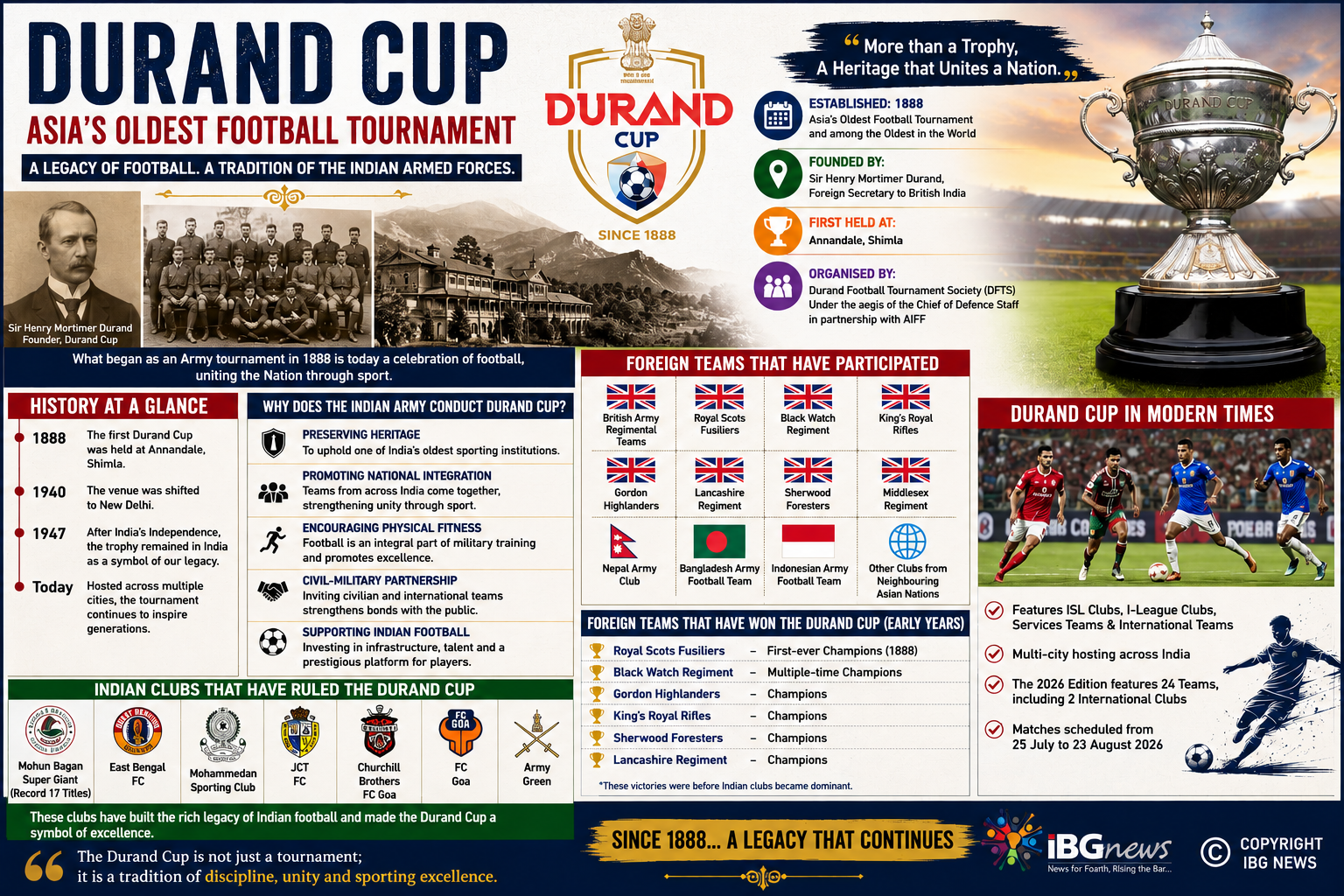
The Durand Cup is far more than a football tournament—it is a living symbol of India’s sporting heritage, military tradition, and footballing excellence. Established in 1888, it is the oldest football tournament in Asia and among the oldest surviving football competitions in the world. Over more than 135 years, the tournament has witnessed the evolution of football in India, producing legendary clubs, iconic players, and unforgettable rivalries. (Durand Cup)
The Birth of the Durand Cup
The tournament was founded in 1888 at Annandale, Shimla, by Sir Henry Mortimer Durand, then the Foreign Secretary to British India.
Originally conceived as an Army competition, it was designed to encourage physical fitness, discipline, camaraderie, and healthy competition among British Indian Army regiments stationed across the country. Over time, civilian football clubs were invited to participate, transforming the tournament into India’s premier football competition. (Durand Football)
From Shimla to New Delhi and Kolkata
Initially played in the hills of Shimla, the tournament shifted to New Delhi in 1940.
Following India’s Independence in 1947, there were discussions about moving the historic trophy to Pakistan because it had been associated with the British Indian Army. However, Indian Defence officials ensured that the prestigious trophy remained in India. Since then, the tournament has continued uninterrupted under Indian stewardship, becoming a cornerstone of Indian football. (Wikipedia)
Why Does the Indian Army Conduct the Durand Cup?
One of the most frequently asked questions is why the Indian Army continues to organize a football tournament.
The answer lies in history and national tradition.
Today, the Durand Cup is organized by the Durand Football Tournament Society (DFTS), which functions under the leadership of the Chief of Defence Staff (CDS) and the Chiefs of the Indian Army, Navy, and Air Force, in partnership with the All India Football Federation (AIFF). (Wikipedia)
The Armed Forces conduct the tournament for several reasons:
1. Preserving Heritage
The Durand Cup is one of India’s oldest sporting institutions. The Armed Forces regard it as a national legacy that deserves preservation.
2. Promoting National Integration
The tournament brings together teams from every region of India, representing diverse cultures, languages, and communities, thereby strengthening national unity through sport.
3. Encouraging Physical Fitness
Football has always been an important part of military training. Organizing elite competitions promotes sporting excellence among Armed Forces personnel.
4. Civil-Military Partnership
By inviting civilian clubs, ISL teams, I-League clubs, and international teams, the Army strengthens its relationship with the public while promoting football nationwide.
5. Supporting Indian Football
The Armed Forces invest considerable resources in hosting matches across multiple states, upgrading stadium infrastructure, and providing young footballers with a prestigious platform.
Foreign Teams That Have Participated in the Durand Cup
Over its long history, several overseas military and club teams have competed in the tournament.
Some of the notable foreign participants include:
- British Army Regimental Teams
- Royal Scots Fusiliers
- Black Watch Regiment
- King’s Royal Rifles
- Gordon Highlanders
- Middlesex Regiment
- Lancashire Regiment
- Sherwood Foresters
- Nepal Army Club
- Bangladesh Army Football Team
- Bangladesh national club sides
- Indonesian Army Football Team (recent editions)
- Foreign clubs from neighbouring Asian nations in modern editions. (Wikipedia)
Foreign Teams That Have Won the Durand Cup
During the early decades, before Indian clubs became dominant, several British military teams lifted the trophy.
Among the notable foreign winners are:
| Foreign Team | Achievement |
|---|---|
| Royal Scots Fusiliers | First-ever Durand Cup champions (1888) |
| Black Watch Regiment | Multiple-time champions |
| Gordon Highlanders | Champions |
| King’s Royal Rifles | Champions |
| Sherwood Foresters | Champions |
| Lancashire Regiment | Champions |
These victories came during the British colonial period when the competition was primarily contested by military regiments.
Following Independence, Indian clubs emerged as the dominant force, and no foreign club has established long-term supremacy in the tournament. (Durand Cup)
The Rise of Indian Football Giants
As civilian participation expanded, legendary Indian clubs made the Durand Cup their own.
Among the most successful clubs are:
- Mohun Bagan Super Giant – Record 17 titles
- East Bengal FC
- Mohammedan Sporting Club
- JCT FC
- Churchill Brothers FC Goa
- FC Goa
- Army Green
These clubs helped transform the Durand Cup into India’s most prestigious knockout football tournament. (Wikipedia)
Durand Cup in Modern Times
The tournament has undergone a remarkable revival in recent years.
It now features:
- Indian Super League clubs
- I-League clubs
- Services teams
- International invited clubs
- Multi-city hosting across eastern and northeastern India
The 2026 edition includes 24 teams, among them two international clubs, with matches staged across multiple cities and states. (The Times of India)
More Than a Trophy
Unlike many sporting competitions, the Durand Cup represents more than winning silverware.
It embodies:
- Military discipline
- National pride
- Sporting excellence
- Football tradition
- Unity through sport
Every edition reinforces the Armed Forces’ long-standing commitment to promoting football while preserving one of India’s greatest sporting institutions.
Conclusion
For over a century, the Durand Cup has survived wars, Independence, political changes, and the professionalization of football. What began as an Army tournament in the hills of Shimla has grown into Asia’s oldest and one of the world’s most respected football competitions.
The continued stewardship of the Indian Armed Forces has ensured that the tournament remains not only a celebration of football but also a powerful symbol of India’s history, discipline, and unity. As the tournament evolves with international participation and modern football clubs, it continues to inspire generations of players and fans while honouring a legacy that began in 1888.