











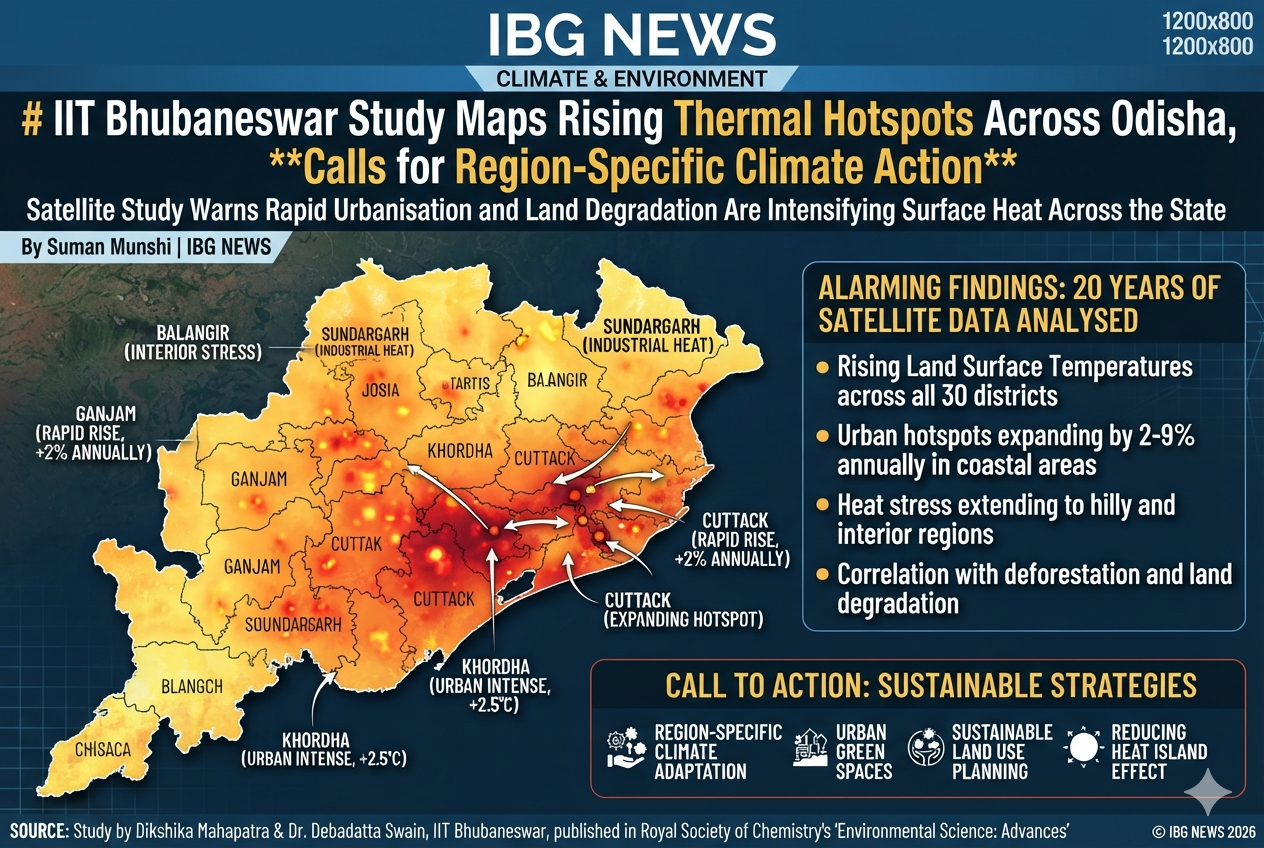
IIT Bhubaneswar Study Maps Rising Thermal Hotspots Across Odisha, Calls for Region-Specific Climate Action
Satellite Study Warns Rapid Urbanisation and Land Degradation Are Intensifying Surface Heat Across the State
By Suman Munshi | IBG NEWS
Bhubaneswar, July 8, 2026: A groundbreaking study by researchers from the School of Earth, Ocean and Climate Sciences at the Indian Institute of Technology (IIT) Bhubaneswar has revealed a significant rise in persistent land surface thermal hotspots across Odisha, highlighting the growing impact of rapid urbanisation, industrial expansion and land-use changes on the state’s climate.
The research, published in the prestigious Royal Society of Chemistry journal, Environmental Science: Advances, presents one of the most comprehensive satellite-based assessments of Odisha’s thermal landscape over the past two decades. The findings raise concerns about increasing heat stress, ecological degradation and the need for urgent, region-specific climate adaptation strategies.
Two Decades of Satellite Data Reveal Alarming Heat Trends
The study, conducted by Dikshika Mahapatra and Dr. Debadatta Swain, analysed nearly 20 years of satellite observations to map the evolution of land surface thermal hotspots across all 30 districts of Odisha.
The researchers found that rapidly urbanising and industrialising districts—including Khordha, Ganjam, Cuttack and Sundargarh—have experienced a continuous rise in land surface temperatures. In several coastal districts, the geographical extent of persistent thermal hotspots has expanded by 2% to 9% annually, reflecting the accelerating impact of urban development and changing land-use patterns.
Heat Stress No Longer Limited to Cities
One of the study’s most significant findings is that rising temperatures are no longer confined to urban centres.
Several interior and hilly districts, including Balangir, Kalahandi, Rayagada and Gajapati, are also experiencing increasing thermal stress. Researchers attribute this trend primarily to forest degradation, declining vegetation cover and the expansion of barren land, which reduce the natural cooling effect of ecosystems.
This indicates that climate-related heat risks are becoming a statewide challenge, affecting both urban and rural communities.
Public Health and Environmental Risks Increasing
According to the researchers, prolonged exposure to thermal hotspots could have far-reaching consequences for:
- Public health through increased heat-related illnesses.
- Rising electricity demand due to greater cooling requirements.
- Agricultural productivity.
- Water resource management.
- Biodiversity and ecosystem stability.
- Long-term environmental sustainability.
The study demonstrates how satellite-based thermal monitoring can help governments identify vulnerable regions and support evidence-based planning for climate resilience.
Recommended Climate Solutions
To reduce future heat risks, the researchers recommend several region-specific mitigation strategies, including:
- Expanding urban green spaces and tree cover.
- Developing heat-resilient infrastructure.
- Restoring mangrove ecosystems and riverbank vegetation.
- Protecting forests and preventing further land degradation.
- Integrating high-resolution satellite data into urban planning and environmental management.
- Implementing district-level climate adaptation policies tailored to local geographical conditions.
The study suggests that these measures could significantly reduce surface temperatures while strengthening Odisha’s resilience against climate change.
Scientific Significance
The publication represents an important contribution to India’s climate research efforts and highlights IIT Bhubaneswar’s growing role in developing scientific solutions to environmental challenges.
By combining advanced satellite remote sensing with long-term climate analysis, the research provides policymakers, urban planners and environmental agencies with valuable tools for monitoring heat extremes and designing sustainable development strategies.
A Warning for India’s Rapidly Growing Cities
Climate experts believe the findings extend beyond Odisha. As Indian cities continue to expand rapidly, unchecked urbanisation, shrinking green cover and changing land-use patterns could intensify heat island effects across many parts of the country.
The study reinforces the need for balancing economic growth with ecological conservation, ensuring that future urban development incorporates climate-resilient infrastructure and nature-based solutions.
With global temperatures continuing to rise, the IIT Bhubaneswar research serves as a timely reminder that scientific data and satellite technology will play a crucial role in protecting communities from the growing impacts of climate change.
Research Paper: Rising Urban Land Surface Thermal Extremes in Odisha
Published in: Environmental Science: Advances, Royal Society of Chemistry.