












West Bengal VISION 2035: From Coconut Waste to a Green Manufacturing Revolution
Can West Bengal Lead India’s Next Sustainable Manufacturing Success Story?
By Anil P. Kastuar & Suman Munshi
Editorial Panel | IBG NEWS
Kolkata/New Delhi: History has repeatedly demonstrated that transformative industries are rarely built upon rare resources alone. More often, they emerge from the intelligent utilization of materials that society once overlooked. Bengal’s global prominence in jute, India’s leadership in tea, and the evolution of numerous agro-based industries all illustrate how innovation and value addition can convert ordinary agricultural products into engines of economic growth.
Today, another such opportunity stands before India and, more specifically, West Bengal. Every day, millions of coconut shells are discarded by households, roadside vendors, temples, hotels, restaurants, food processing units, and fruit markets. Most are burned, dumped, or left to decompose despite possessing immense commercial value. Hidden within this discarded agricultural by-product lies the foundation of a modern green manufacturing ecosystem capable of generating employment, supporting rural entrepreneurship, empowering women, increasing exports, reducing dependence on plastics, and strengthening India’s transition towards a circular economy.
This is not merely an article about handicrafts or cottage industries. It is an editorial vision for transforming coconut shells into a strategic industrial resource aligned with the national priorities of Make in India, Atmanirbhar Bharat, Startup India, sustainable manufacturing, and the United Nations Sustainable Development Goals. By creating an integrated value chain that connects farmers, collectors, artisans, MSMEs, technology providers, designers, logistics companies, and exporters, India has the opportunity to create an entirely new value-added manufacturing sector from a resource that is currently underutilized.
Beyond Agriculture: Unlocking Hidden Industrial Value
India ranks among the world’s largest coconut-producing nations, harvesting more than 21 billion coconuts annually. The coconut economy already contributes significantly through products such as coconut oil, copra, coir fibre, desiccated coconut, and coconut water. However, one of its most valuable components—the shell—continues to receive comparatively little industrial attention despite its suitability for manufacturing hundreds of consumer and industrial products.
The next stage of India’s coconut economy should therefore focus not on increasing production volumes but on maximizing the value extracted from every coconut harvested. Rather than treating coconut shells as agricultural waste, they should be recognized as renewable industrial raw materials capable of supporting a wide spectrum of sustainable products for both domestic and international markets.
Unlike many agricultural commodities that generate revenue from only one principal product, every mature coconut contains four commercially valuable components:
- Coconut kernel
- Coconut water
- Coconut husk
- Coconut shell
Each component can enter a separate industrial supply chain, allowing a near-zero-waste manufacturing model in which almost every part of the harvested coconut contributes to economic value. This characteristic places coconut among the most promising agricultural resources for circular economy-based industrial development.
Building a Circular Economy Around Coconut Shells
The transition from agricultural waste to industrial wealth begins with a relatively straightforward value chain:
Collection → Processing → Manufacturing → Branding → Domestic Sales → Export
Instead of being discarded, coconut shells can be transformed into an extensive range of products that serve multiple industries.
Lifestyle and household applications include premium kitchenware, serving bowls, cups, trays, spoons, lamps, chandeliers, planters, home décor items, furniture accessories, gardening products, and corporate gifts. Fashion applications include jewellery, buttons, watches, and decorative accessories. The hospitality sector increasingly seeks eco-friendly serving products and premium sustainable amenities. Industrial applications extend even further to activated carbon, charcoal briquettes, industrial filtration media, air purification systems, biofuel, and sustainable packaging solutions.
Every additional stage in this value chain generates employment, increases product value, reduces environmental waste, and expands opportunities for MSMEs and rural enterprises.
Responding to a Changing Global Market
Global consumer preferences are changing rapidly. Governments, businesses, hotels, retailers, and consumers are actively replacing single-use plastics with renewable, biodegradable alternatives. Demand for environmentally responsible products continues to grow across Europe, North America, Australia, Japan, and the Middle East.
Coconut shell products naturally align with these market trends because they are renewable, biodegradable, durable, lightweight, aesthetically attractive, and suitable for handcrafted as well as industrial applications. Their versatility enables manufacturers to serve multiple market segments ranging from affordable household goods to premium lifestyle products and industrial filtration materials.
India already possesses the raw materials necessary to participate in this expanding global market. The remaining challenge is the creation of a coordinated manufacturing ecosystem capable of consistently producing high-quality products that meet international standards.
India’s Manufacturing Opportunity
India possesses several strategic advantages that many competing countries lack:
- Abundant raw material
- Skilled artisan communities
- A rapidly growing MSME ecosystem
- Expanding digital commerce
- Established export infrastructure
- Increasing domestic demand for sustainable products
The principal challenge is therefore not the availability of resources but the fragmentation of the existing supply chain. Farmers, coconut vendors, shell collectors, artisans, designers, manufacturers, exporters, and technology providers often operate independently with limited coordination.
An integrated ecosystem supported by common processing facilities, organized collection networks, design centres, quality certification systems, and export assistance could transform scattered local activities into a nationally recognized manufacturing industry capable of generating significant economic value.
The Economics of Value Addition
Perhaps the strongest argument for developing a coconut shell manufacturing ecosystem lies in the economics of value addition.
Traditional tender coconut businesses remain important because they provide affordable entrepreneurship with relatively low investment and dependable local demand. However, the economic potential of mature coconut processing extends far beyond the sale of a single agricultural commodity.
Instead of generating income only from the fruit itself, manufacturers can derive revenue simultaneously from processed kernel products such as virgin coconut oil, coconut flour, coconut milk, coconut cream, and desiccated coconut; shell-based products ranging from handicrafts to activated carbon; husk-based products including coir fibre, rope, geo-textiles, and cocopeat; and other recoverable by-products.
Illustrative business modelling presented in the source document suggests that efficient value-added processing may generate several times the gross profit obtainable from selling mature coconuts as raw produce. While actual returns depend upon operational efficiency, market demand, product mix, and quality standards, the comparison demonstrates the significant economic advantage of diversified processing over simple commodity sales.
Beyond higher revenues, value-added manufacturing also creates broader employment opportunities, encourages export-oriented production, improves resilience against commodity price fluctuations, and strengthens the circular economy by utilizing materials that might otherwise become waste.
Technology: The Next Growth Multiplier
The future coconut industry will not rely solely upon traditional craftsmanship. Instead, it is likely to combine artisanal skills with advanced manufacturing technologies.
Artificial Intelligence can assist quality inspection. Computer Vision systems can identify product defects. CNC machining and laser engraving can improve precision while enabling mass customization. Enterprise Resource Planning systems can integrate procurement, production, inventory, and finance. QR-code traceability can strengthen supply chain transparency, while predictive analytics and digital export documentation can improve operational efficiency and international market access.
Rather than replacing artisans, these technologies have the potential to enhance productivity, improve consistency, reduce waste, and help rural manufacturers compete in premium global markets without sacrificing craftsmanship.
Employment Generation: Building Prosperity from Rural India
One of the most compelling aspects of a coconut shell manufacturing ecosystem is its ability to generate employment across a wide range of skill levels while encouraging decentralized industrial development. Unlike capital-intensive industries that are concentrated around major urban centres, coconut processing units can be established close to raw material sources, allowing economic activity to flourish in rural and semi-urban regions.
The proposed ecosystem has the potential to create opportunities for coconut collectors, women’s Self-Help Groups (SHGs), artisan cooperatives, MSMEs, machine operators, product designers, digital marketers, logistics providers, quality inspectors, packaging manufacturers, export professionals, and entrepreneurs. Because many stages of production depend more on craftsmanship and innovation than on heavy industrial investment, the sector offers an accessible pathway for small enterprises and village-based industries.
Such a model could help reduce rural-to-urban migration by creating sustainable livelihoods within local communities. Women-led enterprises, artisan clusters, and youth startups can become integral participants in this value chain, enabling inclusive economic growth while preserving traditional craftsmanship.
Below is an illustrative cost-benefit analysis comparing two business models in India:
- Tender (Raw/Green) Coconut Business – selling fresh drinking coconuts.
- Mature Coconut Value-Addition Business – processing mature coconuts and shells into multiple products.
These are illustrative estimates based on typical Indian industry practices and should be validated for a specific region, season, and business model before investment.
Cost–Benefit Analysis (Illustrative)
| Parameter | Raw (Tender) Coconut | Mature Coconut Value Addition |
|---|---|---|
| Average Purchase Price per Coconut | ₹18 | ₹22 |
| Average Selling Price | ₹35 | Variable (multiple products) |
| Gross Revenue per Coconut | ₹35 | ₹80–₹250 (depending on products) |
| Gross Margin Before Operating Costs | ₹17 | ₹58–₹228 |
Revenue Comparison
A. Tender Coconut Business
Revenue Sources
- Coconut water
- Tender kernel (optional)
Approximate Economics
Purchase Price ₹18
Transport ₹2
Handling ₹1
Total Cost ₹21
Selling Price ₹35
Approximate Gross Profit
₹14 per coconut
B. Mature Coconut Processing
Instead of selling the whole coconut, every component can generate revenue.
Kernel
- Copra
- Virgin Coconut Oil
- Coconut Flour
- Desiccated Coconut
- Coconut Milk
- Coconut Cream
Approximate Value
₹35–₹80
Shell
Products
- Bowl
- Cup
- Lamp
- Spoon
- Decorative items
- Activated Carbon
- Charcoal
Approximate Value
₹20–₹120
Husk
Products
- Coir Fibre
- Rope
- Geo-textiles
- Cocopeat
Approximate Value
₹10–₹30
Coconut Water (if recovered before maturity)
Industrial beverage processing
Approximate Value
₹5–₹20
Illustrative Total Value Per Mature Coconut
| Product | Illustrative Value |
|---|---|
| Kernel Products | ₹60 |
| Shell Products | ₹50 |
| Husk Products | ₹20 |
| By-products | ₹10 |
| Total Revenue | ₹140 |
Purchase Cost ₹22
Processing ₹30
Packaging ₹10
Marketing ₹8
Total Cost ₹70
Estimated Revenue ₹140
Approximate Gross Profit ₹70 per coconut
Value Creation
| Business | Approximate Gross Profit |
|---|---|
| Tender Coconut | ₹14 |
| Mature Coconut Processing | ₹70 |
Illustratively, value-added processing could generate around five times the gross profit per coconut compared with selling tender coconuts, assuming efficient operations and successful market sales.
Employment Generation
Tender Coconut Shop
Investment ₹1–2 lakh
Employment 1–2 people
Coconut Processing Unit
Investment ₹25–50 lakh
Employment 20–40 people
Medium Factory
Investment ₹2–5 crore
Employment 100–250 people
Export Opportunity
Tender coconuts are mainly sold domestically due to perishability.
Value-added products can be exported, including:
- Activated carbon
- Eco bowls
- Handicrafts
- Designer lighting
- Kitchenware
- Furniture accessories
- Jewellery
- Cocopeat
- Coir products
Environmental Benefits
Tender Coconut
- Organic waste generated after consumption.
- Limited secondary value unless shells and husks are collected separately.
Mature Coconut Processing
- Near-zero waste model.
- Kernel, shell, husk, and residual biomass all have potential commercial applications.
- Supports a circular economy by converting agricultural by-products into marketable goods.
Investment Comparison
| Business | Approximate Investment |
|---|---|
| Roadside Tender Coconut Stall | ₹1–3 lakh |
| Cottage Industry | ₹20–50 lakh |
| Semi-Automatic Factory | ₹2–5 crore |
| Export Manufacturing Unit | ₹10–25 crore |
Strategic Assessment
| Parameter | Tender Coconut | Mature Coconut Processing |
|---|---|---|
| Initial Investment | Low | Moderate to High |
| Skill Requirement | Low | Medium to High |
| Employment Generation | Low | High |
| Export Potential | Limited | High |
| Value Addition | Low | High |
| Product Diversification | Minimal | Extensive |
| Scalability | Moderate | High |
| Circular Economy Impact | Moderate | Strong |
USP:
From a long-term industrial perspective, selling tender coconuts provides a simple, low-capital retail business with steady local demand, while processing mature coconuts into multiple value-added products offers significantly greater revenue potential, broader employment generation, and stronger export opportunities.
A balanced strategy may be the most resilient: high-quality tender coconuts can continue serving the fresh beverage market, while mature coconuts and their by-products are directed into manufacturing. This approach maximizes value from the coconut crop, reduces waste, and supports the development of a more diversified and sustainable coconut economy in India.
Coconut (Cocos nucifera) has been used as both a traditional medicine and a source of modern pharmaceutical and medical products. Different parts of the coconut—water, oil, flesh, shell, husk, flowers, and roots—have distinct uses.
Coconut wine market, West Bengal: an untapped segment:
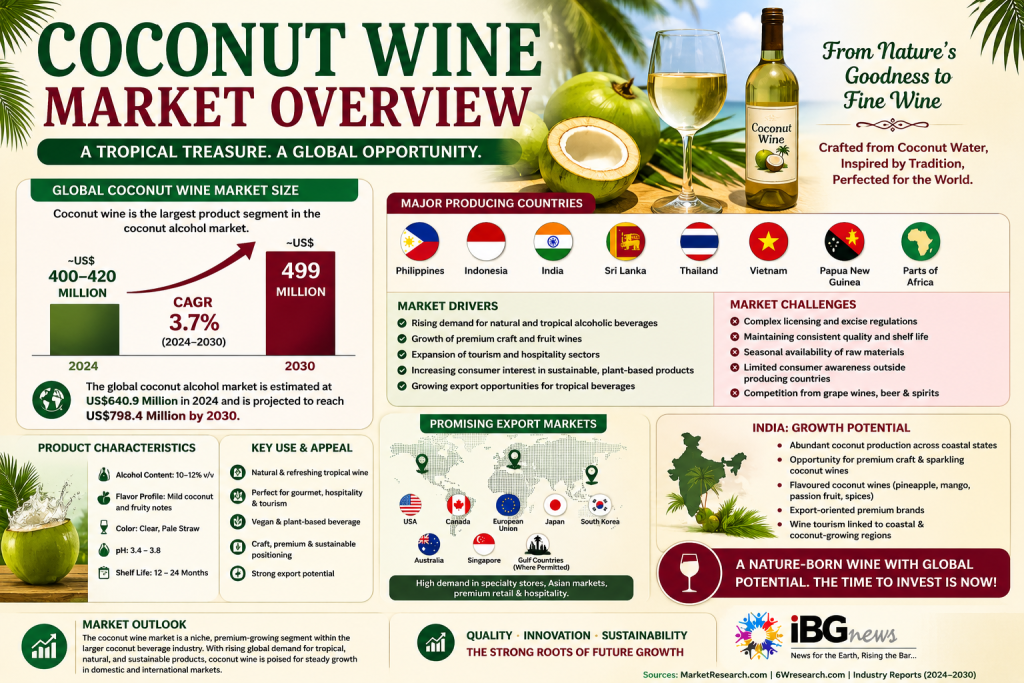
The coconut wine market is still a niche segment within the broader coconut alcoholic beverages market. Unlike coconut water or coconut milk, there is no widely accepted public estimate for coconut wine alone, but industry reports and market data allow a reasonable view of its size and growth.
Global Market Overview
A recent market analysis estimates the global coconut alcohol market at approximately US$640.9 million in 2024, projected to reach US$798.4 million by 2030, growing at a CAGR of 3.7%. Within this market, coconut wine is the largest product segment, expected to reach about US$499.3 million by 2030.
Based on those projections, the coconut wine segment is estimated to have been roughly:
| Year | Estimated Market Size |
|---|---|
| 2024 | ~US$400–420 million (estimated) |
| 2030 | ~US$499 million |
Major Producing Countries
Commercial coconut wine is produced mainly in tropical countries:
- Philippines
- Indonesia
- India (Goa, Kerala, Tamil Nadu, Andhra Pradesh)
- Sri Lanka
- Thailand
- Vietnam
- Papua New Guinea
- Parts of Africa (Mozambique, Tanzania, Ghana)
Many products are sold locally because fresh coconut-based fermented beverages have relatively short shelf lives unless processed and bottled.
Key Market Drivers
- Rising demand for natural and tropical alcoholic beverages.
- Growth of premium craft and fruit wines.
- Tourism and hospitality sectors seeking regional specialty drinks.
- Increasing consumer interest in sustainable, plant-based products.
- Expansion of export opportunities for tropical beverages.
Market Challenges
- Licensing and excise regulations vary significantly by country.
- Maintaining consistent quality and shelf life.
- Seasonal availability of raw materials in some regions.
- Limited consumer awareness outside producing countries.
- Competition from grape wines, fruit wines, beer, and spirits.
Export Opportunities
Promising export markets include:
- United States
- Canada
- European Union
- Japan
- South Korea
- Australia
- Singapore
- Gulf countries (where permitted by local regulations)
Demand is strongest in specialty liquor stores, Asian food markets, gourmet retailers, and premium hospitality channels.
India: Growth Potential
India is one of the world’s largest coconut producers, with Kerala, Tamil Nadu, Karnataka, Andhra Pradesh, Odisha, Goa, and West Bengal providing abundant raw material. Although coconut wine remains a niche product, there is potential to develop:
- Premium craft coconut wines.
- Sparkling coconut wines.
- Flavoured coconut wines (pineapple, mango, passion fruit, spices).
- Export-oriented premium brands.
- Wine tourism linked to coastal and coconut-growing regions.
Market Outlook
Consumer interest in tropical beverages continues to rise. While the broader coconut beverage market is forecast to grow rapidly due to demand for coconut water, coconut milk, and functional drinks, the alcoholic segment remains much smaller but offers opportunities for premium and craft producers. (6Wresearch)
For an entrepreneur entering this sector, success is likely to depend on premium positioning, quality control, attractive branding, compliance with alcohol regulations, and targeting export or tourism markets rather than competing on volume with mainstream wines.
Traditional Medicine (Ayurveda, Siddha, Unani & Folk Medicine)
1. Virgin Coconut Oil (VCO)
Uses:
- Wound healing
- Skin infections
- Eczema
- Dry skin
- Hair nourishment
- Burns
- Massage therapy
- Infant skin care
Active compounds:
- Lauric acid
- Caprylic acid
- Capric acid
- Vitamin E
- Polyphenols
2. Coconut Water
Used for:
- Dehydration
- Fever
- Diarrhoea
- Urinary tract infections
- Kidney stones
- Electrolyte replacement
Traditional practitioners often recommend coconut water during hot weather and after illness because of its natural potassium and electrolyte content.
3. Coconut Milk
Traditionally used for:
- Improving nutrition
- Weight gain in weak patients
- Gastric irritation
- Convalescence after illness
4. Coconut Kernel
Used as:
- Nutritive tonic
- Digestive aid
- Energy source
- Mild laxative
5. Coconut Flower
Traditional uses include:
- Diabetes management (flower sap in some traditions)
- Improving digestion
- General health tonic
6. Coconut Root
Used in traditional remedies for:
- Toothache
- Dysentery
- Urinary disorders
- Mouth ulcers
7. Coconut Shell Charcoal
Traditionally used as:
- Dental powder
- Water purification
- Detoxifying applications
Ayurveda
According to Ayurveda:
- Rasa (Taste): Sweet (Madhura)
- Virya (Potency): Cooling (Sheeta)
- Dosha effect:
- Reduces Pitta
- Balances Vata
- May increase Kapha if consumed excessively
Ayurvedic formulations using coconut include:
- Narikel Taila (Coconut Oil)
- Herbal coconut oils for skin and scalp
- Medicated coconut oils with Brahmi, Neem, Bhringraj, etc.
Siddha Medicine
Common uses:
- Skin diseases
- Psoriasis
- Burns
- Hair disorders
- Digestive disorders
Modern (Allopathic) Medical Uses
Modern medicine does not use coconut as a cure for diseases in the way traditional systems may, but coconut-derived products have several evidence-based medical applications.
1. Medium Chain Triglyceride (MCT) Oil
Derived from coconut oil.
Medical uses:
- Malabsorption syndromes
- Epilepsy (Ketogenic diet)
- Alzheimer’s disease research
- Clinical nutrition
- Weight management
2. Lauric Acid / Monolaurin
Studied for activity against:
- Certain bacteria
- Some viruses
- Fungi
Research is ongoing, but these are not approved as standalone treatments for infections.
3. Coconut Water
Used as:
- Natural oral rehydration support
- Electrolyte replacement
Historically, coconut water was used intravenously in emergencies during wartime when sterile IV fluids were unavailable, but this is not standard medical practice today.
4. Coconut Oil
Used medically in:
- Moisturizers
- Barrier creams
- Emollients
- Treatment of dry skin
- Infant skincare
- Pressure sore prevention
5. Activated Carbon from Coconut Shell
One of the most important modern medical products derived from coconut.
Medical uses:
- Poison treatment
- Drug overdose management
- Water purification
- Dialysis filtration
Activated charcoal from coconut shells is widely used in emergency medicine.
6. Pharmaceutical Excipients
Coconut-derived ingredients are used in:
- Capsules
- Tablet coatings
- Drug emulsions
- Lipid-based drug delivery systems
7. Cosmetic Dermatology
Virgin coconut oil is used in:
- Atopic dermatitis
- Xerosis (dry skin)
- Eczema management
- Skin barrier repair
Some clinical studies suggest it can improve skin hydration and reduce colonization by Staphylococcus aureus in people with eczema.
Nutraceutical Products from Coconut
Examples include:
- Virgin Coconut Oil (VCO)
- MCT Oil
- Coconut Protein Powder
- Coconut Flour
- Coconut Sugar
- Coconut Vinegar
- Coconut Aminos
- Coconut Milk Powder
Conditions Traditionally Associated with Coconut Use
| Condition | Traditional Use | Evidence in Modern Medicine |
|---|---|---|
| Dehydration | ✓ | ✓ (oral hydration) |
| Dry skin | ✓ | ✓ |
| Eczema | ✓ | Moderate evidence for topical coconut oil |
| Hair care | ✓ | Limited evidence |
| Burns | ✓ | Limited evidence |
| Kidney stones | ✓ | Limited research |
| Diabetes | Traditional use | Insufficient evidence |
| Antibacterial | Traditional use | Laboratory evidence only |
| Antiviral | Traditional use | Laboratory evidence only |
| Wound healing | ✓ | Some supportive evidence for topical use |
Important Note
While coconut and its derivatives have nutritional and medicinal value, they should not replace evidence-based medical treatment for serious illnesses such as diabetes, heart disease, infections, or cancer. Traditional uses vary by culture, and many claimed benefits are still under scientific investigation. If coconut-based remedies are being considered for a medical condition, it is best to discuss them with a qualified healthcare professional, especially if the person has allergies, kidney disease, or is taking prescription medications.
Why West Bengal Can Become Eastern India’s Green Manufacturing Hub
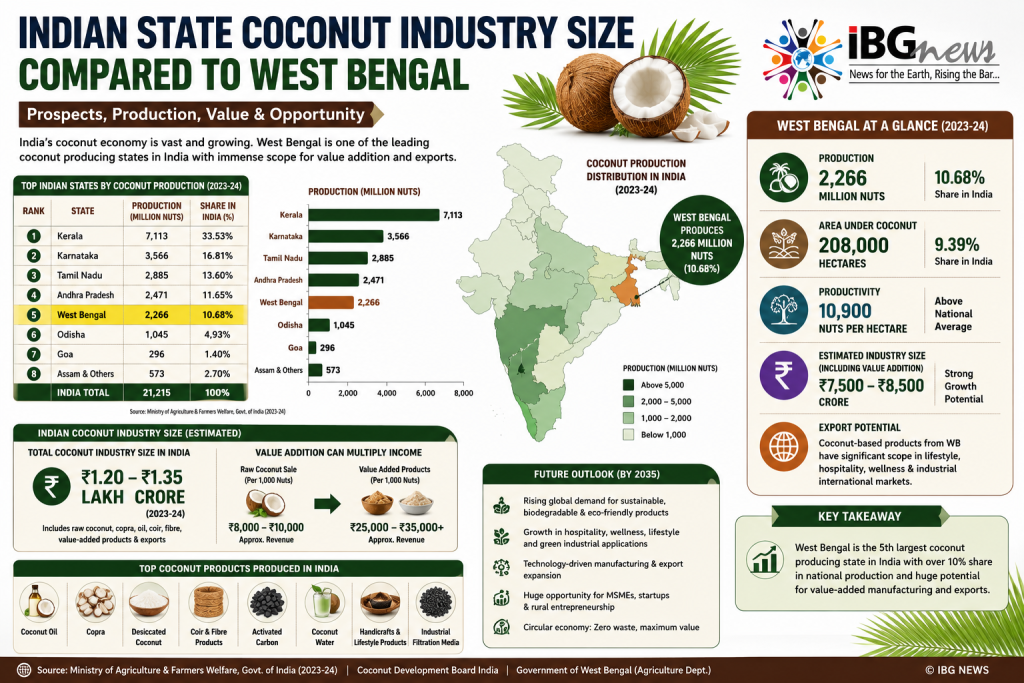
Although Kerala, Karnataka, Tamil Nadu, and Andhra Pradesh dominate India’s coconut production, West Bengal possesses several strategic advantages that remain largely underutilized. The state consistently ranks among India’s important coconut-growing regions and has historically recorded high productivity across several districts. Yet a substantial proportion of its coconut harvest continues to be marketed as raw produce with limited downstream processing.
This gap presents a significant opportunity. Instead of exporting value in the form of raw coconuts, West Bengal can establish an integrated manufacturing ecosystem that converts agricultural by-products into high-value consumer and industrial products.
The state already possesses many of the essential ingredients required for such an industrial transformation. These include Kolkata Port and Haldia Dock Complex, international air connectivity, engineering expertise centred in Howrah, a vibrant MSME ecosystem, skilled artisans, active women’s Self-Help Groups, and proximity to neighbouring export markets including Bangladesh, Nepal, and Bhutan.
Combined with modern logistics, digital commerce, and export infrastructure, these strengths position West Bengal to complement—rather than compete with—the established coconut economies of southern India by emerging as Eastern India’s leading value-addition and export hub.
A District-Based Manufacturing Cluster Model
Rather than concentrating production within one large industrial complex, the Editorial Panel proposes a distributed manufacturing network that leverages the unique strengths of individual districts. Such an approach would reduce transportation costs, encourage local entrepreneurship, and create specialised centres of excellence while remaining connected through a statewide supply chain.
Under this model:
- Purba Medinipur could focus on premium handicrafts, eco-products, and export-oriented home décor.
- South 24 Parganas could specialise in activated carbon, industrial charcoal, and filtration products.
- North 24 Parganas could develop decorative lifestyle products, laser engraving, and precision finishing.
- Howrah could serve as the engineering hub for machinery fabrication, tooling, and manufacturing equipment.
- Murshidabad could strengthen women-led artisan cooperatives and designer handicraft production.
- Nadia could become a centre for research, nursery development, skill training, and product innovation.
Such district-level specialization would create an integrated industrial ecosystem where each region contributes according to its comparative advantage while remaining connected through common branding, logistics, quality standards, and export support.
Empowering MSMEs, Startups and Women Entrepreneurs
The proposed coconut shell economy naturally aligns with India’s extensive MSME network. Many value-added coconut products can be manufactured with relatively modest investment, making the sector attractive for cottage industries, producer companies, village cooperatives, startups, and social enterprises.
With proper training and access to common facilities, artisans can manufacture bowls, lamps, jewellery, planters, decorative accessories, hospitality products, and designer home décor that cater to both domestic and export markets.
Women entrepreneurs stand to benefit significantly from this ecosystem. Organized Self-Help Groups already possess experience in handicrafts and rural enterprises. Integrating them into organized production networks could expand household incomes while promoting inclusive entrepreneurship.
Young entrepreneurs can also leverage digital marketplaces, social media, and e-commerce platforms to build premium brands around sustainable products, reaching consumers well beyond their local markets.
Challenges That Must Be Addressed
While the opportunity is substantial, realizing Vision 2035 requires addressing several structural challenges.
At present, coconut shell collection remains fragmented and largely unorganized. Common processing centres are limited, product design capabilities require strengthening, branding remains weak, export certification can be expensive, quality standards are inconsistent, and awareness among entrepreneurs remains relatively low.
Overcoming these barriers will require coordinated efforts among government agencies, research institutions, financial institutions, industry associations, academic organisations, technology providers, and private enterprises. Without a collaborative ecosystem, the industry’s growth potential may remain constrained despite abundant raw material availability.
A Policy Roadmap Towards Vision 2035
The Editorial Panel proposes a phased strategy that balances infrastructure development, skill creation, technology adoption, and export readiness.
Phase I (2026–2028) should prioritize district-level shell collection centres, artisan cluster development, women’s SHG training, design innovation workshops, and skill development programmes to establish the industry’s foundational ecosystem.
Phase II (2028–2031) should focus on establishing Common Facility Centres, introducing AI-assisted manufacturing, strengthening quality certification, building statewide branding initiatives, and expanding domestic e-commerce networks.
Phase III (2031–2035) should position West Bengal as an internationally recognized exporter through premium lifestyle branding, industrial activated carbon production, sustainable packaging industries, advanced biomaterial research, and expanded participation in global markets.
These initiatives should complement existing MSME, rural development, startup, and value-addition programmes while encouraging greater collaboration between public institutions and private enterprise.
Vision 2035: Transforming Waste into Wealth
The future of West Bengal’s industrial development need not depend solely on large-scale heavy industries. The state possesses abundant agricultural resources capable of supporting a new generation of sustainable manufacturing based on innovation, technology, and value addition.
The coconut shell, once regarded as little more than agricultural waste, has the potential to become the foundation of a modern circular economy that integrates rural enterprise, engineering, advanced manufacturing, digital commerce, and exports. Rather than replacing traditional agriculture, this vision seeks to maximize the economic value of every coconut harvested by ensuring that every component enters a productive industrial supply chain.
If implemented through coordinated action involving government, MSMEs, research institutions, financial organisations, designers, technology companies, exporters, and entrepreneurs, West Bengal could emerge as Eastern India’s leading coconut value-addition hub while demonstrating how agricultural by-products can become drivers of sustainable industrial growth.
Editorial Conclusion
The history of industrial progress has consistently shown that nations create lasting prosperity not simply by producing more raw materials, but by extracting greater value from the resources they already possess. The coconut shell represents precisely such an opportunity.
India has the raw material, skilled artisans, entrepreneurial talent, technological capability, and expanding global market access needed to establish a world-class coconut shell manufacturing ecosystem. West Bengal, with its strategic location, engineering expertise, growing MSME sector, skilled workforce, and export infrastructure, is uniquely positioned to lead this transformation in Eastern India.
Vision 2035 is therefore not merely an industrial proposal; it is a roadmap for building a sustainable economy that generates employment, empowers rural communities, strengthens women-led enterprises, promotes innovation, expands exports, and advances India’s transition towards a circular economy.
If pursued with commitment, collaboration, and long-term planning, the humble coconut shell could become one of India’s most compelling examples of turning agricultural waste into industrial wealth—creating livelihoods, protecting the environment, and showcasing Indian innovation on the global stage.
“The future of manufacturing will not be defined only by the resources a region possesses, but by the intelligence with which those resources are utilized. The coconut shell, once discarded as waste, can become a symbol of West Bengal’s next green industrial revolution. Through innovation, entrepreneurship, technology, and sustainable manufacturing, the state has an opportunity to build a globally recognized circular economy—creating livelihoods, empowering rural communities, and positioning Bengal as India’s gateway for eco-friendly exports.”
— Anil P. Kastuar & Suman Munshi
Editorial Panel | IBG NEWS