














India’s Poverty Declines Dramatically, but Employment Quality and Regional Inequality Remain Major Challenges: World Bank
New World Bank Assessment Reports 496 Million People Moved Above the Lower Middle-Income Poverty Threshold Between 2011 and 2023; Rural Distress, Youth Unemployment and Wage Disparities Require Greater Attention
New Delhi, 31 October 2026: India has made substantial progress in reducing poverty over the past decade, emerging among the countries recording the fastest declines in monetary and multidimensional poverty. However, a closer examination of the latest World Bank assessment reveals that significant structural challenges remain, particularly in employment quality, income inequality, rural productivity and regional development.
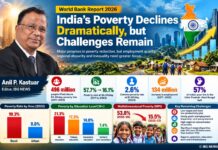
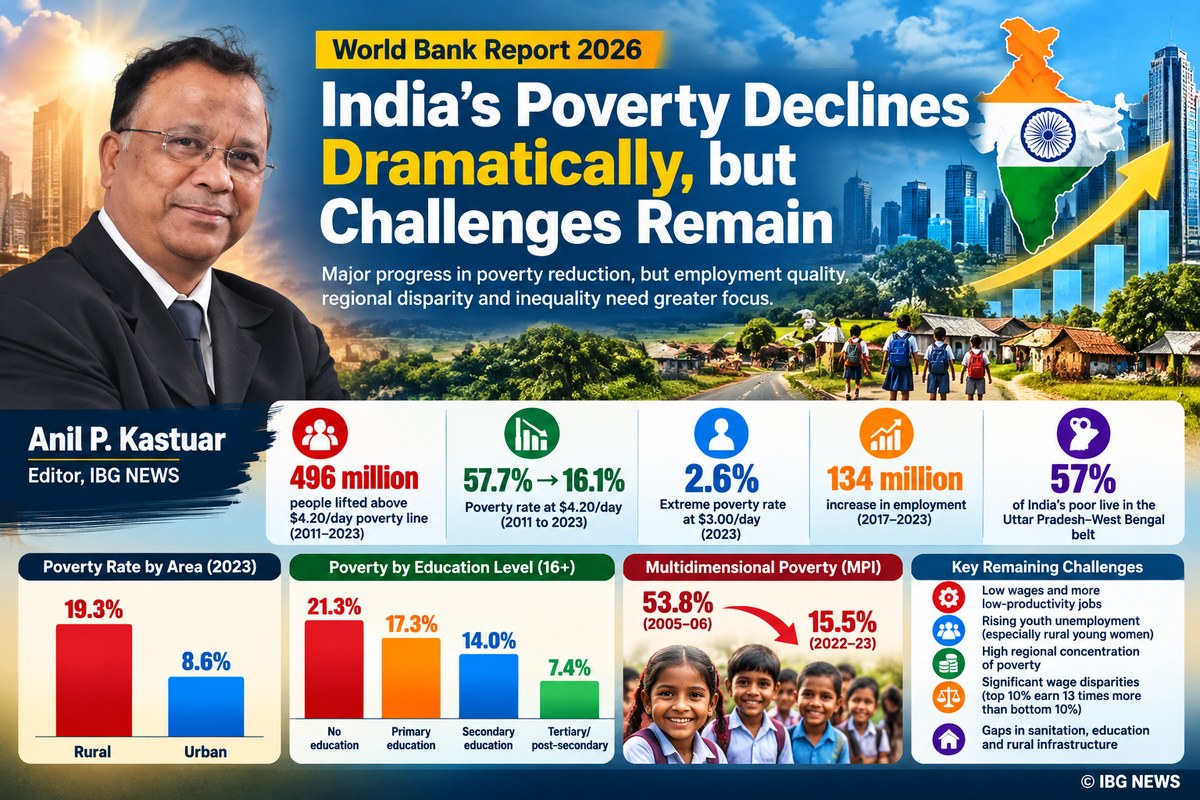
According to the World Bank’s Poverty & Equity Brief – India, October 2026, the proportion of India’s population living below the Lower Middle-Income Country poverty threshold of US$4.20 per person per day, measured using 2021 Purchasing Power Parity (PPP), declined from 57.7% in 2011 to 16.1% in 2023.
This represents a reduction of 41.6 percentage points and an estimated 496 million people moving above that poverty threshold.
Extreme poverty, measured against the international poverty line of US$3 per person per day, also recorded a substantial decline, falling from 27.1% in 2011 to 2.6% in 2023.
The findings indicate a major improvement in household welfare. Nevertheless, the report suggests that the next phase of poverty reduction will require more than expanding employment numbers and social assistance. Improving productivity, wages and access to stable economic opportunities will be equally important.
1. Poverty Reduction: A Significant National Transformation
The World Bank’s figures demonstrate the scale of India’s progress.
| Indicator | 2011 | 2023 |
|---|---|---|
| Poverty at US$4.20/day | 57.7% | 16.1% |
| Extreme poverty at US$3/day | 27.1% | 2.6% |
| Estimated population lifted above US$4.20 poverty line | — | 496 million |
The report also estimates that the poverty rate at the US$4.20 threshold could decline further from 14.2% in 2026 to 12.1% by 2028.
These are indicative microsimulation-based projections, not confirmed future outcomes. They may change as new labour market and macroeconomic information becomes available.
The underlying improvement has been associated with stronger consumption growth, increased employment, particularly among women, and expanded social transfers, including food subsidies.
Analytical perspective: India’s poverty reduction represents a major improvement in measured living standards. However, crossing a statistical poverty threshold does not necessarily mean that a household has achieved economic security or is protected from future income shocks.
2. Rural India Continues to Face Greater Economic Vulnerability
One of the most important findings is the difference between rural and urban poverty.
According to the World Bank’s 2023 survey-based estimates, poverty at the US$4.20 threshold stood at:
- Rural population: 19.3%.
- Urban population: 8.6%.
Although rural India has experienced faster poverty reduction, the remaining poverty burden is still disproportionately concentrated in rural communities.
Lower productivity, limited access to higher-quality non-farm employment and weaker economic opportunities continue to affect rural households.
This suggests that infrastructure development, agricultural productivity, rural industrialisation, better market access and the expansion of non-farm employment will be important in sustaining poverty reduction.
The figures also indicate that national poverty reduction cannot be assessed solely through aggregate economic growth. The distribution of employment and productive opportunities across geographical areas matters equally.
3. Northern and Eastern India Account for a Major Share of Remaining Poverty
A particularly significant observation concerns the geographical concentration of poverty.
The World Bank identifies a contiguous geographical belt stretching from Uttar Pradesh to West Bengal, which accounts for approximately 57% of India’s poor population.
This finding highlights the continuing development challenges in parts of northern and eastern India.
For West Bengal, the observation deserves particular attention. Although the report does not provide a separate poverty share for the state in this particular assessment, its inclusion in the identified geographical belt reinforces the importance of examining regional employment opportunities, rural productivity, infrastructure and household income growth.
The concentration of poverty across this belt also has national implications. Further reductions in India’s poverty rate will increasingly depend on improving productive employment opportunities in these states.
Analytical perspective: The next phase of India’s development requires greater attention to regional convergence. States with larger concentrations of poverty need sustainable employment generation, investment, industrial diversification and stronger rural economic networks.
4. Employment Has Expanded, but Job Quality Remains a Concern
The World Bank estimates that employment increased by approximately 134 million people between 2017 and 2023.
This increase was nearly twice the growth of the working-age population during the period.
A significant contribution came from rural women entering paid employment, thereby increasing the number of earning members in households.
However, the report identifies an important contradiction: employment growth has not translated into comparable improvements in real earnings.
Real earnings remained broadly unchanged, while employment growth was concentrated in relatively low-productivity activities.
This distinction is essential when evaluating the quality of economic growth.
An increase in the number of employed people is positive, but the long-term impact on household welfare depends on wages, productivity, employment security and opportunities for career advancement.
The report also notes that youth unemployment increased from 14.6% to 15.9% between Q1 FY2026 and Q1 FY2027, with particular concern regarding rural young women.
Analytical perspective: India’s employment challenge is gradually shifting from generating work opportunities alone towards creating productive, better-paid and more sustainable employment, particularly for younger workers.
5. Women’s Employment: Progress with Remaining Challenges
The growing participation of rural women in paid employment is one of the important developments highlighted in the assessment.
Women’s entry into paid work has contributed to household earning capacity and helped support broader poverty reduction.
However, the rise in youth unemployment, particularly among rural young women, indicates that access to employment does not necessarily mean access to stable and adequately remunerated work.
Future policy interventions will need to emphasise:
- Skill development and vocational training.
- Access to formal employment.
- Rural enterprise development.
- Digital and technological skills.
- Safe and accessible workplaces.
- Opportunities for women’s entrepreneurship.
The challenge is to transform increased participation into greater economic independence and improved earnings.
6. Income Inequality Remains a Structural Concern
Despite substantial poverty reduction, wage disparities remain pronounced.
The World Bank reports that median earnings among the top 10% of workers were approximately 13 times those of the bottom 10% in 2023.
This indicates that the benefits of economic growth and employment expansion are not distributed equally across the workforce.
The report’s 2023 Gini Index indicator stands at 23.0, while the Prosperity Gap is recorded at 4.9.
These indicators provide additional dimensions for understanding inequality and the distribution of economic welfare.
It is important to distinguish the Gini Index from the reported wage disparity: the former measures overall inequality in the relevant distribution, while the latter compares median earnings across the top and bottom groups of workers.
The coexistence of falling poverty and substantial wage differences demonstrates why poverty reduction and income equality must be evaluated as related but distinct development objectives.
7. Multidimensional Poverty: Sanitation and Education Remain Important
Poverty is not determined by income alone.
The World Bank’s multidimensional poverty assessment records a decline in India’s poverty rate from 53.8% in 2005–06 to 16.4% in 2019–21 under the Oxford Poverty and Human Development Initiative (OPHI) measure.
The World Bank’s own multidimensional poverty measure records 15.5% for 2022–23.
The assessment also identifies several deprivation indicators:
| Deprivation indicator | Share of population |
|---|---|
| Daily consumption below US$3 per person | 5.3% |
| No adult completed primary education | 13.8% |
| Lack of limited-standard drinking water | 6.4% |
| Lack of limited-standard sanitation | 29.6% |
| Lack of electricity | 1.0% |
The lack of adequate sanitation, affecting 29.6% of the population under the reported component measure, stands out as an important remaining challenge.
The figures underline the importance of sustaining investments in public health infrastructure, sanitation, drinking water, electricity and education.
8. Education Has a Strong Relationship with Poverty Outcomes
The World Bank’s poverty-by-group table also reveals a significant relationship between educational attainment and poverty.
At the US$4.20 daily poverty threshold, the reported rates are:
| Educational category | Poverty rate |
|---|---|
| Without education (16+) | 21.3% |
| Primary education (16+) | 17.3% |
| Secondary education (16+) | 14.0% |
| Tertiary/post-secondary education (16+) | 7.4% |
The figures suggest that higher educational attainment is associated with a substantially lower likelihood of living below the specified poverty threshold.
This reinforces the importance of educational access, learning quality, vocational training and the connection between education and employment opportunities.
9. Children and Vulnerable Households Require Continued Attention
The age-based poverty estimates reveal that children remain particularly vulnerable.
The reported poverty rates at the US$4.20 threshold are:
| Population group | Poverty rate |
|---|---|
| Children aged 0–14 | 21.8% |
| Population aged 15–64 | 14.4% |
| Population aged 65 and above | 14.0% |
The poverty rate among children is substantially higher than that of the working-age population.
This has implications for nutrition, healthcare, educational access and long-term human capital development.
Reducing child poverty is particularly important because deprivation during childhood can affect educational attainment, health outcomes and future employment opportunities.
10. Statistical Progress Must Be Interpreted with Methodological Caution
The World Bank also identifies certain limitations in the underlying data.
Its poverty estimates draw on three household surveys: the 2011–12 Consumer Expenditure Survey and the 2022–23 and 2023–24 Household Consumption Expenditure Surveys.
The assessment uses welfare aggregates based on the Modified Mixed Reference Period (MMRP) design, with spatial and temporal adjustments.
Although the surveys are considered broadly comparable, the World Bank cautions that improvements in measurement may account for part of the large welfare gains observed between 2022–23 and 2023–24.
The report further notes that the surveys may not fully capture consumption among wealthier households and could underestimate inequality.
Another limitation concerns the urban–rural population distribution. The survey weights remain anchored in the 2011 Census frame, and continued urbanisation may mean that the current urban population share is understated and the rural share overstated.
These methodological qualifications do not invalidate the overall poverty reduction findings, but they are important when interpreting the exact magnitude and distribution of the changes.
11. The Next Development Challenge: From Poverty Reduction to Shared Prosperity
The World Bank’s October 2026 assessment presents a picture of significant national progress alongside continuing structural weaknesses.
India has achieved substantial reductions in extreme and moderate poverty. Expanded employment, rising household consumption and social transfers have contributed to this transformation.
However, the remaining challenges are increasingly concentrated in specific population groups and geographical regions.
Rural households, children, people with limited education and workers in low-productivity occupations continue to face greater economic vulnerability.
The concentration of approximately 57% of India’s poor population in the geographical belt extending from Uttar Pradesh to West Bengal also suggests that future poverty reduction will depend heavily on regional economic development.
For policymakers, the priorities are therefore becoming more complex: creating productive employment, improving real wages, strengthening rural economies, expanding educational opportunities and reducing persistent infrastructure gaps.
India’s next development milestone will not be measured only by how many people move above a poverty threshold, but also by how many households achieve stable incomes, better living conditions and greater economic security.
The central message of the World Bank assessment is clear: India has made considerable progress in reducing poverty, but the transition from poverty reduction to broad-based and sustainable prosperity remains unfinished.
By Anil P. Kastuar | Editor, IBG NEWS
Primary Source: World Bank, Poverty & Equity Brief – India, October 2026.
Data reference: Monetary poverty estimates primarily relate to 2023; multidimensional poverty and labour market indicators use their respective reference periods as specified in the World Bank assessment.

