


















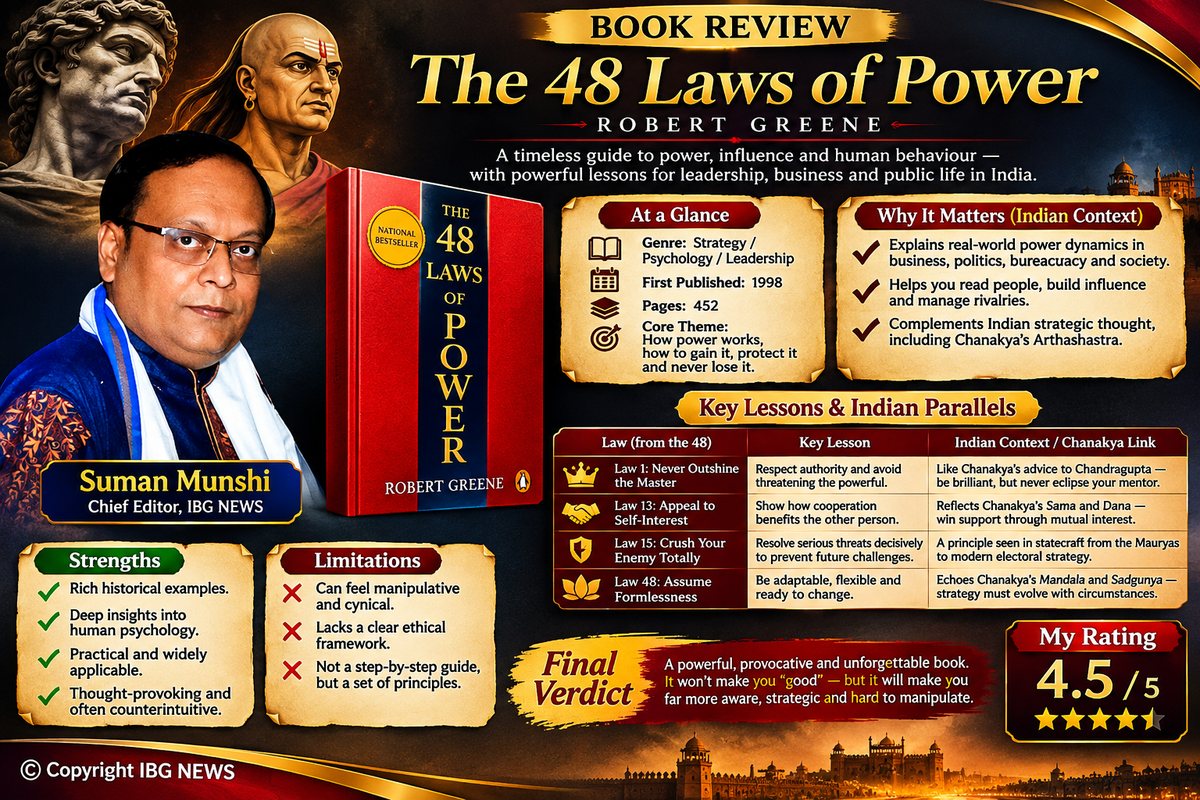

What is behind The 48 Laws of Power by Robert Greene
Author: Robert Greene
Book: The 48 Laws of Power
First published: 1998
Genre: Power, strategy, human psychology, leadership and influence.
Robert Greene’s The 48 Laws of Power presents 48 principles about gaining, maintaining and understanding power in human relationships, professional environments, politics and society.
Robert Greene is an American author best known for writing The 48 Laws of Power, a bestselling book on strategy, influence, and power that was first published in 1998. [en.wikipedia.org], [en.wikipedia.org]
Some key facts about him:
- Born on May 14, 1959, in Los Angeles, California. [en.wikipedia.org]
- Studied Classical Studies at the University of Wisconsin-Madison after attending UC Berkeley. [en.wikipedia.org], [powerseduc…andwar.com]
- Worked many different jobs, including construction worker, translator, magazine editor, and Hollywood writer, before becoming a successful author. [en.wikipedia.org]
- His books focus on power, strategy, leadership, mastery, persuasion, and human behavior. [en.wikipedia.org], [powerseduc…andwar.com]
His most famous books include:
- The 48 Laws of Power (1998)
- The Art of Seduction (2001)
- The 33 Strategies of War (2006)
- The 50th Law (with rapper 50 Cent) (2009)
- Mastery (2012)
- The Laws of Human Nature (2018)
- The Daily Laws (2021) [en.wikipedia.org], [powerseduc…andwar.com]
What makes Greene popular is his use of historical examples from figures such as Niccolò Machiavelli, Sun Tzu, Julius Caesar, and Napoleon to explain how power and influence work in real life. His work is widely read by entrepreneurs, executives, athletes, and artists, though some critics argue that his advice can be overly Machiavellian or manipulative. [en.wikipedia.org], [en.wikipedia.org]
In simple terms, Robert Greene is a writer who studies how people gain influence, achieve success, and navigate human nature, then turns those lessons into practical books. [en.wikipedia.org], [powerseduc…andwar.com]
Below is the complete list of all 48 laws, with concise explanations in simple English. These are paraphrased descriptions rather than the book’s full original text.
Complete list of the 48 laws
Laws 1–12: Reputation, relationships and influence
- Never Outshine the Master – Make those above you feel secure and respected. Avoid making them feel threatened by your abilities.
- Never Put Too Much Trust in Friends, Learn How to Use Enemies – Friendship does not always guarantee loyalty. Judge people by their actions and capabilities.
- Conceal Your Intentions – Do not reveal every plan or strategy before the right time.
- Always Say Less Than Necessary – Speak thoughtfully and avoid unnecessary explanations.
- So Much Depends on Reputation – Guard It with Your Life – Protect your credibility because reputation influences how people perceive you.
- Court Attention at All Costs – Visibility and recognition are important for influence.
- Get Others to Do the Work for You, but Always Take the Credit – Use collaboration and available expertise to achieve greater results. (Ethically, acknowledge contributions rather than taking undeserved credit.)
- Make Other People Come to You – Use Bait If Necessary – Create value and opportunities that naturally attract others.
- Win Through Your Actions, Never Through Argument – Demonstrate your abilities through results rather than endless debate.
- Infection: Avoid the Unhappy and Unlucky – Recognise how persistent negativity can influence your environment.
- Learn to Keep People Dependent on You – Develop valuable skills and expertise that make your contribution important.
- Use Selective Honesty and Generosity to Disarm Your Victim – Genuine honesty and generosity can build trust and reduce suspicion.
Laws 13–24: Human psychology and strategic relationships
- When Asking for Help, Appeal to People’s Self-Interest, Never to Their Mercy or Gratitude – Explain how cooperation benefits the other person.
- Pose as a Friend, Work as a Spy – Observe carefully, listen and understand people’s motivations.
- Crush Your Enemy Totally – Resolve serious conflicts decisively rather than leaving destructive disputes unresolved.
- Use Absence to Increase Respect and Honour – Constant availability can reduce perceived value. Maintain a healthy balance.
- Keep Others in Suspended Terror: Cultivate an Air of Unpredictability – Avoid becoming so predictable that others can easily anticipate every move.
- Do Not Build Fortresses to Protect Yourself – Isolation Is Dangerous – Maintain networks, relationships and access to information.
- Know Who You’re Dealing With – Do Not Offend the Wrong Person – Understand individual personalities before responding or negotiating.
- Do Not Commit to Anyone – Preserve independence and avoid becoming unnecessarily trapped in conflicting alliances.
- Play a Sucker to Catch a Sucker – Seem Dumber Than Your Mark – Do not make others feel inferior by constantly displaying your intelligence.
- Use the Surrender Tactic: Transform Weakness into Power – Sometimes strategic retreat creates an opportunity for a stronger comeback.
- Concentrate Your Forces – Focus resources and energy on the most important objectives.
- Play the Perfect Courtier – Master diplomacy, tact, communication and professional etiquette.
Laws 25–36: Personal development, leadership and strategy
- Re-Create Yourself – Build your own identity rather than allowing others to define you.
- Keep Your Hands Clean – Maintain accountability and protect your professional integrity.
- Play on People’s Need to Believe to Create a Cultlike Following – Understand people’s need for purpose, belonging and inspiration.
- Enter Action with Boldness – Act confidently once you have evaluated the risks.
- Plan All the Way to the End – Consider long-term consequences before beginning an important undertaking.
- Make Your Accomplishments Seem Effortless – Present polished results without unnecessarily displaying every difficulty.
- Control the Options: Get Others to Play with the Cards You Deal – Structure choices so that decisions remain productive and aligned with objectives.
- Play to People’s Fantasies – Understand people’s aspirations, hopes and emotional motivations.
- Discover Each Man’s Thumbscrew – Identify what motivates people, including their fears, ambitions and vulnerabilities.
- Be Royal in Your Own Fashion: Act Like a King to Be Treated Like One – Maintain self-respect, confidence and dignity.
- Master the Art of Timing – Understand when to act, when to wait and when to withdraw.
- Disdain Things You Cannot Have: Ignoring Them Is the Best Revenge – Do not waste energy obsessing over unattainable things.
Laws 37–48: Social intelligence, adaptability and long-term success
- Create Compelling Spectacles – Use effective presentation, visual communication and memorable experiences.
- Think as You Like, but Behave Like Others – Respect social norms while maintaining independent thinking.
- Stir Up Waters to Catch Fish – Remain composed when others become emotional or distracted.
- Despise the Free Lunch – Understand the hidden costs of apparently free benefits and value independence.
- Avoid Stepping into a Great Man’s Shoes – Establish your own identity rather than living in the shadow of a successful predecessor.
- Strike the Shepherd and the Sheep Will Scatter – Address the source of disruptive group behaviour rather than fighting every individual.
- Work on the Hearts and Minds of Others – Win cooperation through empathy, understanding and persuasion.
- Disarm and Infuriate with the Mirror Effect – Reflect people’s behaviour or perspectives to help them recognise themselves.
- Preach the Need for Change, but Never Reform Too Much at Once – Introduce change gradually to avoid unnecessary resistance.
- Never Appear Too Perfect – Show humility and acknowledge that you are human.
- Know When to Stop: Do Not Go Past the Mark You Aimed For – Avoid overconfidence after achieving success.
- Assume Formlessness – Remain flexible, adaptable and ready to change according to circumstances.
The list follows the book’s published contents. Hachette India+3
The 48 laws grouped into six strategic themes
| Strategic theme | Relevant laws |
|---|---|
| Reputation and image | 1, 4, 5, 6, 25, 30, 34, 46 |
| Human psychology | 2, 10, 12, 13, 19, 21, 27, 32, 33 |
| Communication and influence | 3, 8, 9, 14, 24, 31, 37, 43, 44 |
| Leadership and relationships | 7, 11, 16, 18, 20, 26, 38, 41, 42 |
| Strategic thinking | 15, 17, 22, 23, 28, 29, 35, 39, 47 |
| Adaptability and independence | 36, 40, 45, 48 |
My interpretation: The five most valuable laws for professional leadership
For someone managing an organisation, a media house or a professional team, I would particularly emphasise:
- Law 5 – Reputation: Your credibility is one of your most valuable assets.
- Law 9 – Actions: Results speak louder than arguments.
- Law 23 – Concentration: Focus on your most important objectives.
- Law 29 – Planning: Think beyond immediate success.
- Law 43 – Hearts and Minds: People cooperate more willingly when they feel respected and understood.
An important distinction: Greene’s book is a study of power dynamics, not necessarily a moral guide. Some laws advocate manipulation, deception and domination. They are often more useful when understood as behaviours to recognise and defend against than as instructions to follow.
Recommended next reading: The Laws of Human Nature by Robert Greene, which explores the psychological motivations behind human behaviour in greater depth.
Now see the Indian context of Power:
THE ARCHITECTURE OF POWER
The 48 Laws of Power, Chanakya’s Arthashastra and the Indian Science of Statecraft
AN ADVANCED STUDY OF STRATEGY • LEADERSHIP • POLITICS • DIPLOMACY • HUMAN PSYCHOLOGY • INDIAN PHILOSOPHY
48 Laws Of Power Single Book – Fluent Human
Kautilya, The Machiavelli of India – India Today
Kautilya – The Strategist and his science of Statecraft and Governance
A comparative intellectual study of Robert Greene and Chanakya, examining all 48 laws through Indian society, business, administration, politics, media, diplomacy and organisational leadership.
Central proposition
Power is not simply the ability to command people. It is the ability to influence decisions, control resources, build credibility, understand human behaviour, anticipate opposition and sustain authority over time.
Robert Greene approaches power primarily through historical examples, court politics, social psychology and strategic behaviour.
Chanakya, also known as Kautilya or Vishnugupta, approaches power through a much broader framework of statecraft: governance, economics, intelligence, diplomacy, military organisation, law, administration and the welfare and stability of the state.
The most interesting discovery in comparing these two traditions is that many of Greene’s 48 laws have close conceptual parallels in the Arthashastra, but Chanakya’s framework is generally more institutional, economic and state-oriented.
There are also important differences. Greene sometimes presents manipulation as a strategy for personal advancement, whereas the Arthashastra places considerable emphasis on the ruler’s responsibilities, the security of the state, public order and material prosperity.
This study will distinguish between:
- Direct conceptual parallels.
- Similar strategic principles expressed differently.
- Modern interpretations that should not be mistaken for historical quotations.
- Areas where the two thinkers fundamentally disagree.
The purpose is not to teach manipulation. It is to understand power sufficiently well to exercise it responsibly, recognise its misuse and avoid becoming vulnerable to it.
PART I — Understanding the two philosophies
1. Robert Greene: Power as an interpersonal game
Greene’s central concern is how individuals navigate environments where ambition, competition, status, jealousy, reputation and influence determine outcomes.
His book draws on historical personalities and political episodes to identify recurring patterns in the behaviour of powerful people. PenguinRandomHouse.com: Books+1
His model is particularly useful for analysing:
- Corporate hierarchies and workplace politics.
- Leadership conflicts and organisational competition.
- Personal branding and public reputation.
- Negotiation and strategic communication.
- Political positioning and public influence.
- The psychology of rivals, allies and subordinates.
2. Chanakya: Power as an integrated system
Kautilya’s Arthashastra – Read All 15 Adhikaranas | Hindi Translation | Vedapath
Chanakya’s Arthashastra is much more than a collection of clever political sayings. It is a systematic treatise on the organisation and preservation of state power.
It addresses:
- Leadership and self-discipline.
- Selection and supervision of ministers.
- Intelligence gathering and information security.
- Economic management and taxation.
- Law, justice and administration.
- Military strategy and national security.
- Diplomacy and international relations.
- Management of alliances and adversaries.
- Public order and protection of the population.
- Strategic responses to crises.
The text is organised into 15 books and covers a remarkably broad range of administrative and strategic subjects. MP-IDSA+1
3. Five Chanakyan frameworks that help interpret Greene
These frameworks will be used repeatedly throughout the 48-law analysis.
The Saptanga Framework: Ancient India’s Blueprint for Building Strong Organizations
A. Saptanga – The seven limbs of state
The seven elements are Swami (ruler), Amatya (ministers and administration), Janapada (territory and people), Durga (fortification), Kosha (treasury), Danda (armed force and coercive authority) and Mitra (ally).
Application: Power is not merely personal charisma. It depends on the strength of the entire organisation.
B. Mandala – The circle of states
A framework for understanding neighbouring powers, rivals, allies, neutral states and changing strategic relationships.
Application: Relationships should be evaluated according to interests, capabilities and circumstances, not simply friendship or hostility.
C. Chatur Upaya – Four methods of dealing with challenges
- Sama: Conciliation and dialogue.
- Dana: Incentives and concessions.
- Bheda: Division or differentiation of opposing interests.
- Danda: Punishment or coercive action.
Application: Do not use confrontation when negotiation will work. Do not use force when a negotiated settlement is sustainable.
Arthashastra in English – Read All 15 Adhikaranas, Listen & Ask
D. Intelligence and information systems
Chanakya discusses the collection, verification and use of information through different intelligence networks.
Application: Decisions should be based on verified information, not rumours, assumptions or flattering reports.
Arthashastra in English – Read All 15 Adhikaranas, Listen & Ask
E. Yoga-Kshema – Security and well-being
The concept concerns the protection, security and welfare of people and their established means of livelihood.
Application: A sustainable organisation must create value for the people whose cooperation supports its existence.
These are conceptual frameworks, not five laws that Chanakya explicitly numbered in the same way as Greene. Their historical foundations are discussed in the Arthashastra and modern scholarship on Kautilyan statecraft. Wikisource, the free online library+3
4. A critical distinction: Chanakya Niti versus Arthashastra
The two are often treated as interchangeable, but they should not be.
- Arthashastra: A substantial work of statecraft, administration, economics, law, diplomacy and security attributed to Kautilya.
- Chanakya Niti: A body of maxims and ethical-practical teachings traditionally associated with Chanakya, transmitted through a different textual tradition.
This study will primarily use the Arthashastra as the historical comparative foundation. Where a principle is commonly associated with Chanakya Niti but cannot be securely established as an Arthashastra doctrine, it will not be presented as a direct textual parallel.
PART II — The comparative analysis of all 48 laws
For every law, the study uses five levels of analysis:
- Original principle: What Greene’s law actually seeks to explain.
- Indian context: How it operates in Indian institutions, society and professional life.
- Chanakyan connection: The corresponding principle or contrast in the Arthashastra.
- Deep strategic interpretation: Why the principle works, where it fails and what its long-term consequences may be.
- Practical application: How a modern leader can use the insight without resorting to unethical manipulation.
The Indian examples below are analytical scenarios, not allegations about particular individuals or organisations.
SECTION A — Laws 1–8: Establishing authority and controlling perception
Law 1. Never Outshine the Master
Core idea: Do not make a superior feel insecure about your intelligence, achievements or capabilities.
Indian context
Indian organisations often operate through hierarchical structures. This can be seen in government departments, family-owned businesses, political organisations, corporate offices and traditional institutions.
A talented manager may have better technical knowledge than a senior executive. However, if the manager publicly humiliates the senior executive or makes them appear incompetent, the manager may create resistance despite being correct.
Consider an Indian company where a young technology director presents a digital transformation strategy. Instead of publicly highlighting the managing director’s earlier mistakes, the director can demonstrate how the new strategy builds on the company’s existing strengths.
Chanakyan connection: Amatya and Swami
The Arthashastra examines the selection, training, supervision and relationship of ministers with the ruler. It recognises that capable advisers are essential to effective governance.
Chanakya’s approach is not simply that the subordinate must flatter the superior. The ruler also needs competent advisers who can provide accurate information.
Deep analysis
There are two separate problems:
- A subordinate must communicate expertise without unnecessarily threatening authority.
- A leader must be secure enough to accept expertise without suppressing capable people.
Greene concentrates on the subordinate’s survival. Chanakya’s administrative framework also raises the question of the ruler’s ability to identify and retain competence.
Practical application: Give credit appropriately, present disagreements privately where possible, and never sacrifice factual accuracy merely to protect someone’s ego.
Strategic lesson: Manage the relationship without surrendering your professional integrity.
Law 2. Never Put Too Much Trust in Friends, Learn How to Use Enemies
Core idea: Friendship does not automatically produce professional loyalty. Competence, incentives and reliability matter.
Indian context
In India, personal relationships frequently influence business partnerships, recruitment, political associations and family enterprises.
A friend may be an excellent companion but a poor business partner. Conversely, a former competitor may become a dependable collaborator when interests align.
For example, two competing media organisations may cooperate on a major public-interest investigation while continuing to compete commercially.
Chanakyan connection: Mitra and Mandala
Chanakya’s Mandala framework evaluates allies and adversaries according to their strategic positions and interests.
An ally is not automatically permanent. Circumstances, relative strength and changing interests influence international relationships.
Deep analysis
Three distinctions are important:
- Personal affection is not the same as professional competence.
- Past hostility does not automatically make future cooperation impossible.
- An agreement is stronger when responsibilities, incentives and accountability are clearly defined.
Practical application: Evaluate business partners using performance, transparency, financial discipline and contractual commitments.
Strategic lesson: Trust should be earned and continuously validated, not distributed solely through personal relationships.
Law 3. Conceal Your Intentions
Core idea: Do not disclose every strategic move before the appropriate time.
Indian context
In business, revealing an expansion plan prematurely may allow competitors to secure suppliers, recruit key employees or negotiate better locations.
A startup preparing to launch a new service may reasonably keep its commercial strategy confidential until its product, infrastructure and launch arrangements are ready.
In diplomacy, negotiating positions are also not always disclosed publicly.
Chanakyan connection: Mantra and secret counsel
The Arthashastra discusses confidential deliberations, ministerial councils, envoys and intelligence. Strategic decisions require control over sensitive information.
Deep analysis
There is an important distinction between confidentiality and deception.
- Confidentiality protects legitimate interests.
- Deception can undermine trust and create long-term liabilities.
- Excessive secrecy can prevent employees from understanding the organisation’s objectives.
Practical application: Protect sensitive information through appropriate access controls, confidentiality agreements and need-to-know communication.
Strategic lesson: Share the vision widely, but protect sensitive operational details.
Law 4. Always Say Less Than Necessary
Core idea: Thoughtful communication is more powerful than excessive talking.
Indian context
In Indian professional environments, meetings can sometimes become dominated by lengthy explanations, interruptions and personal arguments.
A senior officer who gives a precise, evidence-based briefing may be more effective than someone who speaks continuously.
For example, when responding to a government notice, a business should provide relevant documents and a structured explanation rather than emotional or unnecessary statements.
Chanakyan connection: Indriya-jaya and disciplined counsel
The Arthashastra emphasises control over the senses, disciplined conduct and careful deliberation.
Speech should serve decision-making rather than the speaker’s ego.
Deep analysis
Communication has three strategic costs:
- Every additional statement creates opportunities for misunderstanding.
- Unverified statements can damage credibility.
- Excessive explanations can obscure the central issue.
However, silence is not always strength. In democratic institutions, public accountability requires meaningful explanations.
Practical application: Use concise presentations, documented decisions and clear meeting minutes.
Strategic lesson: Speak with purpose, not merely to occupy attention.
Law 5. So Much Depends on Reputation – Guard It with Your Life
Core idea: Reputation is a strategic asset that influences trust, opportunity and authority.
Indian context
In India, reputation can determine whether a person receives a business contract, media partnership, investment, professional appointment or public responsibility.
A company with consistent delivery and transparent accounting may attract stronger partnerships than a competitor offering cheaper services but lacking credibility.
For a news organisation, credibility is particularly important. A single fabricated report can damage years of editorial work.
Chanakyan connection: The qualities of the ruler and the seven limbs
The ruler’s qualities and the strength of the state’s institutions are important in the Arthashastra. The ruler cannot sustain authority through appearance alone.
Deep analysis
Reputation operates through three channels:
- What people believe about you.
- What evidence supports those beliefs.
- Whether your conduct remains consistent when circumstances become difficult.
A reputation built only on publicity is fragile. One built on verifiable performance is more resilient.
Practical application: Maintain factual accuracy, financial transparency, professional ethics and a consistent record of delivery.
Strategic lesson: Public image attracts opportunity; demonstrated integrity sustains it.
Law 6. Court Attention at All Costs
Core idea: Visibility matters because people cannot recognise value they never encounter.
Indian context
India has a highly competitive media, entertainment, political and business environment.
A small company may have an excellent product but remain invisible because it has not developed effective marketing and public communication.
Similarly, a public-interest organisation may produce meaningful work but fail to attract support if it does not communicate its achievements.
Chanakyan connection: Public communication and the ruler’s visibility
The Arthashastra discusses royal duties, public administration, envoys and the management of state affairs. Authority must be communicated and exercised, not merely possessed.
Deep analysis
Attention is a limited resource. It can be obtained through:
- Expertise.
- Original research.
- Consistent communication.
- Public service.
- Distinctive presentation.
- Demonstrable achievements.
Attention obtained through controversy may create short-term visibility but long-term reputational damage.
Practical application: Build a recognisable professional identity through original work, evidence and consistent public communication.
Strategic lesson: Seek attention through value rather than manufactured controversy.
Law 7. Get Others to Do the Work for You, but Always Take the Credit
Core idea: Greene describes the strategic advantage of leveraging other people’s expertise and work.
Indian context
A successful Indian organisation depends on specialised teams: journalists, researchers, engineers, accountants, editors, administrators and technical personnel.
A managing director cannot personally perform every function. Organisational success requires delegation.
However, taking credit for another person’s contribution can destroy morale and encourage talented employees to leave.
Chanakyan connection: Amatya and administrative organisation
The Arthashastra describes a structured administrative system in which ministers and departmental officers perform specialised responsibilities.
The ruler’s effectiveness depends on selecting competent people and supervising their work.
Deep analysis
The useful principle is leverage, not exploitation.
A leader should:
- Delegate responsibility.
- Define measurable outcomes.
- Provide adequate resources.
- Review performance.
- Recognise contributions.
- Accept accountability for organisational failures.
Practical application: Build a system in which individual achievement contributes to collective success.
Strategic lesson: Share credit generously and accept responsibility decisively.
Law 8. Make Other People Come to You – Use Bait If Necessary
Core idea: Create conditions in which people recognise the value of engaging with you.
Indian context
A business that develops specialised expertise, dependable services and strong customer relationships becomes a destination rather than constantly chasing opportunities.
An Indian media organisation with credible reporting, original investigations and a dependable readership may attract experts, institutions and advertisers.
Chanakyan connection: Sama, Dana and diplomatic initiative
Chanakya’s diplomatic framework includes conciliation, incentives and other methods of achieving strategic objectives.
Rather than approaching every situation through confrontation, the strategist should consider how to create mutually beneficial engagement.
Deep analysis
There are two types of attraction:
- Artificial attraction created through exaggerated promises.
- Sustainable attraction created through genuine value.
The first produces temporary interest; the second creates lasting relationships.
Practical application: Develop expertise, reliable services, useful content and mutually beneficial partnerships.
Strategic lesson: Become valuable enough that people have a reason to approach you.
SECTION B — Laws 9–16: Winning cooperation and managing relationships
Law 9. Win Through Your Actions, Never Through Argument
Core idea: Demonstrated results are generally more persuasive than prolonged debate.
Indian context
In a competitive Indian workplace, an employee may repeatedly argue for a new software system. A more persuasive approach is to conduct a pilot project, measure productivity and demonstrate cost savings.
In public administration, policy outcomes should be evaluated through measurable improvements rather than political slogans.
Chanakyan connection: Varta and practical administration
The Arthashastra treats agriculture, livestock and trade as important economic activities. It is concerned with practical management and the material foundations of the state.
Deep analysis
Arguments can establish theoretical correctness, but implementation establishes practical value.
A good decision-making sequence is:
- Identify the problem.
- Form a hypothesis.
- Test the proposed solution.
- Measure the outcome.
- Present evidence.
Practical application: Replace repetitive arguments with pilots, demonstrations and performance data.
Strategic lesson: Evidence is more durable than rhetoric.
Law 10. Infection: Avoid the Unhappy and Unlucky
Core idea: The attitudes and behaviour of people around you can influence your decisions and performance.
Indian context
In an organisation, persistent blame-shifting, workplace hostility and deliberate obstruction can affect team performance.
However, this law must not be interpreted as avoiding people facing poverty, illness, unemployment or personal hardship.
Indian society places significant importance on family responsibility, community support and social solidarity.
Chanakyan connection: Association with the wise and disciplined conduct
The Arthashastra recommends learning from experienced people and emphasises self-control.
Deep analysis
The critical distinction is between a person’s circumstances and their behaviour.
A person experiencing hardship may be highly capable and constructive. A wealthy or successful person may still create a destructive environment.
Practical application: Evaluate relationships according to conduct, accountability and willingness to improve.
Strategic lesson: Avoid destructive behaviour, not people who need support.
Law 11. Learn to Keep People Dependent on You
Core idea: Develop capabilities that make your contribution valuable.
Indian context
A professional with specialised knowledge in cybersecurity, engineering, taxation, investigative journalism or data analysis can become important to an organisation.
But making an organisation completely dependent on one employee creates operational risk.
Chanakyan connection: Amatya and institutional competence
Chanakya’s administrative approach emphasises competent officials, specialised responsibilities and supervision.
The strength of an organisation should not rest entirely on one individual.
Deep analysis
There are two forms of power:
- Personal dependency: everything stops when one person is absent.
- Institutional capability: the organisation benefits from expertise while maintaining continuity.
The second is more sustainable.
Practical application: Develop specialised expertise, document processes, train successors and build institutional knowledge.
Strategic lesson: Become indispensable through contribution, not by deliberately creating organisational weakness.
Law 12. Use Selective Honesty and Generosity to Disarm Your Victim
Core idea: An unexpected demonstration of honesty or generosity can create trust.
Indian context
In Indian commercial negotiations, transparent disclosure of a genuine limitation can strengthen credibility.
For example, a technology company that openly explains the limitations of its product may earn more trust than one making exaggerated performance claims.
Chanakyan connection: Sama and trust-based diplomacy
Conciliation and dialogue can reduce hostility and create conditions for cooperation.
Deep analysis
Trust is not created by isolated gestures alone. It develops through repeated consistency.
A dishonest organisation may use generosity as a short-term marketing device, but its conduct will eventually expose the deception.
Practical application: Admit mistakes, disclose relevant limitations and honour commitments.
Strategic lesson: Authentic transparency is more powerful than calculated appearances of honesty.
Law 13. When Asking for Help, Appeal to People’s Self-Interest
Core idea: Explain the mutual benefit of cooperation.
Indian context
An entrepreneur seeking investment should explain the commercial opportunity, risks, expected returns and business model rather than relying exclusively on personal relationships.
Similarly, a public-private partnership should demonstrate benefits to citizens, government and participating organisations.
Chanakyan connection: Dana and strategic incentives
Chanakya recognises incentives and material interests as instruments of diplomacy and governance.
Deep analysis
People are more likely to cooperate when they understand:
- What they contribute.
- What they receive.
- What risks they accept.
- What happens if the arrangement fails.
Practical application: Design partnerships around transparent, mutually beneficial objectives.
Strategic lesson: Cooperation becomes stronger when interests are aligned.
Law 14. Pose as a Friend, Work as a Spy
Core idea: Gather information through observation, listening and understanding.
Indian context
A business leader must understand market conditions, employee concerns, competitor offerings, customer feedback and regulatory developments.
A newsroom must verify information from multiple sources before publication.
Chanakyan connection: Gudhapurusha – Intelligence networks
The Arthashastra devotes substantial attention to intelligence gathering and the verification of information.
It discusses different categories of agents and the monitoring of administrative conduct. Wikisource, the free online library+1
Deep analysis
The modern equivalent of intelligence should be lawful research and responsible information gathering, not impersonation, hacking or invasion of privacy.
The strongest intelligence systems distinguish between:
- Information.
- Evidence.
- Interpretation.
- Rumour.
- Deliberate misinformation.
Practical application: Use market research, audits, interviews, public records and independently verified sources.
Strategic lesson: Listen carefully, verify independently and protect confidential information.
Law 15. Crush Your Enemy Totally
Core idea: Do not leave serious conflicts in a condition that guarantees repeated confrontation.
Indian context
A company facing a serious contractual dispute should seek a clear resolution rather than perpetuating hostility.
In Indian politics, a temporary victory over an opponent does not necessarily eliminate the underlying reasons for political opposition.
Chanakyan connection: Danda, Bheda and strategic resolution
Chanakya examines different methods of dealing with adversaries, including coercion and division. The appropriate method depends on the circumstances and relative strength.
Deep analysis
Greene’s language is deliberately extreme. In modern organisations, applying it literally would be destructive.
A better interpretation is to resolve the underlying problem completely.
That may involve:
- Correcting a governance failure.
- Enforcing a contract.
- Establishing clear boundaries.
- Addressing misconduct.
- Negotiating a durable settlement.
Practical application: Eliminate the cause of recurring conflict rather than seeking personal revenge.
Strategic lesson: Seek decisive resolution, not unnecessary destruction.
Law 16. Use Absence to Increase Respect and Honour
Core idea: Constant availability can reduce perceived scarcity and appreciation.
Indian context
A leader who participates in every minor decision may become a bottleneck.
A media editor who personally approves every small administrative detail may have insufficient time for editorial strategy.
Chanakyan connection: Royal discipline and structured administration
The ruler’s time, duties and administrative responsibilities are important subjects in the Arthashastra.
Deep analysis
Availability should match responsibility.
- Senior leaders should remain accessible for significant decisions.
- Routine matters should be delegated.
- Employees should have predictable communication channels.
- Absence should never become neglect.
Practical application: Establish office hours, delegation systems and escalation procedures.
Strategic lesson: Strategic availability is more effective than constant presence.
SECTION C — Laws 17–24: Intelligence, diplomacy and organisational control
Law 17. Keep Others in Suspended Terror: Cultivate an Air of Unpredictability
Core idea: Being entirely predictable can make it easier for others to exploit your behaviour.
Indian context
In negotiations, a company should not disclose every fallback position or reveal its maximum acceptable price.
However, employees need predictable policies, and investors need reliable governance.
Chanakyan connection: Strategic flexibility and Mandala
Chanakya’s foreign policy framework recognises that relationships and decisions change according to circumstances.
Deep analysis
Unpredictability in tactics may be useful; unpredictability in fundamental principles is dangerous.
A leader can be flexible in negotiation while remaining consistent about ethics, contracts and organisational values.
Practical application: Keep strategic options open while maintaining transparent operating standards.
Strategic lesson: Be flexible in methods, predictable in integrity.
Law 18. Do Not Build Fortresses to Protect Yourself – Isolation Is Dangerous
Core idea: Isolation deprives a leader of information, relationships and opportunities.
Indian context
A business owner who listens only to a small group of loyal employees may fail to understand changing market conditions.
A political leader who receives only favourable reports may make poor decisions.
Chanakyan connection: Spies, advisers and public intelligence
The Arthashastra examines the importance of information from different sources, including the monitoring of officials and public conditions.
Deep analysis
An organisation needs multiple information channels.
These include:
- Internal reporting.
- Customer feedback.
- Independent audits.
- External experts.
- Industry intelligence.
- Public records.
Practical application: Maintain professional networks and encourage constructive criticism.
Strategic lesson: A strong leader remains connected to reality.
Law 19. Know Who You’re Dealing With – Do Not Offend the Wrong Person
Core idea: Different people respond differently to the same communication or strategy.
Indian context
India’s diversity requires sensitivity to regional languages, institutional cultures, business customs and professional expectations.
A negotiation approach suitable for a large corporation may be unsuitable for a family-owned enterprise or a government department.
Chanakyan connection: Desha, Kala and Patra – Contextual judgement
The importance of circumstances, timing, place and the nature of the people involved is a recurring theme in strategic reasoning associated with the Arthashastra.
Deep analysis
The same message can produce different reactions depending on:
- Hierarchical position.
- Professional background.
- Personal incentives.
- Institutional responsibilities.
- Cultural context.
Practical application: Understand stakeholders before negotiating, criticising or making commitments.
Strategic lesson: Strategy must account for the person, not merely the problem.
Law 20. Do Not Commit to Anyone
Core idea: Avoid becoming unnecessarily trapped in alliances that compromise independent judgement.
Indian context
An Indian company may maintain relationships with multiple suppliers, distributors and strategic partners to avoid excessive dependence on one organisation.
Similarly, a media organisation needs editorial independence even when it develops commercial relationships.
Chanakyan connection: Mandala and strategic autonomy
Chanakya’s Mandala framework evaluates alliances through changing strategic interests.
Deep analysis
Complete neutrality is not always possible or desirable. Excessive non-commitment can also destroy trust.
The important distinction is between:
- Maintaining strategic independence.
- Avoiding necessary responsibility.
Practical application: Diversify partnerships but honour legitimate commitments.
Strategic lesson: Preserve independence without becoming unreliable.
Law 21. Play a Sucker to Catch a Sucker – Seem Dumber Than Your Mark
Core idea: Do not make others feel intellectually inferior merely to demonstrate your intelligence.
Indian context
During an Indian business negotiation, a technically sophisticated executive may use simple language rather than overwhelming a potential client with jargon.
A leader who listens before responding can discover important information that a more boastful person might miss.
Chanakyan connection: Indriya-jaya and observation
Self-control and disciplined conduct are important elements of the Arthashastra’s training of the ruler.
Deep analysis
There is a difference between intellectual humility and deliberately misleading someone.
Humility encourages others to speak. Pretending to lack competence may eventually undermine credibility.
Practical application: Listen first, ask intelligent questions and explain complex subjects in accessible language.
Strategic lesson: Intelligence does not need constant demonstration.
Law 22. Use the Surrender Tactic: Transform Weakness into Power
Core idea: Strategic retreat can create a better opportunity than immediate confrontation.
Indian context
A small Indian company competing against a multinational corporation may not have the resources to challenge the larger business in every market.
It can instead specialise in a narrower segment, develop superior service and build a loyal customer base.
Chanakyan connection: Sandhi and strategic repositioning
The Arthashastra discusses peace agreements, strategic accommodation and the six measures of foreign policy.
These include Sandhi (peace), Vigraha (hostility or war), Asana (remaining quiet), Yana (marching or preparing to advance), Samsraya (seeking protection) and Dvaidhibhava (dual policy).
Deep analysis
Retreat is not necessarily defeat. It may preserve resources and create better conditions for future action.
But retreat without a clear objective can become permanent weakness.
Practical application: Withdraw from unfavourable competition when necessary and redeploy resources toward stronger opportunities.
Strategic lesson: Preserve the capacity to fight another day.
Law 23. Concentrate Your Forces
Core idea: Focus resources on the objectives with the greatest strategic value.
Indian context
An organisation with limited financial resources should not attempt to enter every market, launch every product and pursue every opportunity simultaneously.
A regional media organisation, for example, may develop a stronger position by investing in distinctive reporting areas rather than trying to compete everywhere without sufficient resources.
Chanakyan connection: Kosha and Saptanga
The treasury is one of the seven constituent elements of state power. Resources must support strategic priorities.
Deep analysis
Concentration requires three decisions:
- What matters most?
- What should receive resources?
- What should be stopped?
Practical application: Use budgets, measurable priorities and regular performance reviews.
Strategic lesson: Focus creates strength; scattered effort creates vulnerability.
Law 24. Play the Perfect Courtier
Core idea: Master diplomacy, tact, professional etiquette and social intelligence.
Indian context
Indian professional life involves interaction with government officers, business owners, employees, investors, media representatives and community leaders.
A person who communicates respectfully across these different environments has a significant professional advantage.
Chanakyan connection: Amatya and diplomatic conduct
The Arthashastra discusses ministers, advisers and envoys, including their duties and conduct.
Deep analysis
Professional diplomacy requires:
- Listening.
- Understanding institutional boundaries.
- Respecting confidentiality.
- Avoiding unnecessary confrontation.
- Communicating difficult decisions tactfully.
- Maintaining ethical independence.
Practical application: Develop the ability to disagree respectfully and negotiate without humiliating others.
Strategic lesson: Diplomacy is not weakness; it is disciplined influence.
SECTION D — Laws 25–32: Building identity, leadership and strategic direction
Law 25. Re-Create Yourself
Core idea: Do not allow other people to define your identity or professional limitations.
Indian context
India’s professional landscape is changing rapidly. Traditional businesses are becoming technology-driven, journalists are adopting digital publishing, and conventional service providers are building online platforms.
A newspaper that refuses to adapt to digital readership may lose relevance even if its editorial history is respected.
Chanakyan connection: Swami and self-development
Chanakya’s approach to leadership begins with the ruler’s personal qualities, education, discipline and ability to govern.
A ruler must develop the capacity to perform changing responsibilities.
Deep analysis
Identity is not merely a logo, title or public image. It is the combination of:
- Competence.
- Values.
- Track record.
- Adaptability.
- Public perception.
Practical application: Reassess your skills, organisational identity and relevance as circumstances change.
Strategic lesson: Preserve your principles while reinventing your methods.
Law 26. Keep Your Hands Clean
Core idea: Protect your reputation by maintaining responsibility and avoiding association with misconduct.
Indian context
This law is particularly relevant to Indian corporate governance, public administration and media organisations.
A company director cannot avoid accountability simply by claiming that an employee made an unauthorised decision.
Likewise, an editor cannot dismiss responsibility for publishing unverified material by blaming a reporter.
Chanakyan connection: Danda and administrative accountability
The Arthashastra discusses supervision, financial administration, punishment and the conduct of officials.
It treats administrative misconduct as a serious governance problem.
Deep analysis
There are three dimensions of accountability:
- Personal integrity.
- Institutional controls.
- Transparent investigation and correction.
The dangerous interpretation of Greene’s law would be to shift blame onto subordinates while preserving the leader’s appearance of innocence.
That is not sustainable leadership.
Practical application: Establish audit trails, approval procedures, independent reviews and clear accountability.
Strategic lesson: Keep your conduct clean rather than merely keeping your image clean.
Law 27. Play on People’s Need to Believe to Create a Cultlike Following
Core idea: People seek purpose, identity, belonging and confidence in the future.
Indian context
In India, people frequently associate with organisations that provide a sense of community, professional identity, national purpose or social contribution.
Political movements, charitable organisations, professional associations and cultural institutions all depend partly on shared beliefs.
However, exploiting religious sentiment, caste identity, nationalism or social anxieties for personal power can be extremely destructive.
Chanakyan connection: Yoga-Kshema and legitimacy
The Arthashastra’s concern with the security and welfare of the population offers a different foundation for durable legitimacy.
Deep analysis
An organisation needs a mission that people can believe in, but belief must be supported by performance.
A strong mission has four components:
- A meaningful purpose.
- Credible leadership.
- Consistent conduct.
- Tangible outcomes.
Practical application: Build communities around shared values, public service and measurable achievements.
Strategic lesson: Inspire loyalty through purpose, not blind obedience.
Law 28. Enter Action with Boldness
Core idea: Excessive hesitation can destroy opportunities.
Indian context
An entrepreneur who waits indefinitely for perfect market conditions may lose the opportunity to launch a viable business.
A technology company entering a new market must take calculated risks before competitors establish dominance.
Chanakyan connection: Vijigishu and strategic initiative
The Arthashastra discusses the ruler seeking strategic advancement and the assessment of capabilities before undertaking action.
Deep analysis
Boldness without preparation is recklessness.
Effective boldness requires:
- Information.
- Resource assessment.
- Risk calculation.
- Contingency planning.
- Timely execution.
Practical application: Establish decision deadlines and launch controlled experiments rather than waiting for absolute certainty.
Strategic lesson: Courage should be supported by preparation.
Law 29. Plan All the Way to the End
Core idea: Consider the consequences of a decision beyond its immediate benefits.
Indian context
An Indian business expanding into another state must examine taxation, employment regulations, logistics, distribution, technology, financing and customer support.
Launching the business is only the first stage. Sustainability is the real challenge.
Chanakyan connection: Saptanga and comprehensive state assessment
The seven limbs of the state provide a framework for evaluating whether an undertaking has sufficient institutional, economic, administrative and strategic support.
Deep analysis
A decision should be examined across five horizons:
| Horizon | Question |
|---|---|
| Immediate | Can we execute it? |
| Short term | Can we finance it? |
| Medium term | Can we sustain it? |
| Long term | Can we adapt it? |
| Crisis | What happens if it fails? |
Practical application: Prepare implementation plans, financial forecasts, risk registers and exit strategies.
Strategic lesson: A successful beginning is not the same as a successful outcome.
Law 30. Make Your Accomplishments Seem Effortless
Core idea: Present professional results clearly without overwhelming others with the complexity of the process.
Indian context
A company may spend months developing an efficient system. The customer should experience a simple and reliable service rather than being forced to understand every internal difficulty.
Similarly, a journalist should deliver a clear report supported by rigorous research, verification and editing.
Chanakyan connection: Administrative discipline
The Arthashastra’s extensive administrative structure illustrates the importance of organised systems and specialised functions.
Deep analysis
There is a difference between polished execution and hiding problems.
A leader should simplify the experience for stakeholders without concealing risks, failures or relevant limitations.
Practical application: Develop repeatable workflows, standard operating procedures and professional presentation.
Strategic lesson: Complexity should be managed internally, not transferred unnecessarily to the audience.
Law 31. Control the Options: Get Others to Play with the Cards You Deal
Core idea: Structure choices so that decisions remain within a productive framework.
Indian context
Consider a government procurement process. Well-designed specifications, eligibility criteria and transparent evaluation methods establish the framework within which bidders compete.
In business, a company can offer customers three clearly differentiated service packages rather than presenting an overwhelming list of possibilities.
Chanakyan connection: Mantra and strategic choice
The Arthashastra’s emphasis on deliberation, assessment and policy selection supports structured decision-making.
Deep analysis
The person who defines the decision framework often influences the outcome.
But there is a critical difference between:
- Structuring choices to make decisions easier.
- Manipulating choices to conceal important alternatives.
Practical application: Present transparent options with costs, benefits, risks and consequences.
Strategic lesson: Design the decision process, but do not compromise informed consent.
Law 32. Play to People’s Fantasies
Core idea: Understand the hopes and aspirations that influence human decisions.
Indian context
In India, aspirations include education, financial security, professional success, entrepreneurship, home ownership, social mobility and a better future for children.
A business that understands these aspirations can develop meaningful products and services.
However, unrealistic promises in education, employment, investment and financial services can exploit vulnerable people.
Chanakyan connection: Praja and economic prosperity
The Arthashastra treats economic activity and the prosperity of the population as important foundations of state strength.
Deep analysis
Successful communication connects an offering with a genuine human need.
The strongest proposition combines:
- Emotional relevance.
- Practical usefulness.
- Credible evidence.
- Realistic expectations.
Practical application: Understand customer aspirations through research and create products that genuinely address them.
Strategic lesson: Understand people’s dreams, but never sell them false hope.
SECTION E — Laws 33–40: Understanding human behaviour and managing power
Law 33. Discover Each Man’s Thumbscrew
Core idea: Understand what motivates each person.
Indian context
In a business negotiation, one stakeholder may prioritise financial returns, another professional recognition, another job security and another organisational reputation.
A leader who treats everyone as motivated by money alone will misunderstand many situations.
Chanakyan connection: Character assessment and intelligence
The Arthashastra discusses assessing the character and reliability of ministers and officials, including through intelligence and testing.
Deep analysis
Human motivation may include:
- Financial security.
- Recognition.
- Authority.
- Belonging.
- Personal ambition.
- Fear of failure.
- Professional purpose.
Understanding motivation is useful for negotiation and conflict prevention.
But exploiting someone’s vulnerability is not ethical leadership.
Practical application: Use one-to-one conversations, employee feedback and stakeholder analysis to understand genuine priorities.
Strategic lesson: Understand motivations before attempting to influence decisions.
Law 34. Be Royal in Your Own Fashion: Act Like a King to Be Treated Like One
Core idea: Maintain dignity, confidence and self-respect.
Indian context
In professional India, a person may face pressure from clients, senior officers, competitors or influential stakeholders.
A leader who accepts every unreasonable demand can gradually lose authority.
Conversely, arrogance and entitlement can destroy cooperation.
Chanakyan connection: Swami Sampat – The qualities of the ruler
The Arthashastra discusses the personal qualities required of a ruler, including discipline, learning, self-control and the ability to discharge responsibilities.
Deep analysis
True authority comes from a combination of:
- Competence.
- Consistency.
- Fairness.
- Confidence.
- Accountability.
A designation without these qualities is merely a title.
Practical application: Set professional boundaries, communicate clearly and treat others with respect.
Strategic lesson: Earn authority through conduct rather than demanding submission.
Law 35. Master the Art of Timing
Core idea: The right decision at the wrong time may still fail.
Indian context
An Indian company launching a seasonal product must understand consumer demand, supply chains and market conditions.
A policy announcement may also require careful timing to ensure that administrative systems are ready for implementation.
Chanakyan connection: Kala – Timing and circumstances
Strategic judgement in the Arthashastra depends on the situation, available strength, resources and external circumstances.
Deep analysis
Timing should be evaluated through:
- Readiness.
- Opportunity.
- Risk.
- Available resources.
- External conditions.
Practical application: Use market indicators, project milestones and risk assessments to determine when to act.
Strategic lesson: Speed is valuable only when the timing is right.
Law 36. Disdain Things You Cannot Have: Ignoring Them Is the Best Revenge
Core idea: Do not waste resources on unattainable goals or unnecessary emotional reactions.
Indian context
An entrepreneur may spend excessive money trying to imitate a larger competitor instead of developing a distinctive business model.
A professional may become distracted by office rivalry rather than improving their own performance.
Chanakyan connection: Strategic prioritisation and resource preservation
The Arthashastra’s emphasis on resource assessment and state stability supports the idea that resources should be deployed where they can produce meaningful results.
Deep analysis
Not every opportunity deserves pursuit. Not every criticism deserves a response.
A leader must distinguish between:
- A strategic threat.
- A competitive challenge.
- A personal insult.
- An irrelevant distraction.
Practical application: Use opportunity-cost analysis and focus on achievable strategic goals.
Strategic lesson: Protect your attention as carefully as your finances.
Law 37. Create Compelling Spectacles
Core idea: Presentation and visual communication can make ideas memorable.
Indian context
India has a strong tradition of public ceremonies, cultural celebrations, visual storytelling, political communication and mass media.
A public institution launching an important initiative can communicate its objectives through effective presentations, demonstrations and visual information.
A news organisation can make complex subjects more understandable through maps, infographics, photographs and data visualisation.
Chanakyan connection: Duta and royal communication
The Arthashastra discusses envoys, diplomatic communication and the presentation of the ruler’s interests.
Deep analysis
Presentation amplifies substance, but it cannot replace substance.
A visually impressive campaign that delivers no real outcome will eventually lose credibility.
Practical application: Combine strong presentation with factual accuracy, evidence and accessible communication.
Strategic lesson: Make important ideas visible, understandable and memorable.
Law 38. Think as You Like, but Behave Like Others
Core idea: Maintain independent thinking while understanding the social environment.
Indian context
India is culturally diverse. Communication that works in Kolkata may need adjustment when dealing with clients in Mumbai, Chennai, Delhi or rural districts.
A professional may maintain independent views while adapting language, presentation and etiquette to the audience.
Chanakyan connection: Desha and social circumstances
The Arthashastra recognises the importance of territory, customs, administrative circumstances and local conditions.
Deep analysis
Adaptation is not the same as surrendering one’s beliefs.
A person should distinguish between:
- Fundamental principles.
- Professional conventions.
- Cultural preferences.
- Temporary social expectations.
Practical application: Respect local customs while maintaining ethical and professional independence.
Strategic lesson: Adapt your communication without abandoning your values.
Law 39. Stir Up Waters to Catch Fish
Core idea: Emotional disturbance can make people behave irrationally.
Indian context
During a business dispute, a frustrated negotiator may reveal confidential information, make unnecessary concessions or damage a long-term relationship.
In politics and social media, provocative messages can generate emotional reactions before facts are established.
Chanakyan connection: Bheda and intelligence
Chanakya examines how differences and divisions among adversaries can influence strategic outcomes.
However, deliberately provoking people is not a sustainable leadership technique.
Deep analysis
A more constructive modern interpretation is to recognise emotional manipulation and refuse to become reactive.
Practical application: Establish cooling-off periods, written negotiation positions and evidence-based dispute procedures.
Strategic lesson: Whoever controls their emotions retains greater decision-making capacity.
Law 40. Despise the Free Lunch
Core idea: Understand the hidden obligations attached to apparently free benefits.
Indian context
Indian businesses may receive proposals involving free technology, promotional partnerships, complimentary services or unusually attractive commercial arrangements.
Some are genuine opportunities. Others involve hidden contractual obligations, data exploitation, future costs or excessive dependence.
Chanakyan connection: Kosha and Varta
The Arthashastra gives considerable importance to revenue, expenditure, trade and financial administration.
Deep analysis
The real cost of an offering may include:
- Money.
- Data.
- Time.
- Dependency.
- Reputation.
- Loss of independence.
Practical application: Review contracts, pricing conditions, data rights and exit clauses before accepting free services.
Strategic lesson: Evaluate total cost, not merely the advertised price.
SECTION F — Laws 41–48: Long-term power, succession and adaptability
Law 41. Avoid Stepping into a Great Man’s Shoes
Core idea: Do not attempt to succeed by merely copying a powerful predecessor.
Indian context
A new editor taking over a respected Indian newspaper cannot succeed by simply imitating the former editor’s style.
A new chief executive must understand the organisation’s history while developing a fresh strategy.
Similarly, political successors must establish their own credibility rather than relying exclusively on inherited popularity.
Chanakyan connection: Succession and continuity of statecraft
The Arthashastra addresses the training, supervision and conduct of princes and the continuity of governance.
Deep analysis
A successor must balance three responsibilities:
- Respect the institution’s legacy.
- Understand what made it successful.
- Identify what needs to change.
Practical application: Conduct a strategic review before introducing major reforms.
Strategic lesson: Preserve institutional strengths while creating an independent identity.
Law 42. Strike the Shepherd and the Sheep Will Scatter
Core idea: Address the source of a problem rather than repeatedly dealing with its symptoms.
Indian context
Suppose a company repeatedly experiences project delays. The cause may not be the individual employees involved but an ineffective approval process or unclear management structure.
Replacing employees without correcting the underlying system will not solve the problem.
Chanakyan connection: Administrative intelligence and organisational accountability
The Arthashastra examines the conduct of officials, supervision and the functioning of administrative institutions.
Deep analysis
The modern application requires distinguishing between:
- Individual misconduct.
- Poor management.
- Structural failure.
- Inadequate resources.
- Weak processes.
Practical application: Conduct root-cause analysis before imposing corrective action.
Strategic lesson: Solve the source of the problem, not merely its visible symptoms.
Law 43. Work on the Hearts and Minds of Others
Core idea: Influence is stronger when people willingly support a decision.
Indian context
An Indian organisation that treats employees as partners rather than replaceable resources may develop stronger institutional loyalty.
A government programme that consults affected communities is more likely to gain cooperation than one introduced without meaningful communication.
Chanakyan connection: Yoga-Kshema and Praja
The welfare and security of the population are important concerns in the Arthashastra.
The relationship between ruler and subjects is not merely one of command; the ruler also has responsibilities.
Deep analysis
People support institutions when they experience:
- Fairness.
- Security.
- Respect.
- Opportunity.
- Meaningful participation.
- Trustworthy leadership.
Practical application: Involve employees, customers and communities in decisions that affect them.
Strategic lesson: Authority can compel compliance; trust creates voluntary cooperation.
Law 44. Disarm and Infuriate with the Mirror Effect
Core idea: Reflecting another person’s behaviour or perspective can help reveal their motivations.
Indian context
During a negotiation, repeating the other party’s main concern in neutral language can demonstrate understanding and expose disagreements.
For example:
“Your principal concern is that the proposed project may increase your operating costs without guaranteeing additional revenue. Have I understood correctly?”
This approach encourages clarification.
Chanakyan connection: Diplomatic listening and assessment
The Arthashastra’s treatment of envoys, ministers and intelligence demonstrates the importance of understanding the intentions and positions of other actors.
Deep analysis
Mirroring is most useful when it is used for understanding rather than psychological provocation.
Practical application: Use active listening, paraphrasing and reflective questioning.
Strategic lesson: Understanding another person’s perspective is a powerful negotiation tool.
Law 45. Preach the Need for Change, but Never Reform Too Much at Once
Core idea: Change should be introduced at a pace that the organisation can absorb.
Indian context
Indian government departments, traditional companies and large organisations may resist rapid transformation because their systems, employees and procedures have developed over decades.
A digital transformation programme introduced without training and consultation may fail despite having excellent technology.
Chanakyan connection: Administrative continuity and institutional strength
The Arthashastra provides detailed attention to established administrative functions and the orderly management of institutions.
Deep analysis
Successful transformation requires:
- A clear objective.
- Assessment of existing capacity.
- Stakeholder communication.
- Phased implementation.
- Training.
- Monitoring and correction.
Practical application: Introduce reforms through pilots and measurable implementation stages.
Strategic lesson: Sustainable change requires both vision and institutional readiness.
Law 46. Never Appear Too Perfect
Core idea: Excessive displays of superiority can generate resentment.
Indian context
A business leader who publicly claims to be responsible for every organisational success may discourage employees from sharing ideas.
A public figure who refuses to acknowledge mistakes may eventually lose credibility.
Chanakyan connection: Indriya-jaya and humility through discipline
Chanakya’s emphasis on self-control and learning offers a foundation for avoiding arrogance.
Deep analysis
There is a distinction between humility and artificial weakness.
A credible leader can:
- Acknowledge mistakes.
- Appreciate others.
- Admit uncertainty.
- Accept constructive criticism.
- Remain confident about genuine expertise.
Practical application: Recognise team contributions and communicate limitations honestly.
Strategic lesson: Competence earns respect; humility helps preserve it.
Law 47. Know When to Stop: Do Not Go Past the Mark You Aimed For
Core idea: Success can produce overconfidence and unnecessary risk-taking.
Indian context
An Indian company that has achieved strong growth may be tempted to expand aggressively into unrelated businesses.
A media organisation with increasing readership may expand its editorial coverage faster than its verification and staffing capabilities can support.
Chanakyan connection: Kosha, Bala and strategic assessment
The Arthashastra emphasises the assessment of resources, strength and the condition of the state’s constituent elements before strategic action.
Deep analysis
Success creates three common dangers:
- Overestimating available resources.
- Underestimating competition.
- Ignoring operational limitations.
Practical application: Establish expansion thresholds, financial controls and performance-based review mechanisms.
Strategic lesson: Know the difference between a genuine opportunity and the temptation of overexpansion.
Law 48. Assume Formlessness
Core idea: Remain adaptable rather than becoming trapped in a fixed strategy.
Indian context
India’s business and technological environment is changing through artificial intelligence, digital payments, new regulatory systems, global competition and changing consumer expectations.
An organisation that depends entirely on one business model may become vulnerable when the market changes.
Chanakyan connection: Mandala, Sadgunya and strategic adaptability
Chanakya’s six measures of foreign policy demonstrate that a ruler’s approach should change according to relative strength, circumstances and strategic objectives.
The seven limbs of state also provide a framework for reassessing the strength and vulnerabilities of the entire system.
Deep analysis
Adaptability is not inconsistency.
A strong organisation maintains stable principles while changing its methods.
For example:
- Its mission may remain constant.
- Its technology may change.
- Its distribution model may evolve.
- Its partnerships may change.
- Its competitive strategy may be revised.
Practical application: Conduct regular strategic reviews, develop alternative plans and avoid excessive dependence on a single market or technology.
Strategic lesson: The organisation that learns and adapts can outlast the organisation that merely defends its old success.
PART III — The deeper relationship between Chanakya and Greene
1. The four Upayas as a master key to interpreting the 48 laws
One of the most revealing comparisons is between Greene’s interpersonal strategies and Chanakya’s four Upayas.
Chatur Upaya – Four strategic instruments
Arthashastra in Hindi – Read All 15 Adhikaranas, Listen & Ask
1. Sama – Conciliation
Dialogue, persuasion and reconciliation.
Greene parallels: 9, 13, 24, 43, 44
2. Dana – Incentives
Rewards, concessions and material incentives.
Greene parallels: 7, 8, 12, 13, 31
Sangrama – Relating to War | Arthashastra | Burmese | Vedapath
3. Bheda – Differentiation
Recognising differences in interests and alliances.
Greene parallels: 2, 14, 19, 33, 39, 42
The Rising Mauryan Empire: Chandragupta and Ashoka
4. Danda – Coercive authority
Lawful enforcement, deterrence and punishment.
Greene parallels: 15, 18, 26, 47
These are interpretive comparisons, not one-to-one classifications in either original text.
The significance is that Chanakya’s approach offers a graduated framework. A leader need not begin with confrontation. Conciliation, incentives and an understanding of conflicting interests can be considered before coercive action.
In modern democratic institutions, Danda must mean lawful authority and due process, not arbitrary punishment.
2. The Saptanga model versus Greene’s individual-centred power
This may be the most important philosophical difference.
Greene frequently analyses the individual who wants to gain power.
Chanakya provides a framework for analysing the entire system that makes power possible.
| Chanakya’s Saptanga | Modern organisational equivalent | Related Greene laws |
|---|---|---|
| Swami | CEO, founder or institutional leader | 1, 25, 28, 34, 46 |
| Amatya | Management and leadership team | 7, 11, 24, 26 |
| Janapada | Customers, citizens and market | 10, 27, 32, 43 |
| Durga | Infrastructure and organisational security | 18, 29, 40 |
| Kosha | Finance and financial reserves | 23, 36, 47 |
| Danda | Lawful enforcement and operational authority | 15, 26, 42 |
| Mitra | Partners, allies and strategic networks | 2, 8, 13, 20 |
The Saptanga model is explicitly described in modern strategic scholarship as a holistic approach to the sources of state power. Indian Design Society+1
The major conclusion: A powerful individual cannot compensate indefinitely for a weak organisation.
A charismatic CEO with no competent management team, inadequate cash reserves, poor infrastructure and unreliable partnerships may appear powerful but is structurally vulnerable.
3. The Mandala theory and modern international relations
The Mandala concept is particularly relevant when analysing contemporary international relations.
Chanakya’s framework considers the relative position of states, their capabilities, their allies, their adversaries and the changing balance of power.
For modern analysis, consider three examples:
India’s neighbourhood
India’s relationships with Bangladesh, Nepal, Bhutan, Sri Lanka, Pakistan, China and other regional actors cannot be understood through a simplistic friend-versus-enemy model. Geography, trade, security, domestic politics and strategic interests all matter.
India and major powers
India may cooperate with the United States in technology and defence, maintain substantial economic relations with Russia, engage with European countries on trade and technology, and compete with China in strategic and economic areas.
These relationships can coexist because national interests are multidimensional.
Business competition
The same framework can be applied to companies. A supplier may be a partner in one market and a competitor in another. A business alliance may be strategically useful for a particular project without becoming a permanent relationship.
This is a conceptual modern application of Mandala, not a claim that contemporary international relations simply reproduce the ancient model.
The six foreign policy measures and the seven constituent elements are discussed in detail in specialist studies of the Arthashastra. MP-IDSA+2
PART IV — Which thinker offers the stronger strategic framework?
The answer depends on the problem being examined.
| Area | Greene | Chanakya |
|---|---|---|
| Personal influence | Very strong | Strong |
| Organisational politics | Very strong | Strong |
| Human psychology | Strong | Strong, with different emphasis |
| Governance | Limited compared with Arthashastra | Very strong |
| Economic administration | Limited | Very strong |
| Intelligence gathering | Strong conceptual treatment | Detailed institutional framework |
| Diplomacy | Strong historical illustrations | Systematic statecraft framework |
| Military and national security | Selective | Extensive |
| Institutional sustainability | Less central | Central |
| Public welfare | Less central | Significant |
This comparison is about the scope of the texts, not a scientific ranking of their effectiveness.
PART V — Ten profound lessons emerging from the comparison
1. Power without self-control is unstable
Greene teaches the importance of managing one’s behaviour and public image. Chanakya places considerable emphasis on restraint of the senses and the ruler’s discipline.
A person who cannot control anger, greed, arrogance or impulsive behaviour becomes vulnerable to manipulation.
2. Information is often more valuable than authority
A leader who has access to accurate information can make better decisions than a leader who possesses greater formal authority but receives misleading reports.
This is one of the strongest connections between Greene’s Law 14 and Chanakya’s intelligence framework.
3. Alliances are built on interests, but sustained by trust
Both traditions recognise that relationships are influenced by interests.
The modern lesson is to establish clear expectations, reciprocal value and accountability rather than assuming that personal friendship guarantees professional loyalty.
4. Reputation is a form of capital
Financial capital enables operations. Reputational capital enables relationships.
A person may recover from financial loss more easily than from a severe loss of credibility.
5. Power must have an institutional foundation
A leader who personally controls everything may initially appear strong. But the organisation becomes fragile if every decision depends on one individual.
Chanakya’s Saptanga offers a stronger model for institutional resilience.
6. Strategic retreat is sometimes more intelligent than confrontation
The willingness to preserve resources, negotiate or change direction is a sign of strategic maturity.
Not every disagreement needs to become a battle.
7. Influence is more sustainable than fear
Fear may produce immediate compliance. Respect and trust are more likely to produce long-term cooperation.
This is where Greene’s Law 43 and the Arthashastra’s concern with public welfare offer a particularly valuable modern synthesis.
8. Money and resources determine the limits of ambition
An organisation cannot execute a strategy merely because its leader has a compelling vision.
Resources, skills, infrastructure and operational capability determine what can actually be achieved.
9. Timing is as important as strategy
A correct strategy introduced at the wrong time can fail.
A leader must understand the market, people, institutional readiness and available resources before taking major decisions.
10. Adaptability is the ultimate strategic advantage
The final law of Greene and the dynamic nature of Chanakya’s foreign policy framework converge on an important principle:
An organisation should not become a prisoner of its previous success.
PART VI — Applying the combined philosophy to modern India
The following framework translates the comparison into practical leadership situations.
| Indian environment | Most useful Greene laws | Chanakyan framework |
|---|---|---|
| Corporate management | 1, 7, 11, 23, 24 | Amatya, Saptanga |
| Entrepreneurship | 8, 23, 28, 29, 35 | Kosha, Varta |
| Politics and public administration | 5, 19, 26, 43, 45 | Swami, Danda, Yoga-Kshema |
| Journalism and media | 5, 6, 9, 14, 37 | Intelligence, information verification |
| International diplomacy | 2, 3, 17, 20, 22 | Mandala, Sadgunya |
| Negotiations | 9, 13, 19, 24, 31, 44 | Sama, Dana |
| Crisis management | 15, 18, 22, 29, 42, 47 | Saptanga, Danda |
| Technology and innovation | 25, 28, 30, 45, 48 | Varta, strategic adaptability |
| Human resource management | 10, 11, 33, 43, 46 | Amatya, Indriya-jaya |
| Financial management | 23, 36, 40, 47 | Kosha |
A practical leadership model: The Chanakya–Greene strategic matrix
Eight pillars of sustainable power
01
Self-mastery
Control emotions, ego and impulses.
02
Intelligence
Collect, verify and analyse information.
03
Reputation
Build credibility through consistent conduct.
04
Relationships
Build alliances based on mutual value.
05
Resources
Manage money, people and infrastructure.
06
Execution
Turn strategy into measurable outcomes.
07
Legitimacy
Earn cooperation through fairness and value.
08
Adaptability
Change methods without abandoning principles.
A modern leader who combines these eight pillars can build something more sustainable than personal influence: an institution capable of surviving leadership changes, competition and crises.
PART VII — A 30-day practical study programme
To turn the book into practical knowledge rather than simply reading 48 memorable statements, use the following study schedule.
Your study progress
0/16 completed
Week 1 – Understanding power
Days 1–7Study Laws 1–7 and their Indian examples.Read the Arthashastra’s opening discussion of leadership and discipline.Map your organisation’s formal and informal decision-making structures.Identify where reputation and communication influence decisions.
Week 2 – Intelligence and relationships
Days 8–14Study Laws 8–16.Examine Sama and Dana as methods of constructive negotiation.Prepare a stakeholder map of allies, competitors and neutral parties.Identify information gaps in your decision-making process.
Week 3 – Strategy and execution
Days 15–21Study Laws 17–32.Examine Saptanga and Kosha.Review your resource allocation and strategic priorities.Prepare a long-term plan with risks and alternative scenarios.
Week 4 – Sustainable leadership
Days 22–30Study Laws 33–48.Examine Mandala and Sadgunya.Review organisational accountability and succession planning.Create a personal leadership code based on integrity, discipline and adaptability.
Reset study progress
PART VIII — Recommended primary reading and research references
For a serious study, do not rely exclusively on modern summaries or quotations circulating on social media.
Read the original works and compare translations.
The 48 Laws of Power – Robert-Greene – Ziopast
1. The 48 Laws of Power – Robert Greene
The principal source for the 48 laws.Penguin Random House – Book details
Kautilya Arthashastra in English PDF – InstaPDF
2. Arthashastra – Kautilya
Read the complete text, particularly Books I, II, VI, VII and VIII.Arthashastra – Sanskrit and English text
Translation by R. Shamasastry; consult modern critical scholarship alongside it.
Kautilya’s Arthashastra translated to English by R. Shamasastri .pdf
3. Kautilya’s Arthashastra: Timeless Strategies for Modern Governance
An Indian Knowledge Systems educational resource covering Saptanga, Mandala and related concepts.Read the IKS India textbook
4. Arthashastra in a Transcultural Perspective
Useful for understanding the text’s international relations and strategic significance.Read the IDSA research publication
Kautilya’s Influence on India’s Foreign Policy | PDF
5. Kautilya’s Arthashastra: Indian Strategic Culture and Grand Strategic Preferences
A research paper examining Saptanga and the foundations of national power.Read the research paper
6. A Comparison of Kamandaka’s Nitisara and Kautilya’s Arthashastra
Academic comparison of Indian traditions of diplomacy, statecraft and warfare.Read the IDSA research article
FINAL CONCLUSION — The real architecture of power
After examining all 48 laws through the Indian context and comparing them with Chanakya’s statecraft, one important conclusion emerges:
Robert Greene helps us understand how individuals compete for power. Chanakya helps us understand how power is acquired, organised, exercised and sustained through an entire system.
Greene provides an analytical lens for:
- Recognising manipulation.
- Understanding professional politics.
- Managing reputation.
- Navigating competition.
- Developing social intelligence.
Chanakya provides a broader framework for:
- Developing disciplined leadership.
- Building competent institutions.
- Managing resources.
- Gathering intelligence.
- Forming strategic alliances.
- Maintaining order and public welfare.
- Adapting to changing circumstances.
Neither text should be treated as an unquestionable instruction manual. Both emerged from different historical settings and intellectual traditions. Their ideas need to be interpreted in the light of contemporary democratic values, constitutional law, human rights and professional ethics.
The most powerful synthesis is therefore not the ability to dominate others.
It is the ability to understand people, anticipate events, build strong institutions, make sound decisions and remain effective without sacrificing integrity.
The highest form of power is not making everyone dependent on you. It is building an organisation, a reputation and a system of relationships that remain strong even when you are not present.
Editorial note on historical accuracy: The parallels in this study are conceptual, not proof that Robert Greene borrowed individual laws from Chanakya. The modern strategic frameworks are interpretations of the Arthashastra, not direct quotations. Also, the date, textual formation and transmission of the Arthashastra are subjects of scholarly discussion; it should not automatically be treated as a single unchanged document written at one precise historical moment.

