











India’s 18 Biosphere Reserves Showcase a Biodiversity Conservation Model; 13 Recognised by UNESCO
By Antara Tripathy | IBG NEWS
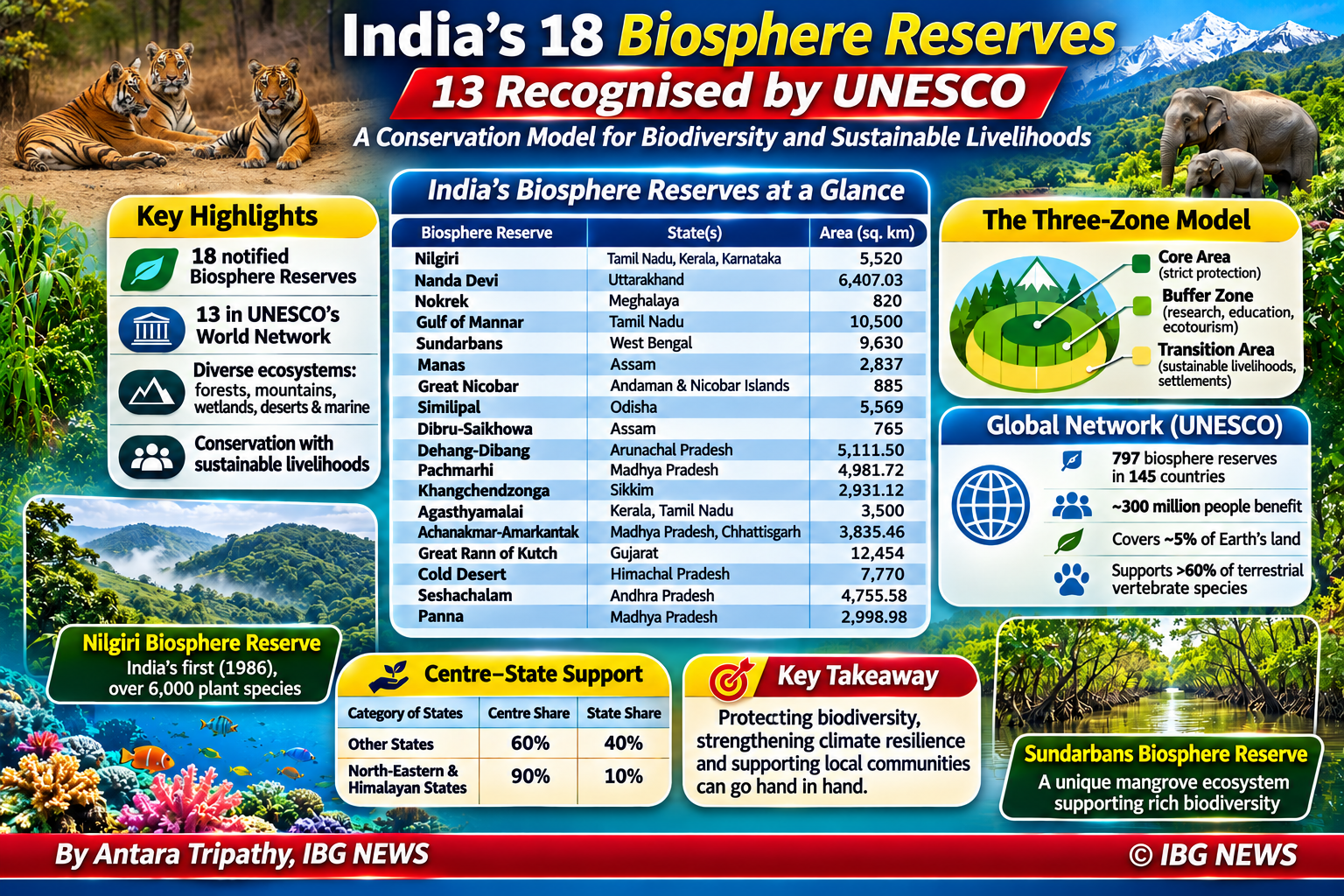
NEW DELHI, 2 November 2026: India’s network of 18 notified Biosphere Reserves represents an important national effort to protect biodiversity while supporting sustainable livelihoods and ecological development. Of these, 13 reserves are included in UNESCO’s World Network of Biosphere Reserves (WNBR), reflecting India’s contribution to international biodiversity conservation.
As the world prepares to observe the International Day for Biosphere Reserves on 3 November, India’s diverse conservation landscapes—from the Himalayan high-altitude deserts and Western Ghats to the Sundarbans mangrove ecosystem and Gulf of Mannar marine habitats—highlight the importance of combining environmental protection with community participation.
According to a backgrounder released by the Press Information Bureau (PIB), Government of India, on 2 November 2026, the country’s biosphere reserve network covers a wide range of ecological systems. These landscapes support scientific research, habitat conservation, environmental education and sustainable economic activities.
The observance of the International Day for Biosphere Reserves, proclaimed by UNESCO, draws attention to the contribution of these protected landscapes towards biodiversity conservation and the well-being of communities dependent on natural resources.
Why Are Biosphere Reserves Important?
Biodiversity represents the variety of living organisms and ecosystems across terrestrial, marine and other aquatic environments. The Convention on Biological Diversity (CBD) recognises three interconnected levels:
- Genetic diversity: Variations within a species, such as different varieties of rice.
- Species diversity: The variety of plants, animals and other organisms, including tigers, elephants and orchids.
- Ecosystem diversity: Different natural habitats, including forests, grasslands, wetlands and coral reefs.
Biosphere reserves are designated landscapes intended to conserve these natural resources while promoting sustainable development. They help maintain ecological balance, protect habitats, support food and water security, strengthen climate resilience and preserve livelihoods.
Unlike conventional protected areas that primarily concentrate on wildlife and habitat protection, biosphere reserves follow a broader approach by integrating conservation with the needs of surrounding communities.

Three Major Functions of Biosphere Reserves
Under UNESCO’s Man and the Biosphere (MAB) Programme, launched in 1971, biosphere reserves function as living laboratories for sustainable development and improved relationships between people and nature.
Their responsibilities are organised around three principal functions:
| Function | Main objective |
|---|---|
| Conservation | Protect biodiversity, genetic resources, ecosystems, landscapes and associated cultural diversity |
| Sustainable development | Promote economic and social activities compatible with ecological limits and local cultural values |
| Scientific support | Encourage research, environmental monitoring, education, training and knowledge exchange |
These functions are supported by a three-zone management structure.
Understanding the Three-Zone Model
| Zone | Purpose and permitted activities |
|---|---|
| Core Area | Strictly protected ecosystems, habitats and genetic resources; limited compatible research and monitoring |
| Buffer Zone | Scientific research, environmental education, ecological monitoring and regulated ecotourism |
| Transition Area | Settlements, sustainable agriculture, responsible forestry, ecotourism and community-based economic activities |
According to the PIB backgrounder, the global average distribution of biosphere reserve areas is approximately 18% core zone, 30% buffer zone and 52% transition zone. This arrangement demonstrates how strict conservation can coexist with sustainable human activity.
India’s Biosphere Reserve Network: Complete Data
India has notified 18 Biosphere Reserves, of which 13 are recognised under UNESCO’s World Network of Biosphere Reserves. The following table presents the reserve-wise information provided in the Government of India’s backgrounder dated 2 November 2026.
Table 1: India’s 18 Notified Biosphere Reserves
| No. | Biosphere Reserve | Year of designation | UNESCO WNBR inclusion | State/Region | Area (sq. km) |
|---|---|---|---|---|---|
| 1 | Nilgiri | 1986 | 2000 | Tamil Nadu, Kerala, Karnataka | 5,520 |
| 2 | Nanda Devi | 1988 | 2004 | Uttarakhand | 6,407.03 |
| 3 | Nokrek | 1988 | 2009 | Meghalaya | 820 |
| 4 | Gulf of Mannar | 1989 | 2001 | Tamil Nadu | 10,500 |
| 5 | Sundarbans | 1989 | 2001 | West Bengal | 9,630 |
| 6 | Manas | 1989 | — | Assam | 2,837 |
| 7 | Great Nicobar | 1989 | 2013 | Andaman and Nicobar Islands | 885 |
| 8 | Similipal | 1994 | 2009 | Odisha | 5,569 |
| 9 | Dibru-Saikhowa | 1997 | — | Assam | 765 |
| 10 | Dehang-Dibang | 1998 | — | Arunachal Pradesh | 5,111.50 |
| 11 | Pachmarhi | 1999 | 2009 | Madhya Pradesh | 4,981.72 |
| 12 | Khangchendzonga | 2000 | 2018 | Sikkim | 2,931.12 |
| 13 | Agasthyamalai | 2001 | 2016 | Kerala, Tamil Nadu | 3,500 |
| 14 | Achanakmar-Amarkantak | 2005 | 2012 | Madhya Pradesh, Chhattisgarh | 3,835.46 |
| 15 | Great Rann of Kutch | 2008 | — | Gujarat | 12,454 |
| 16 | Cold Desert | 2009 | 2025 | Himachal Pradesh | 7,770 |
| 17 | Seshachalam | 2010 | — | Andhra Pradesh | 4,755.58 |
| 18 | Panna | 2011 | 2020 | Madhya Pradesh | 2,998.98 |
Note: An asterisk in the original government dataset denotes inclusion in UNESCO’s World Network of Biosphere Reserves. A dash indicates that no WNBR inclusion year is listed in the supplied table.
Table 2: Key Statistics of India’s Biosphere Reserve Network
| Indicator | Reported figure |
|---|---|
| Total notified Biosphere Reserves in India | 18 |
| UNESCO-recognised reserves | 13 |
| Reserves not included in WNBR in the supplied list | 5 |
| First Indian Biosphere Reserve designated | Nilgiri, 1986 |
| Most recently included in UNESCO’s network | Cold Desert, 2025 |
| Largest reserve by listed area | Great Rann of Kutch, 12,454 sq. km |
| Smallest reserve by listed area | Dibru-Saikhowa, 765 sq. km |
The table illustrates the geographical and ecological diversity of India’s conservation network. The reserves extend across multiple states and Union Territories and encompass mountain ecosystems, tropical forests, wetlands, deserts, mangroves and marine environments.
UNESCO Recognition and India’s International Conservation Role
UNESCO’s World Network of Biosphere Reserves connects conservation landscapes across countries to encourage scientific cooperation, sustainable development and the exchange of environmental knowledge.
The PIB backgrounder reports that UNESCO’s global network comprises 797 biosphere reserves across 145 countries. These areas directly benefit approximately 300 million people living within them.
The global network covers around 5% of Earth’s terrestrial surface while supporting more than 60% of the world’s terrestrial vertebrate species richness, according to the backgrounder.
Other important global indicators include:
| Global indicator | Reported figure |
|---|---|
| UNESCO World Network Biosphere Reserves | 797 |
| Participating countries | 145 |
| People directly benefiting from these areas | Approximately 300 million |
| Share of Earth’s terrestrial surface covered | Approximately 5% |
| Share of global terrestrial vertebrate species richness supported | More than 60% |
| Biosphere reserves potentially facing more extreme climate events by 2050 | Around 40% |
| Biosphere reserves overlapping another international designation | More than 50% |
These figures underline the importance of strengthening climate adaptation, ecosystem restoration and international environmental cooperation.
Government Support for Conservation and Management
The Ministry of Environment, Forest and Climate Change (MoEFCC) administers the Centrally Sponsored Scheme known as the Biodiversity Conservation Scheme, which operates under the broader umbrella programme, Conservation of Natural Resources and Eco-systems.
Under this framework, financial assistance is provided to states for conservation and development activities in biosphere reserves designated under UNESCO’s Man and the Biosphere Programme.
State Forest Departments are responsible for implementing the approved management activities.
Table 3: Centre-State Funding Pattern
| Category of States | Central Government share | State Government share |
|---|---|---|
| Other States | 60% | 40% |
| North-Eastern and Himalayan States | 90% | 10% |
The funding arrangement is intended to support conservation programmes while enabling state-level implementation.
Integrated Management Plans
Since 2022–23, the Ministry has piloted five-year Integrated Management Plans for four biosphere reserves.
| Biosphere Reserve | State/Region | Key management approach |
|---|---|---|
| Nanda Devi | Uttarakhand | Habitat restoration, research and biodiversity monitoring |
| Pachmarhi | Madhya Pradesh | Integrated ecosystem management and sustainable livelihoods |
| Dehang-Dibang | Arunachal Pradesh | Conservation planning and scientific monitoring |
| Agasthyamalai | Kerala and Tamil Nadu | Community participation, research and habitat protection |
These plans bring together reserve authorities, research institutions and local communities. Their priorities include habitat restoration, biodiversity monitoring, scientific research and sustainable livelihood development.
A Closer Look at India’s Ecological Treasures
India’s biosphere reserves protect ecosystems that differ considerably in climate, geography and biodiversity.
1. Nilgiri Biosphere Reserve: A Western Ghats Biodiversity Hotspot
Designated in 1986, the Nilgiri Biosphere Reserve was India’s first biosphere reserve. It extends across Tamil Nadu, Kerala and Karnataka and forms part of the ecologically significant Western Ghats.
The reserve encompasses tropical evergreen forests, montane shola forests and grasslands. Its wildlife includes the endangered lion-tailed macaque and Nilgiri tahr, along with elephants, tigers, gaur, sambar and chital.
The PIB backgrounder notes that the reserve supports more than 100 mammal species and 550 bird species. The Nilgiri district alone records more than 6,000 plant species.
2. Cold Desert Biosphere Reserve: Protecting High-Altitude Ecosystems
Located in Himachal Pradesh, the Cold Desert Biosphere Reserve covers 7,770 sq. km at elevations ranging from approximately 3,300 to 6,600 metres.
Its challenging high-altitude environment supports 732 vascular plant species, including 30 endemic species. Snow leopards, Himalayan ibex and blue sheep are among its notable wildlife.
Approximately 12,000 people inhabit this region, where traditional livelihoods include pastoralism, yak and goat herding, barley and pea cultivation, and Tibetan herbal medicine.
The reserve’s inclusion in UNESCO’s World Network in 2025 marked an important development in India’s international conservation profile.
3. Gulf of Mannar: Protecting Marine Biodiversity
Situated off Tamil Nadu’s southeastern coast, the Gulf of Mannar Biosphere Reserve is one of India’s important marine conservation landscapes.
Covering approximately 1.05 million hectares, it encompasses coral reefs, seagrass beds and mangrove ecosystems.
The interconnected marine habitats support approximately 4,223 plant and animal species. The region also sustains around 25 lakh people across approximately 47 coastal villages.
Its ecological importance extends beyond marine wildlife protection, as the health of these habitats is closely connected with coastal livelihoods.
4. Sundarbans: Safeguarding the Mangrove Ecosystem of West Bengal
The Sundarbans Biosphere Reserve, designated in 1989 and included in UNESCO’s World Network in 2001, is located in West Bengal.
Its mangrove forests form an important ecological barrier along the coastal landscape and provide habitat for a wide variety of wildlife.
The Sundarbans also support communities whose livelihoods depend on fishing, agriculture and other natural resources. Conservation in this region requires attention to biodiversity, coastal resilience and the well-being of local populations.
Community Participation: Turning an Invasive Plant into a Conservation Opportunity
One of the notable examples highlighted in the government backgrounder comes from the Nilgiri Biosphere Reserve, where Indigenous communities have transformed uprooted Lantana vines into elephant sculptures, furniture and handicrafts.
Lantana camara is an invasive shrub that has spread across approximately 300,000 sq. km of Indian forests. Dense growth can suppress native vegetation, reduce biodiversity and alter natural fire patterns. Its ability to regenerate rapidly makes control and removal particularly challenging.
The community-based initiative provides an economic use for removed Lantana while creating opportunities for Indigenous artisans.
In 2021, 125 life-sized elephant sculptures made from Lantana were displayed in London. Other displays have appeared at Bengaluru Airport, across Bengaluru and at Rashtrapati Bhavan.
The initiative demonstrates how conservation programmes can create livelihood opportunities while raising awareness about invasive species and habitat degradation.
India and the Wider Challenge of Climate Change
Biosphere reserves are increasingly important in the context of changing climatic conditions.
Mountain ecosystems face pressures associated with changing temperatures and habitat conditions, while coastal and marine reserves must respond to environmental changes affecting mangroves, coral reefs and seagrass beds.
The global figures cited in the PIB backgrounder indicate that approximately 40% of biosphere reserves could face more extreme climate events by 2050.
This makes long-term environmental monitoring, scientific research, habitat restoration and community participation essential components of conservation planning.
The Way Forward
India’s biosphere reserve network provides a framework for integrating biodiversity protection with sustainable economic development. However, maintaining these landscapes requires continuous investment, scientific cooperation and effective participation by local communities.
The future priorities include:
- Strengthening biodiversity monitoring and scientific research.
- Restoring degraded habitats and controlling invasive species.
- Promoting sustainable livelihoods for communities living within and around reserves.
- Combining traditional ecological knowledge with modern conservation methods.
- Improving climate resilience in mountain, coastal, forest and marine ecosystems.
- Strengthening partnerships among government departments, research institutions, communities and international organisations.
Conclusion: Conservation and Human Well-being Must Progress Together
India’s 18 Biosphere Reserves represent more than a collection of protected landscapes. They demonstrate an approach in which ecological protection, scientific research, cultural heritage and sustainable livelihoods are considered interconnected priorities.
The recognition of 13 Indian reserves by UNESCO also reflects the country’s contribution to international environmental cooperation.
As the International Day for Biosphere Reserves is observed on 3 November, the larger message is clear: protecting biodiversity cannot be separated from protecting the communities, traditions and livelihoods that depend on healthy ecosystems.
The long-term success of these reserves will depend on how effectively governments, scientists and local communities work together to ensure that India’s natural heritage remains resilient for future generations.
Sources and References
- Press Information Bureau, Government of India – Biosphere Reserves in India: Celebrating the International Day for Biosphere Reserves, 2 November 2026.
- Ministry of Environment, Forest and Climate Change (MoEFCC), Government of India.
- UNESCO – Man and the Biosphere Programme and World Network of Biosphere Reserves.
- Convention on Biological Diversity (CBD).
- UNESCO World Network of Biosphere Reserves – global network information.
IBG NEWS | Environment, Biodiversity and Conservation Reporting

