











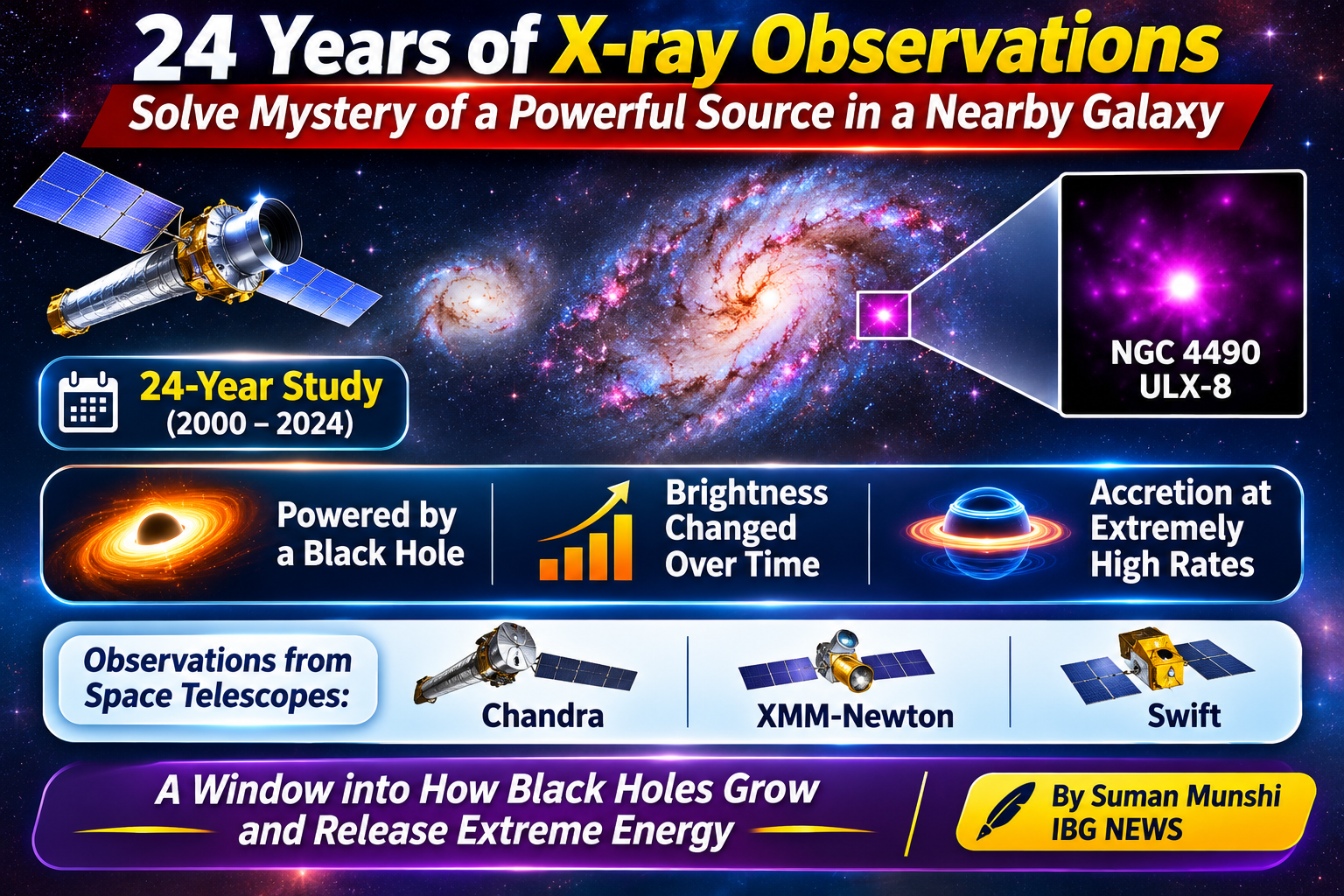

24 Years of X-ray Observations Reveal the Changing Behaviour of a Powerful Cosmic Source in a Nearby Galaxy
By Suman Munshi | IBG NEWS
NEW DELHI, 2 November 2026: A 24-year study of an exceptionally bright X-ray source in a nearby galaxy has offered astronomers important insights into the extreme processes that power some of the most luminous objects in the Universe.
Researchers have investigated the long-term X-ray behaviour of NGC 4490 ULX-8, an ultraluminous X-ray source (ULX) located in the interacting galaxy system NGC 4490/4485. By analysing observations collected between 2000 and 2024, the team identified significant changes in the source’s X-ray brightness and spectral characteristics, providing new evidence about the conditions surrounding the compact object at its centre.
The findings point towards a black hole accreting matter at exceptionally high rates, offering an opportunity to understand how compact astronomical objects operate under extreme physical conditions.
What Makes Ultraluminous X-ray Sources So Extraordinary?
Ultraluminous X-ray sources are among the most powerful X-ray emitters found outside the central regions of galaxies, where supermassive black holes generally dominate high-energy activity.
These sources are believed to be powered by compact objects such as neutron stars or black holes that attract material from nearby companion stars. As gas moves towards the compact object, it becomes extremely hot and releases intense X-ray radiation.
Their extraordinary brightness presents an important scientific puzzle. In several cases, ULXs appear to exceed the luminosity expected from the classical Eddington limit.
The Eddington limit represents the theoretical balance between the gravitational force pulling matter towards an object and the outward pressure exerted by its radiation. When an accreting object appears to radiate beyond this benchmark, astronomers must investigate the physical processes that allow such intense energy emission.
Understanding these systems can help scientists explore super-Eddington accretion, powerful gas outflows and the growth of compact objects.
A 24-Year Investigation Using Three Space Observatories
The research team examined archival and more recent observations collected by three major space-based X-ray observatories:
- Chandra X-ray Observatory: Provided high-resolution X-ray observations of the source and its surrounding galaxy.
- XMM-Newton: Supplied detailed spectral information through its European Photon Imaging Camera instruments.
- Swift: Contributed observations that helped researchers follow changes in the source over time.
The combined dataset covered a period from 2000 to 2024, making it one of the longest investigations of ULX-8’s X-ray behaviour.
Aru Beri, faculty member at the Indian Institute of Astrophysics (IIA) and a co-author of the research, explained that the team combined archival and recent observations from these three observatories to investigate the source’s long-term evolution.
What Did the Astronomers Discover?
The investigation found that ULX-8 remained an exceptionally luminous X-ray source throughout the observation period, although its brightness changed considerably.
An important aspect of the discovery was that the source did not display the pronounced transitions between different accretion states commonly observed in many black hole X-ray binary systems.
Instead, its X-ray emission continued to show characteristics associated with a persistently active ultraluminous accretion flow.
The researchers interpret these observations as strong evidence that ULX-8 is powered by a stellar-mass black hole drawing in matter at an exceptionally high rate, potentially at or near the Eddington limit.
This behaviour makes the source particularly valuable for studying how black holes sustain intense accretion and release enormous amounts of energy.
Why Does This Discovery Matter?
The research contributes to a wider scientific effort to understand the relationship between black holes, surrounding matter and high-energy radiation.
Long-term monitoring is particularly important because a single observation may capture only one stage in the behaviour of an astronomical source. By comparing measurements collected over decades, researchers can identify persistent characteristics, gradual changes and unusual patterns that might otherwise remain unnoticed.
The findings may help scientists investigate:
- How black holes accumulate matter under extreme conditions.
- The physical processes responsible for unusually powerful X-ray emission.
- The relationship between accretion flows and the formation of powerful gas outflows.
- How compact objects evolve in interacting and star-forming galaxies.
- Why some ultraluminous X-ray sources maintain their extreme emission over extended periods.
Next-Generation Observatories Could Reveal More
Future space missions are expected to improve the study of ultraluminous X-ray sources.
The European Space Agency’s proposed NewAthena X-ray observatory and India’s proposed XSat next-generation timing and spectroscopy mission could provide enhanced observational capabilities for examining these energetic systems.
Improved sensitivity and more detailed monitoring would allow researchers to investigate changes in X-ray emission, study the physical conditions surrounding compact objects and refine existing models of super-Eddington accretion.
Such observations could also help determine whether the unusual behaviour seen in ULX-8 is shared by other ultraluminous X-ray sources.
Research Team and Publication
The study was authored by Tarang Vashisht, a student at the Indian Institute of Science Education and Research (IISER), Mohali; Aru Beri of the Indian Institute of Astrophysics; and researchers associated with the Inter-University Centre for Astronomy and Astrophysics (IUCAA) and the Raman Research Institute.
The Indian Institute of Astrophysics and Raman Research Institute are autonomous institutions under the Department of Science and Technology (DST), Government of India.
The research has been published in the Monthly Notices of the Royal Astronomical Society (MNRAS).
Research publication: Read the scientific paper in MNRAS
A Window into the Extreme Physics of the Universe
The 24-year investigation of NGC 4490 ULX-8 demonstrates the scientific value of sustained observations across multiple space missions. Its persistent high-energy emission and changing brightness offer an important opportunity to understand how black holes interact with surrounding matter under extraordinary conditions.
As more advanced X-ray observatories become available, astronomers may gain a clearer understanding of the mechanisms behind ultraluminous X-ray sources and the extreme environments in which compact objects grow and release energy.
For astronomy, the discovery is another reminder that some of the Universe’s most important secrets can only be uncovered through patience, long-term observation and collaboration across scientific institutions.

