












Kolkata’s Lifeline: Water Treatment Plants, Their History, Technology and the Future of a Growing City
From the historic Palta Water Works to modern treatment facilities at Garden Reach, Dhapa and New Town, how Kolkata’s water infrastructure sustains millions of citizens and what must happen next to meet the demands of a rapidly expanding metropolis.
By Suman Munshi | IBG NEWS
Introduction: The Water That Keeps Kolkata Alive
Water is one of the most fundamental requirements of urban life. Every morning, millions of people across Kolkata depend on an extensive network of water treatment plants, pumping stations, underground reservoirs and pipelines to receive drinking water in their homes, workplaces, hospitals, educational institutions and commercial establishments.
Behind the simple act of opening a tap lies a complex engineering and public-service system that has evolved over more than 160 years.
Kolkata is fortunate to have the River Hooghly as its principal source of surface water. However, the availability of river water does not automatically guarantee safe drinking water. It must be collected, treated, filtered, disinfected, tested and transported through a carefully maintained distribution network before reaching consumers.
The responsibility of providing this essential service becomes increasingly challenging as Kolkata expands beyond its traditional boundaries. New Town, Rajarhat, Garia, Joka, Behala, the EM Bypass corridor and other emerging urban settlements are creating new demands on the metropolitan water infrastructure.
The question facing Kolkata is no longer simply how much water can be produced every day. It is how efficiently, equitably and sustainably that water can be delivered to every citizen, including future generations.
1. The History of Water Treatment in Kolkata: A Legacy Dating Back to the Nineteenth Century
Kolkata’s organised municipal water supply system has its roots in the British colonial period.
During the nineteenth century, the growing population of Calcutta faced considerable difficulties in accessing safe drinking water. Dependence on local ponds, tanks, wells and untreated river water created public-health challenges, particularly during epidemics and periods of poor sanitation.
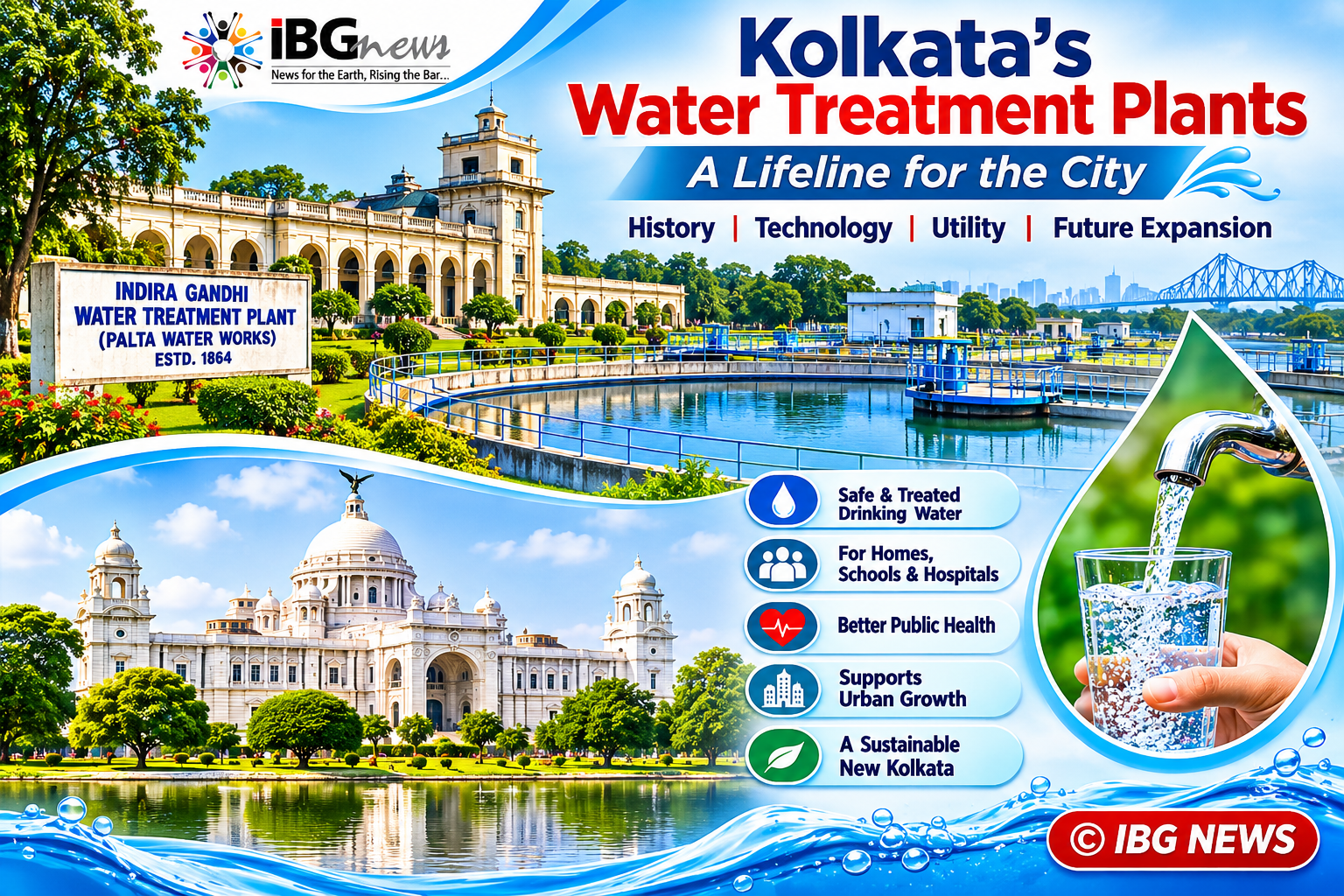
Recognising the importance of a reliable municipal water supply, authorities developed the Palta Water Works, now officially known as the Indira Gandhi Water Treatment Plant (IGWTP).
Palta Water Works: The beginning of organised water supply
The Palta installation was developed between 1864 and 1870, establishing one of the earliest large-scale organised municipal water supply systems in India.
Spread across approximately 480 acres, the facility initially had a treatment capacity of around 6 million gallons per day (MGD).
Its original treatment process involved:
- Collection of raw water from the Hooghly.
- Sedimentation in settling tanks.
- Filtration through slow sand filter beds.
- Storage and distribution through pumping infrastructure.
The system was progressively expanded as the population of Calcutta increased.
Between 1888 and 1893, additional filter beds were constructed. Further expansion took place in 1905 and during 1920–1936, demonstrating how water infrastructure had to evolve alongside urban development.
The historical importance of Palta is not merely its age. It represents the foundation of Kolkata’s modern municipal water supply system.
The evolution of modern water infrastructure
As the city expanded southwards and westwards, additional treatment and pumping infrastructure became necessary.
Garden Reach emerged as another major water supply centre. Smaller treatment facilities at Jorabagan and Watgunge subsequently strengthened supplies to neighbourhoods where distribution requirements and local conditions demanded additional capacity.
A major milestone came in December 2014, when the Jai Hind Jal Prakalpa at Dhapa was inaugurated. It was designed to provide treated surface water to neighbourhoods around the Eastern Metropolitan Bypass, including Kasba, Mukundapur, Anandapur and Patuli.
The development of these facilities gradually reduced dependence on groundwater in several parts of the city.
Kolkata’s water supply system has therefore evolved from a relatively concentrated nineteenth-century installation into a network of major treatment plants, reservoirs, pumping stations and distribution pipelines.
2. The Major Water Treatment Plants Serving Kolkata
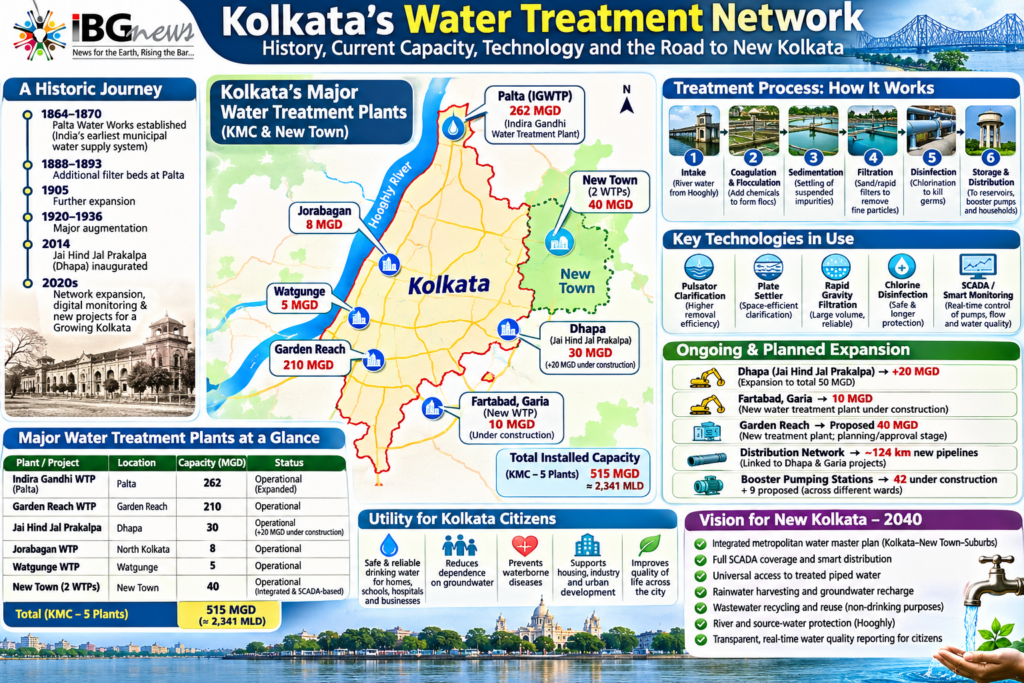
The Kolkata Municipal Corporation (KMC) identifies five principal water treatment facilities serving the city.
Their reported generation capacities are as follows:
| Water treatment plant | Location | Reported capacity |
|---|---|---|
| Indira Gandhi Water Treatment Plant | Palta | 262 MGD |
| Garden Reach Water Works | Garden Reach | 210 MGD |
| Jai Hind Jal Prakalpa | Dhapa | 30 MGD |
| Jorabagan Water Treatment Plant | North Kolkata | 8 MGD |
| Watgunge Water Treatment Plant | Watgunge | 5 MGD |
| Total | 515 MGD |
These figures represent approximately 2,341 million litres per day (MLD) of installed generation capacity, using the standard imperial-gallon conversion.
It is important to distinguish installed capacity from actual daily production and the quantity ultimately delivered to consumers. Maintenance, seasonal river conditions, electricity supply, transmission losses and distribution constraints can affect actual availability.
Indira Gandhi Water Treatment Plant, Palta
Palta remains the historical backbone of Kolkata’s water supply infrastructure.
Its expanded treatment facilities incorporate modern treatment technologies alongside older filtration systems. The New Palta development introduced large-scale treatment modules using pulsator clarification technology.
The plant’s extensive pumping and transmission arrangements enable treated water to travel towards Kolkata through the municipal distribution network.
Garden Reach Water Works
Garden Reach is a major water treatment and distribution centre serving substantial parts of southern and western Kolkata.
Its importance has increased with the development of Behala, Joka, Alipore, Tollygunge and surrounding residential areas.
The expansion of Garden Reach has been particularly significant in reducing pressure on groundwater resources in areas where municipal surface-water distribution has been strengthened.
Jai Hind Jal Prakalpa, Dhapa
Named after the historic slogan associated with Netaji Subhas Chandra Bose and the Indian National Army, the Dhapa project is an important component of eastern and south-eastern Kolkata’s water supply infrastructure.
Raw water is drawn from the Hooghly through an intake arrangement at Mayer Ghat, transported to Dhapa for treatment and subsequently distributed through reservoirs and booster pumping stations.
The facility has helped improve access to treated surface water in neighbourhoods around the EM Bypass.
Jorabagan and Watgunge
These smaller treatment facilities play important local roles.
Jorabagan helps serve parts of North Kolkata, including areas around Chitpur, Nimtala and Sovabazar. Watgunge supports the supply requirements of Watgunge, Khidderpore and adjoining areas.
Such decentralised facilities demonstrate why large treatment plants must be complemented by strategically located smaller installations and pumping infrastructure.
3. How Does a Modern Water Treatment Plant Work?
Water treatment is a scientific and engineering process. Raw river water cannot be supplied directly for drinking because it may contain suspended particles, organic matter, microorganisms and other contaminants.
A conventional surface-water treatment plant generally involves several stages.
Stage 1: Raw water intake
Water is collected from the river through an intake jetty and pumping station.
Screens remove larger floating materials, such as leaves, plastic waste and other debris, before water enters the treatment system.
Stage 2: Coagulation and flocculation
Chemicals such as aluminium-based coagulants are added in controlled quantities.
These chemicals help destabilise fine suspended particles that would otherwise remain dispersed in water.
Through controlled mixing, the particles combine into larger clusters known as flocs.
Stage 3: Sedimentation and clarification
The heavier flocs settle in clarification tanks, allowing a substantial portion of suspended impurities to be removed.
Some modern plants use pulsator clarifiers or plate settlers to improve the efficiency and reduce the space requirements of this process.
Stage 4: Filtration
Clarified water passes through filter beds containing sand and, in some systems, other filtration media.
Slow sand filtration and rapid gravity filtration are established technologies used in municipal water treatment.
Filtration removes remaining suspended particles and helps reduce microbial contamination.
Stage 5: Disinfection
Disinfection is essential to reduce the risk of waterborne diseases.
Chlorination is commonly used in municipal water treatment. It helps destroy disease-causing microorganisms and can maintain a protective residual concentration as water travels through the distribution network.
Stage 6: Storage and distribution
After treatment and quality checks, water enters clear-water reservoirs and pumping systems.
Booster pumping stations help maintain sufficient pressure to transport water through pipelines to neighbourhoods and individual connections.
The entire process must be monitored continuously to ensure that water supplied to citizens meets applicable drinking-water quality standards.