










India’s Judiciary at a Constitutional Crossroads: Decolonising the Colonial Mindset Beyond Symbols and Ceremonies
From the language of colonial authority to the promise of constitutional justice, India’s judicial transformation remains an unfinished national responsibility
By Anil P. Kastuar, Editor, IBG NEWS
New Delhi | November 28, 2026
India’s constitutional democracy has travelled a remarkable distance since Independence. Yet, more than seven decades after becoming a Republic, an uncomfortable question continues to confront its institutions: Have we succeeded in building a genuinely Indian system of governance and justice, or have we largely inherited the institutional mindset of our colonial rulers and merely placed constitutional terminology over it?
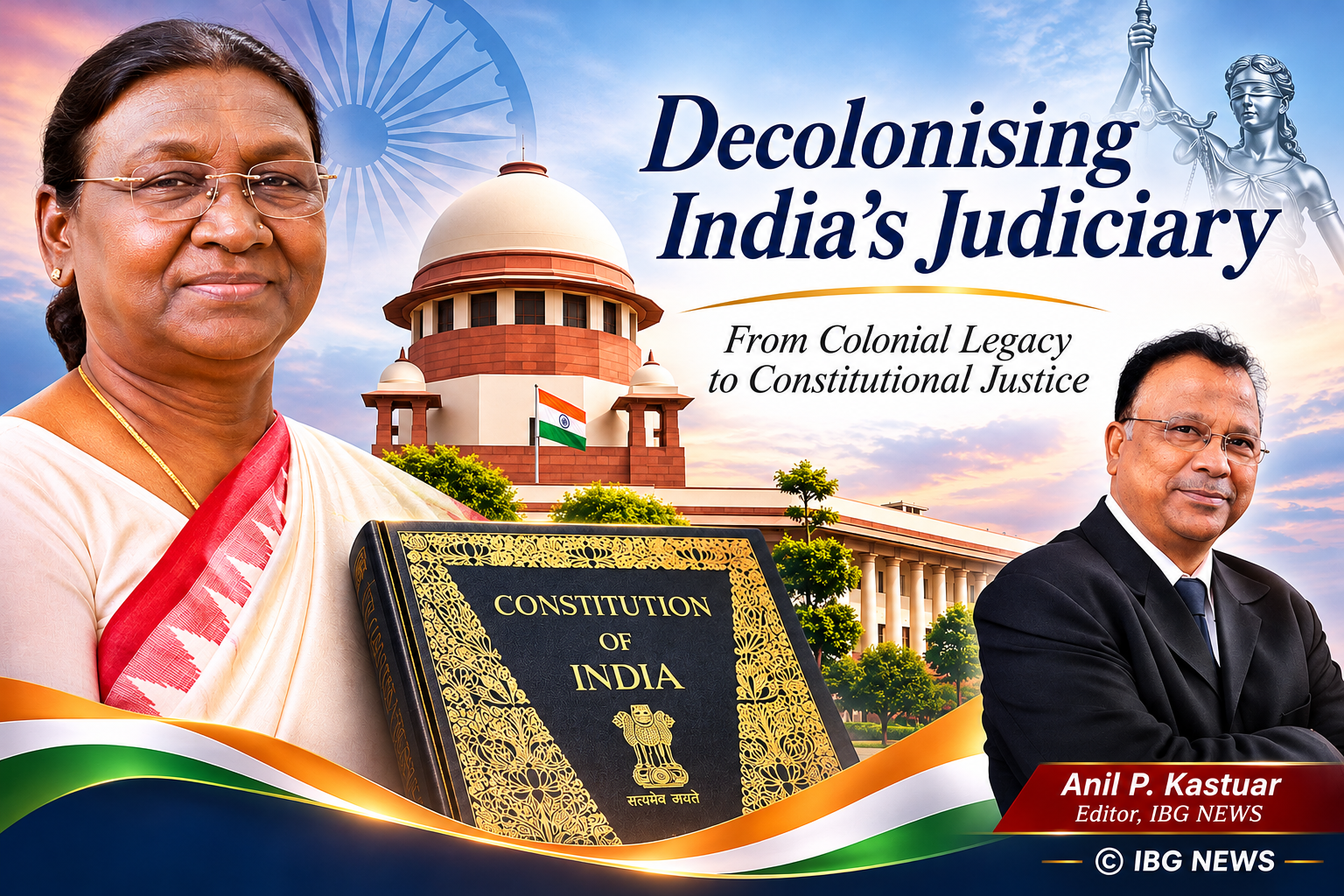
This question acquired renewed significance during the Constitution Day celebrations on November 26, 2026, when President Droupadi Murmu addressed the Supreme Court of India and called attention to the importance of reflecting Indian cultural identity in the working culture of national institutions.
Her observation that the title ‘Excellency’ is no longer used while addressing the President, alongside the replacement of ‘Durbar Hall’ at Rashtrapati Bhavan with ‘Ganatantra Mandap’, may appear to be symbolic changes. However, their constitutional significance extends beyond vocabulary and nomenclature. They represent an effort to redefine the relationship between public authority, democratic institutions and the citizens of India.
The President also called upon the judiciary to contribute to the national objective of decolonisation, while emphasising that judicial independence must remain balanced with judicial accountability. Her message deserves a deeper examination, particularly because the judiciary is not simply an institution administering laws; it is the constitutional guardian of citizens’ rights and the ultimate refuge for those seeking justice.
1. Independence in 1947, Republic in 1950: The unfinished institutional transition
Political independence did not automatically produce institutional decolonisation.
India inherited a legal and administrative architecture substantially developed during British rule. The colonial administration had designed its institutions primarily to govern a vast population, maintain authority, collect revenue and preserve imperial order. The objectives of an independent democratic republic were fundamentally different.
The Constitution of India attempted a historic transformation. Sovereignty was transferred to the people. Equality replaced inherited privilege as a constitutional principle. Fundamental rights placed limits on governmental power, while an independent judiciary was entrusted with protecting constitutional freedoms.
Yet institutional cultures do not change merely because political sovereignty changes hands.
The legal profession, court procedures, official language, administrative hierarchy, ceremonial traditions and several inherited institutional practices continued into independent India. Many were retained because they offered administrative continuity, professional familiarity and established procedural frameworks.
The deeper challenge was to transform their underlying purpose.
A system originally designed to administer colonial authority had to become a system designed to deliver constitutional justice. That transformation remains an unfinished project.
2. The colonial hangover in the Indian judicial system
The colonial legacy in India’s judiciary cannot be reduced to the continued use of English or British legal terminology. Its more persistent influence can be found in institutional attitudes, procedural complexity, social distance and the relationship between the court and the ordinary citizen.
The language barrier
India is a country of extraordinary linguistic diversity. Yet a substantial part of higher judicial proceedings, legal research, legal education and professional communication continues to depend on English.
English has undeniable practical value in a multilingual legal system. It facilitates communication across jurisdictions and provides access to a vast body of legal scholarship. The problem is not the use of English itself; it is the disadvantage created when proficiency in English becomes an informal measure of legal competence or a barrier to meaningful participation.
A citizen should not need to understand sophisticated legal English to comprehend the proceedings that determine his or her rights, liberty, property or livelihood.
The Constitution being made available in Indian languages, including the Santali version in Ol Chiki script referred to by President Murmu, is an important step towards making constitutional principles accessible to communities across the country.
The same commitment must extend to legal aid, court documents, judgments, legal awareness and judicial communication.
The hierarchy of the courtroom
The architecture and ceremonial traditions of the judiciary often communicate authority through distance and hierarchy. Formal robes, elaborate procedures, complex forms of address and highly technical courtroom language have historical roots.
Professional discipline and courtroom dignity are essential. However, dignity must not become a barrier between the institution and the people it serves.
The judiciary must inspire respect through fairness, competence, impartiality and integrity rather than through the intimidating appearance of institutional authority.
The citizen approaching a court should experience the presence of constitutional protection, not the psychological distance of an inaccessible establishment.
Procedural complexity and the cost of justice
One of the most persistent colonial inheritances is the tendency to equate procedural formality with institutional effectiveness.
A legal system can be technically sophisticated and still fail citizens if justice remains prohibitively expensive, excessively complicated or unreasonably delayed.
For a poor litigant, a landless worker, a small trader, a woman facing violence or a family waiting for the resolution of a property dispute, the practical value of the Constitution is measured not by the elegance of judicial language but by whether justice is delivered within a reasonable time and at an affordable cost.
The President’s concern over the enormous backlog of pending cases is therefore central to the decolonisation debate.
A judicial system that takes years to resolve an ordinary citizen’s grievance risks reproducing the distance between authority and the governed that characterised colonial administration.
3. The Constitution must be the judiciary’s primary institutional identity
India did not adopt the Constitution merely to replace British administrators with Indian administrators. It adopted a transformative constitutional framework to redefine the relationship between the State and its citizens.
The Preamble provides the philosophical foundation: Justice, Liberty, Equality and Fraternity.
These are not ceremonial expressions. They are operational principles against which the conduct of every constitutional institution must be evaluated.
The judiciary’s responsibility is consequently twofold.
First, it must protect citizens from arbitrary exercises of governmental authority and safeguard fundamental rights.
Second, it must ensure that its own institutional functioning remains consistent with constitutional values.
Judicial independence is indispensable, but independence cannot be interpreted as immunity from reasoned scrutiny or institutional accountability.
President Murmu’s emphasis on balancing judicial independence with judicial accountability is particularly significant. An independent judiciary must be free from political pressure, executive interference and external influence. At the same time, public confidence requires transparency, ethical conduct, responsible administration and an effective mechanism for addressing institutional shortcomings.
Accountability should strengthen judicial independence, not weaken it.
Equally, criticism of judicial decisions must remain grounded in constitutional reasoning and respect for the rule of law. Neither unquestioning reverence nor politically motivated attacks serve the interests of democracy.
4. The Supreme Court must become more accessible than ever
The Constitution promises equality before the law, but equality in constitutional text does not automatically translate into equality in access to justice.
A wealthy litigant can often afford experienced lawyers, repeated court appearances and prolonged litigation. A financially vulnerable citizen may struggle even to reach the appropriate court.
This imbalance raises a fundamental question: Can justice truly be equal when the ability to pursue it depends substantially on financial resources?
The Chief Justice’s Constitution Day observations about making the Supreme Court a people’s court deserve particular attention.
The historical development of Public Interest Litigation demonstrated that access to constitutional remedies could be widened beyond conventional procedural limitations. Letters and postcards raising serious public concerns were, at different stages, recognised as instruments through which judicial intervention could be sought.
This development helped bring the concerns of disadvantaged communities into the judicial system.
However, access to justice must not depend solely on exceptional judicial interventions. It must become an ordinary and reliable feature of institutional administration.
The President’s call to improve the quality and reliability of legal representation for economically disadvantaged citizens is therefore important.
Free legal aid should not mean merely providing a lawyer’s name or completing a procedural formality. It must provide competent representation, meaningful preparation, continuity and genuine professional commitment.
District Legal Services Authorities, State Legal Services Authorities and the National Legal Services Authority have a critical role in making this constitutional promise real.
Justice must become accessible at the district and local levels rather than remaining concentrated in the country’s major judicial centres.
5. Technology must democratise justice, not create another divide
Digital transformation offers an opportunity to address several structural weaknesses in India’s judicial system.
Online filing, digital records, virtual hearings, electronic case management, translation technologies and improved listing systems can reduce procedural delays and make judicial services more accessible.
President Murmu acknowledged the judiciary’s efforts to simplify procedures, employ technology and establish special courts to address specific categories of cases.
These developments are encouraging. However, technology must not become another instrument of exclusion.
Millions of citizens still face limitations in digital literacy, internet access, language familiarity and the ability to navigate online systems.
A judicial system that becomes digital without becoming accessible may simply replace one barrier with another.
Technology should support judges, lawyers and litigants, not substitute human judgment, empathy and constitutional responsibility.
The objective should be a hybrid, inclusive and citizen-friendly justice delivery system in which digital efficiency strengthens rather than diminishes the human dimension of justice.
6. Decolonising legal education: From technical competence to constitutional empathy
The colonial legacy is also visible in the way legal education is approached.
Legal education must produce more than technically competent professionals. It must develop lawyers and judges who understand the social realities behind legal disputes.
President Murmu specifically emphasised the importance of empathy and ethics in legal education. She also urged experienced members of the legal profession to demonstrate that professional excellence can coexist with compassion.
This is a vital message.
A lawyer representing a poor litigant must understand that the case may determine the future of an entire family. A prosecutor must recognise the importance of fairness and due process. A judge must understand the human consequences of a judicial decision.
The study of law cannot remain detached from society.
Legal institutions must encourage research into rural justice, tribal rights, labour disputes, gender equality, environmental protection and the difficulties experienced by marginalised communities.
The President’s reference to the contribution of Hansaben Mehta in shaping Article 1 of the Universal Declaration of Human Rights is especially meaningful. Her intervention in replacing the expression ‘All men are born free and equal’ with ‘All human beings are born free and equal’ demonstrated how language can reflect a more inclusive understanding of human dignity.
The representation of women in the Bench and Bar must similarly become a priority. Greater participation of women can enrich judicial perspectives, improve institutional inclusiveness and strengthen public confidence.
7. The Bharatiya Nyaya Sanhita and the larger question of legal transformation
The replacement of the Indian Penal Code with the Bharatiya Nyaya Sanhita represents an important legislative transition in India’s criminal law framework.
President Murmu referred to the movement towards a justice-oriented approach rather than an exclusively punishment-centred philosophy.
However, the replacement of statutory names alone cannot establish that a legal system has been transformed.
The real test lies in implementation.
Are investigations fair and professional? Are accused persons protected by due process? Do victims receive timely support? Are trials conducted without unreasonable delay? Is the criminal justice system equally accessible regardless of wealth or influence?
These questions matter more than the terminology of legislation.
A genuinely decolonised criminal justice system must uphold constitutional safeguards, individual liberty, equality before law and accountability of investigative agencies.
The objective should never be to replace one form of excessive authority with another. It must be to establish a system in which power is exercised within constitutional limits.
8. The judiciary must bridge the distance between the Constitution and the citizen
One of the most important aspects of President Murmu’s address was her emphasis on reducing the distance between citizens and the judicial system.
Her personal journey from grassroots public life in Rairangpur, Odisha, to the office of President of India offered a powerful illustration of the constitutional promise of equality of opportunity.
That message is particularly relevant to the judiciary.
The Constitution belongs equally to the citizen living in a metropolitan city and the person residing in a remote tribal village. Its protection cannot depend on geography, economic status, education, social influence or familiarity with the legal profession.
The judiciary must therefore develop stronger institutional connections with district courts, legal aid centres, local communities and vulnerable groups.
The President’s appreciation of initiatives prioritising persons with disabilities, acid attack survivors, senior citizens above 80 years and people below the poverty line demonstrates the importance of placing human vulnerability at the centre of judicial administration.
A people’s judiciary is not one that lowers the standards of law. It is one that removes unnecessary obstacles preventing citizens from obtaining justice.
9. What should genuine judicial decolonisation look like?
India needs a practical institutional agenda rather than a campaign limited to renaming buildings and replacing colonial expressions.
A meaningful transformation should include:
- Language democratisation: Wider availability of judgments, court services and legal documents in Indian languages, with reliable translation and interpretation facilities.
- Simplification of procedures: Reducing unnecessary technicalities, repetitive adjournments and avoidable delays without compromising due process.
- Affordable legal representation: Strengthening legal aid institutions and ensuring that economically weaker litigants receive competent and dependable representation.
- Judicial accountability: Developing transparent institutional practices that preserve judicial independence while reinforcing public confidence.
- District-level justice: Strengthening subordinate courts, infrastructure, staffing, digital facilities and access to legal assistance.
- Ethical legal education: Making empathy, professional ethics, constitutional morality and social awareness integral to legal training.
- Inclusive representation: Encouraging greater participation of women and underrepresented communities in the legal profession and judicial institutions.
- Citizen-centric technology: Ensuring that digital courts and electronic services remain accessible to people with limited technological resources.
- Constitutional literacy: Taking constitutional education beyond universities and courtrooms into schools, villages, workplaces and community institutions.
These measures would transform decolonisation from an abstract national aspiration into a measurable institutional responsibility.
10. The ultimate test: Does the ordinary citizen experience justice?
The most important measure of judicial reform is not the number of colonial-era names removed from government buildings, the form of address used for constitutional authorities or the sophistication of legal terminology.
It is whether an ordinary citizen can approach a court without fear, understand the process, obtain competent representation, receive a fair hearing and secure a timely decision.
Colonial rule treated law primarily as an instrument of governance. The Indian Constitution transformed law into an instrument of democratic protection and social justice.
That philosophical difference must become visible in every judicial institution.
India should not reject every legal principle inherited from the British period merely because of its historical origin. Principles such as judicial independence, due process, the rule of law and institutional checks and balances are valuable precisely because they protect constitutional democracy.
The objective is not to abandon sound legal traditions. It is to examine inherited structures critically, retain what serves justice, reform what perpetuates inequality and reject practices incompatible with the constitutional vision of a sovereign democratic republic.
The Indian judiciary does not need to become less authoritative; it needs to become more accessible. It does not need less independence; it needs stronger institutional accountability. It does not need to abandon professional dignity; it needs to make that dignity inseparable from compassion.
India’s constitutional journey will remain incomplete until the distance between the grandeur of the Supreme Court and the difficulties of the ordinary litigant is substantially reduced.
The President’s Constitution Day message should therefore be read as more than a call to change colonial-era symbols. It is an invitation to undertake a deeper transformation of institutional culture.
The Republic has already achieved political independence. The next challenge is to ensure that every citizen experiences constitutional independence in everyday life.
A truly Indian judiciary will not be defined by the language it speaks, the robes it wears or the names of its courtrooms. It will be defined by the justice it delivers, the dignity it protects and the trust it earns from the people of India.
Anil P. Kastuar
Editor, IBG NEWS