








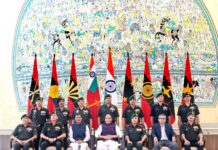








Launch of a Book Narrating 250 Years of Indian Journalism
· Release and discussion of the significant work Samagra Bharatiya Patrakarita, authored by Shri Vijayadutt Shridhar, at IGNCA
· The book was released by IGNCA Chairman Shri Ram Bahadur Rai and senior editor and journalist, former Vice-Chancellor of Makhanlal Chaturvedi National University of Journalism and Communication, Shri Achyutanand Mishra
13th February, New Delhi: The Kalānidhi Division of the Indira Gandhi National Centre for the Arts (IGNCA) organised the release and book discussion of the highly significant work ‘Samagra Bharatiya Patrakarita’, authored by senior journalist and writer Shri Vijayadutt Shridhar. The programme was presided over by the president of IGNCA, Shri Ram Bahadur Rai, while the distinguished guest was senior editor and journalist and former Vice-Chancellor of Makhanlal Chaturvedi National University of Journalism and Communication, Achyutanand Mishra.
On this occasion, the author of the book, Padma Shri awardee Vijayadutt Shridhar, senior journalist Anant Vijay, and the Pradhan Mantri of the Kashi Nagari Pracharini Sabha, Shri Vyomesh Shukla, shared their views as speakers. Delivering the welcome address, the Head of the Kalānidhi Division and Dean, Prof. (Dr.) Ramesh Chandra Gaur, said that the day was exceptional, as the book is unique in many respects. The introductory remarks and moderation of the programme were undertaken by Prof. Kripashankar Chaubey from the Department of Mass Communication, Mahatma Gandhi Antarrashtriya Hindi Vishwavidyalaya, Wardha.
The programme began with the screening of a 15-minute documentary film based on the Madhavrao Sapre Smriti Samachar Patr Sanghralaya Aiwam Shodh Sansthan, Bhopal. The Editor-in-Chief of Prabhat Khabar, Shri Ankit Shukla, read out a written message from the Deputy Chairman of the Rajya Sabha, Harivansh. In his message, he noted that Indian journalism differs from Western journalism and that India charted its own path in the evolution of journalism. According to him, journalism in India was founded primarily on private enterprise. He observed that every page of all three volumes of ‘Samagra Bharatiya Patrakarita’ contains rare and valuable information.
In his presidential address, Ram Bahadur Rai emphasised that the second volume of the book deserves special attention, as it documents four decades of Indian journalism between 1881 and 1920. This period marks the end of the Tilak era and the beginning of the Gandhian era. He remarked that an understanding of journalism during the Gandhian period helps in comprehending the decline not only in journalism but across other spheres as well. Quoting Sri Aurobindo, he said that journalism identifies the greatest challenge of its time and then devotes its entire strength to finding solutions to it. He added that ‘Samagra Bharatiya Patrakarita’ provides a clear sense of direction.
Shri Achyutanand Mishra stated that merely reading the foreword written by Ram Bahadur Rai gives a clear understanding of the content and purpose of the book. He said that Shridhar’s primary endeavour has been to present the glorious history of journalism before the public, and he cited examples to illustrate the various ways in which journalism has been perceived and practised in the country.
In his author’s address, Vijayadutt Shridhar said that the work is not the outcome of an individual’s writing alone, but the result of a long, collective intellectual endeavour rooted in journalism, the renaissance movement, and India’s broader scholarly tradition. He noted that the Madhavrao Sapre Smriti Samachar Patr Sanghralaya Evam Shodh Sansthan, Bhopal, began on 19 June 1984 with limited resources and 73 newspapers and journals. After forty-two years, the Gyan Teerth Sapre Museum today houses a corpus of five crore pages, encompassing material in all Indian languages, including English, and preserving a rich repository of journalism, literature, society, culture, and rare publications.
He described the legacy of Madhavrao Sapre as the intellectual foundation of this work, stating that Sapre’s vision in Hindi fiction, literary criticism, terminology-building, and the identification of talent not only shaped an era but also established enduring intellectual benchmarks for future generations. He underlined that history is never complete and must be continuously revised in the light of new facts, and that the present three-volume work represents a refined expression of this living historical consciousness.
Vijayadutt Shridhar further observed that the history of journalism is not confined to the freedom struggle alone, but reflects the broader processes of renaissance, social reform, language development, and public life. In difficult times—particularly during periods such as the Emergency—the resistance articulated by journalism through symbolism, silence, and courage testifies to its moral strength. He also noted that languages remain alive through dialogue and the constant circulation of words, and that early newspapers and editors played a decisive role in shaping Hindi prose. In his concluding remarks, he emphasised that journalism is not merely about information, but about conscience, responsibility, and public awareness, and that the value of any individual or tradition is determined not by position or prestige, but by its sense of dignity and moral courage.
Anant Vijay remarked that the history of Indian journalism can only be authentically written in Indian languages. He added that the book should be read by universities across the country, students of journalism, and professionals working in news media, describing it as “print capital”—a reservoir of published intellectual wealth.
Vyomesh Shukla observed that, unfortunately, literature and journalism have now become separate disciplines, whereas a hundred years ago they were not distinct. He noted that this division has emerged only in recent decades.
It is noteworthy that journalism in India has completed a historic journey of 246 years, evolving alongside the renaissance movement and passing through many significant milestones of nationalism. Under the aegis of the Gyan Teerth Sapre Museum (Madhavrao Sapre Smriti Samachar Patr Sanghralaya Aiwam Shodh Sansthan, Bhopal), scholar Vijayadutt Shridhar has documented the known and lesser-known dimensions of Indian journalism in Samagra Bharatiya Patrakarita. The work comprises three volumes—The First Century: 1780–1880, The Tilak Era: 1881–1920, and The Gandhian Era: 1921–1948—with the third volume also carrying an appendix on major newspapers and journals published after Independence. The work offers a comprehensive perspective on Indian journalism’s intellectual, historical, and nation-building contributions.