
















IBG NEWS | SPECIAL INVESTIGATION
India’s Infrastructure Revolution: Record Highway Construction, Recurring Bridge Collapses, and the Urgent Need for a National Infrastructure Safety Policy
By Suman Munshi,
IBG NEWS Investigations Desk
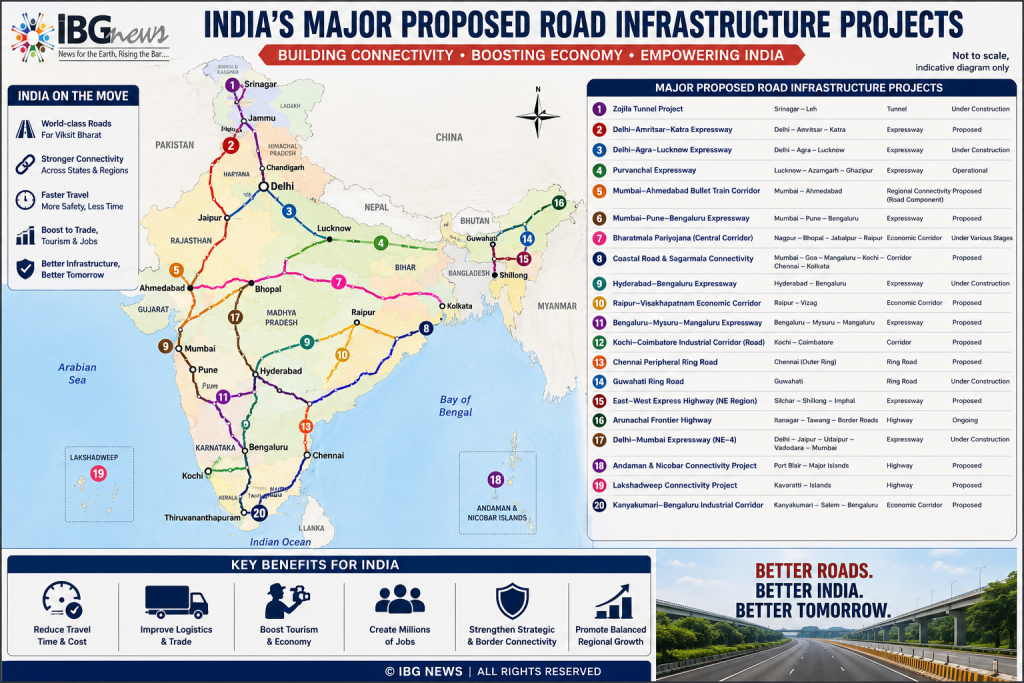
For more than a decade, infrastructure has been the centrepiece of India’s development strategy. Since 2014, the Government of India has invested trillions of rupees in highways, expressways, bridges, tunnels, rail corridors, airports and logistics networks. National highway construction has accelerated dramatically, while mega projects such as Bharatmala, PM Gati Shakti, Dedicated Freight Corridors and numerous expressways have transformed India’s transportation landscape.
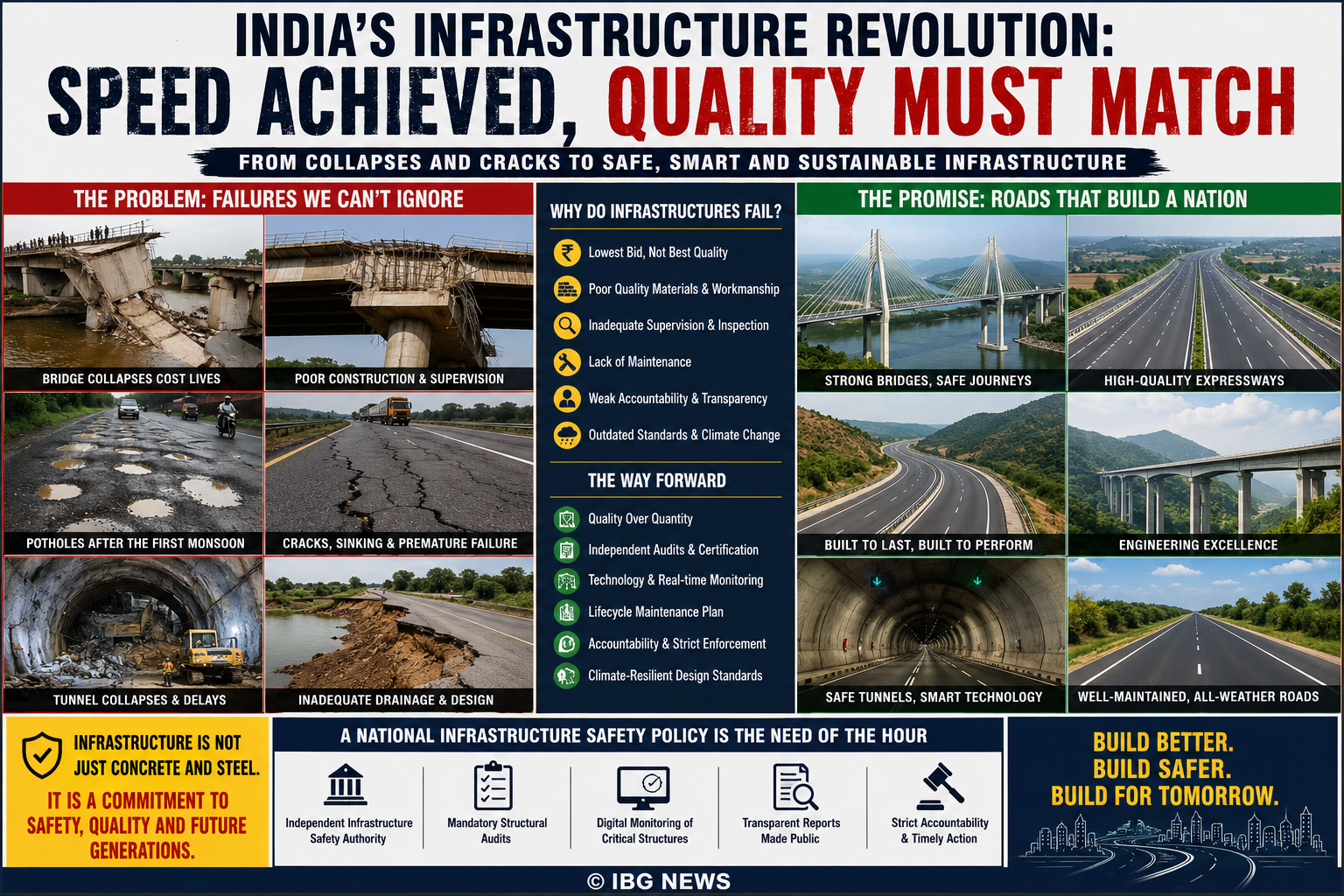
Yet, despite this unprecedented infrastructure boom, India continues to witness disturbing incidents of newly built roads deteriorating after a single monsoon, bridges collapsing before reaching their intended design life, tunnels failing during construction, and ageing structures exposing serious maintenance deficiencies.
The fundamental question is no longer whether India is building infrastructure—it undoubtedly is. The real question is whether India is building quality infrastructure capable of serving future generations safely.
Major Infrastructure Failures (2014–2026): Lessons That Cannot Be Ignored
Several major infrastructure failures over the last decade have exposed systemic weaknesses across India’s construction ecosystem.
2016 – Savitri River Bridge, Maharashtra
The collapse of the decades-old bridge during flooding resulted in multiple fatalities and highlighted the absence of systematic structural health monitoring for ageing bridges.
2016 – Vivekananda Flyover Collapse, Kolkata
An under-construction flyover collapsed in central Kolkata, killing dozens. Investigations focused on construction practices, project management and engineering oversight.
2018 – Andheri Foot Overbridge, Mumbai
The collapse disrupted one of Mumbai’s busiest railway corridors and renewed concerns regarding delayed inspections and maintenance.
2018 – Majerhat Bridge, Kolkata
A major bridge partially collapsed despite carrying heavy daily traffic, exposing weaknesses in routine structural inspection of ageing infrastructure.
2019 – Mumbai CST Foot Overbridge
A pedestrian bridge collapsed during peak hours, raising fresh questions over maintenance protocols.
2022 – Morbi Suspension Bridge, Gujarat
One of India’s deadliest bridge disasters occurred when a renovated suspension bridge collapsed shortly after reopening, leading to over 130 deaths. The tragedy raised serious concerns about renovation standards, certification processes, maintenance oversight and crowd management.
2023 – Silkyara Tunnel, Uttarakhand
A tunnel collapse trapped workers for weeks, highlighting the challenges of geological risk assessment, construction monitoring and emergency preparedness in complex terrain.
2024 – Repeated Bridge Collapses in Bihar
Several bridges collapsed within a short period, including structures under construction and existing bridges. These incidents intensified scrutiny over design, flood resilience, construction quality and contractor supervision.
These failures occurred under different implementing agencies—central authorities, state governments, municipal bodies and private contractors—but they reveal remarkably similar structural weaknesses.
India’s Infrastructure Challenge Is Systemic
Contrary to popular political narratives, infrastructure failures cannot be attributed to a single institution or level of government.
Roads and bridges in India are executed by:
- National Highways Authority of India (NHAI)
- Ministry of Road Transport and Highways
- State Public Works Departments
- Municipal corporations
- Railways
- Public sector agencies
- Private EPC contractors
- Independent consultants
However, investigations into major failures repeatedly identify similar governance problems.
Five Structural Reasons Why Infrastructure Continues to Fail
1. Lowest Bid Wins, Not Always the Best Engineering
India’s procurement framework often rewards the lowest financial bidder.
While competitive bidding reduces costs, it can unintentionally encourage:
- Lower-quality materials
- Reduced safety margins
- Inadequate workmanship
- Cost-cutting during execution
Infrastructure should be evaluated on life-cycle value, not merely construction cost.
2. Weak Independent Quality Assurance
Quality certification often remains closely linked to the implementing ecosystem.
Independent structural audits before opening bridges or highways remain limited.
Without independent verification, defects may remain hidden until catastrophic failure.
3. Maintenance Is India’s Weakest Link
India celebrates new infrastructure but invests comparatively less attention in maintaining existing assets.
Many bridges require:
- Annual structural inspections
- Load testing
- Corrosion assessment
- Drainage maintenance
- Expansion joint replacement
- Bearing inspections
Deferred maintenance dramatically increases long-term risks.
4. Accountability Is Rarely Institutional
After major collapses:
- Committees are formed.
- Investigations begin.
- Compensation is announced.
Yet final engineering reports are often delayed or receive limited public attention, and lessons are not consistently institutionalized across future projects.
Without transparent accountability, similar failures recur.
5. Climate Change Has Changed the Engineering Equation
Infrastructure built decades ago faces new realities:
- More intense rainfall
- Flash floods
- River-course changes
- Heat stress
- Landslides
Engineering standards and maintenance practices must adapt to these changing conditions.
The Promise Versus the Performance
The Modi government deserves recognition for dramatically increasing infrastructure investment and expanding India’s transport network. However, the measure of success cannot rest solely on kilometres of highways built or projects inaugurated.
True infrastructure success depends on:
- Structural durability
- Public safety
- Lifecycle performance
- Engineering excellence
- Transparent accountability
Every bridge collapse or premature road failure erodes public confidence and imposes significant economic and human costs.
A Blueprint for a National Infrastructure Safety Policy
India’s next infrastructure revolution must prioritise quality over quantity.
A comprehensive National Infrastructure Safety Policy should include:
Independent Infrastructure Safety Authority
An autonomous technical body to investigate failures, publish reports and recommend nationwide reforms.
Mandatory Third-Party Structural Audits
Every major bridge, tunnel and flyover should undergo independent certification before opening.
Digital Structural Health Monitoring
Critical structures should be equipped with sensors to continuously monitor stress, vibration, corrosion and movement.
National Bridge and Road Asset Registry
A publicly accessible database should record the age, condition, inspection history and maintenance schedule of all major infrastructure assets.
Performance-Based Contracting
Contractors should remain financially responsible for defects over extended periods, encouraging durable construction rather than minimum compliance.
Transparent Investigation Reports
All inquiry findings should be published within fixed timelines so that engineering lessons are shared across agencies.
Climate-Resilient Engineering Standards
Design codes should reflect future rainfall, flooding and temperature projections rather than relying solely on historical data.
Professional Accountability
Engineers, consultants and contractors found responsible for gross negligence should face proportionate professional and legal consequences after due process.
The Editorial Perspective
India has demonstrated that it can build infrastructure at unprecedented speed. The challenge now is ensuring that infrastructure lasts.
A bridge should not become a national tragedy within years of construction. A highway should not require major repairs after its first monsoon. Public money must purchase long-term safety and reliability—not merely rapid completion.
The recurring failures witnessed over the past decade are not simply engineering problems. They are governance problems involving procurement, regulation, inspection, maintenance, accountability and institutional learning.
The next phase of India’s development must therefore move beyond record-breaking construction targets toward world-class engineering standards.
Infrastructure should not be measured by ribbon-cutting ceremonies or political milestones. It should be measured by whether it remains safe, resilient and economically productive for the next fifty years.
That—not the speed of construction—is the true benchmark of a developed nation.