

















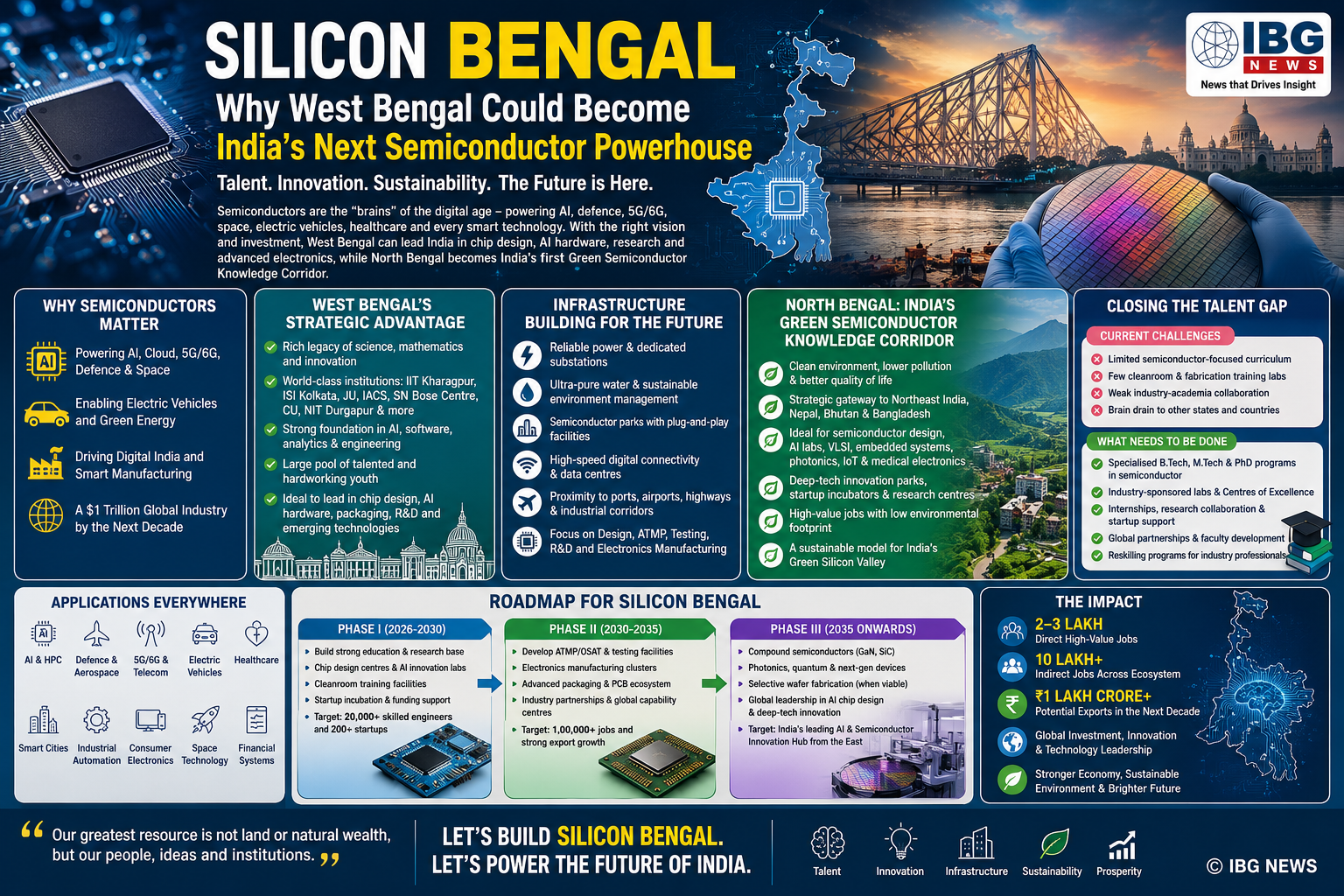
Silicon Bengal: Why West Bengal Could Become India’s Next Semiconductor Powerhouse
How Bengal’s Scientific Legacy, North Bengal’s Green Advantage and AI-Driven Innovation Can Transform Eastern India
A Strategic Analysis
By Suman Munshi | Chief Editor, IBG NEWS
Kolkata | IBG NEWS
The 21st century is witnessing a new geopolitical race—not for oil or minerals, but for semiconductors. These tiny silicon chips have become the backbone of modern civilization, powering everything from smartphones and artificial intelligence (AI) to defence systems, satellites, electric vehicles, healthcare equipment, financial technology, and quantum computing.
The COVID-19 pandemic exposed the fragility of global semiconductor supply chains, while the US–China technology rivalry underscored the strategic importance of domestic chip manufacturing. Governments worldwide have since launched billion-dollar initiatives to secure semiconductor production and reduce dependence on foreign suppliers.
India has responded through the India Semiconductor Mission, backed by significant financial incentives to attract investments in semiconductor fabrication, packaging, and electronics manufacturing. While states such as Gujarat, Tamil Nadu, Karnataka, Uttar Pradesh and Assam have already emerged as key destinations for semiconductor projects, West Bengal remains largely absent from this national narrative.
Yet this absence masks a remarkable opportunity. With its deep scientific heritage, engineering talent and growing AI ecosystem, West Bengal has the potential to become Eastern India’s semiconductor innovation hub. More importantly, North Bengal can evolve into India’s first Green Semiconductor Knowledge Corridor, creating thousands of high-value jobs while preserving ecological sustainability.
Semiconductors: The Foundation of the Digital Economy
Semiconductors are often described as the “brains” of modern electronic devices. Every AI model, cloud server, fighter aircraft, medical imaging system, autonomous vehicle and industrial robot depends on increasingly sophisticated semiconductor chips.
However, semiconductor manufacturing is often misunderstood. A modern semiconductor ecosystem extends far beyond wafer fabrication.
It includes chip architecture, VLSI design, Electronic Design Automation (EDA), semiconductor intellectual property (IP), embedded software, advanced packaging, testing, materials science, precision engineering and AI-assisted chip verification.
Interestingly, the highest economic value is often generated not during manufacturing but during design and innovation. Companies such as NVIDIA, Qualcomm, AMD and ARM have become global technology leaders primarily because of their design capabilities rather than owning fabrication plants.
This distinction is particularly important for West Bengal. Instead of attempting to compete immediately in multi-billion-dollar fabrication projects, the state can build a globally competitive ecosystem around chip design, semiconductor research, AI hardware, and advanced packaging—segments that demand intellectual capital more than massive industrial infrastructure.
Why Bengal Already Possesses a Competitive Advantage
West Bengal’s greatest strength is neither land nor natural resources—it is human capital.
For more than a century, Bengal has been one of India’s leading centres of scientific thought. Visionaries such as Acharya Jagadish Chandra Bose, Acharya Prafulla Chandra Ray, Satyendra Nath Bose, Meghnad Saha, and later Nobel Laureate Amartya Sen, helped establish Bengal as a cradle of scientific excellence. This intellectual tradition continues through institutions such as IIT Kharagpur, Indian Statistical Institute (ISI), Jadavpur University, University of Calcutta, Indian Association for the Cultivation of Science (IACS), S.N. Bose National Centre for Basic Sciences, and NIT Durgapur.
These institutions have produced generations of engineers, physicists, mathematicians, statisticians and software professionals whose analytical strengths align naturally with semiconductor design. Designing advanced integrated circuits requires expertise in mathematics, algorithms, electronics, physics, optimisation and computer science—areas where Bengal has long excelled.
In recent years, the rise of AI, data science and software engineering has further strengthened this knowledge base. As semiconductor design increasingly incorporates AI-driven automation, predictive verification and intelligent chip optimisation, Bengal’s software capabilities become an even greater strategic advantage.
Infrastructure: Building the Foundation for a Semiconductor Ecosystem
While talent is the foundation of innovation, infrastructure determines whether that talent remains within the state.
A semiconductor ecosystem requires uninterrupted high-quality electricity, high-speed digital connectivity, advanced research laboratories, semiconductor-grade industrial parks, and efficient logistics.
For fabrication plants, ultra-pure water, cleanroom environments and precision environmental controls are indispensable. Although establishing a cutting-edge semiconductor fab requires investments running into billions of dollars, West Bengal does not need to begin with such ambitious projects.
Instead, the state can prioritise semiconductor design centres, ATMP (Assembly, Testing, Marking and Packaging) facilities, research laboratories, AI computing centres and startup incubators. These sectors require significantly lower capital investment while generating substantial employment and intellectual property.
Locations such as Kharagpur, Durgapur, Haldia, and the Kolkata metropolitan region possess strong potential due to their industrial base, educational institutions and transportation connectivity. Kolkata Port, Haldia Port and Netaji Subhas Chandra Bose International Airport provide important logistical advantages for future semiconductor exports and equipment imports.
North Bengal: India’s Green Semiconductor Knowledge Corridor
Perhaps the most transformative opportunity lies beyond Kolkata.
Rather than replicating conventional industrial clusters, North Bengal can create a unique identity as India’s first Green Semiconductor Knowledge Corridor.
The region offers several strategic advantages: a comparatively clean environment, lower urban congestion, affordable land, a pleasant climate, and improved connectivity through Bagdogra International Airport, national highways and rail networks. Its location near Nepal, Bhutan, Bangladesh and India’s Northeast also positions it as a strategic gateway under regional connectivity initiatives such as BBIN and India’s Act East Policy.
Unlike heavy wafer fabrication, semiconductor design, AI research, embedded systems development, photonics, medical electronics and VLSI engineering have relatively low environmental footprints. These knowledge-intensive sectors are ideally suited to North Bengal’s ecological profile.
The state could establish a North Bengal Deep-Tech Innovation Park, integrating semiconductor design centres, AI laboratories, startup incubators, high-performance computing facilities, prototyping laboratories and university research centres. Such a campus could become Eastern India’s equivalent of a technology innovation district, attracting global capability centres, research organisations and deep-tech startups.
Beyond direct employment for engineers and scientists, this ecosystem would stimulate demand for housing, healthcare, education, logistics, hospitality, and professional services, creating a powerful economic multiplier across the region.
Closing the Talent Gap
Despite its intellectual strengths, West Bengal faces several structural challenges.
Most engineering institutions continue to offer only basic courses in electronics and VLSI, with limited exposure to semiconductor process engineering, lithography, chip packaging, reliability engineering, or Electronic Design Automation (EDA) tools. Industry-academia collaboration remains weaker than in Bengaluru, Hyderabad or Chennai, resulting in fewer internships, sponsored laboratories and collaborative research projects.
The consequence has been a sustained brain drain, with many of Bengal’s brightest graduates relocating to technology hubs elsewhere in India or abroad.
Reversing this trend requires a comprehensive education strategy. Universities should introduce specialised B.Tech and M.Tech programmes in Semiconductor Engineering, Microelectronics, Nanoelectronics, AI Hardware and Chip Design. Shared cleanroom facilities, semiconductor research laboratories and industry-funded Centres of Excellence would provide students with practical exposure. Collaboration with global semiconductor companies can create internship pipelines, faculty development programmes and joint innovation projects.
A Roadmap for Silicon Bengal
A phased strategy can help West Bengal build a globally competitive semiconductor ecosystem.
Phase I (2026–2030): Focus on semiconductor education, AI research, chip design centres, startup incubation, cleanroom training facilities and academic-industry collaboration.
Phase II (2030–2035): Expand into Assembly, Testing, Marking and Packaging (ATMP), electronics manufacturing, semiconductor testing laboratories and specialised component manufacturing.
Phase III (2035 onwards): Pursue compound semiconductors such as Gallium Nitride (GaN) and Silicon Carbide (SiC), photonic devices, quantum semiconductor research and, where commercially viable, selective wafer fabrication supported by mature infrastructure and skilled manpower.
The Way Forward
West Bengal should not seek to imitate existing semiconductor hubs overnight. Instead, it should leverage its unique strengths—scientific excellence, AI capability, software engineering, research institutions and intellectual capital—to build a distinctive position within India’s semiconductor value chain.
By combining sustainable infrastructure, world-class education, industry partnerships and a dedicated innovation ecosystem, the state can emerge as India’s centre for semiconductor design, AI-enabled chip development and advanced electronics research.
North Bengal, with its clean environment and strategic geography, can further differentiate the state by offering a globally attractive destination for knowledge-driven industries that balance technological progress with environmental sustainability.
Conclusion
History shows that transformative industries are rarely built by infrastructure alone. They are built by people, ideas and institutions.
West Bengal already possesses one of India’s richest scientific traditions. What it now requires is a coordinated vision that aligns government policy, academia, industry and entrepreneurship around the opportunities presented by the global semiconductor revolution.
If the state invests today in talent, research, and sustainable innovation rather than merely chasing large manufacturing projects, “Silicon Bengal” could become far more than a slogan. It could become a strategic pillar of India’s ambition to emerge as a trusted global semiconductor and AI powerhouse.
The semiconductor revolution offers Bengal a once-in-a-generation opportunity. The question is no longer whether the state has the talent—it undoubtedly does. The real question is whether it can build the ecosystem that allows that talent to flourish at home, creating high-value jobs, attracting global investment, and positioning West Bengal at the forefront of India’s next technological transformation.
Author Profile:
Suman Munshi, Recipient of “Balochi Dastar Award” in 2024, the Highest Cultural Award from People of Baluchistan, MBA (IT), PG Comp.Sc, GxP (UK), GxP (US), LIMS(Australia), ISO/IEC 17025:2017 (Ireland), Certified Reuters Journalist and Journalism (Ireland)
See details about the author https://www.linkedin.com/in/sumanmunshi