










Balochistan Unveils Vision for Global Sporting Participation, Eyes International Recognition Through Sports
By Suman Munshi | IBG NEWS
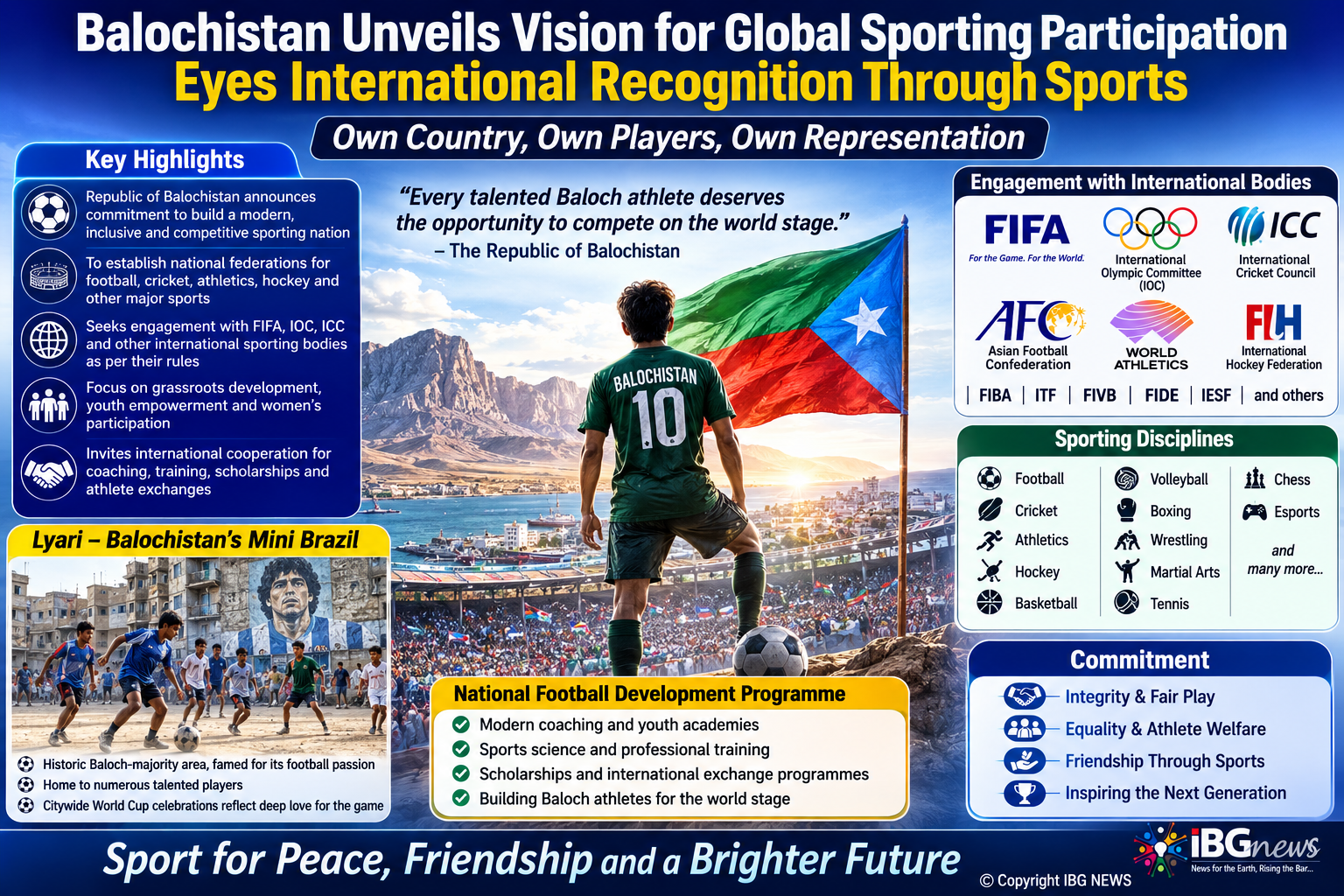
July 20, 2026: A political organization identifying itself as the Republic of Balochistan has issued a declaration outlining its vision to establish sporting institutions and seek participation in international sports competitions, while emphasizing football as a cornerstone of Baloch cultural identity.
The declaration, released on July 20, proposes the creation of national governing bodies for a wide range of sports, including football, cricket, athletics, hockey, basketball, volleyball, boxing, wrestling, tennis, chess, esports, and several others. According to the statement, the proposed federations would focus on grassroots talent development, youth engagement, women’s participation, professional coaching, and athlete welfare.
The announcement also expresses an intention to engage with major international sporting organizations—including FIFA, the Asian Football Confederation (AFC), the International Olympic Committee (IOC), the International Cricket Council (ICC), World Athletics, FIBA, the International Hockey Federation (FIH), the International Tennis Federation (ITF), the International Volleyball Federation (FIVB), the International Chess Federation (FIDE), and the International Esports Federation (IESF)—subject to the eligibility rules and membership procedures of those organizations.
Football at the Heart of the Vision
The declaration places special emphasis on football, describing it as an integral part of Baloch sporting culture.
It highlights Lyari, a historic Baloch-majority locality in Karachi, often nicknamed “Little Brazil” because of its long-standing football tradition and enthusiasm for the FIFA World Cup. According to the declaration, the area has produced numerous talented footballers over the decades and is known for celebrating World Cup tournaments with decorations, flags, and community events.
Building on this heritage, the organization says it intends to introduce a National Football Development Programme, aimed at nurturing young talent through modern coaching methods, sports science, youth academies, scholarships, and international exchange opportunities. Similar development initiatives are proposed for other sporting disciplines.
Call for International Cooperation
The declaration invites governments, Olympic committees, universities, professional clubs, and international sports organizations to collaborate through coaching support, technical assistance, athlete exchanges, scholarships, training camps, and friendly matches.
It further states that the proposed sporting framework would adhere to internationally recognized principles of fair play, athlete welfare, equality, and sporting integrity.
Recognition Remains a Separate Process
While the declaration outlines ambitious plans for international sporting engagement, participation in global competitions would depend on meeting the constitutional and membership requirements of the respective international federations. Admission to organizations such as FIFA, the IOC, or the ICC is governed by their own statutes and approval processes, and any future applications would be evaluated under those established regulations.
At present, the declaration represents the organization’s stated aspirations and policy objectives rather than confirmation of membership or recognition by international sporting bodies.
Sports Beyond Competition
Observers have often noted that sport has historically served as a platform for cultural identity, youth development, and international engagement across many regions of the world. The declaration reflects an effort to present sport as a means of promoting community participation and showcasing athletic talent on a global stage.
Whether these ambitions translate into formal participation in international competitions will ultimately depend on future developments, institutional recognition, and compliance with the rules governing international sports organizations.
The process differs by sport, but most international sports federations follow a similar pathway. Importantly, there is no automatic right to membership simply because a political entity declares itself a country. Most international federations have constitutional requirements regarding recognition, governance, and sporting development.
General Roadmap for International Sports Recognition
Step 1: Establish a Recognized National Sports Authority
Create a legally constituted national governing body (NGB) for each sport.
Requirements typically include:
- Constitution and bylaws
- Democratic governance structure
- Elected executive committee
- Ethics and disciplinary regulations
- Financial transparency
- Compliance with international sporting principles
Step 2: Develop Domestic Competitions
Establish:
- National leagues
- Regional associations
- Annual championships
- Youth tournaments
- Women’s competitions
- Coaching certification
- Referee development
Most federations require evidence that the sport is actively organized nationwide.
Step 3: Obtain Recognition by Domestic Authorities (Where Required)
Depending on the federation’s statutes, applicants may need recognition from:
- National Olympic Committee (NOC)
- National sports ministry
- Government sports authority
- Other legally recognized national sports bodies
Some federations require this; others may have alternative criteria.
Step 4: Meet Governance Standards
Most international federations require compliance with:
- Anti-doping rules (World Anti-Doping Code, where applicable)
- Safeguarding policies
- Match-fixing prevention
- Athlete protection
- Financial accountability
- Independent disciplinary mechanisms
Step 5: Become a Member of the Continental Federation
For many sports, the normal sequence is:
National Federation
↓
Continental Confederation
↓
World Governing Body
Examples include:
- Football: Continental confederation before FIFA membership
- Basketball: Continental zone before FIBA recognition
- Volleyball: Continental confederation before FIVB
Requirements vary by sport.
Step 6: Submit Formal Membership Application
A typical application includes:
- Constitution
- Registration documents
- Governance policies
- Membership lists
- Club registrations
- Competition calendar
- Athlete registrations
- Financial reports
- Development plans
- Letters of support (if applicable)
Step 7: Technical Inspection
The international federation may conduct:
- Governance review
- Document verification
- Stadium/facility inspection (where relevant)
- Athlete participation review
- Development assessment
Step 8: Executive Committee Review
The federation’s executive board evaluates whether the applicant satisfies its statutes and eligibility criteria.
Step 9: Membership Vote
Many organizations require approval by:
- Congress
- General Assembly
- Council
- Member federations
Voting thresholds vary.
Step 10: Provisional Membership (If Applicable)
Some organizations offer:
- Observer status
- Associate membership
- Provisional membership
before granting full membership.
Step 11: Full Membership
Once admitted, the federation may receive rights such as:
- Participation in official competitions
- Voting rights
- Access to development funding
- Coaching education
- Referee programs
- Technical support
Specific rights depend on the organization’s rules.
Olympic Recognition
Participation in the Olympic Movement generally involves:
- Establishing a National Olympic Committee (NOC), where eligible under the Olympic Charter.
- Having a sufficient number of national sports federations affiliated with the relevant International Federations recognized by the IOC.
- Meeting governance and eligibility requirements set out in the Olympic Charter.
- Applying to the International Olympic Committee (IOC), which evaluates applications under its own statutes.
Recognition by the IOC is governed by the Olympic Charter and is not automatic.
Football (FIFA)
A typical pathway is:
National Football Association
↓
Continental Confederation (e.g., AFC, UEFA, CAF, CONCACAF, CONMEBOL, OFC)
↓
FIFA Membership
Applicants must satisfy FIFA’s Statutes, including governance requirements and any eligibility criteria relating to territorial status and football administration.
Cricket (ICC)
The ICC generally requires:
- A functioning national cricket governing body
- Domestic competitions
- Governance and integrity standards
- Compliance with ICC membership criteria
Membership categories and eligibility are determined by the ICC’s constitution and regulations.
Athletics (World Athletics)
Applicants generally need:
- National athletics federation
- Organized national championships
- Anti-doping compliance
- Technical officials
- Affiliation through regional athletics structures where applicable
Basketball (FIBA)
Requirements generally include:
- National federation
- Domestic leagues
- Youth development
- Governance compliance
- Acceptance of FIBA statutes
Key Challenges for Newly Created or Disputed Entities
For entities that are newly established, have limited recognition, or whose political status is disputed, additional challenges may arise because many international sports organizations have membership rules linked to territorial status, recognition, or National Olympic Committee eligibility. Each federation’s constitution determines these requirements independently, and decisions are made on a case-by-case basis.
Practical Timeline
| Stage | Typical Duration |
|---|---|
| Establish national federation | 6–12 months |
| Organize domestic competitions | 1–3 years |
| Develop governance and compliance | 1–2 years |
| Continental engagement | Varies |
| International application review | Several months to multiple years |
| Full participation | Depends on approval under the federation’s statutes |
Conclusion
Successful integration into international sport requires more than athletic talent. It typically involves building robust national sports institutions, maintaining transparent governance, fostering widespread domestic participation, complying with international integrity and anti-doping standards, and satisfying the membership rules of each sport’s international federation. For newly created or disputed entities, political and legal considerations embedded in federation statutes may also play a significant role in determining eligibility.
Disclaimer: This report is based on a public declaration issued by an organization identifying itself as the representative of the “Republic of Balochistan.” References to proposed institutions and international participation reflect the contents of that declaration. They should not be interpreted as confirmation of international recognition, statehood, or membership in any international sporting body, and are published under freedom of expression and general awareness of the matter for public knowledge.

