







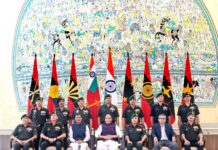









Heritage Preservation is a Strategic Pillar of National Security, Says Bihar Governor at IGNCA Book Launch
By Suman Munshi
IBG NEWS
New Delhi, July 28: The preservation of India’s cultural heritage is no longer merely a matter of history or tradition but has become an essential element of national security in an age of hybrid warfare, observed Lt. General Syed Ata Hasnain (Retd.), Governor of Bihar, while launching the book Guardians of Glory: Heritage and the Armed Forces in Kashmir at the Indira Gandhi National Centre for the Arts (IGNCA) in New Delhi.
The publication, authored by Major Saras Tripathi (Retd.), explores the role of the Indian Armed Forces in safeguarding Kashmir’s rich cultural and civilisational heritage amid decades of conflict. The event was organised by IGNCA’s Kala Nidhi Division at the Samvet Auditorium and was attended by eminent scholars, defence personnel, academicians, researchers, and heritage experts from across the country.
The book was released in the presence of Shri Ram Bahadur Rai, President of IGNCA; Prof. Ramesh C. Gaur, Dean, Faculty of Arts and Design, South Asian University and former Dean (Administration), IGNCA; Prof. Anand Vardhan of Dr. B.R. Ambedkar University, Delhi; and Prof. K. Anil Kumar, Head of the Kala Nidhi Division.
Heritage in the Age of Hybrid Warfare
Delivering the keynote address, Lt. Gen. Hasnain highlighted that contemporary conflicts extend far beyond conventional battlefields. He said that culture, identity, history, and civilisational memory have increasingly become targets in modern hybrid warfare, making the protection of heritage a strategic national priority.
Drawing upon his years of military service in Jammu and Kashmir, he noted that attacks on cultural symbols and historic traditions often aim to weaken the social and civilisational fabric of a nation. Referring to the displacement of the Kashmiri Pandit community, he described it as an attempt to erase a centuries-old cultural legacy.
The Governor also recalled initiatives undertaken to document Kashmir’s iconic shrines, secure the annual Amarnath Yatra, and revive the historic Sharda Peeth tradition. According to him, these efforts represent significant steps toward preserving the region’s pluralistic cultural identity.
He further stressed that military officers deployed in sensitive regions should possess a sound understanding of local history, customs, and faith traditions, describing cultural awareness as an important component of modern military preparedness.
Commending the author, Lt. Gen. Hasnain said the book makes a valuable contribution to understanding the relationship between heritage preservation and national security and expressed hope that it would become a reference text within military institutions.
Documenting the Indian Army’s Cultural Role
IGNCA President Shri Ram Bahadur Rai described the publication as essential reading for anyone seeking to understand Kashmir’s historical and cultural evolution. He said the book combines rigorous academic research with the author’s practical military experience to document how the Indian Army has contributed to protecting religious sites, cultural monuments, and traditional heritage across the region.
He observed that the work presents a balanced account of Kashmir’s history while examining the challenges posed by terrorism and highlighting initiatives such as Operation Sadbhavana, security arrangements for the Amarnath Yatra, and conservation efforts for important heritage sites.
Shri Rai also appreciated the author’s discussion on constitutional provisions and legal mechanisms related to heritage conservation, expressing confidence that the publication would contribute meaningfully to future policy discussions.
Four Years of Research
Prof. Ramesh C. Gaur noted that the book is the outcome of more than four years of extensive research into the role played by the Indian Armed Forces in preserving Kashmir’s tangible and intangible heritage.
He emphasised that protecting cultural property during conflicts is an international concern and reaffirmed IGNCA’s commitment to heritage conservation through research, documentation, digitisation, and institutional collaboration. He added that the publication sheds light on an often-overlooked dimension of military service by highlighting the armed forces’ contribution to safeguarding monuments, sacred places, and traditional cultural practices.
A Comprehensive Study on Kashmir’s Heritage
Author Major Saras Tripathi (Retd.) explained that the book originated from an IGNCA research project examining the impact of terrorism on Kashmir’s social, cultural, and religious life. The scope of the research later expanded to include India’s legal framework and international conventions related to heritage protection.
He said the publication presents a comprehensive overview of Kashmir’s rich civilisational history through extensive fieldwork and documentation, while encouraging greater awareness about conserving heritage in conflict-affected regions.
Prof. Anand Vardhan described the work as a significant academic contribution that deepens understanding of Kashmir’s cultural and spiritual traditions while recognising the Indian Armed Forces’ role in protecting both tangible and intangible heritage.
Earlier, welcoming the gathering, Prof. K. Anil Kumar said the publication reflects IGNCA’s continued commitment to documenting and preserving India’s cultural legacy, particularly in regions affected by conflict.
The event concluded with participation from distinguished scholars, defence personnel, students, researchers, and heritage enthusiasts, reinforcing the growing recognition that preserving cultural heritage is not only a matter of history but also an important component of India’s national resilience and civilisational continuity.