














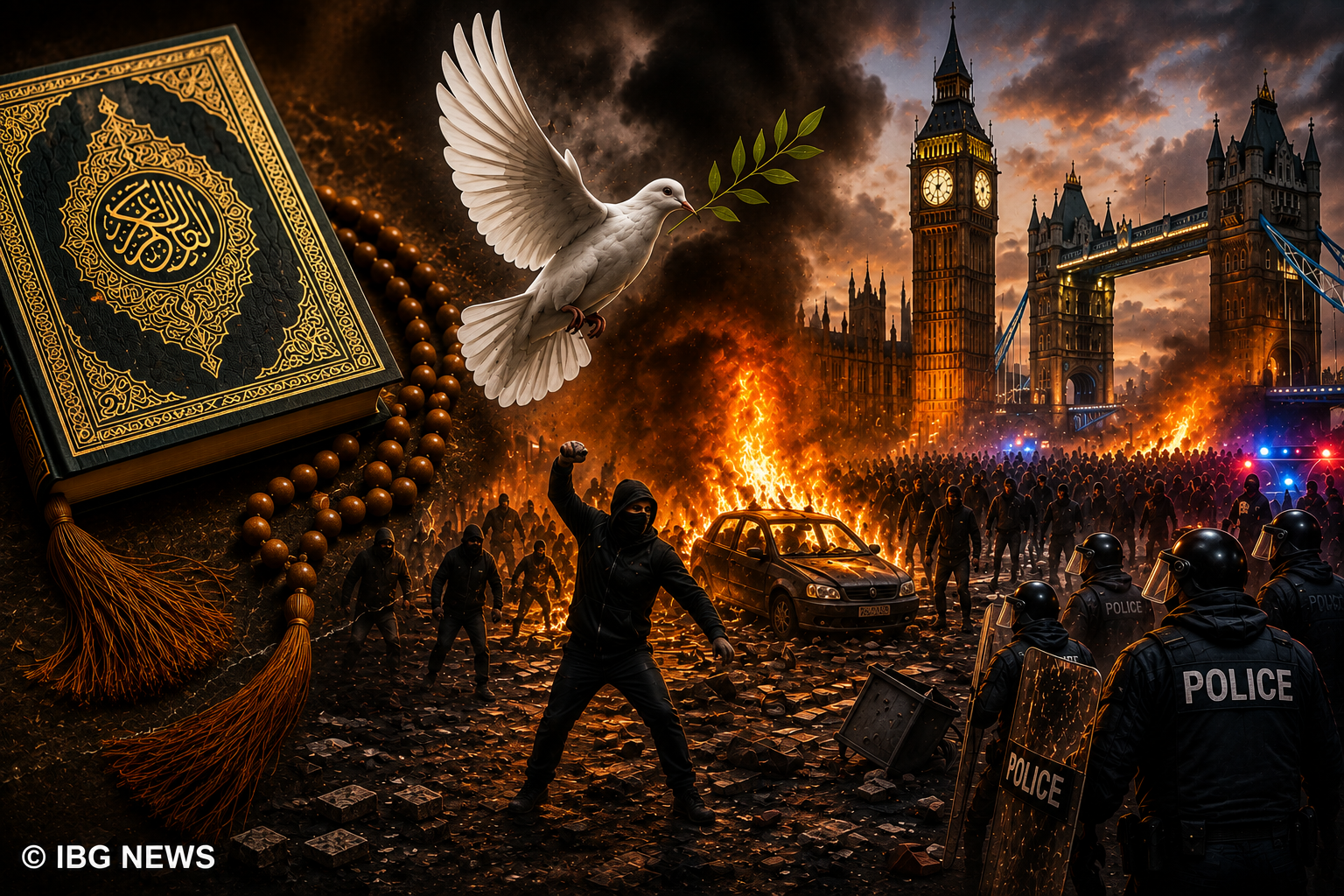
Jihad, Islam and Europe: What the Quran Says and What the Reality Check Reveals
By Suman Munshi | IBG NEWS
Introduction
Few words in contemporary political discourse carry as much emotional and political weight as “Jihad.” In Europe, the word is frequently associated with terrorism, extremism, and religious violence. At the same time, many Muslims argue that the term has been reduced in public debate to a meaning that does not adequately reflect its broader Islamic and Quranic context.
A serious examination requires confronting both sides of the argument honestly. The Quran contains verses concerning armed conflict, but it also establishes restrictions on warfare, prohibits transgression, recognises religious choice and instructs Muslims to pursue peace when the opposing side is willing to do so. Conversely, extremist organisations have undeniably invoked Islamic vocabulary and selected religious texts to justify violence against civilians.
The reality, therefore, is more complicated than either “Islam is inherently violent” or “nothing violent exists in Islamic history or political thought.”
The more important question is: What does the Quran actually say about fighting, and how should that be distinguished from the actions of modern jihadist organisations?
What Does Jihad Actually Mean?
The Arabic word jihad is derived from the root associated with exertion or striving. In Islamic thought, it can refer to striving in Allah’s cause and, depending on context, armed struggle. It should therefore not automatically be translated as “holy war.”
The Quran’s passages on armed conflict emerged in a historical environment marked by warfare, persecution, expulsion, and tribal conflict. The text nevertheless places boundaries around fighting.
One of the clearest examples is Quran 2:190, which instructs believers to fight those who fight them while explicitly warning them not to transgress. (Quran.com)
Quran 22:39 similarly presents permission to fight in the context of people who were being attacked and wronged. (Quran)
These passages complicate the popular claim that the Quran simply commands Muslims to wage unrestricted war against non-Muslims.
The Quranic Emphasis on Peace
Perhaps one of the most important verses in this debate is Quran 8:61. It instructs Muslims that when the opposing side inclines towards peace, they should also incline towards peace. (Quran.com)
This principle matters because it places peace within the Quranic framework alongside the provisions dealing with warfare.
Similarly, Quran 60:8 states that Muslims are not prohibited from treating people who have neither fought them on religious grounds nor expelled them from their homes with kindness and justice. (Quran.com)
And Quran 2:256 contains the widely cited principle that there is no compulsion in religion. (Quran.com)
Taken together, these verses demonstrate that the Quran cannot responsibly be reduced to a single command about warfare.
But What About the Quran’s More Severe War Verses?
This is where intellectual honesty becomes essential.
Critics of Islam frequently cite Quran 9:5, sometimes called the “sword verse,” as evidence that Islam commands the killing of non-believers. Such a reading, however, removes the verse from the surrounding passage. Quran.com’s contextual explanation notes that the passage concerns polytheists with whom Muslims had entered treaties and that the following verse provides protection to a polytheist seeking asylum in order to hear the Quran. (Quran.com)
This does not mean that every difficult passage disappears through contextual interpretation. Islamic scripture contains genuine passages concerning warfare, punishment and relations with enemies, and different schools of Islamic jurisprudence have debated their scope and application.
But the same intellectual standard must be applied in both directions: isolating one violent verse and presenting it as the entire Quran is as misleading as pretending that the Quran contains no passages concerning warfare.
Where Does the “Dark Picture” Come From?
The darkest image of Islam in modern public consciousness has been shaped partly by the actions of organisations that describe themselves through Islamic terminology.
Al-Qaeda, ISIS and other extremist movements have used Quranic vocabulary, Islamic historical references and concepts such as jihad to construct ideological justifications for terrorism and political violence.
Their actions have included attacks against Muslims themselves as well as Christians, Jews, Hindus, secular people and others.
That reality cannot simply be dismissed.
At the same time, it is analytically incorrect to assume that the existence of violent groups proves that every Muslim shares their ideology. Political extremism exists within multiple religious, ethnic and ideological traditions. A religion’s scripture, its classical legal traditions, its political history and the ideology of a contemporary militant organisation are related subjects—but they are not identical subjects.
The reality check therefore has to operate in both directions.
Islam should not be shielded from criticism when Muslims or organisations acting in its name commit violence. But Muslims should not collectively be held responsible for crimes committed by extremist minorities.
Why Has Europe Become Increasingly Concerned About Islam?
Europe’s relationship with Islam has been transformed by several factors: immigration, colonial history, integration challenges, terrorism, the refugee crisis, political polarisation, debates over religious symbols and the growth of far-right movements.
The terrorist attacks that struck European cities profoundly influenced public perceptions of Islam. For many Europeans, security became inseparable from debates about radicalisation.
However, this has also created a dangerous tendency to blur the distinction between Islamism, jihadist terrorism and ordinary Muslim religious identity.
The European Union’s own Fundamental Rights Agency provides evidence that anti-Muslim discrimination is a genuine and growing problem.
Its 2024 report, based on responses from 9,604 Muslims across 13 EU countries, found that 47% had experienced racial discrimination during the previous five years, compared with 39% in the comparable 2016 survey. Thirty-five percent reported such discrimination during the previous year. (FRA)
The agency also found that more than one in four respondents had experienced racist harassment during the previous five years, while 4% reported experiencing a racist attack during that period. (FRA)
These findings do not prove that Europe is uniformly “Islamophobic.” They demonstrate something more precise: anti-Muslim racism and discrimination are significant social problems in parts of Europe.
The European Commission itself acknowledges persistent hatred, hate speech and hate crime targeting Muslims and has established institutional mechanisms to combat anti-Muslim hatred. (European Commission)
Islamophobia Is Not the Same as Criticism of Islam
A democratic society must preserve space for criticism of religion.
Questioning Quranic interpretations, Islamic law, political Islam, historical events involving Muslim rulers, gender norms or religious institutions is not automatically Islamophobia.
Likewise, criticism of Israeli, European, American, Pakistani, Indian or any other government’s policies does not automatically constitute hatred of its people.
Islamophobia begins when criticism of ideas becomes hostility towards people because they are Muslim—for example, treating an entire religious population as inherently dangerous, inferior or collectively responsible for terrorism.
This distinction is vital.
Europe has both a legitimate security concern about violent extremism and a responsibility to protect Muslim citizens from discrimination.
One obligation does not cancel the other.
The Security Reality Cannot Be Ignored
The opposite mistake would be equally dangerous.
There are genuine security threats associated with jihadist terrorism. European governments have had to respond to terrorist networks, radicalisation, recruitment, online propaganda and attacks inspired by extremist interpretations of Islam.
It would be irresponsible to conceal these realities simply because they might contribute to Islamophobia.
The answer, however, is targeted counter-terrorism rather than collective suspicion.
A Muslim citizen who peacefully practices Islam is not equivalent to a person who advocates terrorism. A conservative religious belief is not automatically equivalent to jihadist ideology. And political disagreement with Western foreign policy is not, by itself, evidence of terrorism.
Security policy becomes stronger—not weaker—when these distinctions are maintained.
The Uncomfortable Question for Muslim Societies
A serious discussion must also ask difficult questions within Muslim societies.
Why have extremist interpretations been able to attract young people in some environments?
Why do political movements sometimes exploit religious identity?
Why have some clerics or institutions failed to challenge extremist interpretations quickly enough?
How should Islamic education address concepts such as jihad, apostasy, religious authority and relations with non-Muslims in modern constitutional states?
These questions cannot be answered simply by blaming Western governments or European media.
Muslim scholars, educators, political leaders and civil society organisations have an important responsibility to confront interpretations that legitimise attacks on civilians and religious minorities.
The Quranic injunction against transgression, its recognition of peace and its principle concerning religious compulsion provide important resources for such an internal debate. (Quran.com)
The European Question Is Equally Serious
Europe also needs its own reality check.
If security concerns are allowed to become collective suspicion of Muslims, integration becomes more difficult. Discrimination in employment, housing and education can deepen alienation and create precisely the social conditions that extremist recruiters attempt to exploit.
The FRA’s findings show that discrimination is particularly pronounced in employment and housing, while young Muslims and women wearing religious clothing face elevated risks in several areas. (FRA)
A democratic Europe therefore faces a difficult balancing act:
Defeat jihadist terrorism without demonising Islam.
Protect freedom of religion without protecting violent extremism.
Allow criticism of Islam without permitting hatred of Muslims.
Defend secular democratic institutions without demanding cultural uniformity.
The Real Dark Picture
The darkest picture is not simply “Islam.”
The darker picture is what happens when religion, political grievance, historical trauma, identity politics and violence are fused together.
Extremists turn religion into an instrument of political mobilisation. Politicians sometimes turn fear of extremists into electoral mobilisation. Media ecosystems can amplify the most shocking examples. Social media algorithms reward outrage. Ordinary citizens then become trapped between competing narratives.
One side says: Islam itself is the problem.
The other says: Every criticism of Islam is hatred.
Both positions are inadequate.
The real challenge is to distinguish faith from fanaticism, criticism from hatred, security from collective punishment, and political Islamism from ordinary Muslim religious life.
A More Honest Way Forward
The Quranic discussion of jihad deserves neither propaganda nor caricature. Its passages on fighting should be read in their historical and textual context, including the prohibitions on transgression, the permission to fight in response to being attacked, the instruction to accept peace when offered and the principle against religious compulsion. (Quran.com)
At the same time, Muslims and Muslim institutions should be willing to confront the fact that extremist organisations have appropriated Islamic concepts to justify real violence.
Europe, meanwhile, should confront another uncomfortable fact: its own official human-rights data show that anti-Muslim discrimination is widespread and has increased in recent years. (FRA)
The solution is neither denial nor demonisation.
It is evidence, scholarship, accountability and equal citizenship.
Islam should be examined critically as a religion, political tradition and historical civilisation. Its followers should be judged as individuals rather than as a collective. Extremists should be confronted without ambiguity. And European societies should defend both freedom of expression and freedom from religious discrimination.
The real test of modern civilisation is not whether it can condemn its enemies.
It is whether it can criticise ideas without dehumanising people, defend security without abandoning liberty, and confront religious extremism without turning an entire faith community into a suspect population.
When you win land over hate, you become a preacher of Jihad. When you win hearts with honesty, love, and respect, you become human. Buddhists won Japan, China, and the Far East without blood and remained so for centuries, but the conflict started the moment Islam tried to overrule the local culture. See the enlightened mind’s explanation on Islam.
‘Allah’s Islam’ and ‘Mullah’s Islam’: Tarek Fatah’s Challenge to Political Islam
A significant strand of Tarek Fatah’s criticism of contemporary Islam centred on his distinction between what he called “Allah’s Islam” and “Mullah’s Islam”—a phrase he used to differentiate personal religious faith from the politicisation of religion by clerics and Islamist movements. In his 2020 article carrying that title, Fatah argued that Muslims should confront the gap between spiritual faith and political struggles conducted in the name of Islam. His earlier book, Chasing a Mirage: The Tragic Illusion of an Islamic State (2008), developed the broader argument that
Islam, Islamism, Muslims and Islamists should not automatically be treated as interchangeable concepts. Fatah maintained that Islamism represented an attempt to turn religious ideas into a political doctrine and questioned the assumption that Muslims must recreate a historical caliphate or establish a state specifically defined as “Islamic.” His thesis was that the Quranic message could be examined independently of later political struggles and that faith should not necessarily be placed under the control of clerical institutions or political movements. Contemporary reviews of his book also recognised this central distinction between an “Islamic State” and a “state of Islam,” although reviewers disagreed with aspects of his historical interpretation and conclusions.
Fatah’s argument therefore provides a useful lens for examining one of the central debates surrounding Islam in the modern world: where religious belief ends and political ideology begins. It should nevertheless be presented as Fatah’s own reformist interpretation, rather than as an officially recognised theological division within Islam. His central challenge was whether political authority should be allowed to claim exclusive ownership of religious truth—and whether Muslims can practise their faith while simultaneously rejecting the idea that religious clerics or political movements possess an automatic mandate to govern society in the name of God.
If Europe is Islamophobic, then there must be some reason behind it. So it is time for Islam to prove that they are civilized people and not less than anyone else, but as of now it has proved otherwise without any doubt. But definitely, if this terror face of Islam continues, the world will soon make Islam and Taboo rather than a religion of peace.
Do Terror Groups follow any of these lines written in the Holy Book
I would use these four together:
Quran 8:61 — Peace: If the other side inclines toward peace, Muslims should incline toward peace.
Quran 2:190 — Limits on warfare: Fight those who fight you, but do not transgress.
Quran 60:8 — Coexistence: Kindness and justice are permitted toward those who do not fight Muslims.
Quran 2:256 — Religious freedom: “There shall be no compulsion in religion.”
Together, these verses provide a much stronger and more nuanced Quranic foundation for discussing peace, warfare, coexistence, and religious freedom than relying on a single verse.
Now followers of Islam have to decide why people should love them when they are walking on the path of destruction or remove the mask and show the true peace in action.
I have more than thousands of students from the Islamic faith, and I have never had any issues with most of them, but some of them were so fanatic and did direct harm to my Hindu teachers, who were their teachers also. I saw rape, murder, and conversion too. So the spectrum of experience is so wide open that who to believe and who not to believe is very thin now.
Hope humanity soon realizes cruelty is not the language of humanity; if a kid in Gaza, in Tel Aviv, or in Balochistan or in Bangladesh is suffering, ultimately humanity is suffering.
So till the time the Islamic world shows true peace as per the holy book, the world will continue to be Islamophobic for a genuine cause.
— Suman Munshi
IBG NEWS